Currency liquidity and how it affects the choice of strategy
Liquidity is often confused with volatility, but they are different concepts.
Liquidity is the ability of assets to be sold quickly at a price close to the market price.
A liquid currency is a currency that can be quickly exchanged for another asset. This means that there are always many sellers and buyers in the liquid market, and therefore the spread will be minimal there. But as soon as some important news are out, buyers or sellers disappear from the market and the currency turns from liquid to volatile. However, there is no strict inverse correlation between these phenomena. In this review you will learn more about this, as well as what liquidity is, what it depends on and much more.
Which market is the most liquid? It is logical that the least liquid markets are the markets of antiques and collectibles, where there is a relatively small turnover of capital and, most importantly, few participants. The stock and foreign exchange markets are different. It is believed that the stock market is more liquid, at least because the turnover of the over-the-counter currency market is practically impossible to estimate accurately. But can you buy a share in two clicks with 10 dollars? Now what about currency? That is precisely why I think liquidity of the foreign exchange market is most promising for a private investor with a small capital.
In this review you will learn:
- What currency liquidity is and why a trader needs to know about it.
- What the difference is between a liquid currency and an illiquid one, as well as the factors affecting liquidity.
- Liquidity and strategy. How to choose a currency pair for your type of trading system.
The term liquidity can also often be found in financial reports of companies. It means evaluating the company's ability to quickly repay its obligations. Liquidity ratios are a tool for assessing the solvency of a legal entity. I can talk about this topic separately (if interested, leave a comment), but this review will focus on the liquidity of currencies.
Using liquidity and volatility in building strategies
The liquidity of a currency is the ability to quickly exchange one currency unit for another. The faster this can be done, the more liquid the unit is. Freely convertible currencies are the most liquid. The less the country's involvement in the global economic space, the more “regulation” of the national market and manual control of the economy, the less liquidity of the currency.
Example. You have US dollars. You can always quickly find someone who will be ready to exchange them, for example, for the euros, because both of these currencies are quoted all over the world. You can exchange them back just as easily. The US dollar and the euro are highly liquid currencies, while the EUR/USD pair is a highly liquid currency pair. You can also buy Venezuelan bolivar for your dollars. The country is experiencing hyperinflation and they will be happy to sell you the national currency. But then you will find no buyers for it and you will be forced to sell it for a penny. Bolivar is a low-liquid currency.
In a highly liquid market there is always a relatively equal number of buyers and sellers (or an equal ratio of supply and demand). Liquidity reflects the interest of market participants both as the absolute number of traders and the volume of trades per time unit. The greater the liquidity of the market, the faster you can sell/buy goods and the greater the volume of transactions is possible.
Example. There is a market in which there are 10 sellers, each ready to give 5 euros. The buyer needs 45 euros, the market size is 50 euros (10*5). For the buyer, this is a highly liquid market. Suppose there are 3 sellers each ready to offer 15 euros. This market can be described as highly liquid, since supply and demand satisfy each other almost completely. Suppose there is 1 seller and 1 buyer on the market. The buyer needs 40 euros, the seller is ready to give only 10 euros at the current price. The buyer is either forced to raise the price or wait for other sellers. This is a low-liquid market.
Traders often confuse liquidity and volatility. Volatility is the amplitude of changes in price per time unit. In a highly liquid market, the price chart does not have sharp spikes in one direction or another, since purchases and sales are carried out almost instantly at satisfactory prices. The price moves smoothly in small steps. Vice versa, a low-liquid market has frequent sharp price spikes.
High liquidity does not mean high volatility. A highly liquid market is characterized by a smooth movement, while in a low-liquid market, the actions of individual large players can bring chaos to the movement. Why do most people advise not to trade during news releases? Because any news is ambiguous and liquidity providers (for example, investment banks) prefer to refrain from opening trades. A decrease in liquidity creates an increase in volatility (amplitude) - a situation where even small amounts can influence the price amid the reduced trade volumes.
Characteristics of liquid currencies:
- Small spread (difference between the buy and sell prices). If the currency is not interesting to buyers, the seller will have to lower the price until one of the buyers is interested in it.
- Free access to information. If liquid currencies are interesting to most traders, they are also interesting to analysts, news agencies, etc. You can find information about illiquid currencies mostly in the original sources.
- Market formation of quotes. Quotes of highly liquid currencies are determined by the ratio of supply and demand (floating rate). Illiquid (low-liquid) currencies most often are strictly regulates by central banks.
- Economic development. Low-liquid currencies are the currencies of developing countries.
Liquidity tends to change. Despite the fact that freely convertible currencies are considered the most liquid pairs, a situation is possible when the price of an asset falls, but it cannot be sold due to a lack of buyers.
Forex currency liquidity depends on the following factors:
- Volumes of supply and demand. Large trading volumes provide the currency with constant supply and demand. If there are few buyers on the market, for example, the seller is forced to set a lower price to attract buyers or wait it out. The fewer parties to trades, the less liquid the currency.
- Session. Trading activity, and hence liquidity, is to some extent determined by the session. For example, the largest number of trades in the Japanese yen is observed in the Asian session, during daylight hours in the region. As to the foreign exchange market in general, it is the most liquid in the European session, and the least liquid in the Asian session.
- Fundamental factors, including holidays. News, releases, speeches by heads of central banks, force majeure - all this affects the trading volume, and therefore liquidity, to some degree. Currency liquidity is also affected by trading days. For example, on the eve of the holidays (or the holiday season), trading volumes are reduced, and liquidity along with them.
Highly liquid currencies include EUR, USD, JPY, CAD, GBP, AUD, and CHF. As to the liquidity of currency pairs, these are all the above currencies paired with the USD, although opinions differ here. In some sources, GBP/JPY is also considered highly liquid.
Interesting fact. The crisis of 2008 showed how liquid currencies can quickly become volatile. Also, investor dissatisfaction with the growing US public debt that we see more and more is a time bomb waiting to explode. According to one version, the liquidity of the USD may stagger and commodity currencies will come to the fore as the most stable (less prone to volatility and in demand). Among them are Norwegian krone and Australian, New Zealand and Canadian dollars. Is this opinion is true? Let's discuss in the comments.
Liquidity and selection of a trading strategy
Should I take liquidity into account when building a strategy? The issue is not so straightforward. Small traders often follow the trend, i.e. they follow the majority led by market makers. Which market is profitable for large players in terms of liquidity? There are two versions:
- Highly liquid market. High liquidity acts as a buffer for sudden price spikes. In other words, large volumes suppress sudden price spikes. This market is considered more calm, because it is interesting to market makers who are accustomed to stable pragmatic trading.
- Low-liquid market. The situation when a small number of traders remain in the market is called the thin market. For example, during holiday season or holidays. For big business, this is a gold mine. The less liquidity, the easier it is to shift (you need less money) the price in the right direction, pushing it to key levels (breaking other people's stop orders).
It all depends on the situation. It is logical that the level of liquidity affects the choice of strategy, but not as much as it seems at first sight. For example, the EUR/USD pair is considered liquid with an average level of volatility. In calm times, it is ideal for scalping and intraday trading, but during news releases, its volatility increases sharply, thereby eliminating most of the scalping strategies. For example, below is a chart of the same pair over 10 years.

We can see here that despite the high liquidity on short timeframes, in the long-term periods, the amplitude of the movement is quite large.
Features of trading highly liquid currency pairs:
- Liquid currencies require maximum attention and the ability to make decisions instantly.
- The timeframe is most often short - M5-M30, hourly intervals are used less often.
- A trader must understand the macroeconomics and microeconomics, know where to get certain information quickly, understand economics and political processes of developed countries, and know what will have the greatest impact on the rate.
- Quotes of highly liquid currencies are more susceptible to manipulation by large capital. The larger the market size and the more small participants there are, the more opportunities there are to create the right news background using the media, analytical reviews or statistics presented in the right way.
Low-liquid currencies are suitable for two categories of traders: those who prefer long-term strategies (provided that the predicted income is more than the actual spread) and those who work on Forex for the sake of excitement and enjoyment, because the probability of earning is low. But you do not need to constantly monitor the news in this case.
Liquidity changes, so there are no liquidity calculators. But there are volatility calculators showing the current range of price changes.
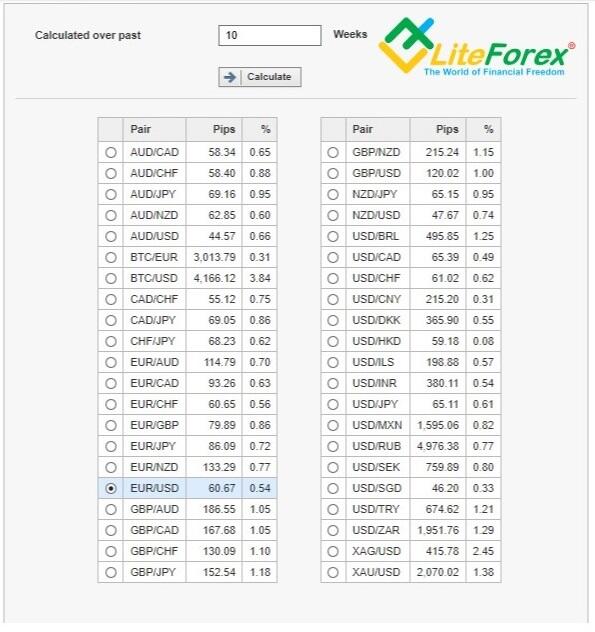
This calculator can give us some indirect information about liquidity. For example, low volatility may indicate high liquidity at the moment. On the other hand, this may mean a flat, i.e. the absence of trading in this pair. In other words, the volatility calculator does not allow to make certain conclusions regarding the liquidity level, but can serve as an auxiliary tool.
Conclusion. Liquidity is the ability to quickly exchange one asset for another. Low-liquid markets are not protected from sudden price spikes. They may be of interest to investors who are more likely to take risks for higher returns. The main advantage of highly liquid markets is that no major player is able to significantly affect the price. Therefore, they carry fewer risks and, due to greater predictability, are better suited for technical analysis. There is no single recipe for choosing the optimal pair in terms of liquidity and volatility, therefore I propose to discuss these issues in the comments:
- How to choose a strategy for a particular currency pair and vice versa?
- How important is the liquidity level of the instrument for you when choosing a pair and strategy?
- Do you prefer high or low liquidity markets?
Join the discussion!
P.S. Did you like my article? Share it in social networks: it will be the best "thank you" :)
Useful links:
- I recommend trying to trade with a reliable broker here. The system allows you to trade by yourself or copy successful traders from all across the globe.
- Use my promo code BLOG to get a 50% deposit bonus on the LiteFinance platform. Simply enter this code in the appropriate field when funding your trading account.
- Telegram chat for traders: https://t.me/litefinancebrokerchat. We are sharing the signals and trading experience.
- Telegram channel with high-quality analytics, Forex reviews, training articles, and other useful things for traders https://t.me/litefinance
Price chart of EURUSD in real time mode

The content of this article reflects the author’s opinion and does not necessarily reflect the official position of LiteFinance broker. The material published on this page is provided for informational purposes only and should not be considered as the provision of investment advice for the purposes of Directive 2014/65/EU.
According to copyright law, this article is considered intellectual property, which includes a prohibition on copying and distributing it without consent.