This article delves into copy trading, which is considered one of the most advanced trading systems available on Forex.
The overview explains why copy trading has replaced PAMM services, how this system works, and which types of copy trading are more advantageous. Read this article and learn how to earn by copying the strategies of professional traders.
The article covers the following subjects:
- What Is a PAMM Account and How Does It Work?
- What Is Copy Trading and How Does It Work?
- Why Do Investors More Often Choose Copy Trading Than PAMM?
- How to Make A Profit from Copy Trading?
- How Investors Start Working In The System
- Copy Settings
- How Traders Start Working In The System
- How to Make Your Profile Appealing to Investors and Attract Them Yourself
- Conclusion
- Copy Trading System vs PAMM FAQs
What Is a PAMM Account and How Does It Work?
PAMM, or Percent Allocation Management Module, is a management system where a managing trader allocates their profit evenly among investors, after deducting commission, according to their investment share. In essence, investors entrust their funds to a manager, who then has the authority to manage the funds to generate returns. Although similar to an asset management system, PAMM is generally considered more appealing.
How It Works
Managers can open several PAMM accounts depending on the implemented strategy. An investor opens an account with a broker, reviews the terms and conditions of the agreement, and then transfers funds to the manager's PAMM account. After this, investors can monitor trading statistics in their client profiles.
Example. Suppose a person invests $1,000. A manager sets a 40% commission and deposits $1,000. The final yield is 5%. The profit amounts to $100, which is 5% of $2,000. Initially, the investor's share of the common portfolio's income is 50%, but 40% is paid to the manager. Therefore, the investor's net profit is $30, calculated as 100/2 * 0.6.
PAMM Accounts Advantages Compared to Asset Management
- In the PAMM system, investing and profit allocation happen automatically, allowing investors to review the manager's agreement from anywhere in the world. All it takes is to top up an account opened with a broker. In contrast, forming an agreement with a management company and depositing money in it is a lengthier and more intricate process.
- PAMM offers relative transparency. Investors can track the deposit curve, review the manager's backtesting statistics, discuss the strategy in a personal conversation, and withdraw funds at any time if permitted by the agreement. This type of information is often kept confidential by many management companies.
- Risk diversification. Investors can choose any number of managers and allocate the deposit at a favorable ratio.
- Tax savings. A management company usually deducts taxes from profits. If a broker is not a tax agent, an investor is responsible for filing a tax declaration.
PAMM Accounts Disadvantages
- Manager's commissions are relatively high, typically ranging from 20% to 50% of the profit.
- Considerable risks involved. The ZuluTrade company suggests that most managers employ the Martingale and averaging strategies. Moreover, some fraudulent brokers may use fake accounts, pretending to provide management services.
- Difficulties with money withdrawal. Withdrawal of funds before the rollover at the end of the trading period may lead to challenges due to potential penalties for early withdrawal, which are typically incurred during profit distribution.
- An investor can not directly influence the course of trading.
In the heyday of PAMM accounts, comprehensive broker platforms appeared, providing asset management services. Nevertheless, the allure of PAMM accounts dwindled after investors of prominent Forex market entities such as MMCIS, Panteon Finance, and ForexTrend suffered complete financial losses. Initially, these platforms offered an attractive system where the risks were mutually shared by investors and managers, albeit to the latter's disadvantage. However, investors were impressed by this possibility, and their enthusiasm benefited managers. In fact, these platforms revealed themselves to be typical financial pyramids, and the existence of PAMM managers remains a debatable point.
PAMM accounts have lost the investors' credibility, leading to the emergence of a new trading system known as copy trading.
What Is Copy Trading and How Does It Work?
Copy trading involves following the strategy of a professional trader without transferring funds to their account. Instead, investors subscribe to a trader, and the trades are automatically copied. All the professional trader's open and closed positions are replicated on the investor's account. Each broker's client can be both an investor and a trader at the same time.
- All traders are brokers' clients. Trades are instantly copied as they are executed on the broker's servers, eliminating delays or slippages. Trading is only conducted on ECN accounts.
- A broker provides four options for copy trading: copying the full or fixed volume of each trade, copying a percentage of a trade volume, or copying in proportion to the investor's assets.
- A broker serves as an intermediary between an investor and a trader, earning solely on the spread. A broker does not charge any commissions, ensuring that the transaction between the parties is conducted properly. A broker does not have access to the traders' and investors' accounts. The history of transactions is recorded on the server and cannot be corrected.
How It Works
The copy trading platform provides extensive functionality to safeguard the investor's interests. Each trader has their own investor password, preventing any interference from brokers in their trading activities. Before starting to follow, an investor can receive the investor password and ask a trader any strategy-related questions in the chat room. Traders, in turn, are motivated to uphold and enhance their reputation. The more investors they can attract, the higher their commission income.
Note: In the PAMM system, a manager has full control over the investor's funds. There have been cases where a platform offered a manager to waste the investor's deposit for compensation. Otherwise, a manager would jeopardize their account. In copy trading, a trader earns a commission for successful trades and values his reputation. An investor can instantly terminate communication with a trader, which is impossible in the PAMM system.
Before you start copying, you need to assess the risks, potential profit, and deposit size. Use a calculator to avoid getting stopped out prematurely.
Platform where traders earn more

Trade on LiteFinance’s high-tech ECN platform and open an account so that beginner traders can copy you. Earn a commission for copy trading and boost your income.
Copy Trading Advantages
- All traders' transactions are available, including a brief description of the strategy and their trades history. All questions can be asked to a trader personally.
- The investor's assets remain in their account. They can disconnect from a trader at any time if they suspect them of trying to deplete the deposit intentionally.
- An opportunity to limit risks by setting stop-loss and take-profit levels for copying.
- An investor can influence the trading process by setting stop-loss orders based on a trader's strategy, closing trades prematurely, and adjusting the position volume. This allows an investor to mitigate risks according to their risk management rules.
- Investors can communicate with traders in real time. They can access traders' news feeds to observe real-time performance and trading discussions.
In copy trading, investors rely on fully transparent data to make informed decisions. Investors themselves evaluate managers and their strategies.
How to Choose a Trader for Copy Trading
- Check the period the account has been active and the number of open and closed accounts. Traders often close accounts to avoid negative performance affecting their statistics. If there are numerous closed accounts, exercise caution. An account should have been active for at least six months.
- Analyze the average yearly and monthly profitability and gains for the previous month. Review the deposit curve performance during critical moments of the last year.
- Assess the account's maximum drawdown and profit as a percentage of the deposit.
- Do not chase the most efficient traders. It is better to copy traders who offer minimal or optimal risks. The higher the return, the greater the risk.
- Follow the majority opinion when choosing a trader, as a higher number of subscribers usually indicates a better trader. Additionally, pay attention to how much of the trader's own assets are invested, aiming for at least 10% of the investor's capital, and how much they consistently reinvest. This can be seen in the statistics of each trader.
Remember that a successful choice of a trader does not guarantee 100% earnings. It is not advisable to invest in scalping, where split-second decisions determine everything. Ensure that the conditions on your account closely match the trader's, including leverage and deposit percentage.
After all, what to choose: PAMM or copy trading? Undoubtedly, copy trading. This system offers greater transparency than PAMM, and most importantly, it eliminates the temptation for managers or traders to misuse investors' funds.
Why Do Investors More Often Choose Copy Trading Than PAMM?
PAMM is an investment system in which the profits of a managing trader are evenly distributed among investors depending on their investments. Investors transfer their funds to a manager, who then has the discretion to use the money for a specific period.
Copy trading means replicating the transactions of a professional trader. Unlike in PAMM, investors do not transfer money to their managers. They simply mimic traders' strategies. Transactions opened on the trader's account are automatically duplicated on the investor's account. Besides, this system allows a participant to act as both a trader and an investor simultaneously, potentially gaining two streams of income.
Which system is better? Let's compare their key parameters.
Where Are Your Funds Located?
In the PAMM system, your funds are transferred to the trader's account, granting them sole discretion over the funds. Conversely, in the copy trading system, your funds remain in your account and are designated for copying trades, allowing you to retain full control and discretion over their use.
Statistics for Analysis
In the PAMM system, investors usually have access only to the statistics that a managing trader wishes to display, including a profitability chart, the percentage of income in relation to the initial capital, and the commission size. In copy trading, each manager automatically provides comprehensive information and cannot conceal anything. Investors can monitor both closed and open trades in their history. Additionally, a yield curve can be represented in the form of Japanese candlesticks on various time frames, simplifying the analysis process.
Trade Managing
In the PAMM system, investors are unable to monitor active trades, but only those that have been completed upon request. Thus, investors cannot intervene in the trading process until the investment period ends. In copy trading, the funds remain in the investors' account. They have access to all active and completed trades online and can independently set pending orders.
Management Settings
In the PAMM system, investors only set the amount of funds they want to invest. In case of failure, a trader can lose all the funds. In copy trading, various parameters can be set, such as the copying method, volume, the amount to be copied, and the maximum loss threshold for the investor.
Commission
In the PAMM system, some successful traders set their commission rates at 80% or higher. This has sparked a divide on the platform, with novice traders charging commissions ranging from 20% to 50% and seasoned professionals charging 50% or more. Perhaps such high commissions were the reason for the current low popularity of PAMM platforms. Essentially, investors have to pay more than half of their profits to collaborate with a successful trader. In contrast, in copy trading, the most successful and popular traders tend to have lower commissions. This is because the system has more investors than traders, and professionals do not lack investments. Therefore, it might be beneficial to lower the commission rates to attract more new investors. Currently, the average commission in the system stands at 20%, which is certainly appealing.
Investor and Trader Communication
In the PAMM system, investors can find traders' profiles and message them. However, a common issue is that traders may not log in for extended periods, causing them to miss important messages. Copy trading offers a special platform, allowing traders and investors to communicate easily. They can exchange quick messages via chat, and investors can monitor traders' news feeds displaying their latest performance. Besides, investors can view comprehensive statistics and ask questions whenever necessary.
How to Make A Profit from Copy Trading?
In the copy trading system, anyone can act as a trader, an investor, or in both roles simultaneously. Let's explore the ways of generating income for each of the categories.
A trader is a system participant who registers and manages their own trading account, allowing others to copy their trades. They trade on their own account, and the news feed shows the results of their transactions. Traders earn a commission based on a percentage of their investors' profits, known as profit-sharing. The more investors copy a trader, the greater their potential reward. Successful traders with many investors copying their strategy can earn significantly more from commissions than from their own trading activities.
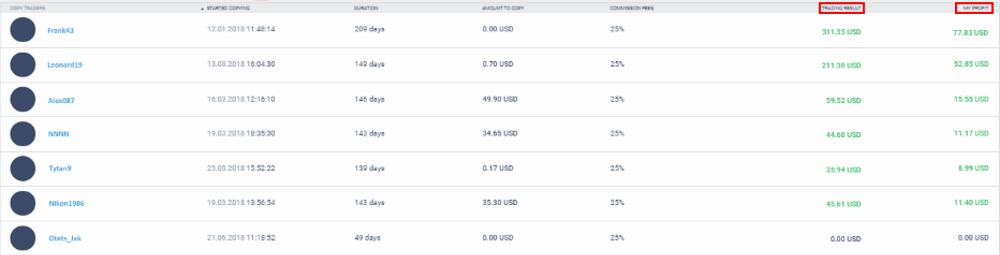
An investor is a system participant who independently analyzes the traders' ratings in the system based on various factors. They select a suitable option and set the parameters for copying trades. Subsequently, they generate income from profitable trades in parallel with the trader. Investors pay a commission based on their individual agreement with each trader for the gains yielded during copying.

Investor's income in the system depends on a number of following parameters:
- Investment amount or the assets allocated for copying trades.
- Copying type. Investors can set a fixed volume and receive a predetermined income or copy trades in proportion to their own funds. In this case, the potential profit will depend on the trader's amount of funds.
- Trader's performance. Investors usually focus on the profitability chart and the account fluctuations to gauge the profit. However, this parameter is not always reliable. Investors frequently overlook the duration of a trader's activity in the system. For instance, a trader with a 300% profitability over six years achieves a 50% annual profit, which is not exceptional in the currency market. Another trader with 300% profit in just one year will yield significantly different income for investors who copy their trades.
- Trader's commission. Traders can determine their own commission rates, meaning that an investor's earnings can vary significantly, ranging from 20% to 50%.
How Investors Start Working In The System
Let's review all the nuances of using the copy trading system.
1. To start copying trades, log into your client's profile and select the Copy tab on the left navigation menu.
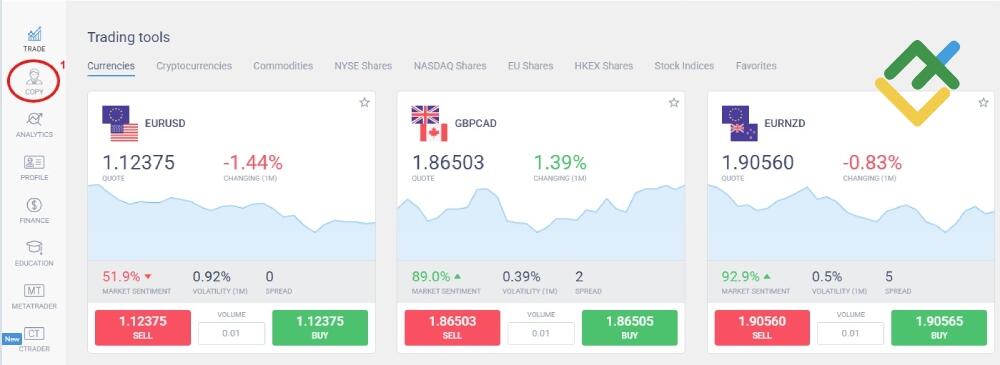
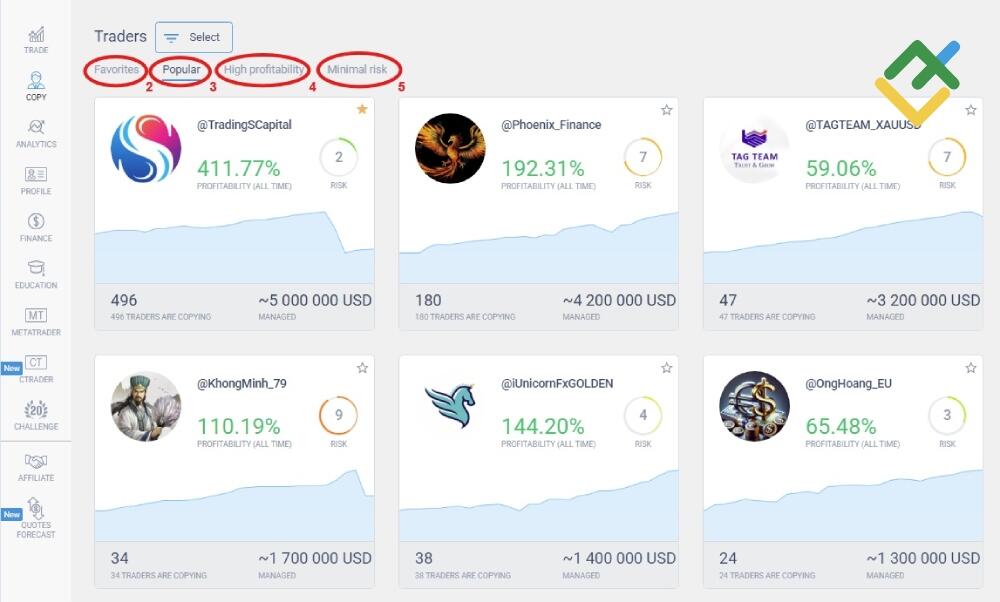
2. In the window that appears, you can choose traders and adjust filter settings. The Favorites tab will be displayed by default, showing brief information about the traders you have selected.
3. The Popular tab automatically ranks traders based on their popularity, highlighting those who are frequently viewed and chosen for copying.
4. The High Profitability tab allows you to sort traders by their profitability percentage. Traders with the highest profitability will be at the top of the ranking.
5. The Minimal Risk tab classifies traders according to the risk parameter. This parameter is calculated using a complex formula that takes into account the value of the maximum drawdown and the percentage of funds involved. Once sorted, traders with the least risky strategies will be at the top of the rating.
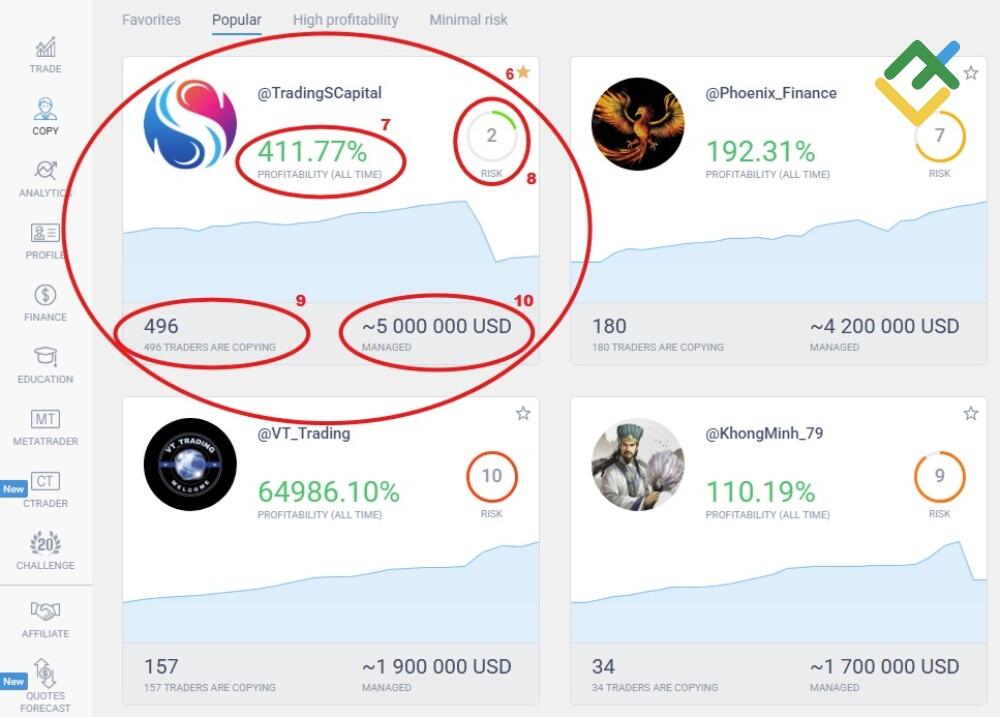
6. Let's review traders' profile widgets.
7. The trader's overall profitability throughout the trading period can be found in the center of each widget.
8. The risk information can be found to the right of the profitability data. It is measured on a scale from 1 to 10, with 10 indicating the highest potential for profit compared to other traders but also the highest level of risk.
9. The number of investors who copy this trader is also indicated there.
10. The approximate value of investor assets managed by this trader is displayed at the bottom of each widget.
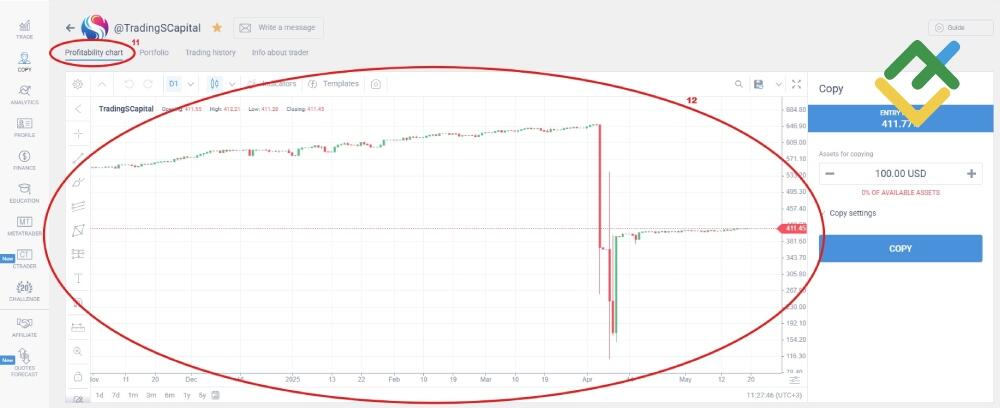
11. Clicking on a trader's profile widget will open their expanded statistics.
12. The profitability chart is located in the center of the page, displaying the trader's profits gained and losses incurred during the account's lifespan. However, relying solely on the profitability chart may not always accurately identify a truly successful professional. The longer the trading period, the smoother the curve, making significant drawdowns in profitability less noticeable. For a trader, a 100% drawdown will only mean a slight dip on the chart, whereas, for an investor who started copying at the very peak, a sharp drop will be significant. For this reason, it is advisable not to assess traders solely based on their profitability.
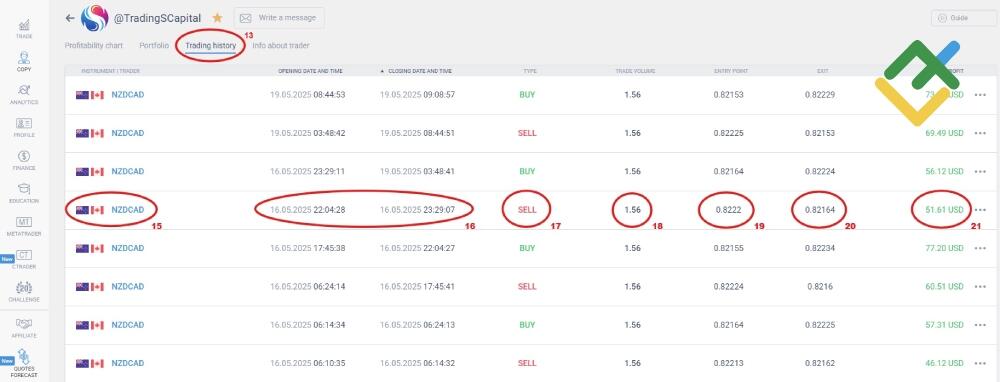
13. In order to conduct a more detailed analysis, you should open the Trading History section containing details about all closed trades. While this information may seem complex to a beginner, a seasoned investor usually assesses a trader's success by this parameter.
14. The area containing all the information about closed trades is marked in the screenshot below.
15. The first column displays the instrument on which a trade was executed. Let's review the NZDCAD currency pair as an example.
16. The next two columns show the date and time of the trade's opening and closing. This parameter often provides insights into the trader's strategy. After analyzing the majority of trades, it becomes apparent that the trader favors a short-term trading approach.
17. The next column indicates the type of transaction, which, in this case, is a selling operation. Traders can be categorized as sellers, buyers, or both, depending on their trading operations. This particular trader is a universal trader whose strategy involves both buying and selling.
18. Next comes the trade volume, which is displayed in lots. In the given example, the volume equals 1.56 lots.
19. The next column shows the trade's opening price.
20. The following column displays the trade's closing price. Together, these parameters provide a comprehensive overview of the trading strategy. Obviously, this trader primarily focuses on short-term time frames and favors closing trades within a day.
21. The last column contains information on profits and losses.
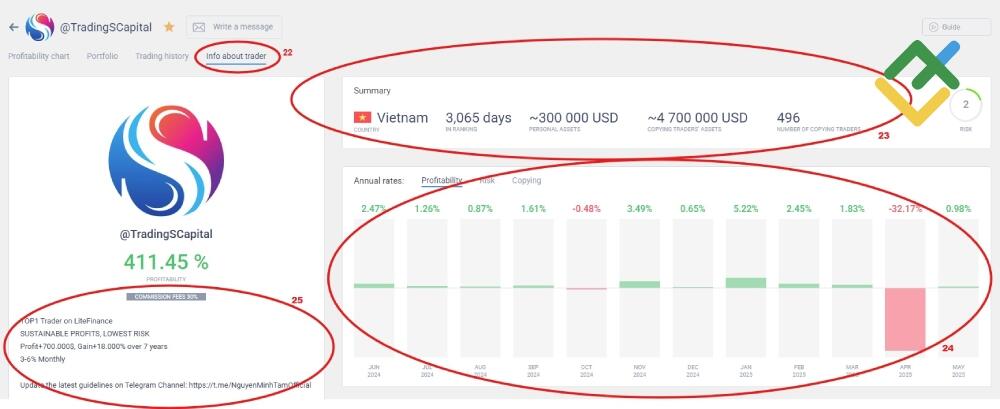
22. Once the closed trades are evaluated, the Info about trader section should be analyzed.
23. The summary section contains information about the trader's country of residence, total days in the system, approximate size of personal and copying traders' assets, and the number of copying investors.
24. Next, you can examine the trader's monthly profitability chart. This data can help you analyze the trader's strategy.
25. Moreover, you can review the details shared by a trader. Typically, traders specify the optimal investment amount and provide recommendations for a fixed copying volume.
Copy Settings
Once a trader is chosen, the copy settings can be adjusted.
Firstly, you should choose the type of copying. There are four options available: in proportion to the investor's assets, the full volume of each trade 1 to 1, fixed volume, and % of the trade's volume.
- In proportion to the investor's assets. The volume of the copied trade is determined by the ratio of the assets for copying to the assets on the trader's account. The amount of assets used for copying is specified in the corresponding settings.
- Full volume 1 to 1. The volume of the copied trade equals the volume of the corresponding trade on the trader's account.
- Fixed volume. In this case, the volume of the copied trade equals the fixed volume specified in lots.
- % of each trade volume. The volume of the copied trade is equal to the percentage of the corresponding trade volume on the trader's account.
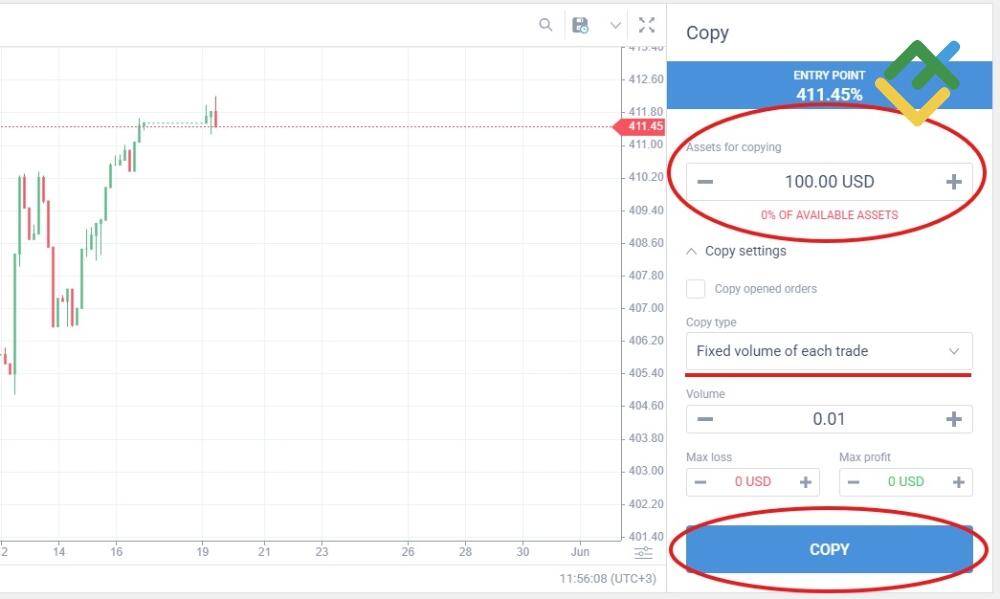
Let's set the Fixed volume of each trade option.
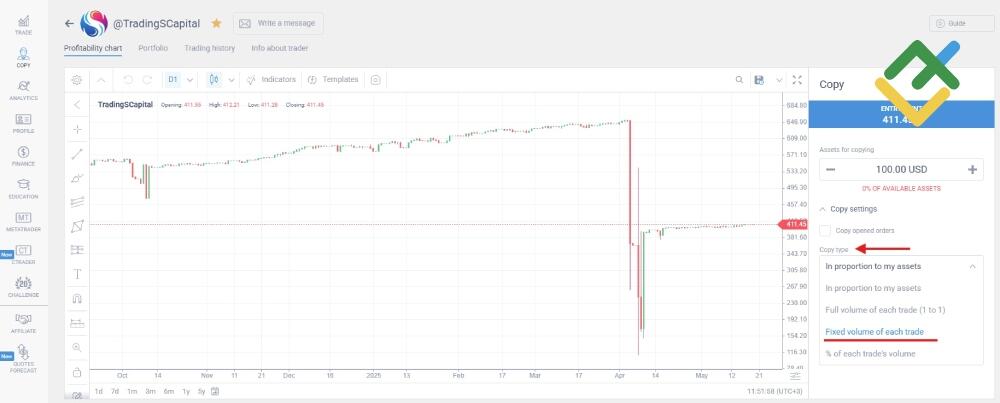
After that, more precise setting parameters will appear, including the volume of copying in lots.
Additionally, you can specify the amount of assets to allocate for copying. Remember to follow the risk management rules.
Afterward, you can adjust the Max Loss and Max Profit level or the amount of assets at risk when copying trades. This parameter should be taken seriously, as it can significantly affect the outcome of a trade.
For instance, you might choose to set the Max Loss parameter at $100. However, there can be a $101 drawdown, followed by rapid growth, resulting in a solid profit. Nonetheless, you would incur a loss of $100. It is advisable to set this parameter at no less than 20% of the invested capital. Ultimately, the decision should be based on the trader's strategy.
Although this feature can sometimes be useful, some maximalists prefer not to set it.
When all parameters are specified, simply click Copy.
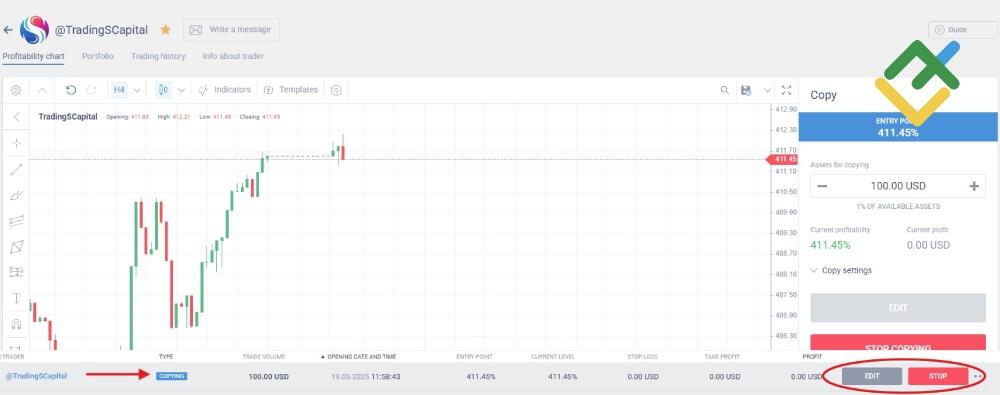
When the copying starts, you will receive a notification. The information about open trades will appear in the terminal panel. Copying can be stopped or edited by pressing the corresponding button.
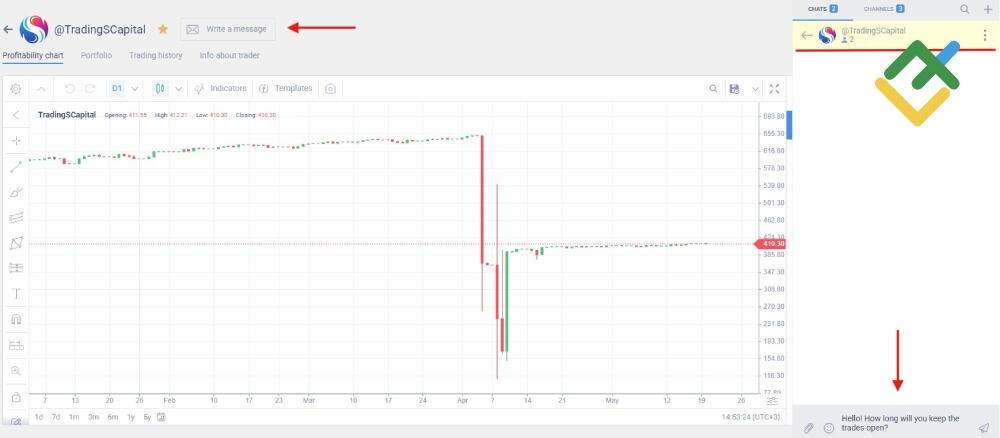
Once the copying process begins and all parameters are set, you can explore the system's extra features and message a trader if you have any questions. Although the opportunity to communicate with professional traders is valuable, you should remember that a trader is working to help you make money. Thus, it would be best if you did not interrupt them with questions too often.
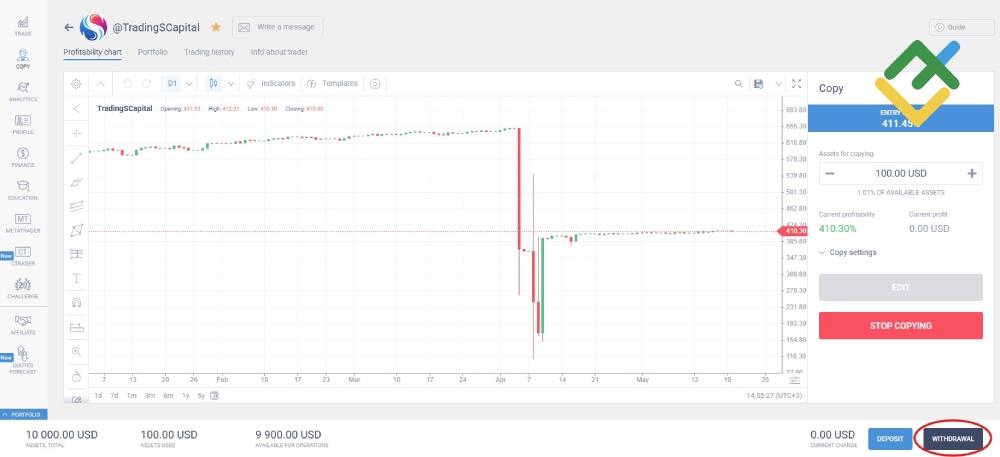
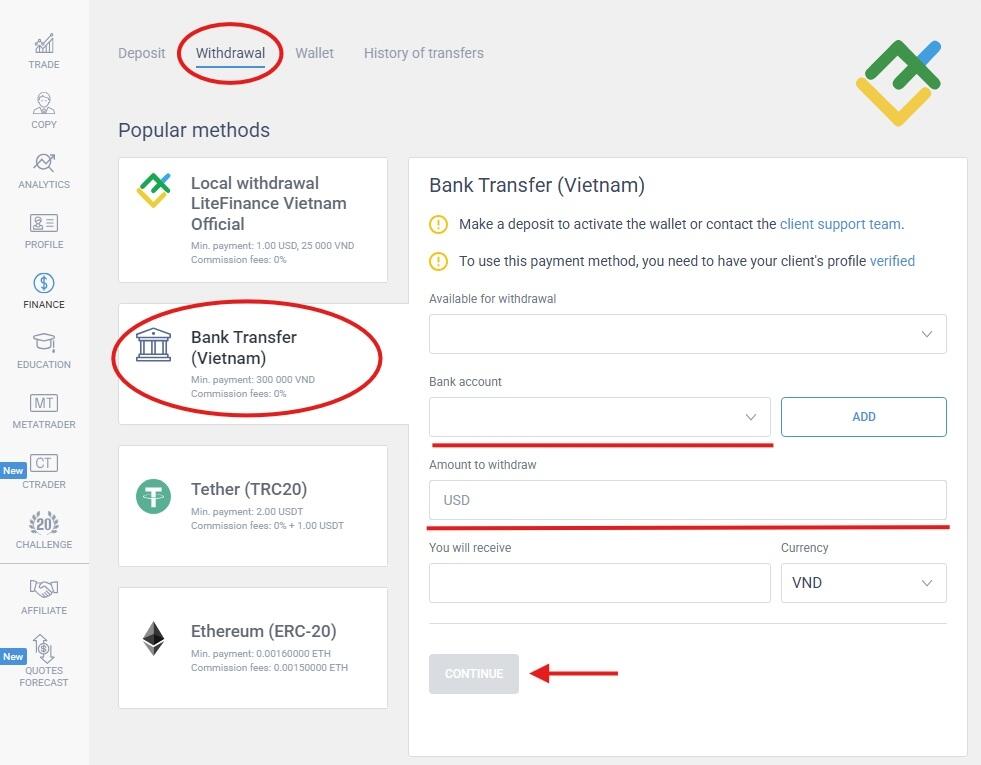
In order to fully enjoy the profit received from investing, you need to withdraw it from the deposit by pressing the Withdrawal button.
There are several ways to withdraw funds from the account. Opting for a bank transfer, you should enter your bank account number and press the Add button.
Enter the amount of funds you wish to withdraw in your desired currency. The example shows the Vietnamese dong.
Finally, press the Continue button, and the funds will be transferred to a designated bank account after a brief processing period.
How Traders Start Working In The System
This section describes the intricacies of working in the Copy trading system as a trader.
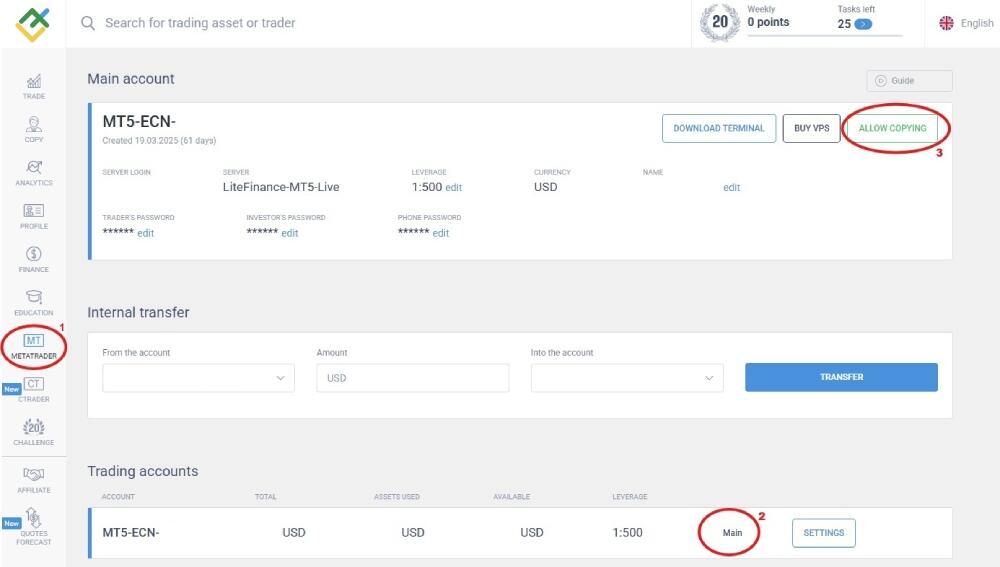
1. To get started, you need to choose and set up a trading account that will be displayed in the system. For this purpose, click on the METATRADER tab located in the left-hand panel of your profile within the main window.
2. Next, you should select the account that will be displayed in the system. If you have multiple accounts, it is necessary to designate one as the primary account.
3. Once the desired account is selected, press the Allow Copying button at the top of the window.
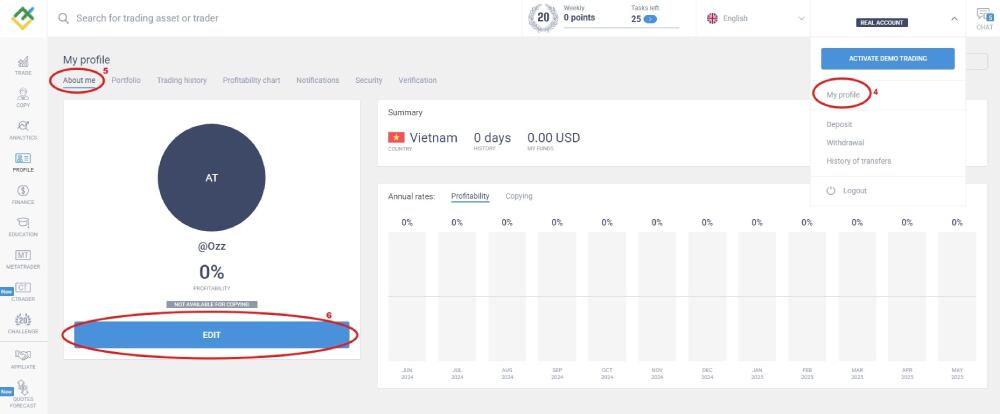
4. You can also open an account for copy trading in the Client Profile settings. Select My Profile in the menu located at the top right corner of the page.
5. A window with the About Me section selected by default will open.
6. Afterward, you should set up your trading account by pressing the Edit button.
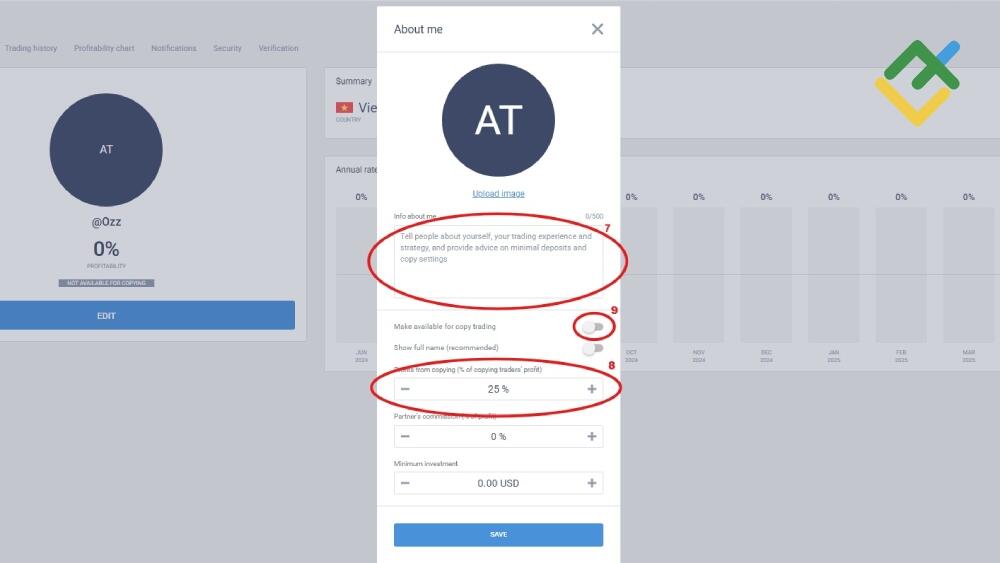
7. When you open a tab, you can enter relevant information in the provided window. This typically includes essential details like a brief strategy description or fund parameters on investors' accounts, which are comfortable for a trader to work with.
8. In this section, you should set the size of the commission that you will receive from the investor's profit. Notably, a lower commission makes you more appealing to investors. However, setting it too low means you will work practically for free. Aim for the average commission rate among the top-rated traders, which typically ranges between 20%–25%.
9. Finally, move the Make Available for Copy Trading toggle button to the right.
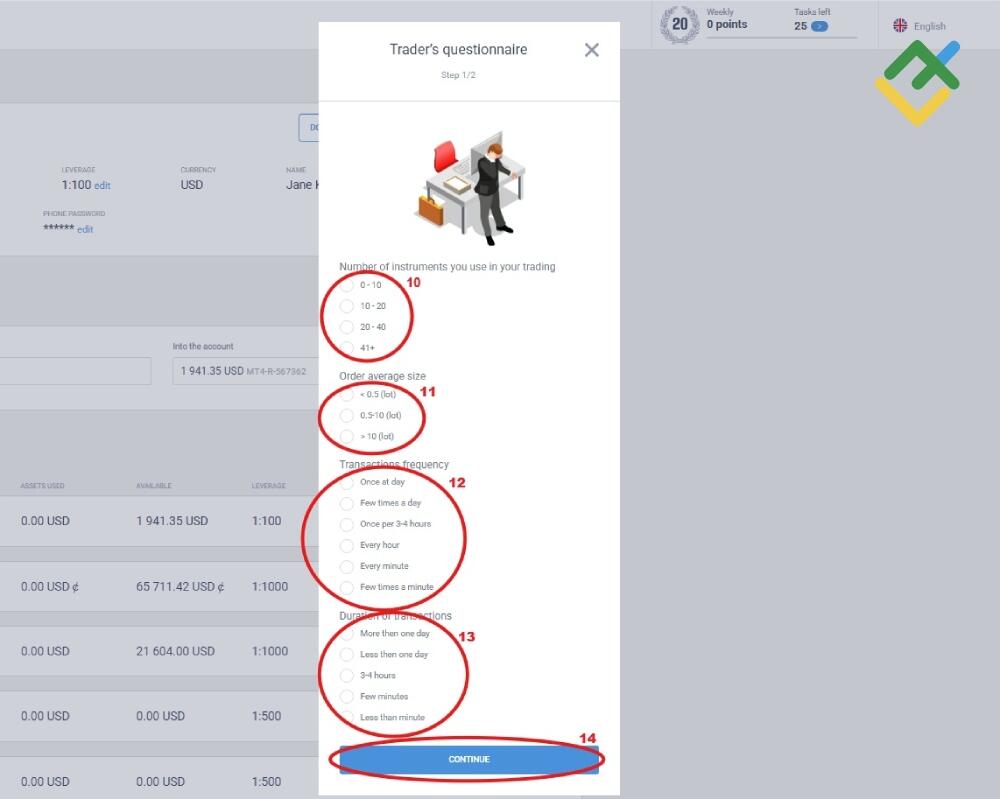
10. The Trader's Questionnaire page will open. This questionnaire is aimed at identifying the main aspects of your trading strategy, which will help a potential investor decide whether to copy you or not. The first point is the question about the number of instruments you use in trading.
11. Next, you need to adjust the average order size, which refers to the average volume of the trade opened in lots. As a trader, it is essential to understand how this parameter is calculated and what factors influence it.
12. Make sure to establish the frequency for opening new orders after that. Note that your trading strategy may be different from what is presented in the examples.
13. The final point is the duration of transactions, which is the average time you keep a trade open. This point determines whether you employ a short-term or long-term strategy.
14. Once all items are filled in, press the Continue button.
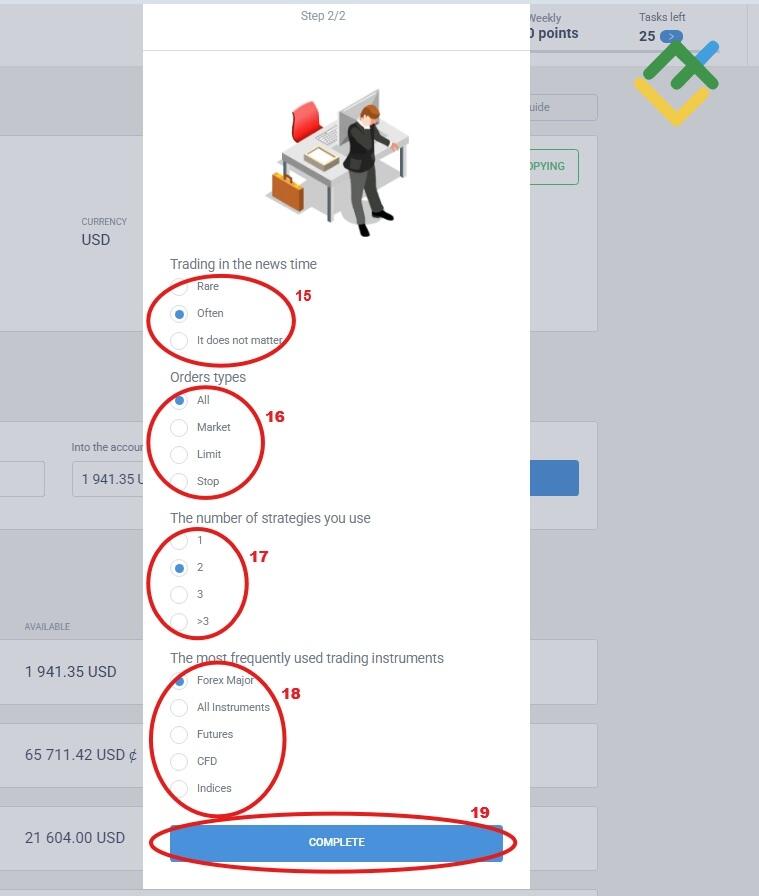
15. The second part of the questionnaire inquires about trading on the news. This aspect is highlighted since trading on the news is one of the most dangerous types of trading and involves huge risks.
16. The next item is the types of orders. Indicate whether you typically use pending orders or trade without them.
17. Specify the number of trading strategies you use. Some traders work according to a situation, employing a variety of approaches tailored to specific market conditions. However, most seasoned traders typically rely on one or two primary strategies.
18. Next, indicate the most frequently used instruments. Most traders prefer working with certain types of assets to which they are accustomed.
19. Once the questionnaire is filled in, press the Complete button.
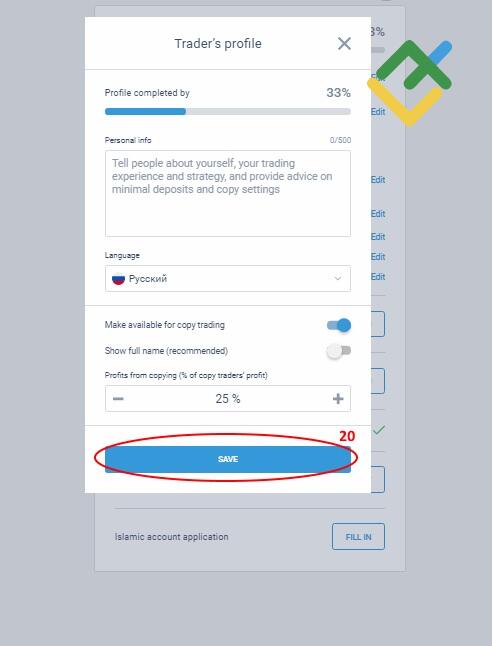
20. You will return to the Trader's Profile window. The profile setup progress bar will move to the right, indicating that your account is now available for others to copy and will appear in the traders' rating. To finish all the adjustments, click on the Save button.
21. Once copying is allowed, statistics start to appear in the trader's profile.
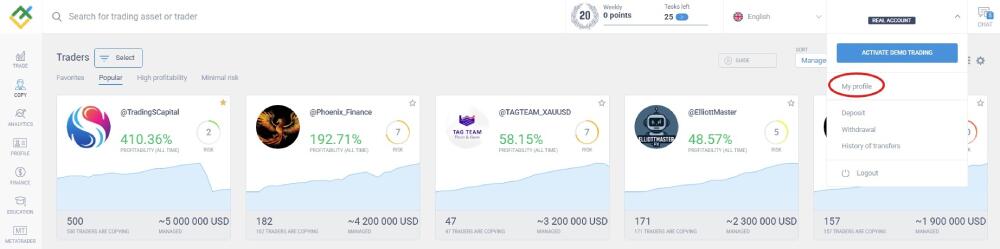
22. In the opened window, click on the Portfolio tab to view all current trades on the trading account. Judging by the intermediate result in the example, there are chances of becoming successful and attracting many investors.
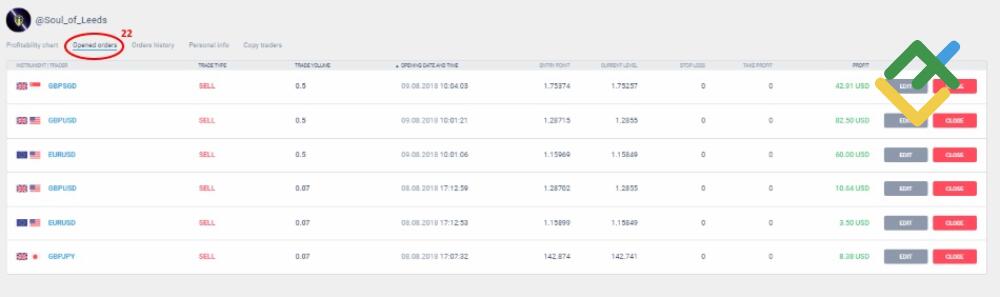
23. Over time, your trading statistics will be formed. If your trading performance attracts investors, they will choose to copy your strategy, providing a percentage of the profits from the copied trades.
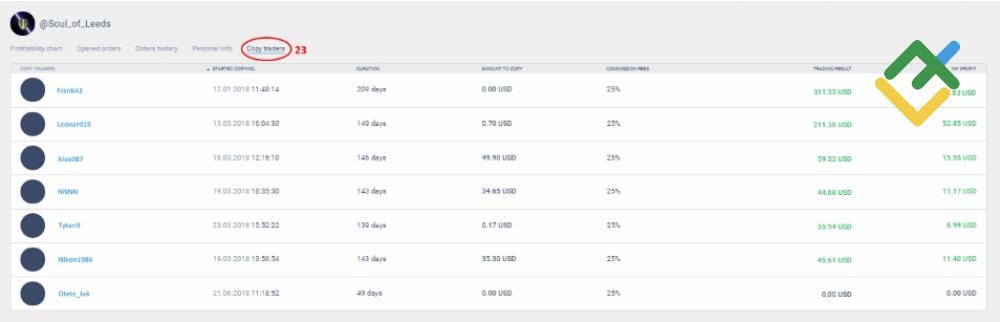
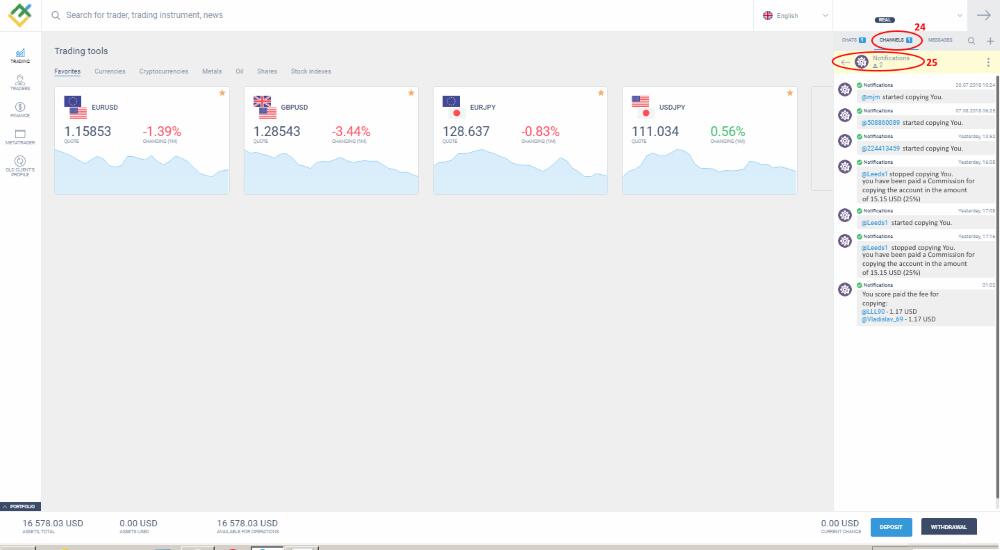
24. You will receive all the information about the investors who started to copy you and unsubscribed from you via system messages.
25. All important updates will be available in the Notifications channel.
Thus, the trader's workflow in this system is straightforward and efficient. Nevertheless, the work of a trader is much more complicated. To achieve success, you need to possess trading skills, a deep understanding of the trading process and system operations, the ability to attract investors, and much more.
How to Make Your Profile Appealing to Investors and Attract Them Yourself
A large number of individuals rely on the returns generated from online trading as their primary source of income. However, these people have to be confident in their skills and capacity to consistently earn profits.
The copy trading system offers a pathway to this confidence. Your profile is your mirror. The more transparent your profile is, the more chances a potential investor will be attracted.
Naturally, transparency alone is not sufficient. Your trading statistics should assure investors that their assets are safe from risks and can generate profit. Therefore, the profitability chart should trend upward without significant dips. This is what novice investors pay attention to. Experienced system participants already have a group of relevant and proven traders to copy.
Your trading process should be well-established to inspire confidence in investors. While beginner's luck might initially benefit novice traders, statistics will eventually reveal their lack of experience. Investors are hesitant to entrust their funds to inexperienced traders. Thus, your account's lifespan is also a crucial factor. Accounts that have shown consistent profitability over an extended period are more appealing to potential investors.
Nonetheless, every investor has different objectives. Some want to make substantial and rapid profits and thus opt for a trader capable of delivering significant returns in a short period. However, such investors should be prepared for high risk. Conversely, others prioritize steady, albeit modest, long-term profits and, therefore, choose traders with minimal risk exposure.
Once your trading account shows consistent success with an upward profitability curve and a solid trading history of at least two months, you can begin to attract investors on your own.
Fortunately, these days, numerous opportunities abound. Social networks host diverse communities where traders and investors exchange their ideas. If you consistently make accurate predictions, why not share them with others? You need to present yourself as open and approachable. Having active social media accounts and being proficient in using various messengers is crucial. When trying to attract investors, you need to let people know who they are dealing with. When risking their money, they have the right to get to know the person they are going to entrust it to.
The copy trading system provides chances to engage with potential investors, providing transparency and publicity. You can communicate with others through social network communities, thematic group chats on Telegram, and finally, in the system's chat.
Exchange your insights, post your trade results, and share your profitability chart. This will help attract potential investors soon.
Conclusion
To sum up, there are numerous ways to generate additional income in the modern world. Importantly, these methods do not demand significant effort or extensive expertise from you. All you need to do is take the first step, and success will follow. If you have experience in financial markets, the copy trading system is the best way to increase your income.




Copy successful traders
Make profits from the first day of trading without training. The best traders from the whole world gathered on the same platform to share their money-making strategies.
Copy Trading System vs PAMM FAQs
PAMM is a management platform where a professional trader utilizes investors' funds to execute transactions while maintaining full control of their assets. After deducting a commission, all profits are evenly allocated among investors according to their share. Copy trading is a service that allows investors to replicate the transactions of a professional trader for a certain commission from the profit of investors' accounts. Investors can set the parameters for copying, determine the degree of risk, and stop copying at any time.
In copy trading, an investor selects a trader whose strategy they wish to emulate. Next, the type of copying should be chosen: copying full or fixed volume, percentage of the trade, or in proportion to the investor's funds. Investors can also set stop-loss levels. Once all the parameters are adjusted, an investor can start copying. All professional traders' transactions will be duplicated on the investor's account.
Yes, copy trading offers more flexible settings for mirroring trades, as well as a transparent trading history of professional traders. Additionally, the commission in a social trading system is usually lower than in the PAMM system. Investors can directly contact a trader, inquire about the trading strategy, and halt the copying process at any time.
Before copying trades, it is crucial to thoroughly analyze the trader's profitability chart. If not, investors may miss serious drawdowns in the traders' history of transactions and lose their funds. Besides, it is necessary to follow the rules of money and risk management, including setting stop-loss levels and calculating the amount of assets used for copying.
You should register, open, and deposit your LiteFinance trading account. Next, proceed to the Copy section, choose a trader that suits your preferences, and adjust the copying parameters, including the number of assets, type of copying, and the stop-loss and take-profit levels. After that, click on the Copy button, and all the trader's transactions will be automatically replicated in your trading account.
A managing trader opens one or several PAMM accounts with a broker. Investors open an account with a broker and transfer funds to a PAMM account. After that, a managing trader utilizes the investors' funds to work in financial markets. Profits are allocated automatically. Investors can observe trading statistics. Profits are distributed automatically, and investors have access to trading statistics.
Yes, you can make a profit by investing in PAMM accounts. However, the considerable commission, ranging from 20% to 50% of the profit, along with the high risks and comparatively low reliability, has led to a waning interest in PAMM accounts.
PAMM accounts are legal if they are regulated by law. However, before investing, ensure that a managing trader has opened a PAMM account with a licensed broker.
There are risks of losing all your savings. Some unscrupulous brokers could use fake accounts, pretending to provide management services, offering a manager compensation for wasting the investor's deposit. Additionally, many investment managers employ high-risk tactics such as Martingale and averaging strategies. Withdrawing funds can also be challenging. The agreement often stipulates a penalty for early withdrawal of money before the rollover date.

The content of this article reflects the author’s opinion and does not necessarily reflect the official position of LiteFinance broker. The material published on this page is provided for informational purposes only and should not be considered as the provision of investment advice for the purposes of Directive 2014/65/EU.
According to copyright law, this article is considered intellectual property, which includes a prohibition on copying and distributing it without consent.