Definition, causes and factors, goals and procedure, positive and negative consequences. Examples of redenomination and their impact on the rate
Reasons and examples of currency redenomination
History knows many examples of redenomination, most of which occured in the post-war period or in developing and underdeveloped countries. Redenomination is an auxiliary tool that accompanies a decrease in the money supply and eliminates the effects of hyperinflation. But in itself, it is more of a threat - in panic, the population will buy up hard assets or foreign currencies, thus further exacerbating the situation. In this review you will find out what redenomination is, how and when it is held, the risks it carries and the impact it has on the rates with examples from history.
Redenomination: what is it and what are its consequences?
In August 2018, Venezuela held a major redenomination and took 5 zeros from the national currency. 500 bolivars became the largest bill, but this did not change the situation. Within a year, this bill could buy one egg, and the minimum wages of 40,000 bolivars - as much as two kilograms of meat. As a result of the deep economic crisis in the country with the largest explored oil reserves in the world, in 2018, according to the IMF, hyperinflation exceeded 1 million percent. The year 2019 fared better for Venezuela - the inflation accumulated from the beginning of the year was about 3,300%, and in annual terms from October 2018 to September 2019 – 50,100%.
Venezuela is a good example of how one of the most effective economic instruments for overcoming the crisis turned out to be useless.
In this review you will learn:
- What redenomination is and what factors precede it.
- How redenomination is held, its advantages and disadvantages.
- Examples of redenominations from the history of the world economy.
- How to make money on redenominations and whether it can be of interest to investors
I should emphasize that we are talking about redenomination of bills. In some sources (legislation of some countries) one can also find the notion of “redenomination of share capital”. This is a change in the nominal value of all shares issued by one issuer, accompanied by their fragmentation or consolidation, i.e. change in their number and, therefore, value (the size of the authorized capital does not change). But the review will focus on currencies.
Redenomination and how to make money on it
Redenomination is proportional substitution of national currency bills for bills with a lower denomination. Simply put, extra zeros are removed.
Factors preceding redenomination:
- Imbalance in the national economy. Significant prevalence of imports over exports, unjustified growth of money supply not provided by production, budget deficit, growth of public debt and its maintenance costs, growth in unemployment, etc.
- Hyperinflation. The imbalance of the national economy leads to uncontrolled price increases. To support the population, the state resorts to issuing. The increase in the money supply creates a new round of demand, followed by a new increase in prices.
The goals of redenomination are regarded as potential, since they are not always achieved.
Denomination goals:
- Moving capital out of the shadow. The population that stores money in national currency will be forced to exchange it in any way possible. History knows examples where, in order to detain the economy, stringent conditions for the exchange of money involving personal identification were introduced. For example, in Russia in 1993, two weeks were given for money exchange, the restriction was 100 thousand rubles per person, and the passport was stamped upon exchange. These measures are ineffective, because, instead of exchanging for a new currency, the population will invest shadow money in foreign currency, gold, and real estate. And such cash flows cannot be controlled.
- Simplification of calculations. Operating in amounts with no extra zeros is simpler and more convenient.
- Reduced issuing costs. Large bills require the issue of change bills/coins, the cost of which sometimes turns out to be higher than face value.
Redenomination is often accompanied by a decrease in the money supply (withdrawal of money from circulation) in order to contain and prevent inflation. Therefore, we can say that redenomination is also an auxiliary step towards strengthening the national currency.
The best time for redenomination is the beginning of economic growth or a radical restructuring of the economy after hyperinflation is stopped. A crucial factor determining the success of this event is awareness-raising among the population. When neglecting this need, the authorities were faced with redenomination further aggravating the economic situation:
- The redenomination only fueled panic and demand for other safe-haven assets: foreign currency, essential goods, etc. Prices for these assets rose while real estate and expensive property fell.
- Money was withdrawn from the banking system, effectively dehydrating the national economy. The situation was aggravated by a series of bankruptcies with a sharp drop in the value of collateral.
Redenomination will not be effective if it is not accompanied by economic growth, which means inflation control, GDP growth, a decrease in unemployment, balancing the country's balance of payments, etc. The example of Venezuela from the beginning of the review is what will happen if this principle is ignored.
The negative consequences of redenomination are mostly psychological in nature:
- Rounding prices up. While before the redenomination a product was worth 10,700 units, after it the new price of 10.7 will most likely be rounded to 11 units. However, in comparison with the previous inflation, such rounding is rather painless.
- The need to get used to new monetary units. The need to adapt to constant change is inevitable.
- Perception. When you are holding in your hands 1000 or more times less money, it may feel like you have been robbed. The feeling goes away quickly.
There is no single format of redenominations. In its free form, it can last for a fixed period of time (2-4 weeks) and not be controlled by the state. Prices are indicated in both currencies in the transition period. Even after the transition period, people will be able change the old bills to in banks for a long time (there have been cases where old bills were accepted in banks for another 3 years after the redenomination). The fixed form provides two options:
- The state sets a limit on the amount of exchange per person. Exchange time is limited - an average of 3-14 days.
- The redenomination is a one-time even. From a certain date, new bills begin to operate, which could be obtained earlier by exchanging old ones, for example, in banks.
The most famous examples of redenomination in the history of the world
- Weimar Republic. In the postwar years from 1919 to 1923, the German economy was at the bottom. The paper mark, which replaced the gold mark after August 1914, could not perform its functions well. The hyperinflation that followed the war was well described by Remarque in the novel The Black Obelisk. In 1923, the paper mark was replaced by the Reichsmark, which existed until 1948.
- Hungary. Hungarian hyperinflation and the subsequent redenomination in 1945-1946 became the highest in the entire history of the world financial system. The country's economy was destroyed by the war, prices doubled every 15 hours and it became impossible to control their turnover. The largest pengo bill at the time of redenomination was 1 sextillion (billion trillion or 10^21). On August 1, 1946, forint was introduced, the exchange rate was 4*10^29 (400 octillion). In general, along with other measures, the reform was successful.
- Turkey. In 2005, the country redenominated at the rate of 1 million to one. It had no negative consequences, apart from price confusion.
There are many examples over the past 100 years, about 60 countries have redenominated at least once and you can easily find information about them. The most common ratio is 100:1 and 1000:1, although there are examples of redenomination with a ratio of 10:1.
There are also examples of unsuccessful monetary reforms in history when redenomination only aggravated the situation:
1. Zimbabwe. The country was in the top 10 strongest redenominations in the world twice. On August 1, 2008, 10 billion old dollars were exchanged for 1 new dollar. It took the country only 7 months to repeat the record: on February 2, 2009, the next redenomination was held at the rate of 1 trillion to one dollar. Inflation amounted to 231 million %, and in mid-2009, the national currency completely ceased to exist for 10 years. Recently, the government decided to return the Zimbabwean dollar again, but its rate remains unstable.
2 .Russia. The non-diversified oil export-oriented economy failed in 1997. The drop in oil prices, the Asian recession, and the decline in production were preceded by hyperinflation of more than 2,500% per year. In an effort to compensate for the budget deficit, the government resorted to the following methods:
- Unsecured emissions, which by 1997 led to a rapid increase in consumer prices.
- Issue of short-term government bonds. To cover debt and pay out profits, the state was forced to resort to issuing more and more securities, thereby building a classic pyramid.
In early 1998, three zeros disappeared from ruble denominations. But this did not eliminate the structural problems of the economy, and in August of that year national bankruptcy followed. This partially solved the internal problems, albeit at the expense of investors. After the bankruptcy, the country's economy gradually went up, but the redenomination was an example of an unsuccessful economic policy.
3. Venezuela. This example is described at the beginning of the review. As of autumn 2019, the country so far has not been able to get out of the long crisis. And most likely, the redenomination held in 2018 is not the last one.
How does redenomination affect currency quotes and can you earn money on it?
No. You can’t. Redenomination means the liquidation of the old currency and the emergence of a new one, and the exchange rate of the new currency will depend solely on the effectiveness of the reforms. If the methods of dealing with hyperinflation are successful, the rate will increase. But no one can guarantee this and after hyperinflation, economic growth is very slow and investors are not ready to freeze money in such high-risk dubious projects. Therefore, investors are not interested in currency either before or after the redenomination.
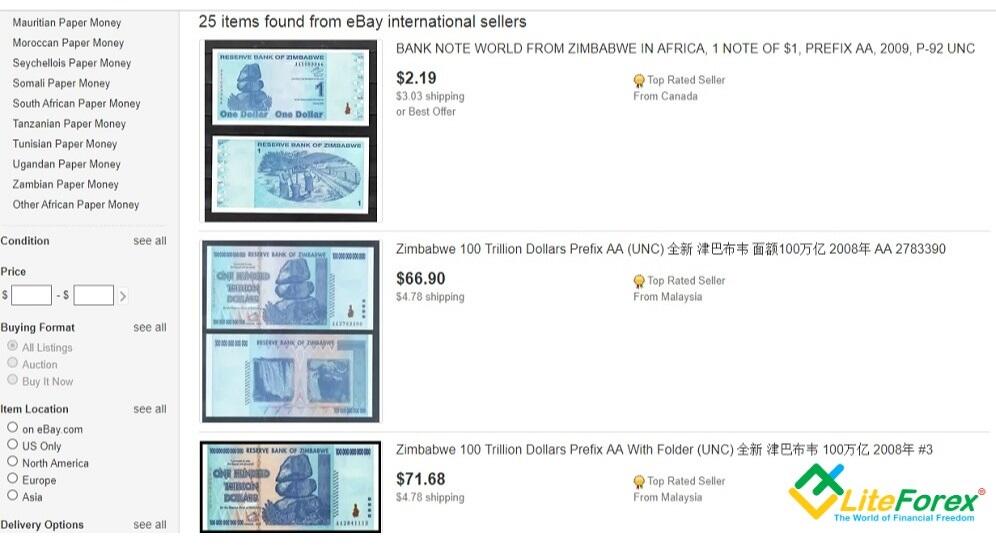
Only collectors with perspective can earn on the redenomination. Not much though. Hyperinflation preceding the redenomination means a large number of bills in circulation, therefore, no rare bills with high collection value. For example, after 10 years, the Zimbabwean dollars of 2008 and 2009 are sold at auctions at an average price of 1 to 100 US dollars depending on face value, series and number.
Another recommendation for collectors - pay attention to small bills and coins. When hyperinflation starts, the need for them disappears and they cease to be issued. This means that their number may be less than the number of large bills.
Conclusion. Redenomination is only an auxiliary tool for improving the economy, allowing to smooth out the effects of the crisis and hyperinflation. Its task is to restore confidence in the national currency, simplify settlements and take control of the shadow turnover. It is carried out in conjunction with a comprehensive program of economic growth. In itself, it can only aggravate the situation due to the panic of the population. It is practically impossible to make money on redenominations directly, but the changes in the country can lead to increased investor interest in the future.
If you still have questions, ask me in the comments!
P.S. Did you like my article? Share it in social networks: it will be the best "thank you" :)
Useful links:
- I recommend trying to trade with a reliable broker here. The system allows you to trade by yourself or copy successful traders from all across the globe.
- Use my promo code BLOG to get a 50% deposit bonus on the LiteFinance platform. Simply enter this code in the appropriate field when funding your trading account.
- Telegram chat for traders: https://t.me/litefinancebrokerchat. We are sharing the signals and trading experience.
- Telegram channel with high-quality analytics, Forex reviews, training articles, and other useful things for traders https://t.me/litefinance
The content of this article reflects the author’s opinion and does not necessarily reflect the official position of LiteFinance broker. The material published on this page is provided for informational purposes only and should not be considered as the provision of investment advice for the purposes of Directive 2014/65/EU.
According to copyright law, this article is considered intellectual property, which includes a prohibition on copying and distributing it without consent.