The article covers the following subjects:
A trader first consciously faces a market maker in a rather banal situation. After having had several losing trades for the first time and dived into the Internet in search of a reason, they find an explanation for all their failures. It turns out that in the market there is a great and dreadful monster which pulls up the price to its stop-loss that the trader has calculated so correctly and set with such a margin of safety.
Who is this monster? Is it true that it is so omnipotent? How do we keep peace with it, and is it possible to earn with its help?
Forex market maker manipulation
Is it true that the Forex Market is manipulated by a lot of banks and market makers? If so, how can we know when they manipulate the forex markets and is it something that requires approach to sophisticated tools? Well, let’s begin by getting a few things straight. Firstly it is true that the forex markets are manipulated and while you don’t need any cosmopolitan tools or secret contacts to know how this happens, figuring out when it happens is not easy for majority of retails traders.
Every trade that is completed in the forex markets need to have a buyer and seller and when this takes place then we have a trade. This happens usually in a fraction of a second electronically but in essence, each time you start a buy trade you are being paired with someone who is excited to enter a sell position and take the opposite side of your trade. If this does not happen then there would not be a trade. Why is this so important? Because it states the problems that large banks have which small traders do not. Any retail trader is able to place whatever position size they wish into the market without ever fearing slippage or bad fill.
The only alternative is to buy or sell in a secluded way without alerting all the other traders as to what is really happening. How does this happen? This happens by purchasing into selling pressure or selling into buying pressure. In other words, what a market maker will do is do the opposite of what they wanted to do initially in order to push the price to a particular level.
What Is a Market Maker?
Behind the mask of this main enemy is one of the market participants - market maker. Unlike ordinary exchange speculators who earn on to the difference in price when buying and selling various trading instruments, the market maker solves another, more global task - it provides market liquidity, acting as the second party to the trade (in the absence of another counterparty). If there is a stable tendency, it must work against the crowd. Since any resources have a limit, and financial ones are not an exception, market makers apply sophisticated hedging systems to their transactions through various option strategies. All work must be paid for, and all market participants pay a market maker for each trade. This fee is a spread, not your stop-loss, and the difference between Sell and Buy always goes in favor of the market maker.
It is a financial emissary set up with the sole aim of matching buyers and sellers together to make a commission in the process. For instance, a large European conglomerate wants to purchase outof a US company for $10 Billion. It can’t just go to the bank to change that amount of money. Instead, it will go to a currency broker or a large bank who will complete the transaction by going into the money markets via their brokerage arm.Once the market maker gets the order for the transaction, what they do is to convert the conglomerate’s money from Euro’s into USD. They will, therefore be trading the EUR/USD pair and selling Euro’s and buying USD. Since this transaction of selling Euros and buying USD happens immediately, what the market maker does is to get the highest exchange rate they can for Euros to USD.
How to trade like market maker?
Now we will consider possible ways of making a profit on various actions of a market maker. To begin with, it is not interested whatsoever in the ways and strategies with which speculators enter the market. It is interested in the area in which the traders’ money is concentrated. And naturally, to get it, it is ready to make effort and push the quotation in the zone where the largest volume of trade operations is concentrated.
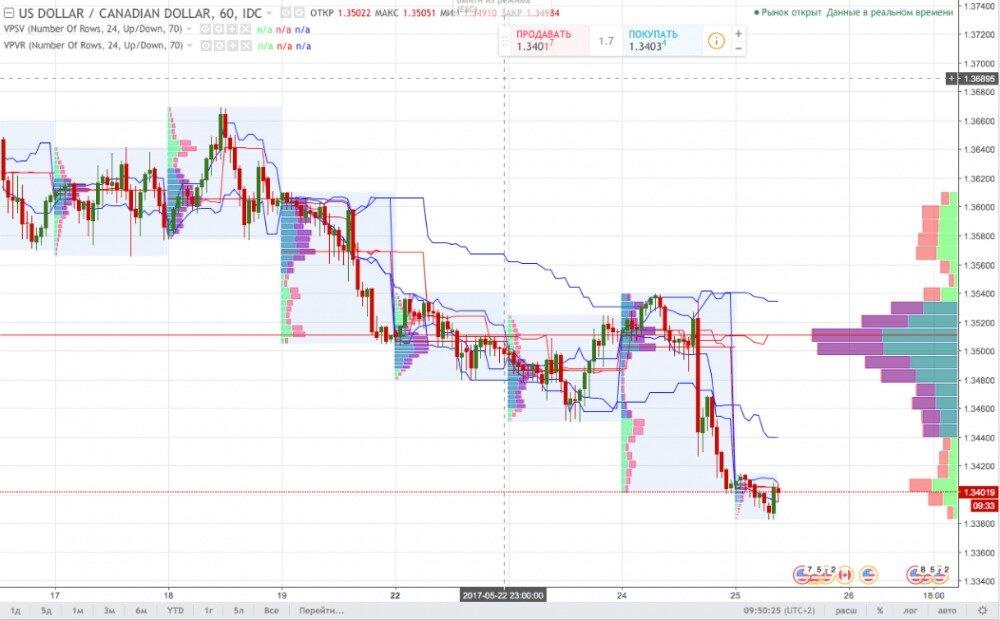
The figure shows USDCAD price chart and the trading volume on H1 timeframe (hourly chart). Here, market volumes are displayed within each trading session and as cumulative for the period.
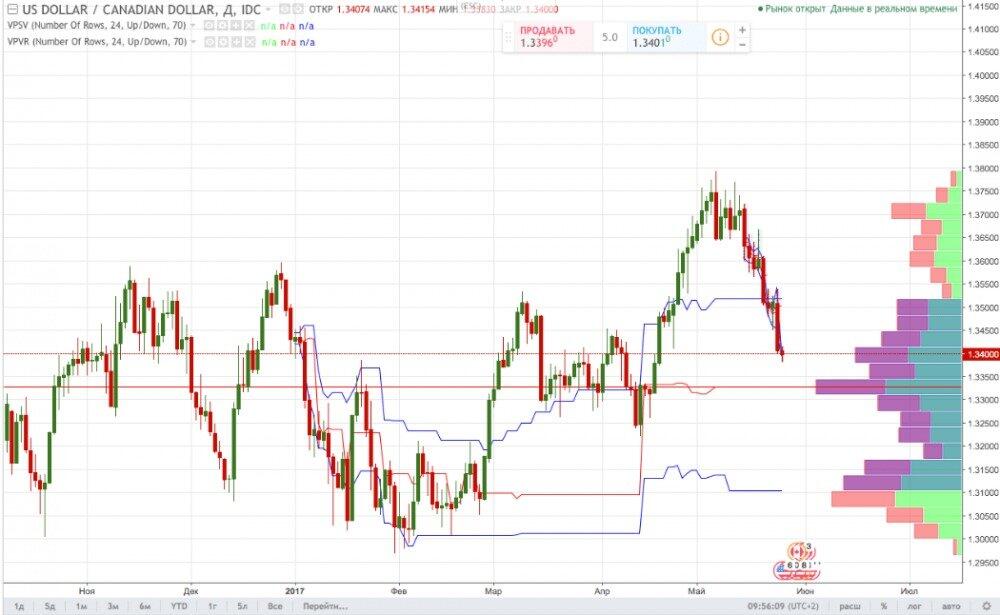
Similar data is also presented in the daily interval.
When comparing the trading volumes in the indicated time intervals, it can be concluded that at the present time the price, being in a downward trend, is approaching the level at which the increased interest of market participants in this currency pair was manifested. Accordingly, at this level, a large number of orders of both buyers and sellers are placed. The former will buy from the support level with a stop-order for sale below, the latter will sell in case of a breakdown of support with a stop-order to buy above. Both of them will use protective stop orders (the shorter the time interval, the closer they will be to the entry point to the position). It will not be very difficult to collect all the stop orders set in both directions, provided that they are located within the price band, which may be attractive for large participants in regard to the accumulation of positions. Here, triangles are formed, as well as other price and candle patterns. For a market maker, it is easier and more interesting to work in the flat, because in this case it needs to compensate only the difference between the volumes of purchase/sale and doesn’t have to go long distances to trigger stop orders set by traders to protect their positions.
There’s one way to earn with marketmakers— to make oneself think the way they do.
To do so, let’s look at the H1 USDCAD price chart again.
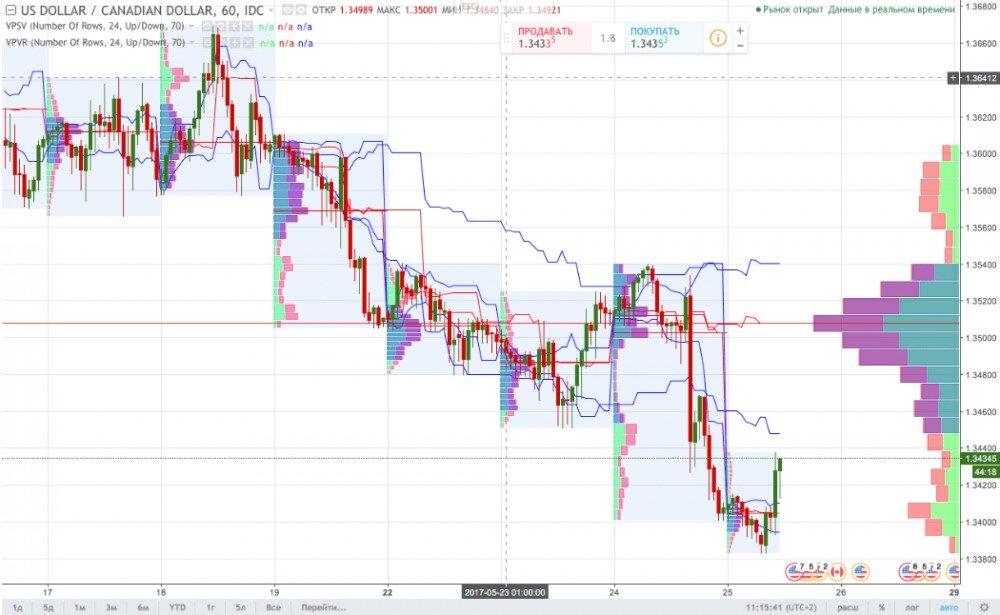
Suppose that the MM (market maker) sees the formation of the level of demand from buyers of the asset at 1.3400, followed by a price movement in the direction of resistance at 1.3500. An ideal situation is being formed - at these levels the struggle of speculators is most probable, and it will be possible to realize all of its goals. Do not forget that the MM, seeing a large amount of deferred demand, can act as a speculator. This is a win-win strategy, as at 1.3400 its open volume will be completely covered by deferred demand. In the event it can push the price through the specified resistance level, it may direct the movement in the direction of the trend using speculative volume.
Is it possible to trade together with a market maker? It is and you should, but you need to think like it. The basis for building a strategy is the volume schedule (you can use the tick volumes that your broker supplies as an element of analysis). Given this information, build your vision of the situation on the market as a market maker. Are there areas of increased interest of traders? How would you work it out?
And most importantly, you should never forget about the fact that the MM often stands on the opposite side, and its capabilities exceed the trader's capabilities in everything. In addition, you came to the market for its money, and it’s hardly a pleasant thing for it. But unlike a market maker, a trader can always exit both from a profitable and from a loss-making position, which MM cannot do.
Trading strategy based on liquidity providers’ preferences
It’s hard to imagine modern financial markets without market makers - companies which provide liquidity. If not for them, slow-moving trading would create a perfect environment for manipulations where prices would soar and collapse for no reason. Still, even market makers can’t save Forex from a risk of flash accidents, which the Japanese yen, the Swiss franc and other currencies have faced in the past 5 years. But such events occur rarely, thanks to liquidity providers.
Market makers’ profit comes from the difference between buying and selling prices. If there has been a long consolidation amid low trading volumes, market makers won’t be happy. On the contrary, when quotes update latest extremums, where stop orders or pending orders have been certainly placed, liquidity providers rub their hands.
TPSL1 and TPSL2 levels where most likely a big number of orders have been placed:
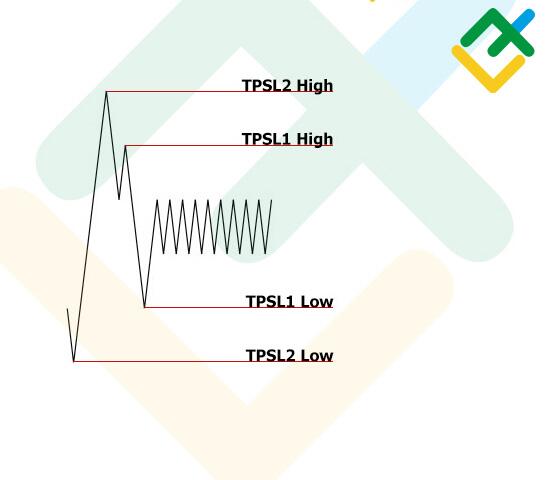
How can a regular trader make use of this information? First, pay attention to long periods of weak market activity. They usually manifest themselves through forming a narrow trading range and low trading volumes. Second, check the way trading volumes behave when leaving the trading range or when they are near TPSL1/TPSL2 extremums. The ideal version would be a sharp growth of volumes and wide spreads. They will suggest the most likely direction of prices in the short term.
GBP/USD quotes leaving the trading range:
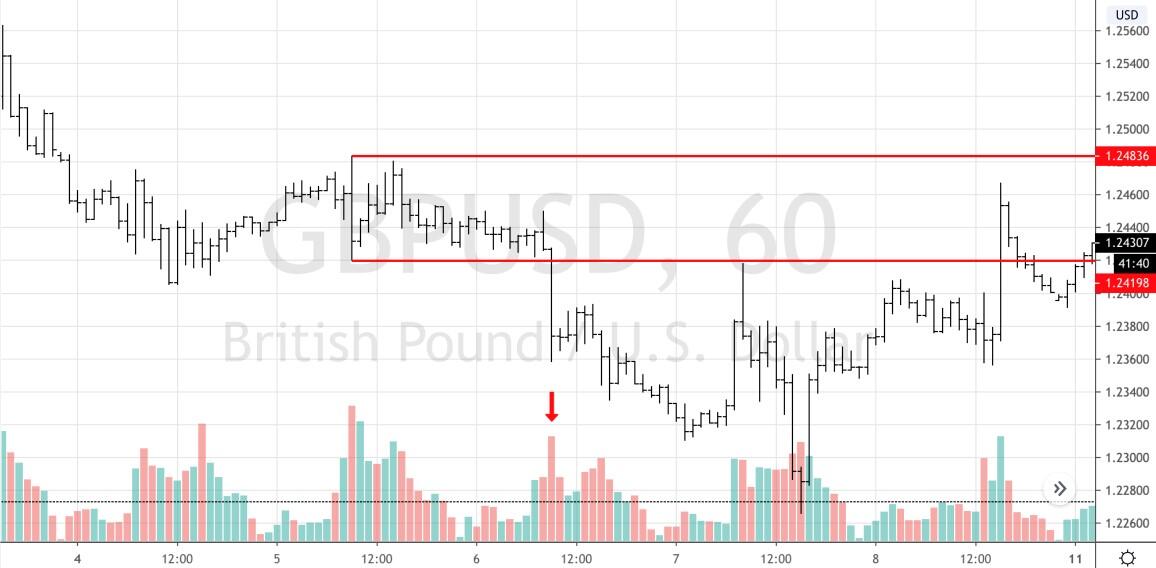
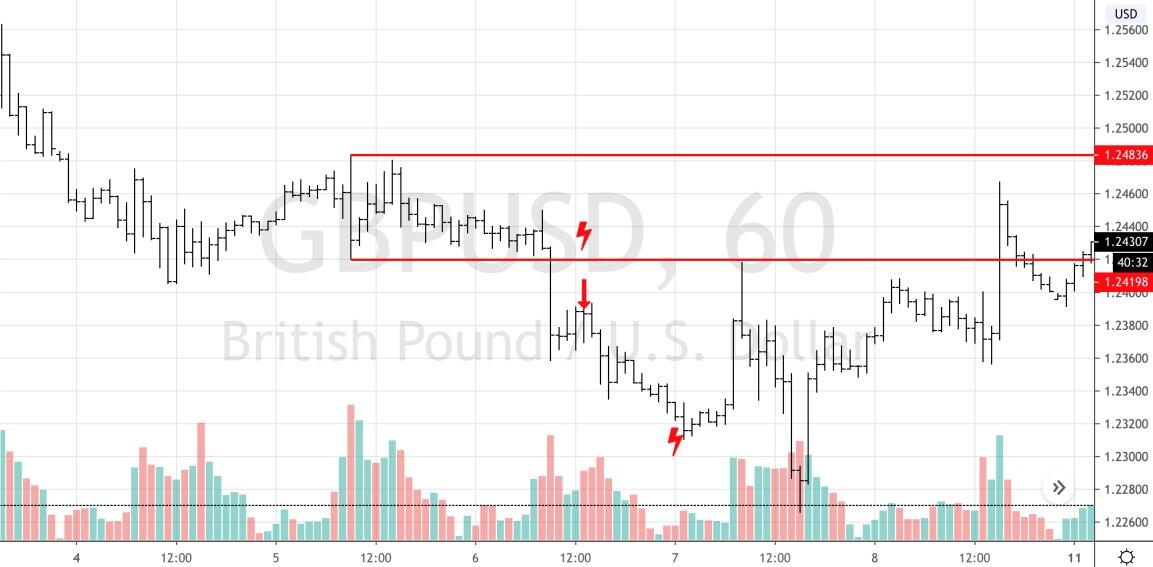
During the whole American and Asian session GBP/USD traded inactively. That didn’t satisfy the market maker for sure. Pushing the market towards selling, the liquidity provider made traders want to conduct trades. Knowing where the quotes would move to, we could sell the pound during the growth. In this strategy a protective stop order should be placed a bit above the lower limit of the previous consolidation range. In the ideal scenario, the price won’t get back to that range. It will mean the weakness of bulls. Bears shouldn’t go too enthusiastic and set fantastic targets because it’s a short-term speculation. Sixty or seventy points will be enough.
Work strategy based on market maker’s stimulation of trading activity
A similar situation may happen to other currencies too, including EUR/USD that is traded actively in the Forex market. If it trades in a narrow range amid low volumes most of the American and Asian session and then “explodes” suddenly, the breakout bar’s closure will point to a future direction of quotes. It happened on 5th May when EUR/USD grew to the lower limit of the previous consolidation range, which allowed going short. The same can happen now if bulls fail to return to the previous trading range that formed because of traders’ low activity.
EUR/USD quotes leaving trading ranges:
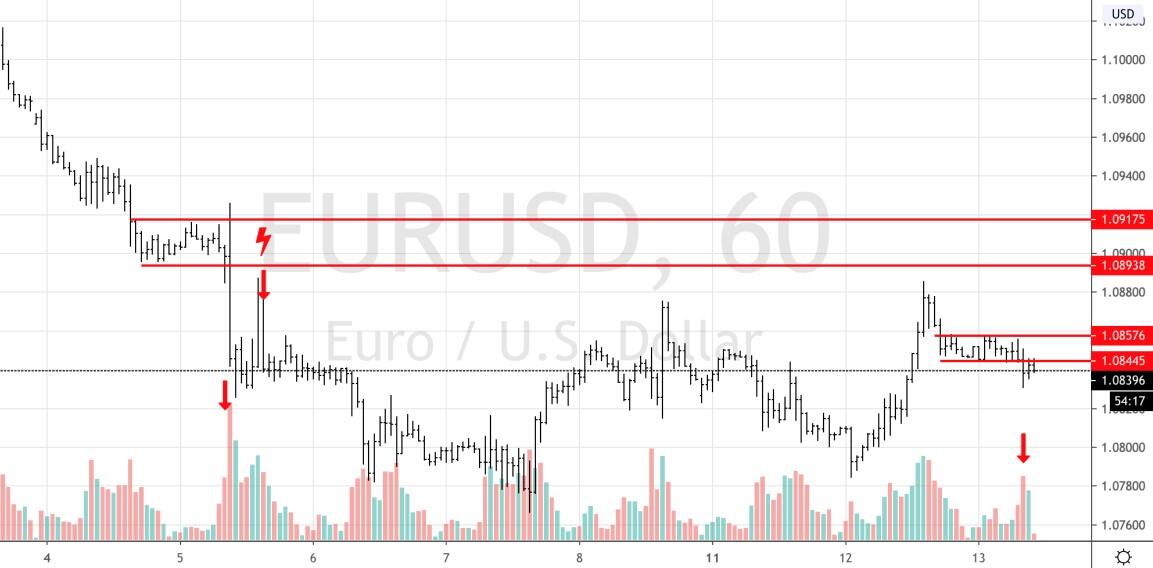
So, we can form our strategy knowing that market makers are interested in stimulating traders and remembering that trading volumes behave in a peculiar way when going outside consolidation ranges. Such a strategy will be based on understanding market processes, not on blind actions inspired by “tried-and-true” signals.
P.S. Did you like my article? Share it in social networks: it will be the best "thank you" :)
Useful links:
- I recommend trying to trade with a reliable broker here. The system allows you to trade by yourself or copy successful traders from all across the globe.
- Use my promo code BLOG to get a 50% deposit bonus on the LiteFinance platform. Simply enter this code in the appropriate field when funding your trading account.
- Telegram chat for traders: https://t.me/litefinancebrokerchat. We are sharing the signals and trading experience.
- Telegram channel with high-quality analytics, Forex reviews, training articles, and other useful things for traders https://t.me/litefinance

The content of this article reflects the author’s opinion and does not necessarily reflect the official position of LiteFinance broker. The material published on this page is provided for informational purposes only and should not be considered as the provision of investment advice for the purposes of Directive 2014/65/EU.
According to copyright law, this article is considered intellectual property, which includes a prohibition on copying and distributing it without consent.