Position trading is a strategy where traders open positions following the trend in the timeframes starting from D1 and longer. Working with long-term market moves, you will eliminate the influence of the price noise and local speculative manipulations of individual traders and institutional investors. Position trading strategies do not have the highest profitability. However, position traders do not have to monitor the chart all the time, and position trading strategies could be used as additional ones.
This article is an ultimate, comprehensive guide to position trading. Read on, and you will learn everything a position trader needs. I will also describe in detail some position trading strategies with real trading examples.
The article covers the following subjects:
What is position trading?
Forex position trading is a trading strategy where traders work in long-term timeframes and hold trades for a long time. Besides, position traders exit trades before weekends, holidays, or during a sharp drop in liquidity. Position trading is a long-term trading strategy, which is often compared with target investments or swing trading, as they have a lot in common.
A position trader is a trend follower; the trades are entered on local corrections and held as long as possible. Positions trading, like any trading strategy, has its peculiarities, pros and cons.
How to benefit from position trading?
According to one of the legends, positional trading became a full-fledged trading strategy during the tithe stock market time, when quotes were written on tablets. The existing communication means did not provide quick data updates, so short-term trading was impossible for technical reasons.
Position trading suggests benefiting from a strong long-term trend, eliminating price noise – short-term market swings. The holding time could be even longer than a year, although this is rather an exception.
The position trading strategy suggests you spot the beginning of a trending movement on the timeframe starting from 1 day (D1). A long-term trend often begins after a fundamental factor, for example, an important news publication. A trade is held until the next global trend reversal.
The periods when the day traders make profits are the period of uncertainty for position traders. If a swing trader or position trader makes several transactions in one day, a position trader enters a few trades in a month.
Positional trading is just one of the trading systems that have similarities with swing trading, long-term investing, and trending strategies. None of these trading systems have clear boundaries and rigid rules for a trader’s market behavior. The secret of success is flexibility and an effective combination of existing trading tools and strategies.
Primary features of position trading
- Trades are entered following the trend in the daily, weekly, or monthly timeframes. Local corrections are mostly ignored, as a position trader does not monitor the chart during the whole day. However, a combination of position and swing trading may increase the strategy performance.
- You must insure the trades with stop orders (in investments, for example, stops are not used). The stop-loss distance is usually long so that the position won’t be closed at the local correction. Therefore, one of the essential rules of position trading risk management is that the deposit size and the trade volume should allow you to withstand relatively deep corrections. You can insure the positions with a trailing stop.
- Position traders often use fundamental analysis. Traders could benefit from short positions during a crisis. Or position traders can spot the local bottoms, according to the wave theory, and bet on the global market recovery. Local fundamental events (economic data publications or news releases) affect the trend only in the short term; therefore, they are ignored.
- The holding time doesn’t have rigid limits. For one asset, based on the swap size and volatility level, it is enough to hold a position open for 3-5 days (until the weekend).
One of the differences between position trading and swing trading is as follows. In a long-term trend, swing-traders spot correction and pick up only a part of a global trend, while position traders hold the trades during the entire trending price movement.
A classic example of position trading is making money on the blue chips or the US stock indexes. The US stock indexes are steadily rising during the global economic expansion and a sharp drop during the crisis.
On average, a position trader earns 1000-2000 pips on a trend over two or three months. If we consider swap costs and risks (the need to compensate for losing trades) and the chance that it is not always possible to pick up a strong trend, the daily average profitability is not so high. However, there is no easy money anywhere.
Let us look again at the previous example. In 2019, on the US stock indexes bull trend, one could have earned more than 25% a year.
One could have also made an equal profit from their drop in early 2020. Is it much or little? It is up to you to decide.
In addition to swaps, another problem of a position trader is the necessity to strictly follow the risk management rules, which read:
- The total position volume is not more than 5% of the deposit.
- The total risk for all positions should not exceed 15% of the deposit.
- The recommended distance for a stop loss is 100-200 pips, which corresponds to the average volatility for one-three days. A shorter stop loss distance can result in the frequent closing of positions by a stop loss.
For day trading, 15-20 pips are enough for a stop loss. If the minimum trade volume is 0.01 lots, where the pip price of the pairs of */USD is 0.1 USD, the risk taken into account should be $10-$20, not $1.5-$2.0. Therefore, the required minimum deposit size increases.
Some sources recommend using the leverage of no more than 1:10 or 1:20. Let me remind you that leverage, if used correctly, does not increase risks but only allows you to increase the transaction volume. The volume of the transaction, in turn, affects the value of the pip. $ 1000 with 1: 1 leverage or $ 10 with 1: 1000 leverage does not matter.
One thing is essential: the transaction volume affects the pip value, and it must be such to comply with the risk management rules. Leverage is necessary here.
Example. I top up my deposit with $135, willing to open a EURUSD position at the exchange rate of 1.0900.
The minimum lot is 0.01, and the pip value is $ 0.1. With a stop-loss of 200 pips, I risk losing 200 * 0.1 = $ 20, which is 14.8%. The condition for the total risk of positions opened is met.
To open a 0.01 lot position, I need $1090. That is, even with a 1:10 leverage (135 * 10 = 1350), the 5% condition will not be met. I use a 1:200 leverage. The broker freezes the funds in the amount of 1090/200 = 5.45 US dollars, accounting for 4.03% of the deposit. The condition is fulfilled.
Do not be afraid of leverage! Leverage is one of the primary tools for a position trader using long stop-losses.
Assets and tools for position trading
The best assets for long-term position trading in weekly and monthly timeframes are the assets of the stock and commodity markets. Currency pairs can also move in a long-term trend but in shorter daily intervals. Currency exchange rates are the scales on which the economies of countries are. And depending on their economic development, the scales tilt in one direction or another, forming a short-term trend and, in the long-term, a consolidation range.
The short-term in this case is relative since we are talking about long intervals. That is, a weekly trend in the context of a 2-year chart can be called short-term.
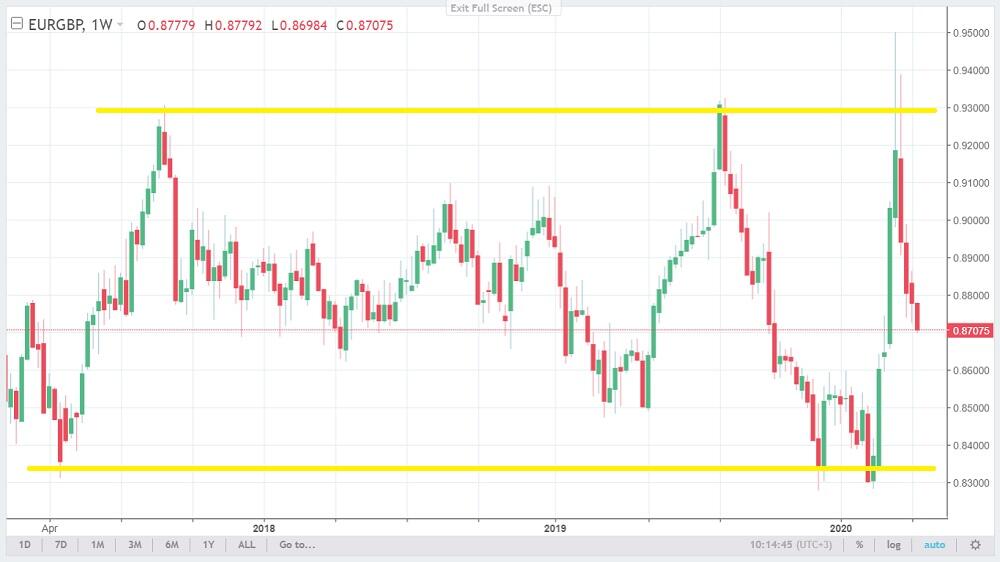
For example, there is a clear range in the EURGBP price chart. Nonetheless, trading within this corridor could also be seen as position trading, as each price movement within the range lasts for more than a month. It could be seen as a trend-following strategy in a shorter timeframe.
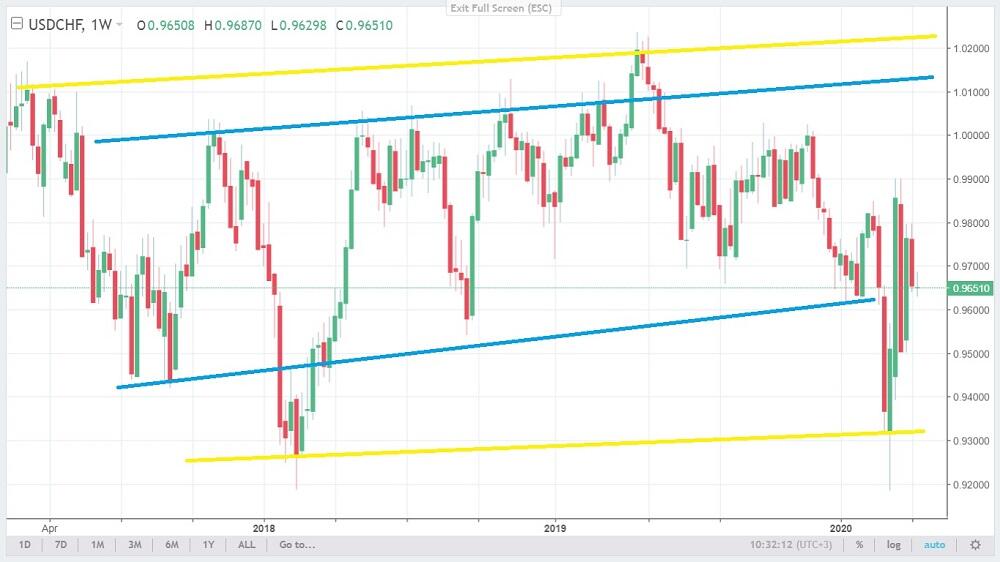
The same situation is in the USDCHF. In the weekly timeframe, there is also a trading corridor with strong trend movements within the corridor.
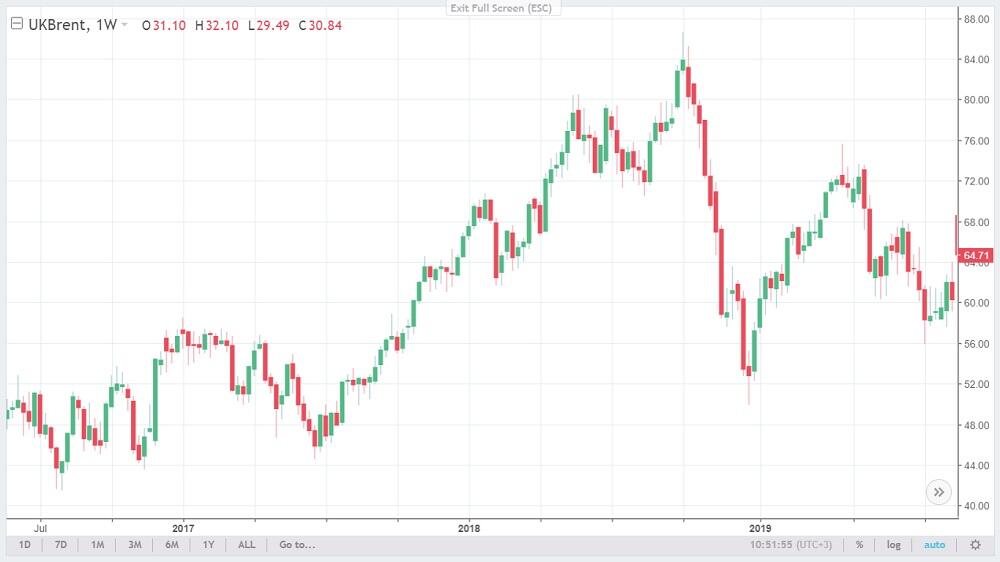
There is also a long-term uptrend in the weekly timeframe of the oil price chart, followed by a downtrend. The same situation is in the stock market chart.
These examples show that position trading could refer to a channel and trend strategy combined with swing tradings. The matter is that in the context of what time frame it is considered. For each trading asset, you need to select a different timeframe depending on the strategy.
Technical analysis tools for position trading
Moving averages. The classical indicator to confirm the trend. In daily charts, for example, one could use two EMAs.
Trend candlestick patterns. In position trading, not only reversal patterns but also psychologically-based trend patterns perform well. In long intervals, the trend is determined by large capitals, which do not aim at profiting from speculations but also like round levels. If there are three consecutive candlesticks in the same direction, marking the first three weeks of the month, the last, fourth, candlestick should also close in the same direction.
Levels. The rules for constructing levels for several timeframes are a topic for a separate article. In speculative short-term trading, large investors manipulate using levels, and price noise violates the regularities. However, in positional trading, price channels and levels are a separate strategic instrument.
- Set a separate period for each pair and interval. I prefer to use MAs with short periods of 15-20 in the daily timeframes.
Oscillators are hardly ever used in position trading, though you could identify the trend start using oscillators.
Example of position trading strategy
Since early 2019, oil had been trading in a relatively narrow price range. Oil hardly reached $74 and, following a short inertial drawdown to $58, returned to the range of $60-$70.
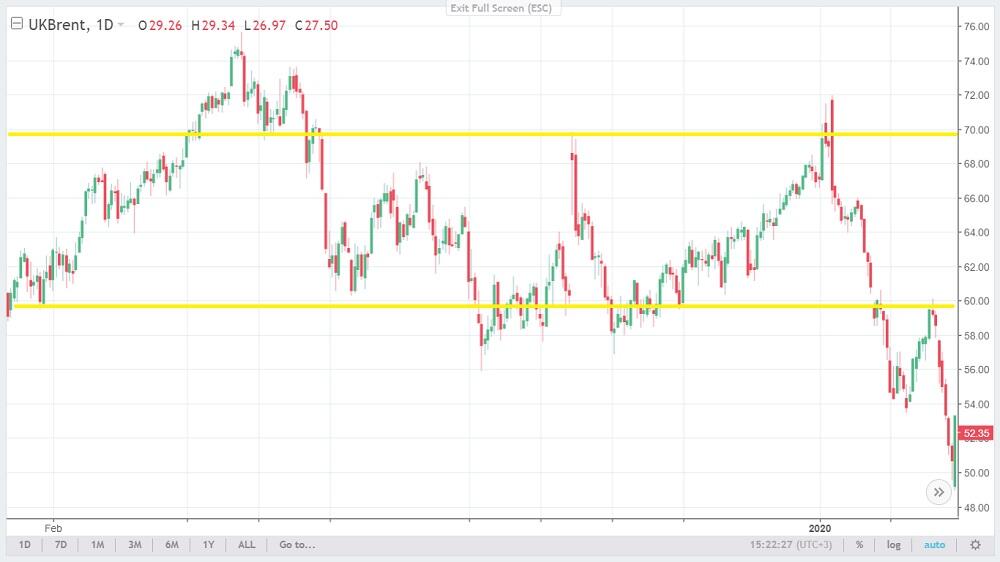
As I have already mentioned, an ideal start for a position trader is a strong fundamental factor. There has been enough fundamental news in the oil market over the past fifteen years. I am focusing on the first few months of 2020.
In January, the price reached the strong resistance level, to which it had been going since 2019. For a position trader, whose trading is based on strong levels, it is a signal of a soon reversal and a new trend, unless there are other fundamental factors supporting further growth.
The following events occur in January 2020:
- There are severe wildfires and the first signs of a coronavirus epidemic in the Chinese Wuhan. The OPEC published the report, showing that the global oil demand will decline by 200,000 barrels per day (down to 1 million).
- There is a geopolitical conflict between the United States and Iran/Iraq, followed by an attack on military columns and disruption of nuclear agreements.
- There is a lack of progress in resolving long-standing trade disputes between the United States and China.
The price growth is unlikely to continue, as there is a sell signal, appeared at the moment of the price reversal and the reverse breakout of the resistance level (green dot). The target level is the resistance level (blue dot).
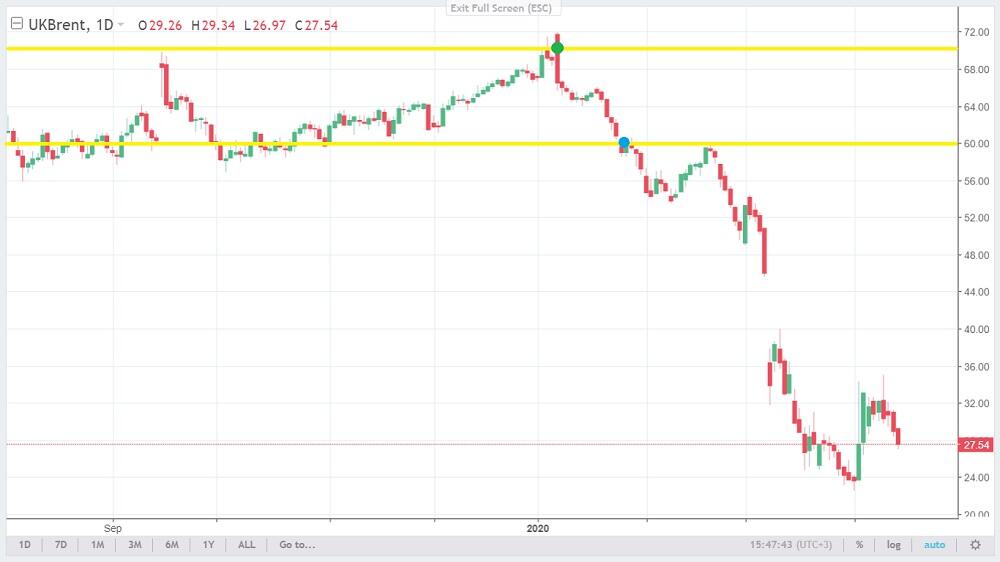
After the price reaches the support level in late December, I again have a question if the downtrend will continue or the price will reverse up. I look at fundamental factors:
- The panic continues, the epidemic turns into a pandemic, spreading all over the world.
- Disruption of transport and economic links, reduction in production, and lockdowns (decline in consumption) resulted in the surplus in the oil supply in the global market, which would not support the price growth.
There is no reason to close the position. Next, the news that the OPEC agreement failed sends the price down even deeper. After the oil price breaks out level $30, I can exit the trade for a few reasons:
- It is evident that cheap oil is unprofitable for oil-producing countries, so sooner or later, it would be necessary to return to the OPEC agreements.
- The last time the price was so low was in 2016, and it is hardly worth waiting for oil at 20 USD.
- The pandemic will soon decline, and it is better to exit the trade, catching the beginning of the opposite trend in June-July after the world returns to normal life.
Now you see how such a simple position trading strategy, based on strong levels and fundamental analysis, could yield more than a 100% profit over three months.
The risks of a positional trader working on fundamental analysis can be judged by another asset - XAU, which is traditionally considered a safe-haven. In theory, the March 2020 crisis should have led to the money inflow from stock markets and oil into gold and gold assets.
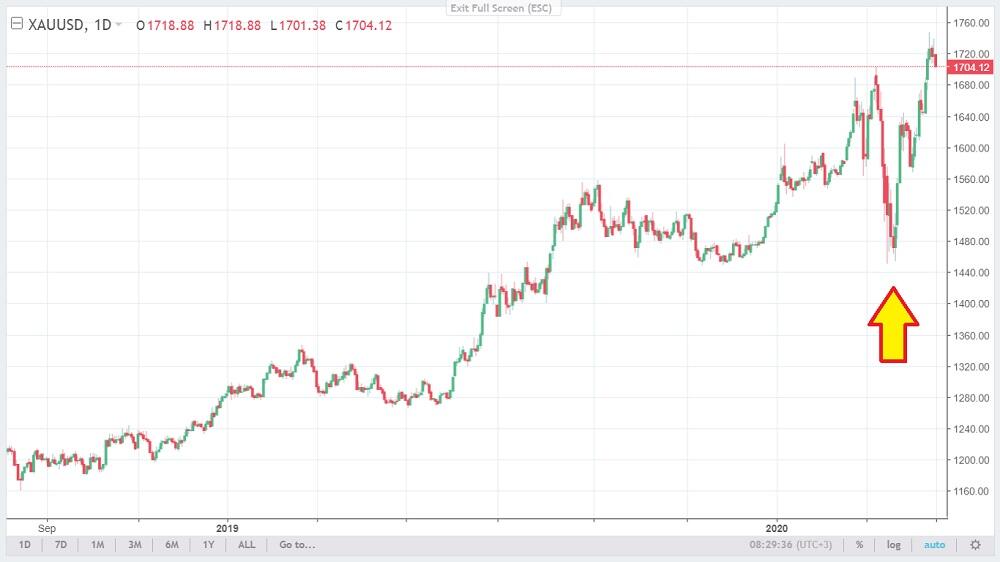
Gold was growing steadily over the past year, peaking by early 2020 thanks to the U.S.-China trade war. But in March, after the drop in oil prices and the collapse of the OPEC deal, gold went down following the rest of the assets, thereby violating the investment theory.
Although the gold price recovered later, amid the panic, many long positions were closed by stop losses. This example shows that trading based on fundamental analysis in the long-term trend is also not always accurately predictable; therefore, one must put protective orders.
Amid the crisis in spring 2020, uranium rose in price to 4-year highs. Analysts explained that, with stable demand, some of the industry's largest producers had cut mining and production.
In conclusion, I would like to add that both pros and cons of long-term forex trading strategies, as well as five strategies based on patterns and indicators (a combination of position and swing trading), are covered in this article. There you will find indicator settings, detailed conditions of entering and exiting conditions, with the risk optimization and templates of unique trading tools for the MT4.
Summary
Position trading could be attractive in several cases:
- If you want to profit from fundamental factors of global scale and are prepared to hold the position open from a few days/weeks to a few months.
- If you have a deposit big enough to withstand considerable drawdowns and cover swap.
- If you apply short-term, intraday trading strategies and position trading for you is an additional trading strategy to diversify the risks.
Did you like the article? What else would you like to read about trading strategies and trading tools? I am looking forward to your comments!
P.S. Did you like my article? Share it in social networks: it will be the best "thank you" :)
Useful links:
- I recommend trying to trade with a reliable broker here. The system allows you to trade by yourself or copy successful traders from all across the globe.
- Use my promo code BLOG to get a 50% deposit bonus on the LiteFinance platform. Simply enter this code in the appropriate field when funding your trading account.
- Telegram chat for traders: https://t.me/litefinancebrokerchat. We are sharing the signals and trading experience.
- Telegram channel with high-quality analytics, Forex reviews, training articles, and other useful things for traders https://t.me/litefinance
Price chart of EURUSD in real time mode

The content of this article reflects the author’s opinion and does not necessarily reflect the official position of LiteFinance broker. The material published on this page is provided for informational purposes only and should not be considered as the provision of investment advice for the purposes of Directive 2014/65/EU.
According to copyright law, this article is considered intellectual property, which includes a prohibition on copying and distributing it without consent.