This article will explain in detail all aspects of quantitative analysis and quantitative trading. You will also get acquainted with the terms, and consider historical data. Read on and you will learn how quantitative trading works, what software is used and what quant trading strategies are most profitable.
The article covers the following subjects:
- What is Quantitative Trading?
- Major Takeaways
- Why should we use Quantity Trading?
- When Quantitative Trading is Needed?
- Market conditions necessary to apply quant strategies
- How does it work?
- Difference between quantitative and traditional trading
- Examples of using quantitative trading
- Quantitative trading systems
- Pros and cons of quant trading
- Quantitative trading strategies
- Conclusion
- Quantitative trading strategies FAQs
What is Quantitative Trading?
Quantitative trading (also called quant trading) involves the use of computer algorithms and software. Quant trading is widely used at individual and institutional levels for high frequency, algorithmic, arbitrage, and automated trading.
The quantitative trader’s job is to determine the direction of the trend and possible reversal points. It does not matter what tools, strategies or type of analysis are used for this, as long as it does the trick. You only need to find reversal points, determine the strength of the trend and enter the market at its beginning.
A quant trader, unlike ordinary traders, hardly participates in the trading process. Quant trading involves activities related to Data Science and programming. Simply put, a quantitative trader should determine the statistical patterns and price movement patterns of a trading instrument. This data will then be used in writing software for automated trading.
An example of a quant strategy is weather forecasts. Meteorologists, in their work, are guided by quantitative data on atmospheric pressure, temperature, and wind speed. Given the laws of weather change, a meteorologist can make a relatively accurate forecast based on this information. A quant trader works the same way.
Major Takeaways
- Quantitative trading relies on automated algorithms and data analysis.
- High-frequency trading includes numerous strategies.
- Quantitative analysis minimizes calculation errors.
- Quantitative trading allows effective asset diversification.
- Quantitative strategies work best in highly liquid markets.
History of quant trading
In 1973, Fischer Black and Myron Scholes first published the option pricing model formula. The key point in determining the option value was the expected volatility, which can be calculated mathematically. The formula includes the cumulative distribution function of the standard normal distribution, the risk-free interest rate (we see something similar in the Sharpe ratio), spot and strike prices, and volatility.
In 1997, the Black-Scholes model won the Nobel Prize in economics, radically changing the approach to developing trading strategies. The yield of 75-80% of transactions based on mathematical analysis proved the profitability of this technique and quantitative equity trading was adopted by market makers and investment banks.
Why should we use Quantity Trading?
The trader community considers quantitative stock trading to be the next evolution in market analysis. The technique has many advantages:
Scalability.
Traders usually use no more than 5-7 analytical tools simultaneously, including the simplest ones, such as trend following or moving average crossovers. High-frequency trading can hypothetically include an unlimited number of strategies and inputs, from classical mathematical methods of analysis to the study of behavioral biases. The only limitation is computing power. But even retail investors have access to quantitative analysis using dozens of analytical tools.
Unlimited opportunities for diversification.
Quantitative analysis is suitable for any market. In exchange trading, the optimal allocation of capital is the most important aspect of risk reduction.
Minimum error.
Statistical arbitrage involves the use of highly accurate data. To recognize an algorithmic pattern and build a prediction based on it, a computer operates with hundreds of different parameters with an accuracy of up to ten thousandths, and sometimes even higher. Due to this, it is possible to reduce the calculation errors to a minimum.
Decision-making speed.
High-performance computing enables fast trading decisions. This is especially important when trading in the shortest timeframes.
When Quantitative Trading is Needed?
With the growing popularity of exchange trading, the efficiency of the classic "manual" market analysis is steadily declining. Therefore, many hedge funds have long since moved from classical trading to quantitative trading.
When is quantitative trading necessary? Firstly, when a trader wants to diversify his/her asset portfolio as much as possible. In traditional trading, you can track, analyze and trade a maximum of several dozen instruments. If you apply quantitative trading, finance can be invested in hundreds of assets. Also, the automated execution mechanism allows you to simultaneously operate multiple trading strategies.
Another example is testing trading strategies and methods. With a quantitative approach, it takes far less time to test an existing strategy or develop a new trading system; extensive statistics on the effectiveness of the tested methods are also collected.
Market conditions necessary to apply quant strategies
Quantitative analysis tools are based on the simple principle of “ the more, the better.” I mean the depth of historical data, the number of available quantitative trading algorithms and analysis methods, scenarios for future price movements, and the transaction executing mechanisms. The more elements included in a quantitative trading system, the higher the accuracy of the forecasts.
Besides, in quantitative trading, it is necessary to run algorithms on different trading instruments, otherwise, it will not be possible to achieve the target profit. When choosing assets, it is worth checking their correlation coefficient with each other. For some strategies, the correlation should be as close to zero as possible, while others, on the contrary, are designed to work in conditions of a clear correlation.
Quantitative analysis methods are not yet perfect enough to be applied to all types of markets and assets. Quantitative strategies work best on highly liquid instruments. Quantitative analysis can yield quite a profit in balanced markets with high competition. For example, in quant trading stocks, the profitability is almost always higher than when trading using traditional strategies. However, quant trading Forex is used less frequently.
Another promising area is high-risk markets, such as cryptocurrencies. Quant Trader tools, once configured, provide optimal capital allocation. They better control maximum drawdowns and calculate risks compared to traders.
The efficiency of quantitative algorithmic trading does not always depend on the number of profitable trades. Quant funds demonstrate high investment returns with a total number of profitable trades of just over 50%.
How does it work?
Quantitative trading is based on mathematical analysis; projection models are created and used as part of a quant trading strategy. Programming knowledge is required to develop, test, and configure the software. C++, C#, MATLAB, R, and Python languages are used to write quantitative algorithms. The most advanced algorithms are built on the basis of self-learning neural networks, the capabilities of which are beyond the scope of standard algorithms.
Almost all quantitative trading methods work on the same principle:
- A particular time interval is selected;
- A data set is selected (for example, open/close price, drawdowns, high/lows, and so on);
- Depending on the data obtained, algorithmic methods of market research are selected;
- The selected time period is analyzed according to the chosen criteria;
- Based on the analysis, trading decisions are made.
Let's have a look at a simple example. Supposing the price of a share at the opening of trading was $5. At 12.00, it rose to $5.82, at 18.00 to $6.52, and after the close of intraday positions, the price fell to $4.62. At the pivot points, the MACD indicator showed overbought and oversold conditions. Therefore, the simplest mathematical model can include the following data:
- Current time;
- Current bid-ask prices;
- Opening price;
- High/low price;
- Current price direction;
- MACD readings.
With such a small set of data, a trader can achieve quite good trading results using traditional strategies. But imagine that instead of seven parameters, 30 or 50 parameters will be taken into account. Such an analysis is beyond human capabilities, especially if you need to make trading decisions quickly.
High-frequency trading allows you to analyze dozens or hundreds of parameters in a fraction of a second. It automatically finds patterns, selects effective methods of analysis, and builds probabilistic forecasts based on them. That is, a quantitative trader does not delve into separate market indicators but immediately deals with a ready-made mathematical model, which already takes into account market entry points, stops, price movement areas, sideways trends, spreads, the possibility of minimizing transactions, etc.
However, the configuring of algorithms cannot be shifted to the machine. Quantitative traders try to understand the forecasts built using algorithms; they conduct thorough strategy testing for each market, refine the software, collect statistics, and also identify systematic errors, trying to reduce trading and operating costs. Only when the trading system is configured and optimized can transactions be carried out without the trader’s participation.
Difference between quantitative and traditional trading
You may have a question about the difference between quantitative trading and algorithmic trading. Indeed, both quant and algo traders are engaged in the same activity. Quantitative trading involves building mathematical models for market analysis, searching for trading instruments, and identifying strategies. An algorithmic trader sets up an algorithm that will make the optimal allocation of capital and maximize profits without human participation.
Here are the diffrences between algorithmic and quant trading:
- Quantitative trading is a departure from fundamental and technical analysis in the traditional sense. Algorithmic traders use technical analysis when creating trading strategies.
- Algorithmic trading involves opening positions under certain conditions; the trades are managed by the trading bot. A quantitative trader creates a model that evaluates trading opportunities more flexibly and is only indirectly tied to the conditions for opening positions that are featured by classical algorithms.
- Quantitative trading uses more assets and market information. With this approach, you can get the maximum of available data that will be useful in the search for price patterns.
At the same time, algorithmic and quantitative trading approaches can easily work together. A good example of such a combination is arbitrage trading.
Arbitrage trading uses the vulnerability of a decentralized market system, so you can profit from the difference in the price of the same asset on different trading platforms. This is a type of high frequency trading where you need to monitor dozens of exchanges and make decisions quickly. Such trading goes beyond the limits of human capabilities and is implemented only with the help of an algorithmic approach. Quantitative forecasting methods are useful in identifying patterns in the movements on each of the trading platforms. This allows you to be one step ahead of most arbitrage traders.
Examples of using quantitative trading
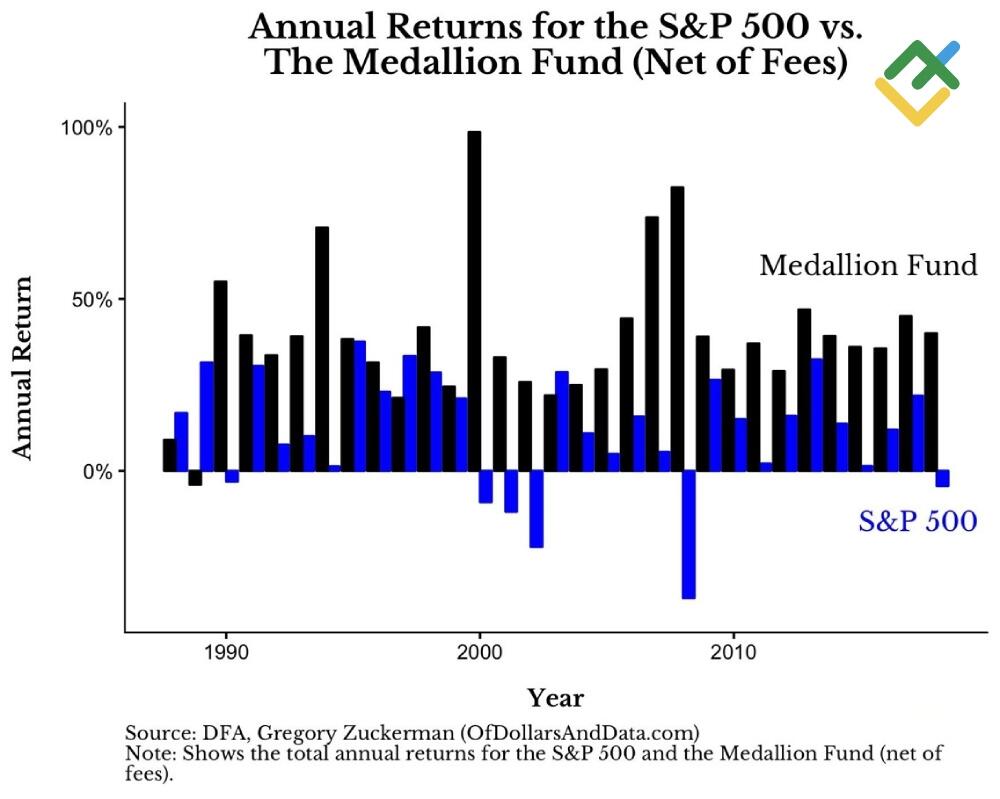
Medallion Fund is one of the oldest funds using quantitative trading strategies. It was founded by the famous American mathematician and investor James “Jim“ Harris Simons, known as the "Quant King." During its existence, the fund has shown negative returns only once. At the same time, the average annual profitability of Medallion outstrips even the hedge funds of George Soros, Peter Lynch, Warren Buffett and other famous investors.
No one knows what quantitative trading system is used in Medallion, but some information is still there. Every day, the fund's algorithms open hundreds of thousands of trades. Most strategies are market-neutral, that is, they work both when the market rises and when it falls. The average ratio of profitable strategies, contrary to expectations, barely exceeds 50%. Experts call Medallion "the blackest box" in the field of money management, as no one has been able to unravel the secrets of James Simons.
Comparison of profitability of Medallion and S&P 500
Also examples of successful quantitative trading are:
- Two Sigma Investments. The fund was founded in 2001. Trading strategies are based on technological methods, such as artificial intelligence, machine learning (similar to neural networks), distributed computing.
- D.E. Shaw & Co. The fund was founded in 1988. The company is known for developing sophisticated modeling systems and programs to track market anomalies.
Quantitative trading systems
A quantitative trading strategy is a complete system for identifying and implementing trading opportunities. Conventionally, it can be divided into four subsystems:
- Strategy identification – searching for a trading system, analyzing the features of trading operations.
- Strategy Backtesting – testing the algorithm on historical data, profitability analysis and elimination of system errors to lower the risk of losing money.
- Execution system – synchronization of the algorithm with trading software and a brokerage account.
- Risk Management – capital allocation, accounting for minimising transaction costs, bets, risks, etc.
Strategy Identification
It all starts with market research and searching for trading methods. Quantitative trading strategies can be divided into two types:
- The trend strategy takes into account the psychology of market participants and the factors influencing the price movement. It involves opening positions in the trend direction.
- Reverse strategy works on the principle that the price tends to its average value.
Important parameters of quant strategies are the trades holding time and their frequency. In high-frequency strategies, transactions are carried out intraday. With low frequency, traders can hold positions open for two days or longer. Also, when identifying quantitative trading strategies, dozens of other parameters are taken into account, which traders try not to share.
Strategy Backtesting
Backtesting is a test of the strategy performance. It involves using special backtest software for strategy testing based on a data sample for a particular period.
Quantitative strategy testing involves:
- Optimization factor – the profitability of the trading system is checked for the selected period of time;
- Survival factor – testing is perfomed for a historical period of 10 years or more to check the maximum drawdown of capital and drawdowns over time.
However, high backtested performance does not guarantee high profitability in the future. Low returns and a high risk of losing money can be caused by optimisation bias, low accuracy of historical data, various systematic errors, and transaction costs.
Execution Systems
To make an algo quant system with minimum or no participation of a trader, an order execution system is needed. This is a trading algorithm that turns the algorithmic patterns and signals generated by the strategy into market orders.
The execution system can be manual, semi-automatic or fully automated. The first two types are typical for low-frequency trading systems. With high-frequency trading, a quantitative trader cannot control the execution of all orders. Therefore, such strategies include an automated mechanism.
Risk Management
The trading risks could prevent a trading algorithm from working correctly. These are errors of the strategy itself that were not taken into account during backtesting, for example, false definitions of a main reversal or other signals. There are technical risks associated with the continuous operation of the broker’s own equipment and servers, and cognitive risks that affect the perception of the trader, etc.
Do not forget about money management. It is necessary to provide for everything, from capital distribution and allowable maximum drawdowns to minimizing transaction costs.
Pros and cons of quant trading
Like other analytical methods, quantitative trading has its advantages and drawbacks:
Advantages | Disadvantages |
Great opportunities for diversification of assets and risks. | Traditional data does not always work, and the possibility of obtaining insider information, for example, about the activity of companies, is limited for individual traders. Even large funds cannot get all the data, many transactions are closed with a loss. |
Optimal capital allocation | Specific knowledge is required. Complexity. Quantitative methods require deep knowledge of mathematical analysis and programming. |
The scale of quantitative analysis is limited only by computing power. | High requirements for computing power. Quant traders work with Big Data and cloud computing. Cvc files and labels are a thing of the past. |
You can automate all processes, up to entering and exiting trades. |
|
Quantitative trading strategies
Let me describe some basic strategies of quant trading. Quantitative traders define six common trading strategies:
- Mean reversion;
- Trend following;
- Statistical arbitrage
- Algorithmic pattern recognition;
- Behavioural bias recognition;
- ETF rule trading;
Mean reversion
Mean reversion is one of the first quantitative trading strategies. The main idea is that the price often returns to its average values (in the simplest version, they are calculated using a moving average), which is what the quant trading strategy is based on.
Entry conditions:
- The price deviates from the moving average;
- The market reverses towards the MA (confirmed by the MACD indicator);
- The position is opened in the MA direction and is closed when the price reaches the moving average.
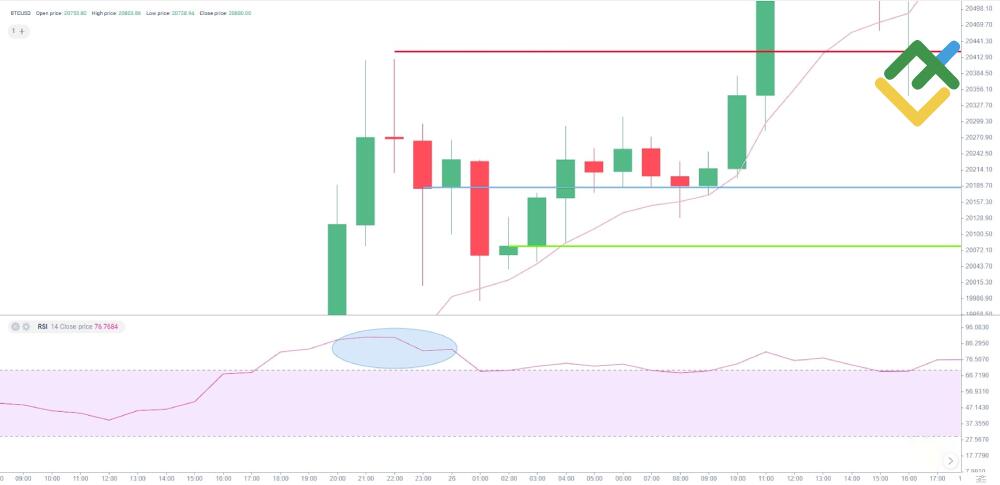
The blue line in the above chart marks the short entry when the big red candle closes. The entry point is confirmed with the overbought state indicated by the RSI indicator. The red line marks the stop loss that is set at the local high, the green line marks the take profit at the pivot point close to the EMA.
Trend following
It is another common strategy that every quantitative trader has used. The strategy aims at making money in a rising or falling market. The method is based on the principle of Dow theory. If there is a trend in the market, it will continue in the future.
The position is opened after the nearest support or resistance level is broken out. These levels are usually local highs or lows. Exit condition is the appearance of two candlesticks with medium bodies that are moving in the opposite direction or one candlestick with large body.

The purple line in above chart marks the local support level. The trade is entered when the support is broken out and the signal candlestick closes; the entry level is marked with the blue line. The quant trade is exited when the big bullish candlestick closes.
Statistical arbitrage
Quantitative trading through statistical arbitrage involves making a profit by buying one instrument and selling another that correlates with the first one.
This quantitative strategy involves measuring the trading spread between assets. As soon as it becomes wider than the average, opposite positions are opened. A long position is opened for an asset with a lower price, at the same time a sell trade is entered with the same instrument. Positions are closed when the spread narrows to the average.
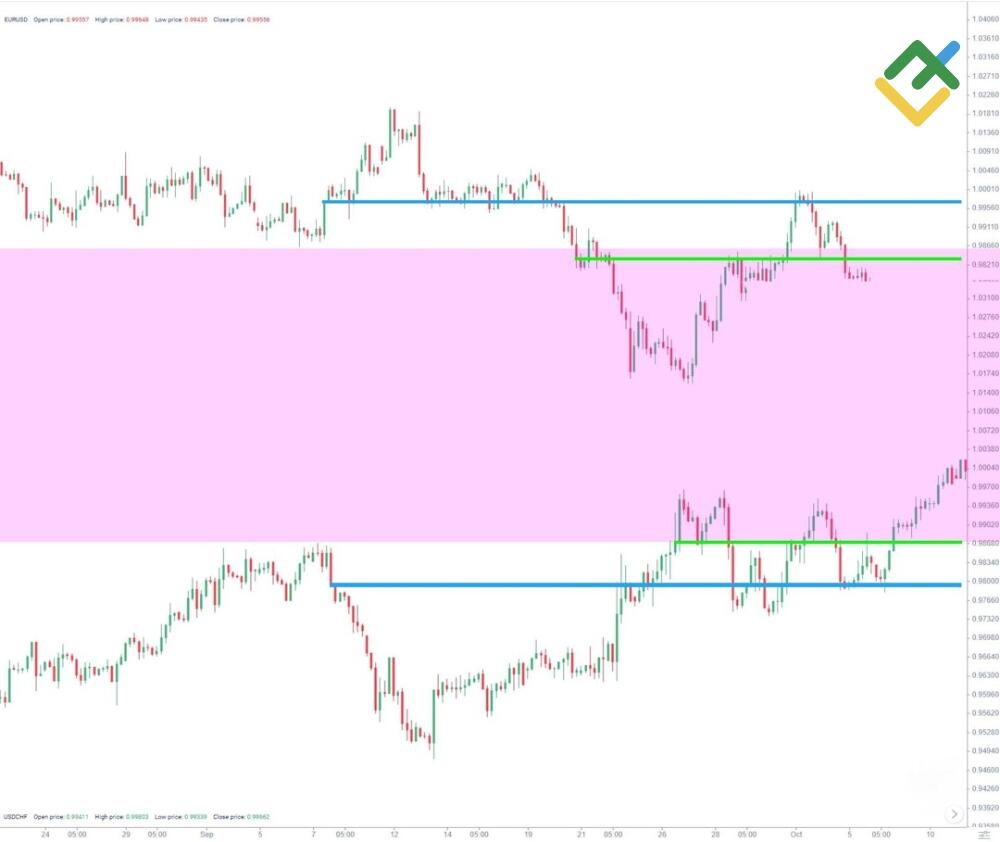
Let us consider the example of correlated currency pairs EURUSD and USDCHF. When the spread deviates from the average value, open two opposite positions (marked with blue lines). Green lines are the moments of profit taking under the terms of the trading strategy, that is, when the spread value returns to its average (purple area in the chart).
Algorithmic pattern recognition
Quantitative traders use candlestick patterns, and their search is easy to automate. I mean classic formations, like shooting star, bear/bullish engulfing, hammer, etc. A quantitative strategy involves looking for such patterns and opening positions immediately after the price reverses. Profit is taken using a trailing stop at key levels or according to any other signals.
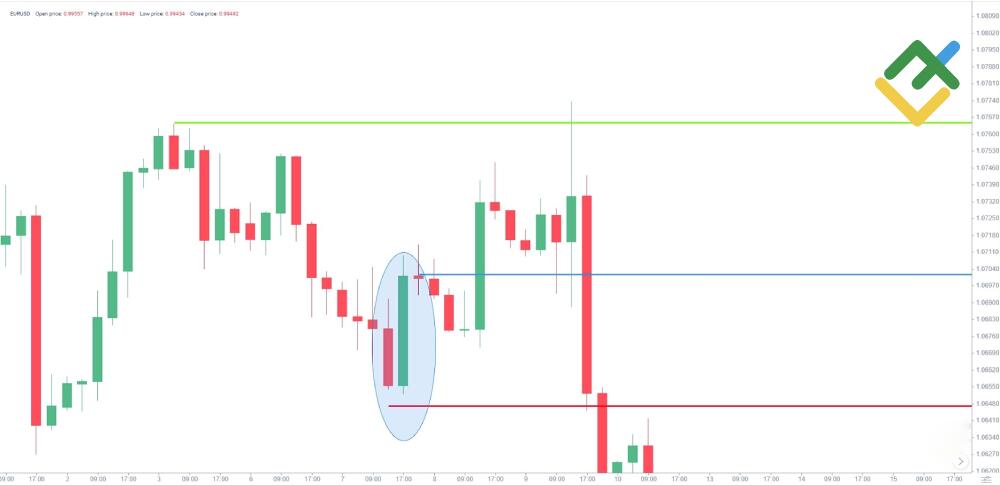
Blue circle in the chart highlight a bullish engulfing pattern. A big green candlestick covers the previous red candlestick. When the formation appears, the algorithm opens the position once the pattern completes (blue line). Stop losses are set at the pattern low and the take profit is set at the resistance level (green line).
Behavioural bias recognition
Quantitative trading using this strategy involves the search for behavioral patterns that are typical for traders:
- Status Quo bias is a behavioural pattern similar to a survivorship bias that makes a person maintain the current or previous situation or state (for example, one may not exit the trade although the price doesn’t go in the needed direction).
- Herd behaviour is the decision to follow the behaviour of others (to buy when other traders are buying).
- Overconfidence means exaggeration of the ability to achieve goals (hoping for profit despite high risks).
- Halo effect is the common bias, meaning the tendency to have positive impression about the prospects of an available trading instrument amid insufficient information (for example, the decision to buy based on positive news).
- Retrospective bias, similar to a look-ahead bias, is an erroneous judgement that an event in the recent past was predictable. For example, after an unsuccessful purchase of a stock, an investor believes that he/she intuitively knew about the subsequent fall in the price.

The blue circle in the chart marks the market oversold condition because of the bitcoin sharp drop. Herd behaviour and overconfidence encourage many traders to continue selling. This factor is taken into account by the quantitative algorithm. A short position is opened on the next candlestick, and when the market exits the oversold zone, the position is closed with a profit.
ETF rule trading
Quantitative ETF rule trading is based on the principle that individual stocks often correlate with the stock indexes they participate in. Therefore, it is possible to track the index price trend and anticipate the prices for the largest companies’ shares.
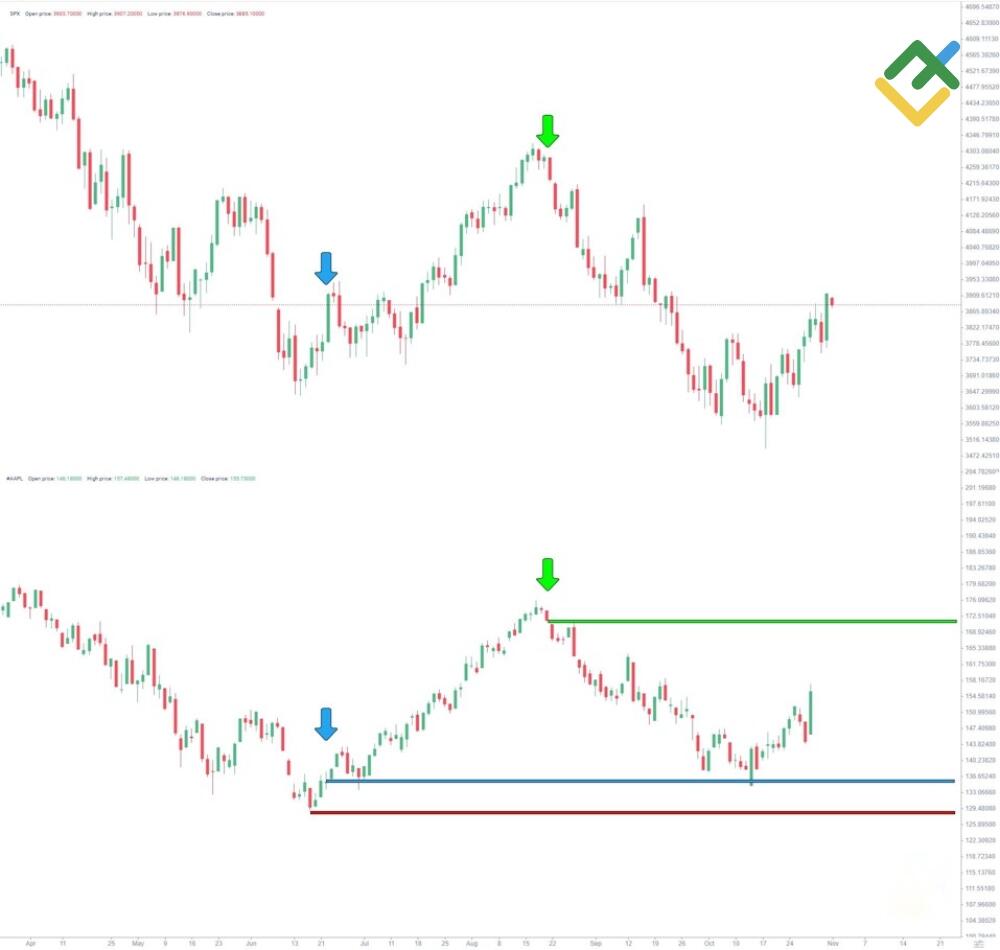
The above figure shows the daily price charts of the S&P 500 and Apple stock. As you can see, they correlate with minor deviations. For the S&P 500, the algorithm spots signs of a reversal in the area marked with a blue arrow. Therefore, a long position is opened in the Apple market – the blue line. The trade is exited when the S&P 500 trend reverses, it is marked with the green line.
Conclusion
Quantitative trading is another attempt to create a perfect trading system that could provide a stable income, despite the growing competition among traders. And, I must say, the most advanced quantitative strategies have come close to this dream. For example, the case of the Medallion Fund shows that with the help of quant trading, one can make a sustainable profit for decades.
However, one should not see quantitative trading strategies as a 100% guarantee of profit. There are very few relly professional quantitative traders in the market. The point here is not so much the complexity of strategies, but the ability to use complex statistical and mathematical tools with the help of powerful trading stations.
At the same time, the strategies of recent years cope well with high-risk markets, and the development of social trading allows beginners to copy quant trading solutions and trade like professional traders. LiteFinance also provides a copy trading platform where you can participate in social trading. The only thing I should warn you about is that you should not risk more than you can afford to lose. No profitability of even a professional quantitative trader in the past guarantees a positive result in the future.
Quantitative trading strategies FAQs
Quantitative strategies are approaches to investing and trading based on mathematical and statistical models aimed at making decisions. Quantitative trading strategies aim to find the optimal strategy and the best set of trading instruments to generate stable profits by fitting a mathematical set of parameters. The mathematical models allow you to go through many strategies for all trading assets, determining the optimal risk-reward ratio.
Quantitative analysis employs mathematical and statistical methods to analyze market data and help make trading decisions. For example, it can be used to create an algorithm that predicts changes in stock prices based on historical data and trends.
A quantitative or quant trader uses strategies based on mathematical analysis of quantitative data, mathematical modeling and software algorithms to track patterns and trading opportunities.
A quantitative trader aims to find statistical patterns in a separate historical area that can be described by a function, depending on many parameters. This pattern will take into account technical and fundamental analysis, correlation, spectral analysis, etc. A quantitative trader develops a model, based on a dozen input parameters and a given mathematical algorithm, which will analyze all possible trading opportunities to find the best one.
The quantitative trading model is based on a complex mathematical system for automated searching for patterns and market analysis. The model may include several trading strategies, which are sorted out by the algorithm depending on the market situation. The complete trading model also includes an order execution system, which can be manual, semi-automated or automated.
Quant trading is based on mathematical system, whose efficiency is tested with statistical methods. So, quantitative trading really works, which is proven statistically.
The experience of reputed trading funds, such as DE Shaw & Co, Two Sigma Investments, Medallion Fund, shows the real profitability of quant algorithms. They have shown positive returns for several years. Among individual traders, the strategies’ profitability depends on the backtesting quality and strategies optimization.
Quantitative trading has good prospects of further development. Analytical methods and technologies based on artificial intelligence are of interest. Obviously, in the future, intelligent algorithms will replace usual traders.
Mathematical models are used to create trading systems. On their basis, algorithms are written using the programming languages C++, C#, MATLAB, R, Python. For example, beginner quantitative traders use basic models: mean reversion, statistical arbitrage, behavioral bias recognition, algorithmic pattern identification, and so on.
To build trading strategies, many quant traders use the number theory, mathematical and functional analysis, applied mathematics, theories of order and probability, game theory, and statistics.

The content of this article reflects the author’s opinion and does not necessarily reflect the official position of LiteFinance broker. The material published on this page is provided for informational purposes only and should not be considered as the provision of investment advice for the purposes of Directive 2014/65/EU.
According to copyright law, this article is considered intellectual property, which includes a prohibition on copying and distributing it without consent.