Elliott waves are a form of technical analysis of financial markets developed by Ralph Nelson Elliott in the 1930s. Wave analysis has proven effective in analyzing and forecasting future price movements. The Elliott Wave Theory places significant emphasis on market psychology, a factor that renders it highly relevant in the current era of algorithmic trading and social media. Moreover, larger wave cycles or supercycles allow analysts to gain insights into global trends over extended periods, ranging from several years to even decades.
The fundamental premise of the Elliott Wave Theory is that while an individual may behave unpredictably, the behavior of a crowd follows certain patterns. This article examines how traders collectively influence financial markets and how to predict price movements using wave patterns.
The article covers the following subjects:
- Major Takeaways
- Elliott Wave Theory in Technical Analysis
- History and Core Principles Elliott Wave
- Elliott Wave Pattern Types: Impulse and Corrective Waves
- Corrective Waves: The 3-Wave ABC Pattern
- Elliott Wave Theory Rules and Guidelines
- Fibonacci Ratios in Elliott Wave Analysis
- How to Trade Using Elliott Wave Theory
- Conclusion
- Elliott Wave Theory FAQs
Major Takeaways
- The Elliott wave principle has been used in trading for over 70 years.
- The Elliott wave theory posits that the actions of market participants invariably comprise one of ten types of Elliott wave patterns on price charts. The purpose of the analysis is to identify the wave that is currently forming.
- The Elliott wave theory in technical analysis is a widely adopted technique among successful traders.
- There are two types of waves: impulse waves and corrective waves.
- There are three impulse waves and seven corrective waves.
- Fibonacci retracements and extensions are frequently employed in Elliott's theory to forecast wave sizes.
Elliott Wave Theory in Technical Analysis
The Elliott Wave Theory in trading is a type of technical analysis. Notably, almost all successful traders use Elliot wave trading strategies.

The Elliott Wave Theory in trading plays a key role alongside trend analysis, candlestick patterns, and indicators such as the RSI or MACD. Elliott waves embed the psychological aspect into a mathematical model, making this theory a powerful tool for market forecasting.
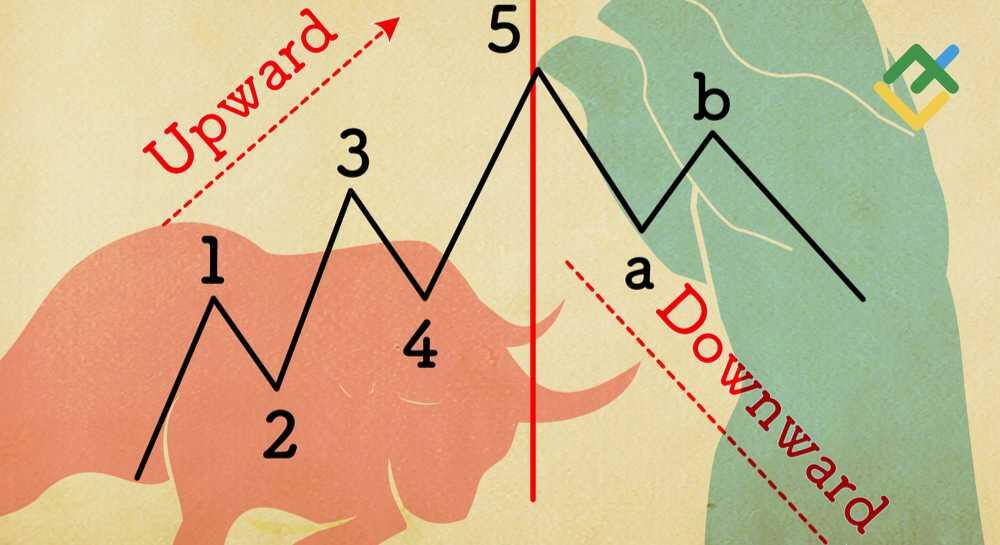
The theory is particularly effective in analyzing bull and bear markets, helping traders determine whether the market is in a phase of active growth (upward waves 1, 3, 5) or a decline (corrective waves A, B, C), which increases the accuracy of forecasts.
A wave is a section of price movement between one reversal and another.
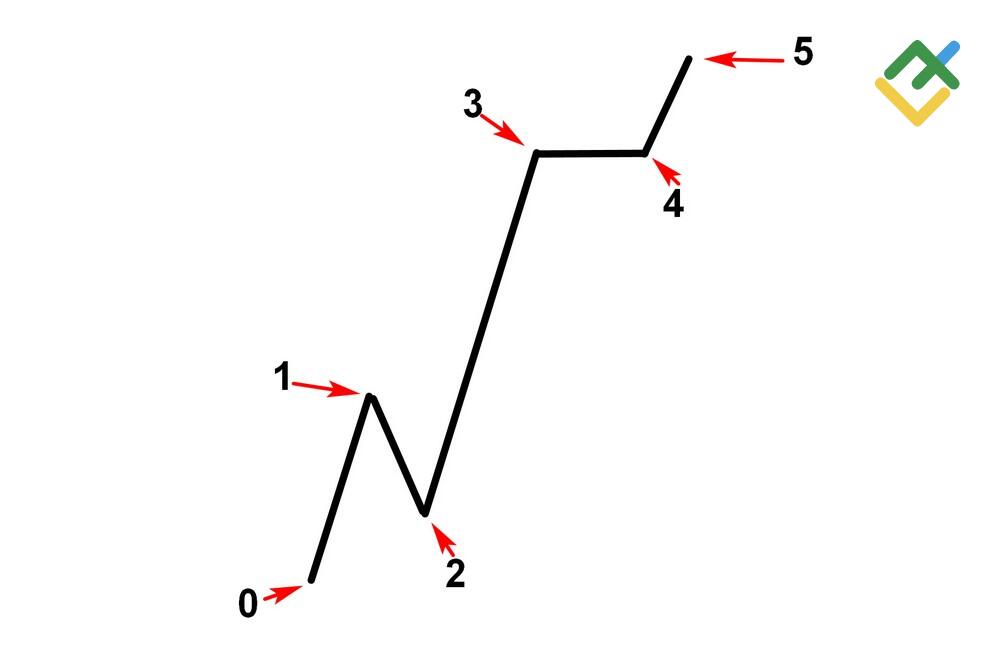
In contrast to fundamental analysis, which focuses on economic indicators and news, the Elliott wave analysis relies exclusively on historical price data and trading volume, viewing the market as a self-regulating system. Elliott's theory is often used in conjunction with wave patterns to determine the optimal entry and exit points.
Elliott wave theory is a widely used technical analysis model in modern trading, particularly among professionals trading stocks, currency pairs, commodities, and cryptocurrencies. These markets are cyclical, and these assets often display strong impulses.
The following sections will provide a brief overview of the wave theory's fundamental principles and rules. If you want to delve deeper into the subject, please read this comprehensive guide on the Elliott wave theory.
History and Core Principles Elliott Wave
Elliott Wave Theory was developed by Ralph Nelson Elliott in the 1930s. It was based on observations of cyclical price movements in financial markets. Elliott discovered that market trends are not random and unpredictable, but follow recurring wave graphical patterns that reflect market psychology. His work, entitled The Wave Principle, formed the basis of modern wave analysis, making wave analysis one of the most popular tools.

Robert Prechter, an American financial analyst and founder of Elliott Wave International, significantly contributed to the theory's popularity and development. In 1978, Robert Prechter and A. J. Frost co-wrote the book Elliott Wave Principle: Key to Market Behavior, which became a classic guide for traders. Prechter systematized the theory and expanded its application rules. He included the concept of socionomics, which studies the impact of mass sentiment on financial markets.
The basic principle of the Elliott wave theory in trading is that prices move in waves—impulses, which are five waves unfolding in the direction of the trend, and corrective waves, representing three waves moving against the trend. These waves form fractal patterns, where smaller cycles are part of larger ones.
According to the basic rules of Elliott's theory, the second wave should not fall below the starting point of the first wave, the third wave is often the longest and strongest, and the fourth wave does not extend into the price territory of the first wave. The theory emphasizes the role of emotions, such as greed and fear, in shaping market movements, allowing traders to predict turning points and develop more reliable strategies.
Elliott Wave Pattern Types: Impulse and Corrective Waves
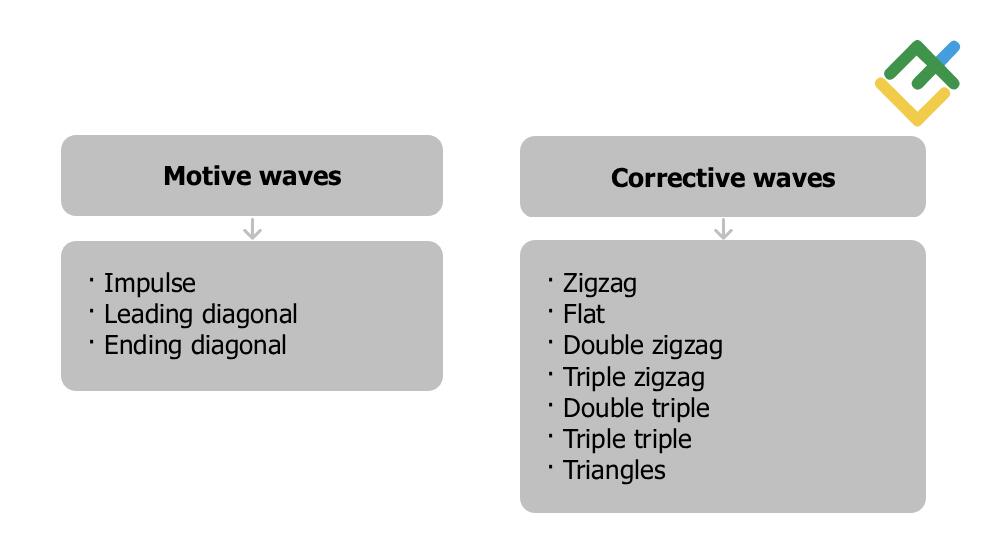
The Elliott Wave Theory suggests that there are several types of fractal patterns. All Elliot waves in trading are divided into motive or actionary and corrective waves.
Motive waves always develop in the direction of the existing trend, while corrective waves move against it. To determine the wave type, you need to find a wave of a larger degree and check in which direction this wave is moving. Impulse waves always unfold in the direction of the higher-level wave, while corrective waves, on the contrary, move against it.
There are three types of impulse waves and seven types of corrective waves. Impulse waves and their varieties – leading and ending diagonals – are considered actionary waves. Corrective wave types include zigzags, flats, double and triple zigzags, double and triple threes, and triangles.
Corrective Waves: The 3-Wave ABC Pattern
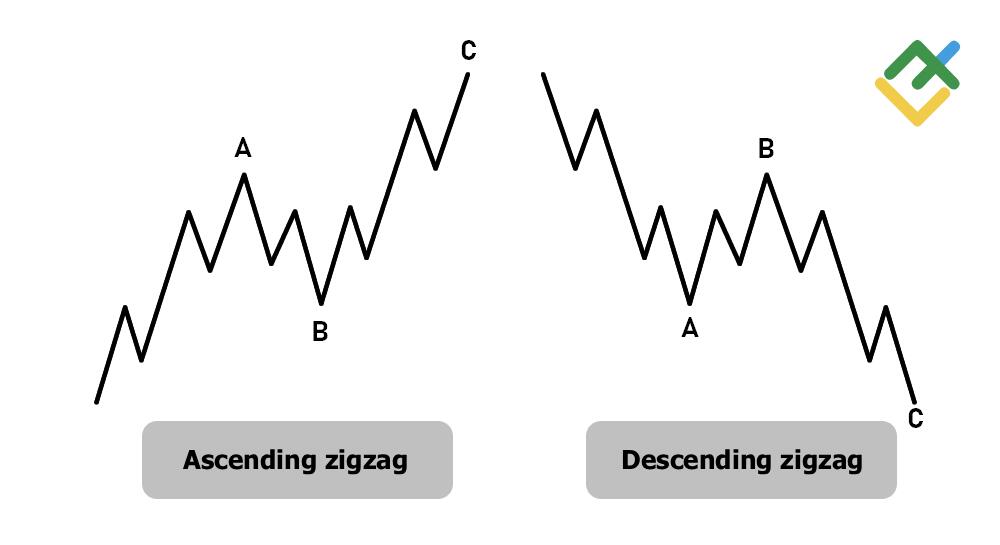
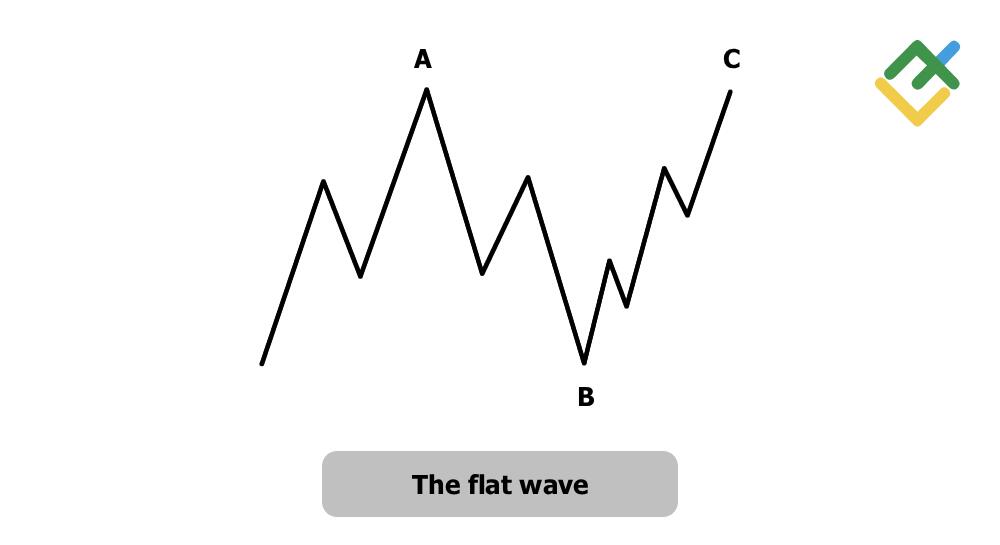
When considering the most popular corrective patterns, it is important to study zigzags and flat patterns. These waves are labeled as sub-waves A, B, and C. However, there is a significant difference between them.
In a zigzag, subwaves A and C are considered impulse waves, while wave B is considered a corrective wave. In a flat, A and B are considered corrective waves, while wave C is an impulse wave. Another important difference is that a zigzag is a trend pattern, i.e., it shows that the market is moving up or down. A flat is a sideways pattern, and the price moves horizontally in this wave.
Elliott Wave Theory Rules and Guidelines
Elliott wave analysis assumes that prices move according to certain rules and algorithms due to the actions of a large number of market participants. The pattern that forms on the price chart will always correspond to one of ten types of waves. Therefore, traders should determine which wave is currently developing. This analysis allows them to make accurate forecasts and determine potential profit-taking levels.
The Elliott theory, when combined with candlestick analysis, enables traders to discern if the prevailing trend is a bull market with upward momentum or a bear market with prevailing downward price movements.
Fibonacci Ratios in Elliott Wave Analysis
The Elliott Wave Theory and Fibonacci levels are perfectly designed to work together. With their help, traders can determine the optimal points for opening/closing positions, thereby increasing their potential profits.

Fibonacci ratios are used to predict wave values based on so-called reference waves. For example, if we take a typical bullish or bearish impulse consisting of five sub-waves, then according to statistics, wave 2 most often corresponds to 61.8% or 76.4% of the Fibonacci lines.
Notably, 0.618 and 0.764 are perhaps the most common Fibonacci ratios used in wave analysis. As a rule, wave 3 often extends to 161.8% of wave 1, and wave 5 retraces 61.8% of wave 1. Even in this brief example, it is evident how Fibonacci ratios influence wave development.
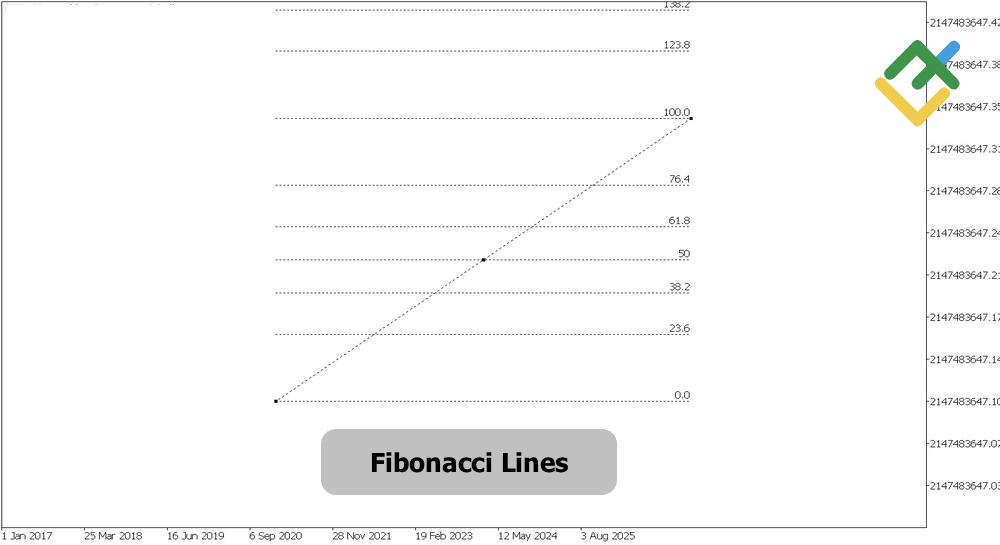
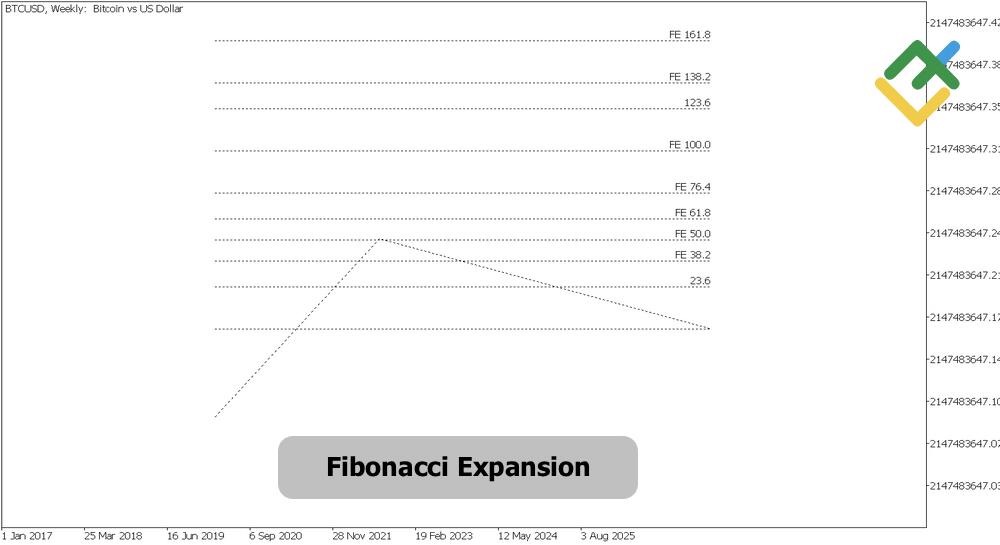
Fibonacci levels often coincide with key support and resistance levels. Support areas form when demand exceeds supply and the price cannot slide any further. Resistance areas occur when supply exceeds demand. In wave analysis, traders use these levels to confirm wave completion points (e.g., waves 2 or 4) or to predict targets for waves 3 or 5. This significantly increases the accuracy of trading decisions, so it is worth considering how to combine the Elliott wave theory and Fibonacci levels in your trading strategy.
How to Trade Using Elliott Wave Theory
Some traders analyze the market from different angles and determine several possible scenarios as to what wave pattern is currently forming. Trades are only opened when several scenarios confirm the signal. This strategy involves opening fewer positions, but they are more accurate and successful.
The second option for applying Elliott waves is to determine the most likely scenario. In this scenario, trades are executed in the areas of the wave patterns that have the highest potential for profit. For instance, wave 3 is the fastest and most powerful wave in the impulse. When wave 4 is forming sideways, traders tend to open trades to take profits during the fifth wave.
Conclusion
The Elliott Wave Theory has indisputably secured a pivotal role within the realm of technical analysis. Elliott's wave principle allows traders to grasp market trends through the lens of market psychology. Its fractal patterns, when combined with Fibonacci ratios, generate accurate signals. Despite its complexity, the theory can be mastered with proper practice. Elliott wave analysis is a comprehensive framework that provides a foundation for both effective trading and a comprehensive understanding of market behavior.
Given that virtually all successful traders apply the Elliott wave theory in one form or another in their trading strategies, this section of technical analysis is highly recommended for study by both beginners and seasoned traders and investors.
Elliott Wave Theory FAQs
The five waves of Elliott's theory represent the wave that is most commonly found in financial markets. This wave is called an impulse and includes three motive waves 1, 3, and 5, and two corrective waves 2 and 4.
Elliott wave rules state that wave 2 almost never reaches 100% of wave 1. In my professional experience, I have never encountered any such cases.
The Elliott wave theory is not a strategy in itself. However, it can be used as a basis for building reliable trading strategies. I have proven this through many years of my own experience.
Elliott waves 1-2-3-4-5 are parts of an impulse, a pattern consisting of five sub-waves. Waves 1, 3, and 5 are impulses, while waves 2 and 4 are corrections. Wave 1 can take the form of a leading diagonal, and wave 5 can take the form of an ending diagonal.
The difference between impulse and corrective waves is that Elliott impulses are the driving force behind the market and, as a rule, push prices either up or down. Corrective waves, on the other hand, only shape pullbacks.
Elliott wave analysis has been applied successfully in all financial markets. I have personally tested this theory over many years on currency pairs, stock markets, indices, cryptocurrencies, and commodity trading.
The content of this article reflects the author’s opinion and does not necessarily reflect the official position of LiteFinance broker. The material published on this page is provided for informational purposes only and should not be considered as the provision of investment advice for the purposes of Directive 2014/65/EU.
According to copyright law, this article is considered intellectual property, which includes a prohibition on copying and distributing it without consent.