As much as Donald Trump may seek a deal with Iran, Tehran's demands remain a significant obstacle. Meanwhile, Israel is pursuing its own strategic interests in the region and is unlikely to align fully with Washington's agenda. What implications could this have for Brent crude? Let's examine the key drivers and develop a trading plan.
The article covers the following subjects:
Major Takeaways
- Brent prices have risen amid the escalating conflict.
- Iran and Israel are once again attacking each other.
- Global oil inventories are rapidly melting away.
- Long trades on Brent can be opened if the price breaks through $98.8 per barrel.
Weekly Fundamental Forecast for Oil
Not everything Donald Trump wants becomes reality. Yet there is some truth to the notion that markets often take his wishes seriously. Otherwise, Brent crude would likely have rallied much further amid the escalating conflict in the Middle East. Iran and Israel have exchanged direct strikes for the first time since the ceasefire reached in early April. Nevertheless, the US president remains focused on securing a deal and continues to urge both sides to return to the negotiating table.
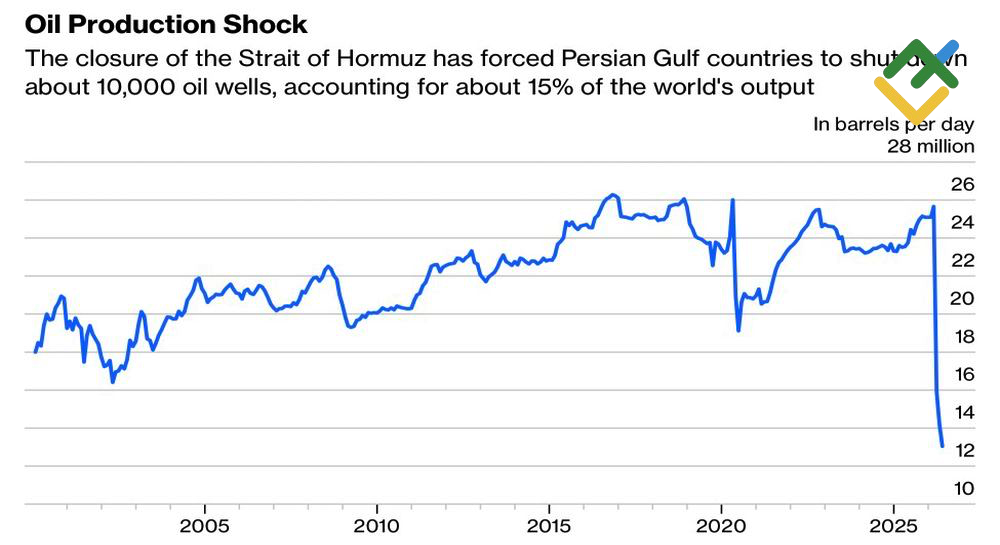
History shows that all armed conflicts eventually end with some form of agreement. Investors are reluctant to miss the moment when oil flows through the Strait of Hormuz returns to normal. As a result, FOMO—the fear of missing out—is driving the market to react more strongly to Donald Trump's conciliatory rhetoric than to the actual disruption in supply. Yet those disruptions are substantial. According to IEA estimates, the conflict in the Middle East has reduced regional oil production by roughly 45%, from 30 million bpd to 14.5 million bpd.
Oil Production in Persian Gulf Countries
Source: Bloomberg.
It will take quite some time to restore oil production to its previous levels. Combined with the caution shown by tanker owners, this suggests that the Strait of Hormuz will not return to full capacity until the end of the year. Since the start of the conflict in the Middle East, Brent crude has surged by 40%. Does it have a ceiling?
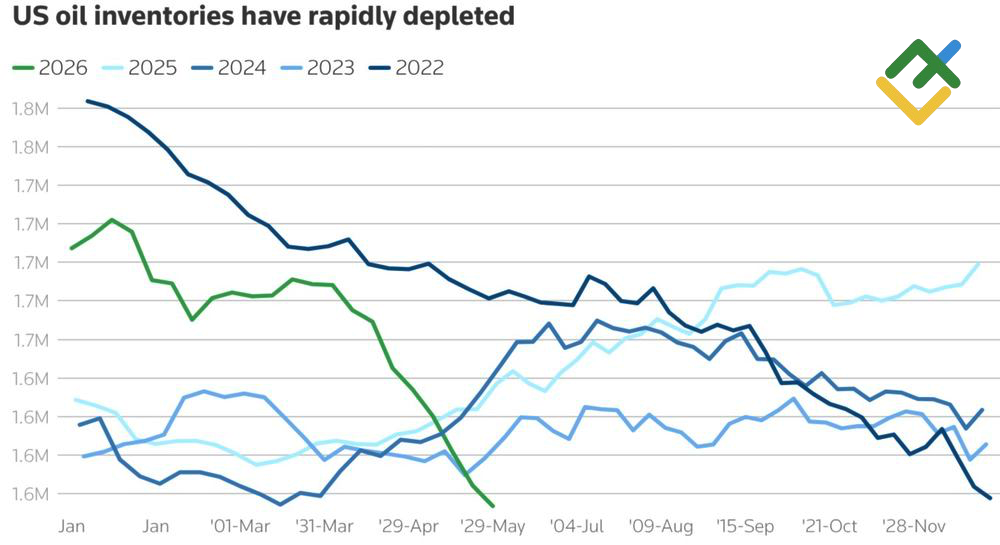
In many ways, the oil market resembles a leaky bucket, with new supply being poured in through reduced Chinese imports and increased US exports, each contributing roughly 2 million barrels per day. At the same time, global inventories are preventing the market from running dry. However, those inventories are being depleted at an accelerating pace. According to the US Energy Information Administration, global oil stocks declined by 5.27 million bpd in March, 8.62 million bpd in April, and 9 million bpd in May. With the peak US driving season approaching, the drawdown could deepen to as much as 11 million bpd in June—an unprecedented rate of inventory depletion.
US Oil Inventories
Source: Reuters.
The longer the Strait of Hormuz remains closed, the higher Brent crude is likely to trade. No matter how much Donald Trump might want to conclude a deal, the positions of the US and Iran remain far apart. Tehran continues to insist on new terms for transit through the world’s main oil supply route—including a fixed fee charged to tankers passing through it. This is hardly part of the US administration's plans.
At the same time, it will not be easy to force Israel, which is pursuing its own interests, to refrain from action.
Weekly Trading Plan for Brent
Investors still believe that Donald Trump can resolve the conflict, but the risks of a major escalation in the Middle East are mounting. If so, Brent will likely soar. If it settles above $98.80, long positions can be opened.
This forecast is based on the analysis of fundamental factors, including official statements from financial institutions and regulators, various geopolitical and economic developments, and statistical data. Historical market data are also considered.
Price chart of UKBRENT in real time mode
The content of this article reflects the author’s opinion and does not necessarily reflect the official position of LiteFinance broker. The material published on this page is provided for informational purposes only and should not be considered as the provision of investment advice for the purposes of Directive 2014/65/EU.
According to copyright law, this article is considered intellectual property, which includes a prohibition on copying and distributing it without consent.