The bullish Gartley is a unique harmonic pattern formation that gives forex traders a reliable method to enter existing uptrends at mathematically calculated points. First discovered and defined by seasoned technical analyst H.M. Gartley in the 1930s, the bullish Gartley remains ubiquitous among current-day chart pattern traders for its tendency to produce high-probability continuation signals when confirmed.
Let’s take an in-depth look at how to correctly identify the essential structure of the bullish Gartley pattern, the rules for confirmation, and how to effectively trade the bullish Gartley setup for optimal risk to reward.
The article covers the following subjects:
Major Takeaways
- Bullish Gartleys form best in uptrends, taking on an M/W shape through 5 turns.
- Each segment must meet Fibonacci criteria to become tradable.
- Long entries follow point D with stops below C.
- Partial profits target XA extensions before trailing the rest.
While requiring nuanced identification, bullish Gartleys give savvy harmonic traders an edge with high-probability setups.
Structure and Sequence of the Bullish Gartley
The bullish Gartley pattern takes on a distinctive M/W shape through 5 key turning points labeled X, A, B, C, and D. It begins with point X, which marks the start of the initial retracement after a preceding uptrend. Point A then forms through a sharp correction to the downside from point X. Point B follows as a consolidation area showing sideways price movement. Point C makes the lowest swing on the chart before the pattern completes at the final point D, which terminates slightly higher than point A.
Each swing within the pattern adheres to specific Fibonacci ratios that define the range of one point relative to the prior point's range. These precise alternating price swings produce the hallmark harmonic Gartley shape that traders rely on for reasonable trade planning.
While the unfolding pattern's visual shape may seem subjective during development, the mandated Fibonacci levels objectively confirm whether the pattern qualifies as a tradable bullish Gartley or not upon completion.
Proper identification against the mandated Fibonacci levels is the key to trading Gartleys successfully. We'll next examine the exact qualification rules each turn must meet for validation.
Identification Rules and Confirmation
While the bullish Gartley's signature 5-turn shape gives it a distinctive look on the chart, the pattern only qualifies as a valid trading opportunity once it meets specific Fibonacci ratio criteria. Each swing leg must adhere to the following guidelines:
- The XA retracement leg must be between 0.618 and 0.786 of the range of the prior uptrend swing into point X. This means XA will retrace somewhere between 61.8% and 78.6% of the uptrend's price movement.
- The AB retracement leg must be between 0.382 and 0.618 of the XA leg's range. So AB will be a minor retracement ranging from 38.2% to 61.8% of the XA swing.
- The BC projection leg must equal AB's range or extend between 1.618 and 2.618 times the length of AB. Here, BC projects beyond the start of the pattern at least 1.618 times the AB range or as much as 2.618 times AB.
- Finally, the CD projection leg must equal 0.786 and 1 times the length of the initial XA leg. So, CD approaches or exceeds the original XA swing.
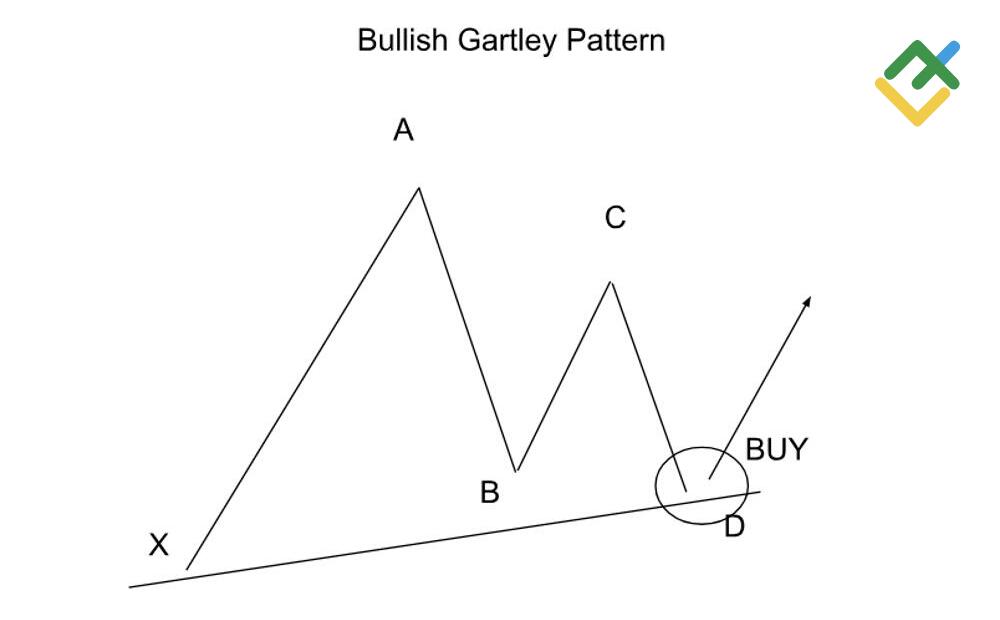
Meeting all these Fibonacci qualifications is required for the bullish Gartley to become a valid trading pattern. But one more rule remains for confirmation before entries can be made:
- Confirmation - The market must continue higher beyond point D by at least 1.27 Fibonacci extensions of the original XA leg. This shows acceptance above resistance, indicating the uptrend is likely to resume.
- Invalidation - If the market drops below point C after forming point D, it invalidates the sequence and stops the pattern.
Adhering to these precise Fibonacci roadmap levels and watching for explicit confirmation or invalidation makes the seemingly vague bullish Gartley formation become an objectively defined trade setup.
Having explored structuring a qualified bullish Gartley pattern, we'll examine how to trade it next.
As legendary trader W.D. Gann once remarked, "The way to make money is to make it according to definite rules." The Fibonacci requirements of the Gartley pattern provide just such rules.
Trading the Bullish Gartley Pattern
Once an adequately qualified Gartley bullish pattern completes development and the trader has confirmation of the upside breakout, they can begin planning entries, stop losses, and profit targets based on the chart structure:
Entries. Enter long positions as price breaks convincingly above point D on expanding volume. Alternatively, traders may elect to wait and enter on a retest of the 1.27 XA extension level if the price pulls back after initially breaching point D. Use limit buy orders at the trigger levels to get filled at perfect entry points.
Stop Loss. Place protective stops just below the swing low formed at point C to contain downside risk if the pattern fails. This defines risk before reward.
Profit Targets.
Take partial profits at each XA Fibonacci extension level as the price increases. These correspond to:
XA x 1.618 extension;
XA x 2.618 extension;
XA x 4.236 extension.
Trail the remaining open position with a widened stop below entry or just under point C. Let profits run until stopped out.
This trading strategy allows capitalizing on the expected trend continuation signaled by the completed Gartley pattern with predefined risk on the stop and staged profit-taking at Fibonacci-based targets.
Now that we've detailed the precise rules for validating the pattern and planning trades around it let's see some real chart examples.
Bullish Gartley Trading Examples
Let's examine two real-world examples of completed bullish Gartley patterns on forex currency pairs and how the trades could be planned:
Long AUDUSD
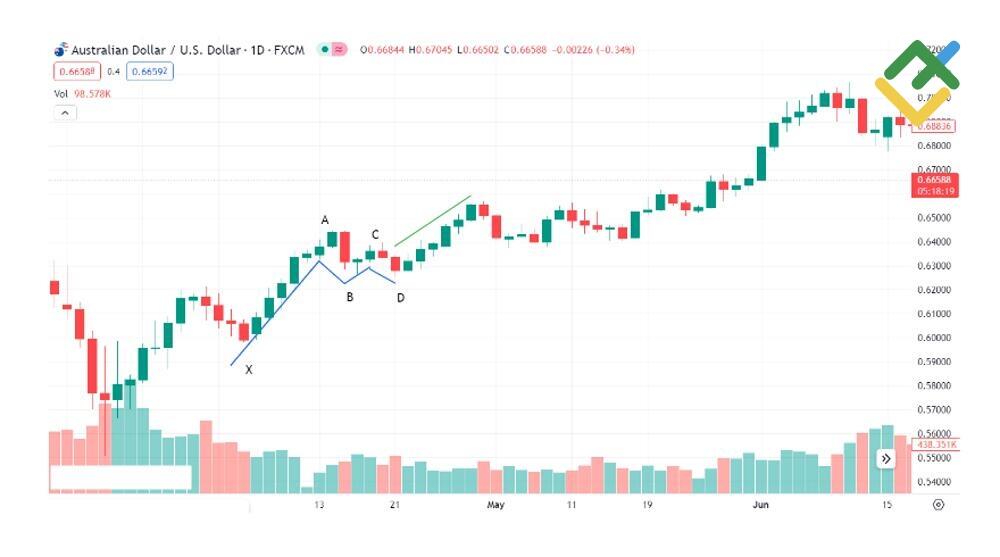
This daily chart on the AUDUSD forex pair shows a textbook Gartley bullish pattern.
We get confirmation of the pattern above point D when the price breaks out over 1.27 extensions of the XA leg. This gives the signal to go long AUDUSD. Stops are placed below point C to limit risk.
The chart highlights partial profits at each XA extension level until the trade reaches the 4.236 extensions. There, the remainder of the position is closed for total profits. This exemplifies complete trade planning around a qualifying Gartley.
Long USDJPY
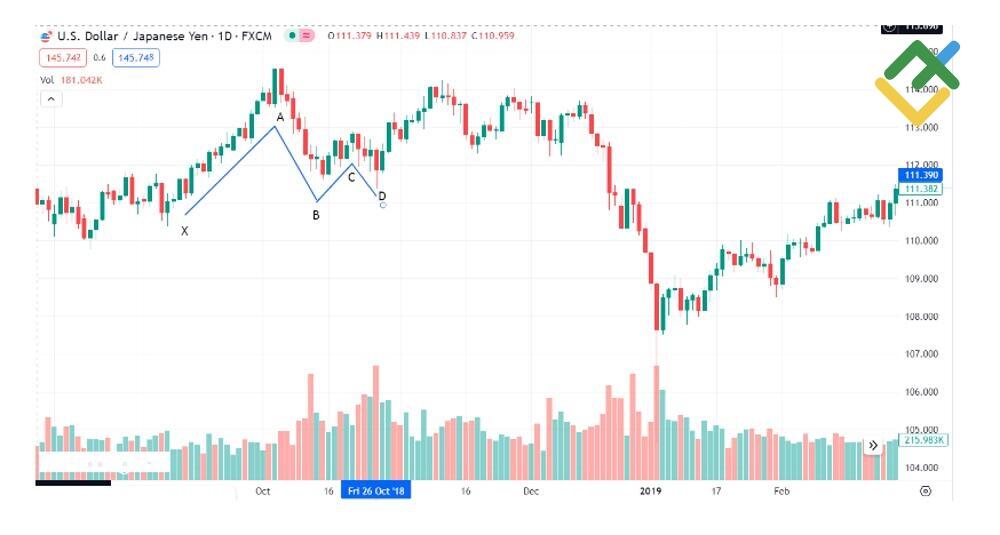
On this daily chart of USDJPY, we again see an adequately qualified bullish Gartley pattern.
When the price breaks above point D, triggering the extended entry, we place stops under the C swing low to define risk. As the price climbs, partial profits are taken at each extension level until the final take profit at the 4.236 XA target.
When leveraging the bullish Gartley pattern, these real trade examples demonstrate the complete planning process around entries, stop placement, and staged exits.
Pros and Cons of Trading Bullish Gartleys
When weighing the potential advantages and drawbacks of trading the bullish Gartley pattern, traders should consider the following:
Pros:
- High frequency of occurrence across many different markets and asset classes like forex, stocks, commodities, and cryptocurrencies.
- Clear directional bias to the upside once pattern qualification and confirmation are achieved.
- The ability to define optimal risk/reward trade planning using the pattern's Fibonacci structure.
Cons:
- Identification can be subjective in real-time as the pattern develops. Traders must exercise discretion.
- Meeting all Fibonacci criteria with textbook perfection is uncommon. Some minor deviation is often seen.
- Trading the Gartley pattern requires a trend-following approach. Counter-trend traders may not find suitable opportunities.
The primary strengths of trading bullish Gartleys are their frequent formation across diverse markets and the quantifiable edge provided by their Fibonacci ratios. However, traders must be flexible since turning points sometimes develop picture-perfect symmetry in market conditions. They are balancing taking good enough signals versus holding out for ideal forms.
Conclusion
In summary, the Gartley bullish pattern belongs to the harmonic family. It offers traders distinct quantitative advantages for planning low-risk, high-reward trades upon completion. Combining Fibonacci-based trend retracements and extensions within its distinctive M/W shape, the bullish Gartley signals a high likelihood of trend continuation to the upside.
Skilled traders can confirm precise entry points, place protective stops, and set staged profit targets once the pattern reaches qualification standards. While nuanced identification criteria make application challenging, the edge provided by trading confirmed bullish Gartleys makes the time invested in learning this method worthwhile for savvy harmonic traders.
Platform where traders earn more

Trade on LiteFinance’s high-tech ECN platform and open an account so that beginner traders can copy you. Earn a commission for copy trading and boost your income.
Bullish Gartley pattern FAQs
The bullish Gartley harmonic pattern is a 5-point harmonic pattern composed of specific Fibonacci retracements and extensions that signal likely trend continuation upon completion.
Use Fibonacci drawing tools to measure each leg of the XABCD pattern. It must meet outlined retracement and projection ratios between turns to qualify.
When confirmed, the bullish Gartley produces winning trades around 70% of the time, giving it a favorable edge compared to most chart formations.
Plot the highs and lows, connect them with trendlines, and then use Fibonacci retracement and extension tools to map the precise ratios that define the pattern.

The content of this article reflects the author’s opinion and does not necessarily reflect the official position of LiteFinance broker. The material published on this page is provided for informational purposes only and should not be considered as the provision of investment advice for the purposes of Directive 2014/65/EU.
According to copyright law, this article is considered intellectual property, which includes a prohibition on copying and distributing it without consent.