


Day trading cryptocurrencies remains a popular way to profit from market volatility thanks to 24/7 access, global availability, and frequent price movements.
When looking for the best cryptos for day trading, traders should avoid hype and focus on key metrics such as trading volume, liquidity, market depth, and Bitcoin's performance as the market benchmark. To pick crypto for day trading, it is essential to evaluate assets based on objective data rather than promises of quick gains.
If you are looking for the best cryptocurrency to buy, you should also focus not on empty promises of exorbitant gains, but on assessing liquidity and trading fees.
Choosing the best crypto also means considering trading costs. Along with volatility and liquidity, traders should assess exchange fees, Funding Fees, and Funding Rates, as these factors can significantly impact profitability and help identify the best cryptos to day trade.
The article covers the following subjects:
Major Takeaways
Liquidity is paramount. BTC and ETH generate trillions of dollars in monthly trading volume, ensuring tight spreads, minimal slippage, and fast execution.
Volatility creates profit opportunities. Daily price swings typically range from 2–5% for major cryptocurrencies and can exceed 15% for speculative assets, making intraday trading attractive.
Bitcoin sets the tone for the market. Its price action often influences the direction of the broader crypto sector, making BTC a key benchmark for day traders.
When selecting an asset, focus on factors such as trading volume, liquidity, volatility, market capitalization, exchange availability, and correlation with Bitcoin.
Every cryptocurrency has unique catalysts. BTC reacts to macroeconomic events, while DOGE, SOL, and SUI are often driven by social sentiment, ecosystem growth, and new partnerships.
Unlike fiat markets, crypto trades 24/7. This flexibility allows traders to react to events in real time and profit from both rising and falling markets through perpetual futures.
Risk management is the foundation of successful trading. Even the most liquid cryptocurrencies can experience sharp reversals, making stop-losses and proper position sizing essential for preserving capital.
Understanding Day Trading in the Cryptocurrency Market
Day trading is a trading style in which all trades are opened and closed within a single trading day. In the crypto space, this refers to the period when the trader is active and awake, since the market operates around the clock.
Day trading crypto encompasses a variety of approaches and strategies. Below, we'll briefly review some of them.
Scalping
Scalping is a strategy in which a trader executes multiple trades in seconds or minutes, profiting from small price movements. With the right approach, a series of such trades can yield significant gains, but they also come with a high level of risk.
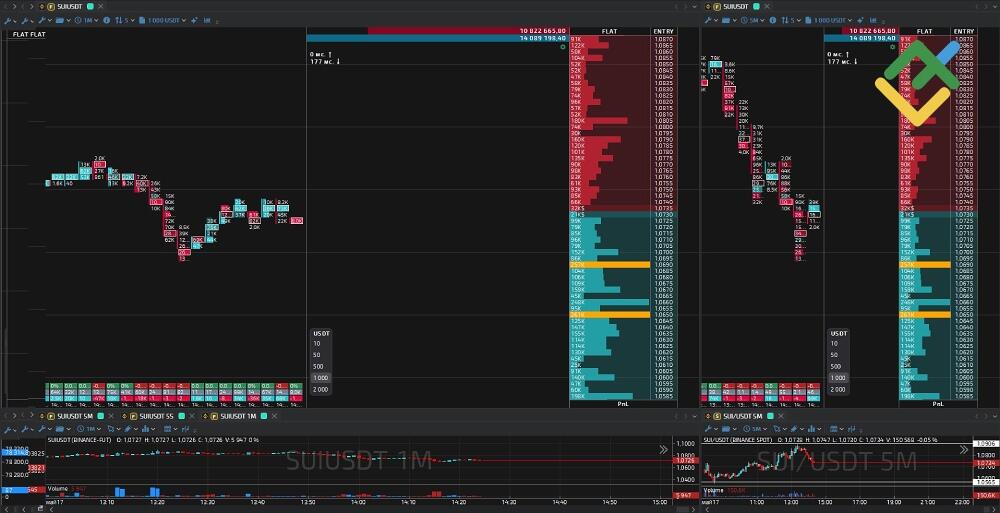
Traditional price charts are often insufficient for scalping. Advanced traders use specialized tools such as scalping platforms, order books, market depth charts, and screeners. These tools help them monitor order book density, large-order behavior, and potential trading opportunities in real time.
News Trading
News trading is a strategy in which positions are opened in response to news reports, economic data, and market events. The goal is to profit from a sharp increase in volatility and strong price movements.
This approach is also frequently used at the opening and closing of trading sessions, when market activity and trading volumes surge significantly.
Momentum Trading
Momentum trading involves finding digital assets with strong, directional price movements and high trading volumes. Traders aim to ride the trend and close their positions before the momentum begins to fade.
The most common technical indicators used to implement this strategy are Momentum, RSI, Stochastic, MACD, and CCI, along with advanced charting tools. Technical analysis tools such as trend and volume indicators are also used.
Breakout Trading
Breakout trading is a strategy that involves entering a trade when an asset's price breaks through a key support or resistance level. A breakout can signal the start of a strong, directional move.
However, it is important to distinguish a genuine breakout from a false one. To confirm the trend, active traders often use additional signals:
cascading liquidations;
an increase in open interest;
increased trading volume.
The combination of these factors helps assess the strength and likelihood that the trend will continue.
Range Trading
Range trading is a strategy in which a trader looks for assets with clearly defined support and resistance levels. Purchases are usually made at the lower boundary of the range, and sales are made at the upper boundary, as long as the price remains within the trading range. This strategy is particularly effective during a flat market—a period when prices move sideways without a clear trend.
Fading
Fading is a strategy that involves trading against a short-term trend, relying on a rapid price reversal at the first signs of fading momentum.
Thus, day trading encompasses a variety of approaches, each of which can be effective depending on the chosen asset and market conditions.
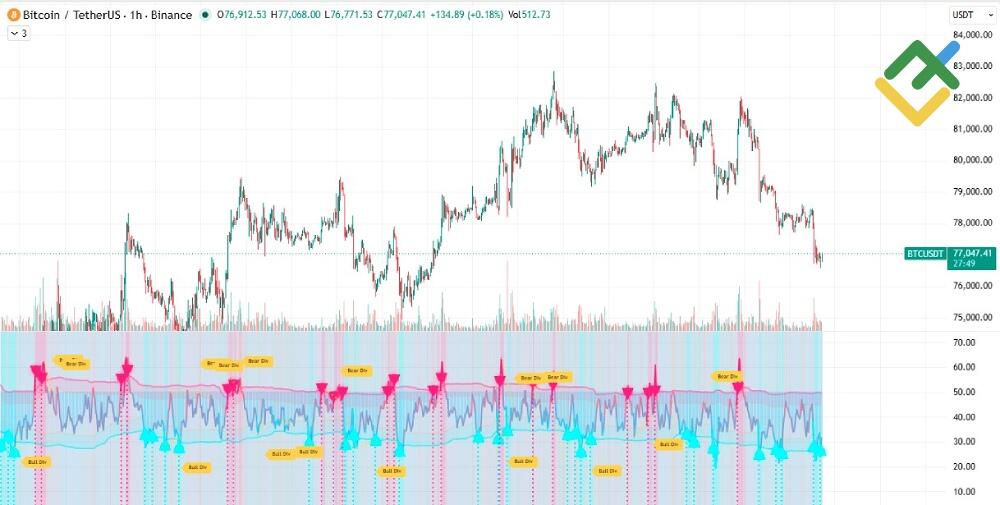
Risk management and "paper trading" are key to success. Any strategy requires multiple backtests in different market conditions: trending, ranging, and during high volatility. Only statistics can reveal whether a strategy has a real edge.
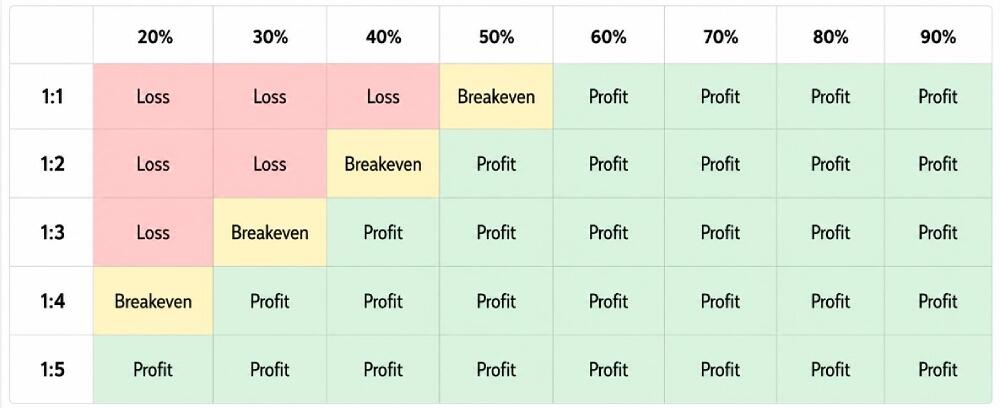
After selecting a strategy and an asset, you need to calculate the risk-to-reward ratio and the win rate. Without these metrics, trading turns into pure guesswork.
The table below shows win rates and risk/reward ratios. It demonstrates why even a 50% win rate can yield consistent results if the risk-to-reward ratio exceeds 1:1. Only after such thorough testing should a strategy be applied to a live account.
This section is well summed up by one of Bruce Lee's most famous quotes:
I fear not the man who has practiced 10,000 kicks once, but I fear the man who has practiced one kick 10,000 times.
From a broader perspective, day trading strategies—just like the best Forex trading strategies—are not so much a "button to make money" solution. Instead, they teach you how to manage risks and find optimal entry and exit points.
Why Day Trade Cryptocurrencies?
Day trading in cryptocurrencies attracts traders due to high volatility, 24/7 market access, and a low entry threshold. The crypto market offers the opportunity to rapidly respond to price movements and profit from both rising and falling prices.
As a rule, traders cite the following reasons why they choose day trading:
Low entry threshold. Cryptocurrency exchanges allow you to start trading even with a small deposit.
Borrowed funds. Most platforms provide access to leveraged trading.
High volatility. Significant price movements create numerous opportunities for profit.
Accessibility. You can access crypto coins from virtually anywhere in the world, regardless of jurisdiction.
Wide selection of assets. The crypto market offers thousands of trading instruments with varying levels of liquidity and volatility.
Full control over positions. Traders can monitor long and short positions throughout the day and manage risk in real time.
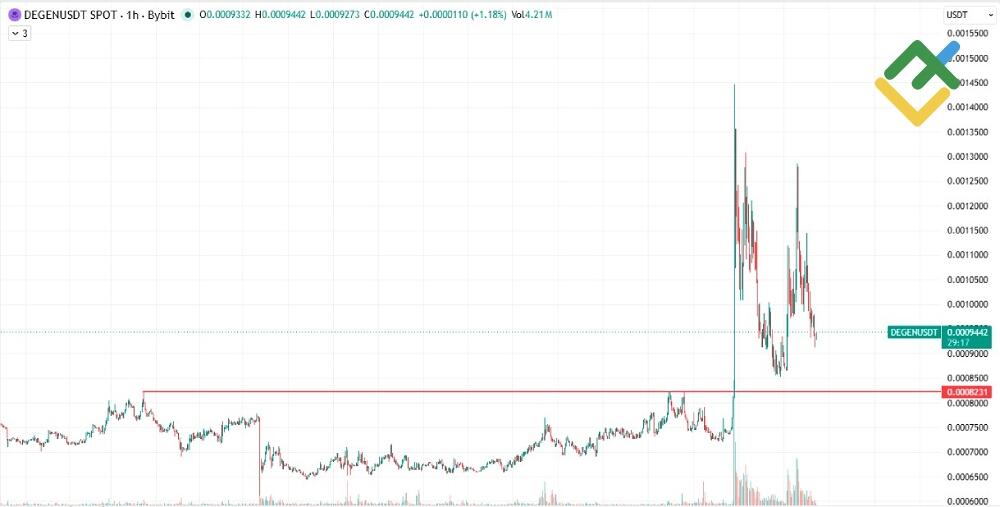
Below is an example of how to apply a breakout trading strategy. The chart shows a cluster of stop-loss orders and short liquidations. The red line marks a price extreme, beyond which stop-loss orders are placed, and liquidations typically occur. The consolidation was followed by a sharp rally: the asset rose by 76% in just two hours.
At the same time, it is essential to choose the best trading platform to ensure ease of use and the ability to execute trades suited to your trading style.
Factors to Consider When Selecting Cryptocurrencies for Day Trading
Success in intraday trading depends largely on choosing the right asset. Blindly investing in the first cryptocurrency that comes to mind, without analyzing its characteristics and market behavior, almost always leads to greater risk and losses. When selecting a cryptocurrency for day trading, you should look at the coin's reputation, trading volume, price history, liquidity, and performance on major exchanges.
Key selection criteria:
24-hour trading volume. Pick coins with a daily trading volume of several hundred million dollars, as they typically ensure fast order execution and minimal slippage.
Spread and order book depth. The smaller the difference between the best bid and ask prices, the lower the hidden costs when you enter and exit positions.
Volatility and ATR. The asset should demonstrate sufficient price range—typically at least 3–5% intraday.
Sensitivity to news. Coins that actively react to protocol updates, partnerships, or posts by major influencers are more likely to form predictable momentum moves. Analyzing the asset's historical performance is particularly helpful here.
Market capitalization. High market cap typically reduces the likelihood of sharp manipulative moves and pump-and-dump schemes.
Availability on major exchanges. It is important that the asset has high trading volume on the platform where the position is opened, as this reduces the risk of fragmented liquidity.
Correlation with BTC. Understanding whether a coin moves in tandem with Bitcoin or follows its own trajectory helps to more accurately assess the likely direction of the price movement.
Open interest in futures. A sharp increase or decrease in open interest often precedes strong momentum-driven price moves.
Funding rate. A strongly positive or negative rate indicates a skew in the cryptocurrency market toward longs or shorts and may signal the likelihood of a cascade of liquidations.
Token unlocks. Large-scale token releases by project teams or funds can create significant selling pressure, so these dates should be monitored in advance.
At the same time, analyzing higher time frames remains a key factor. Traders should identify the trend direction, key levels, and areas of liquidity clustering to see the big picture, rather than focusing solely on short-term fluctuations.
Day trading is best suited not simply to popular cryptocurrencies but to assets with a clear trading structure shaped by technical analysis, indicators, and volume. This is especially important when using trading bots, as poor asset selection can significantly increase the likelihood of trading errors.
Top Cryptocurrencies for Day Trading
When selecting digital currencies for day trading, trading volume is far more important than marketing hype, as it reveals where deep liquidity, market interest, and active trading exist, and where the market is driven primarily by speculation and empty promises.
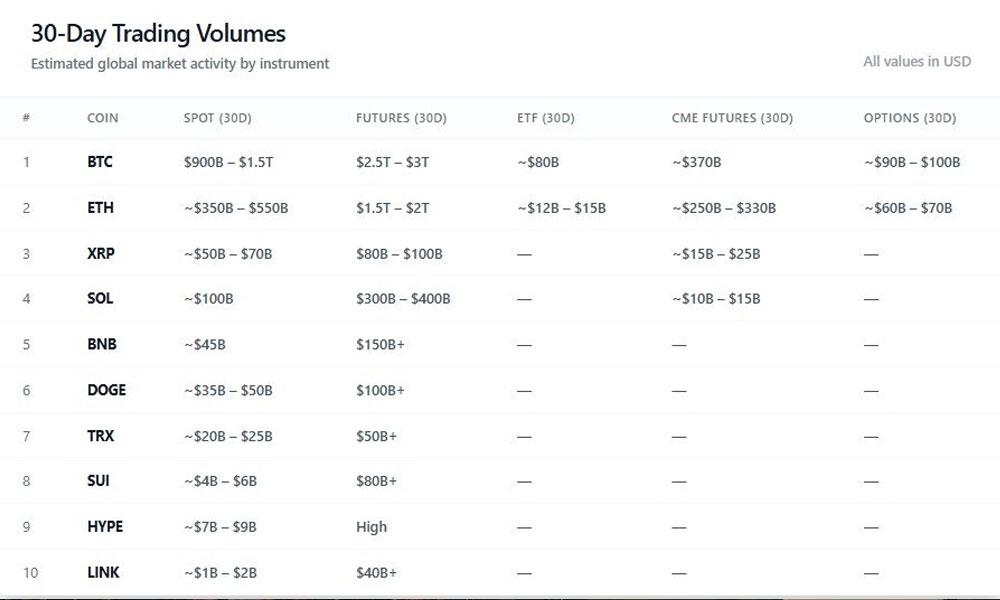
Based on spot and futures volumes over the past 30 days, a list of ten coins was compiled that offer the optimal combination of excellent liquidity, volatility, technological stability, and current market narratives. The analysis takes into account not only futures and spot volumes, but also ETF and options flows. Each of these coins offers numerous trading opportunities daily across various time frames.
You can expand this list yourself using the selection criteria described above. For example, for scalping, serious traders often compile a list of "in-play" coins—assets with trading volume exceeding $200 million over the past 24 hours and price movements of more than 20% either up or down. This helps quickly identify where liquidity and heightened trading activity are currently concentrated.
Before buying an asset, it is important to develop a suitable trading strategy, as the same cryptocurrency can perform differently in scalping, breakout, or range trading.
The table below shows parameters that meet the requirements for intraday trading. We intentionally used 30-day data for the analysis, as statistics covering only the last 24 hours often reflect a short-term spike in activity rather than a sustained market trend.
Bitcoin
Bitcoin is the flagship of the cryptocurrency market, with a total monthly trading volume exceeding $4 trillion. Spot market volume typically ranges between $900 billion and $1.5 trillion, while futures turnover reaches $3 trillion. ETFs and options provide additional liquidity, accounting for another $170–$180 billion.
For traders, this means high liquidity, a deep order book, and minimal slippage even when executing large orders. Intraday BTC volatility rarely drops below 2%, and during the release of major macroeconomic news, the price can change by 5–8% in just a few hours.
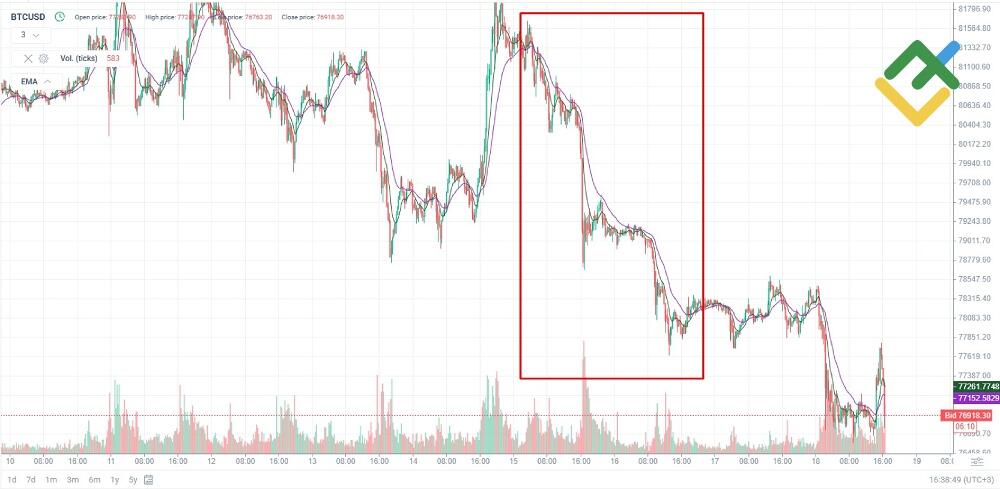
The BTC chart shows the crossover of EMA9 and EMA25.
Bitcoin remains the primary benchmark for the entire cryptocurrency market: its price movements often dictate the direction of most altcoins, so monitoring BTC is important even when trading other assets.
From a technical analysis perspective, Bitcoin is sensitive to Fibonacci levels, volume profiles, and key support and resistance zones.
Ethereum (ETH)
Ethereum is the second-largest cryptocurrency by market capitalization, with a total monthly trading volume exceeding $2 trillion across spot, futures, and options markets. The significant share of CME futures indicates sustained demand from institutional investors, making ETH a solid option for day traders.
ETH's average daily volatility typically exceeds 3%, while network upgrades, hard forks, improved scalability, and DeFi activity can trigger short-term price swings of 5–10%.
From a technical analysis perspective, Ethereum often reacts well to overbought and oversold conditions, while trend lines and key support and resistance levels tend to generate clear signals. On major exchanges, the ETH/USDT pair also maintains a tight spread, which is especially important for active intraday trading.
DeFi, NFTs, and ecosystem updates provide additional news-driven momentum for ETH. At the same time, indicators such as the RSI and VWAP on hourly time frames often help identify high-quality entry points.
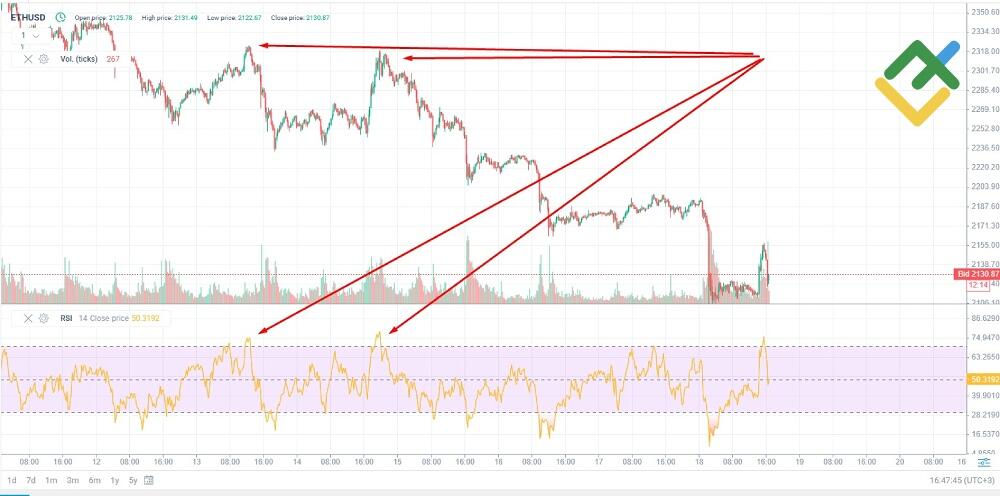
The chart shows the correlation between ETH price movements and RSI signals in the overbought zone.
Notably, Ethereum regularly exhibits clear intraday price movements, driven by a combination of institutional investor activity, the expansion of DeFi, and ongoing network upgrades.
Ripple (XRP)
XRP demonstrates a balanced distribution of liquidity: the spot market is valued at $50–$70 billion, the futures market is at $80–$100 billion, and CME futures add another $15–$25 billion. The fact that the asset is listed on most regulated exchanges means that it is mature and attracts major players.
The main catalyst for intraday volatility remains news related to banking sector integrations and cooperation with central banks. During such periods, the price can fluctuate by 5% or more, and these movements are typically accompanied by spikes in trading volume.
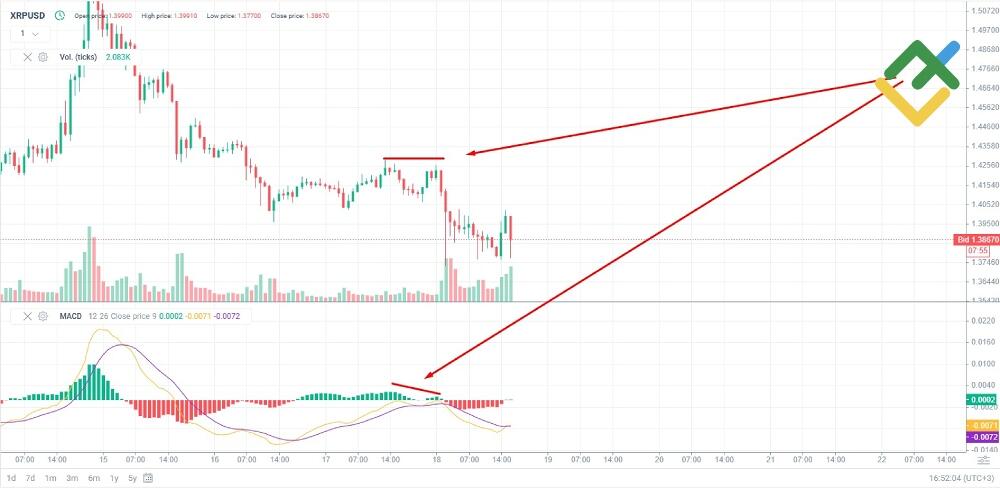
The XRP chart shows MACD divergence.
When the market is relatively calm, XRP often moves at its own pace and shows a weaker correlation with BTC than many other altcoins. It makes the asset less dependent on overall market sentiment and creates additional trading opportunities, making it a good choice for day traders.
The XRP order book is deep enough to execute average orders without significant slippage, and classic technical patterns—such as Flags, Double Tops, and Double Bottoms—regularly appear on the charts. Average daily volatility typically ranges from 3–5%, while major news events can trigger price fluctuations exceeding 10% and are often accompanied by a sharp increase in futures open interest.
Solana (SOL)
Solana has seen high trading volumes over the past month: approximately $100 billion in the spot market and $300–400 billion in the futures market. The launch of an ETF also reflects growing demand from institutional investors.
The asset is characterized by high intraday volatility: movements of 5–7% per hour occur quite regularly, especially during surges in meme coin activity or news about network scaling. At the same time, the order book remains deep enough to maintain a narrow spread even near psychologically significant levels.
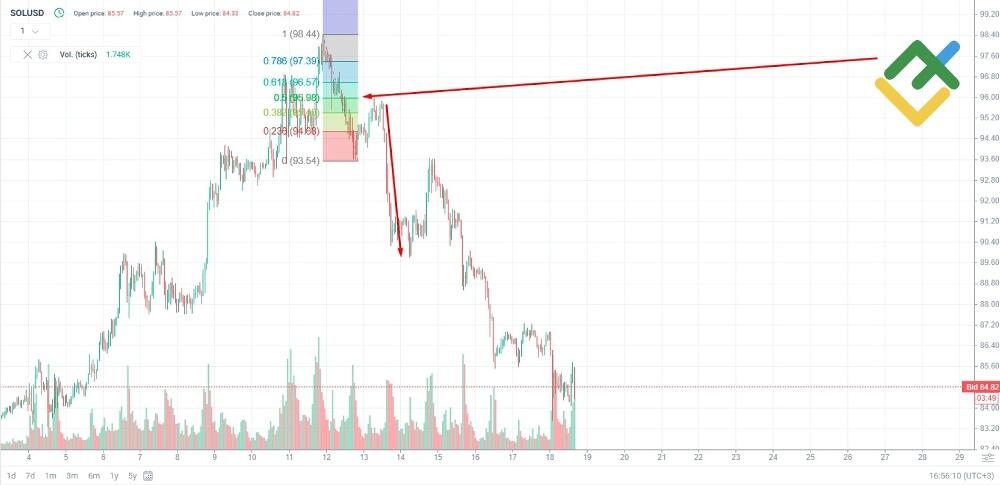
The SOL chart displays a retracement to the 0.5 Fibonacci level followed by a decline.
The Solana ecosystem quickly adapts to protocol updates and the launch of new projects, which regularly leads to increased trading volume and strong price momentum. In a bull market, SOL often outperforms many altcoins, and during corrections, it frequently returns to key moving averages more quickly.
Technically speaking, Fibonacci levels and the EMA20 and EMA50 on SOL charts often act as key support and resistance zones, and high trading volume reduces the likelihood of sharp manipulative moves.
Binance Coin (BNB)
BNB is closely tied to the Binance ecosystem. The asset's futures trading volume exceeds $150 billion, while the spot market hovers around $45 billion. Token burns, the Launchpad, and the listing of new coins regularly trigger local spikes in activity.
Average intraday volatility is typically 3–5%, so BNB is considered a moderately volatile asset. At the same time, the coin often exhibits classic trend-continuation patterns and has fewer false breakouts than many altcoins.
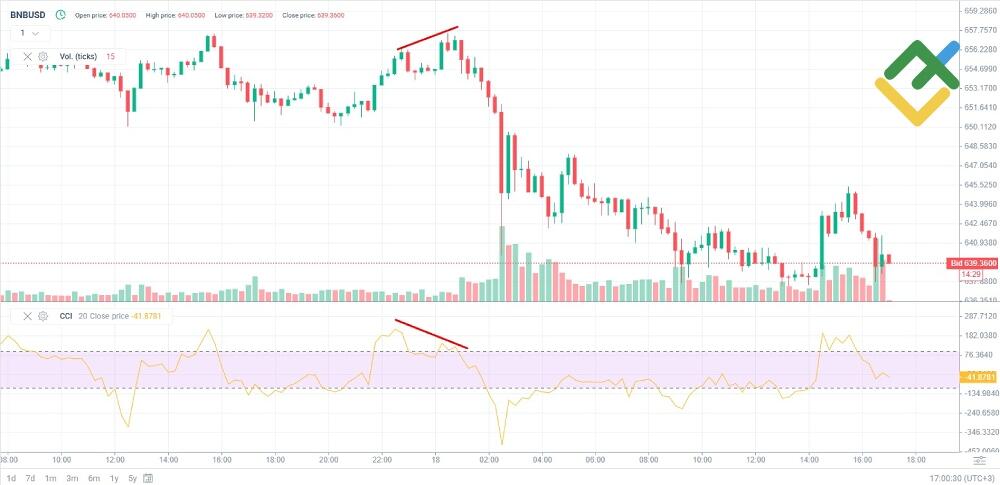
The BNB chart shows the CCI divergence.
High liquidity and tight spreads mean you can open large positions and minimize slippage. Binance news and changes to the exchange's fee policy also influence prices.
Dogecoin (DOGE)
Despite its status as a meme coin, Dogecoin maintains high trading volumes: futures trading volume exceeds $100 billion per month, while spot trading volumes range from $35 billion to $50 billion.
DOGE is highly sensitive to news, with posts from well-known figures and surges in social media activity capable of triggering 10–20% price swings within minutes. Despite this, liquidity generally remains high enough for rapid order execution, although spreads may temporarily widen during periods of intense demand.
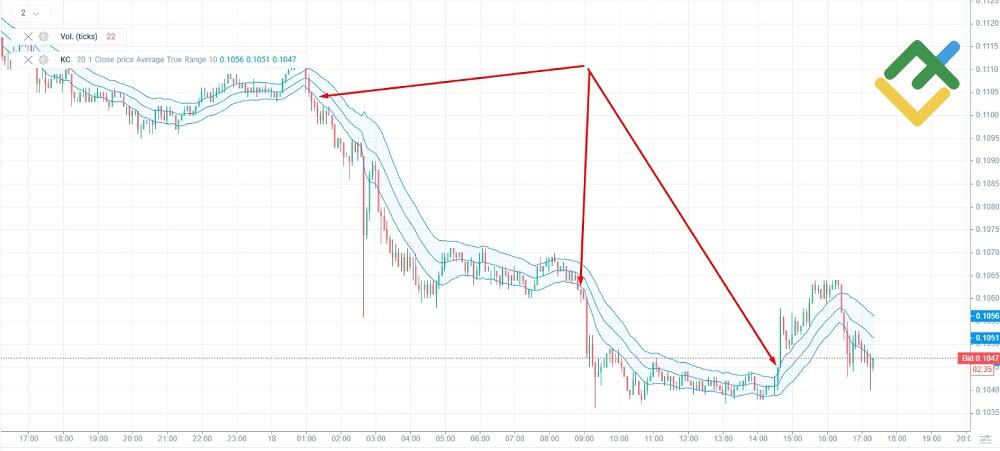
The DOGE chart demonstrates a sharp breakout of the Keltner Channel.
DOGE often moves independently of other major cryptocurrencies and can show strong momentum even during periods of general market lull. After sharp price movements, it often enters a consolidation phase, with trading volume gradually declining.
DOGE's average daily volatility is around 3% during calm periods and can exceed 20% during news-driven hype, making the asset a high-risk trading opportunity.
TRON (TRX)
TRX maintains spot trading volumes of $20–$25 billion and futures trading volumes exceeding $50 billion per month. The asset often moves independently of the overall market trend, making it an attractive choice during periods of consolidation in the crypto market.
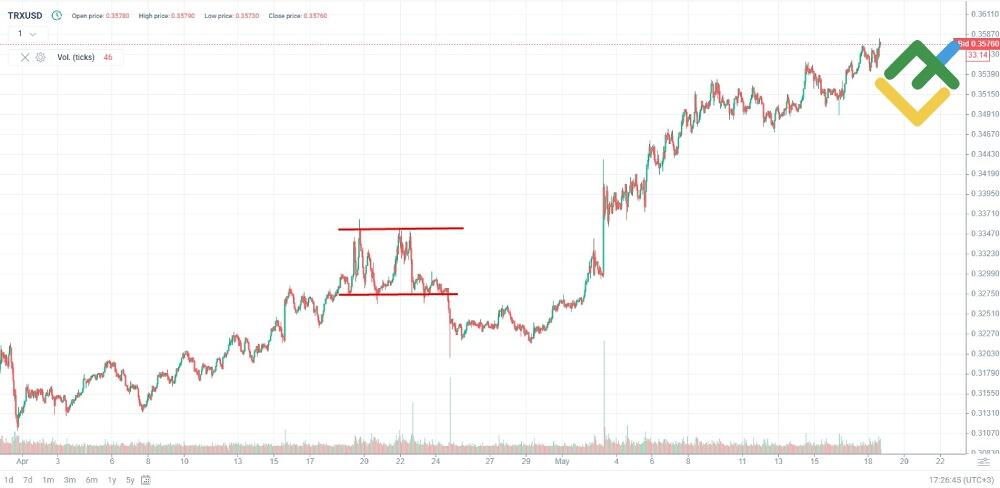
The chart shows TRX trading sideways.
The Tron ecosystem has become one of the key platforms for USDT transfers, which supports steady demand for the token. Intraday movements in TRX are typically smoother and come with fewer chaotic spikes and dips compared to many altcoins.
Average daily volatility is 2–4%. On the hourly chart, TRX often forms steady trends with clear corrections. Volume clusters often act as reversal points, and a breakout through them can accelerate price movement. The narrow spread makes the asset comfortable for trading with a moderate position size.
Sui (SUI)
SUI is a relatively new asset with a strong bias toward the futures market: spot trading volumes range from $4 billion to $6 billion, while derivatives trading volume exceeds $80 billion. These figures reflect high speculative demand for the coin.
SUI's intraday volatility reaches 8–15%: price movements often occur in sharp spikes, and corrections are just as rapid. Move technology and the development of the DeFi ecosystem are driving investor demand for the asset.
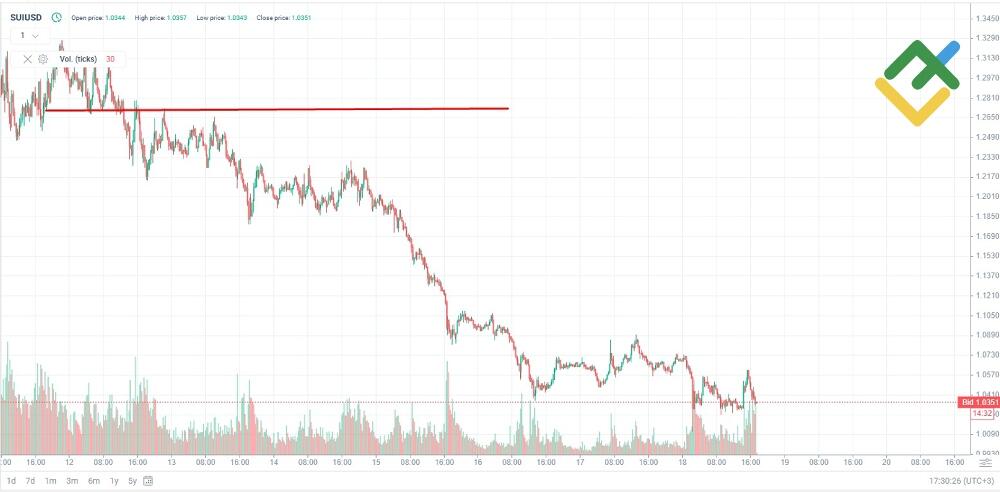
The SUI chart displays how the price reacts to a resistance level.
News about partnerships and network updates regularly trigger significant price movements. At the same time, high leverage in the futures market can trigger a cascade of liquidations.
Liquidity in the derivatives market remains high, but the spread in the spot market periodically widens.
Hyperliquid (HYPE)
HYPE is the native token of a decentralized exchange focused on trading perpetual contracts. Monthly spot trading volume stands at $7–$9 billion, while derivatives trading volume is significantly higher.
The price of HYPE reacts actively to Hyperliquid's internal metrics: user growth, protocol updates, and the launch of new trading pairs. Intraday, the asset often shifts from tight consolidation to sharp 5–10% moves, then returns to accumulation.
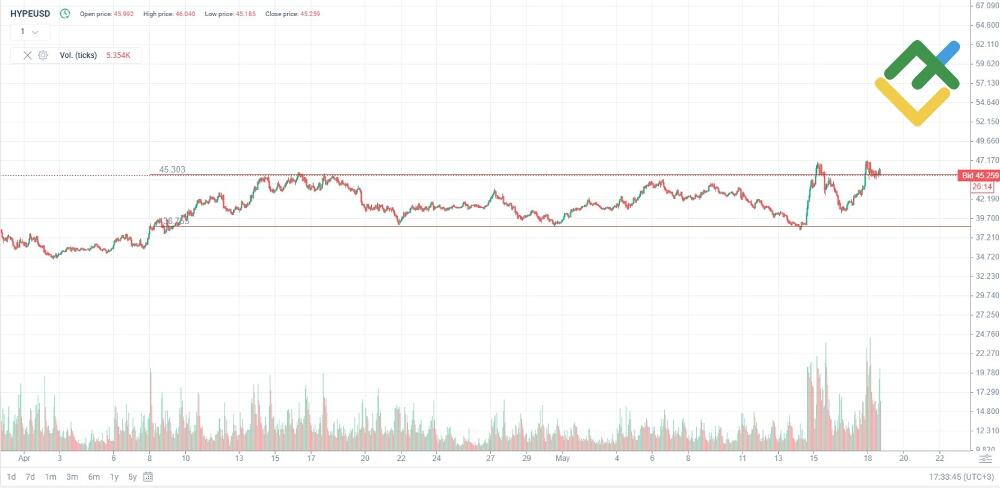
The Hype coin is trading in a sideways range.
The blockchain's transparency makes it possible to track the activity of large wallets and gauge market sentiment. HYPE typically has a wider spread than major cryptocurrencies, but pronounced trends partially offset this drawback.
Another factor driving demand for the asset is the project's tokenomics, which could support the coin's continued appeal.
Chainlink (LINK)
Chainlink maintains a futures trading volume of over $40 billion, with a spot trading volume of $1–$2 billion. The asset attracts investors thanks to news about oracle technology, integrations with traditional finance, and the development of cross-chain protocols.
Such events often trigger directional movements that can last several hours. LINK’s average daily volatility is 4–7%, and price movements are typically smoother than those of highly speculative assets.
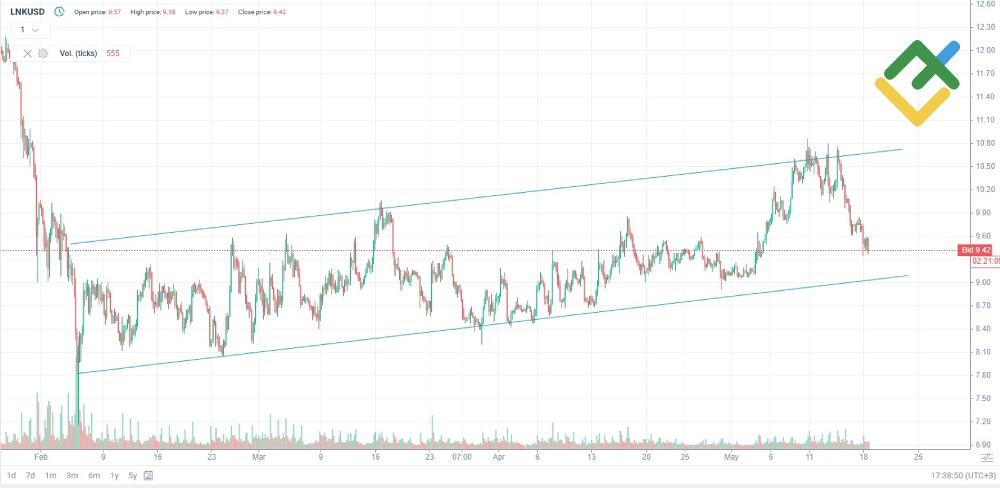
The LINK chart shows an ascending trading channel.
The LINK chart often accurately tracks historical levels and key zones. Its moderate correlation with BTC makes the asset attractive during periods when altcoins begin to diverge from BTC's trajectory.
Additional news momentum is driven by the development of CCIP and partnerships with major financial institutions, which regularly boost the coin's intraday trading activity.
Conclusion
Choosing the right asset is the foundation of profitable intraday trading. Without high liquidity and sufficient volatility, even high-quality analysis rarely yields consistent results. The coins in this selection present trading opportunities every day, but no single instrument guarantees gains.
It is important to understand the relationship between trading strategies and asset selection. This approach helps transform market noise into more systematic and controlled trading. Advanced trading begins with understanding how cryptocurrencies respond to news, trading volume, and price fluctuations, rather than predicting market movements.
Starting with observing selected major trading pairs, keeping a trading journal, and testing different strategies. Over time, the market will become more predictable as you gain experience.
For beginners, copy trading can be a viable alternative, though it should be approached with caution, taking into account risks, competitive fees, and potential capital drawdowns.
Best Crypto For Day Trading FAQs
Bitcoin and Ethereum remain the market leaders thanks to their exceptional liquidity, transparent order books, ETF support, and high trading volumes on the CME. Among altcoins, HYPE, Solana, and Dogecoin are performing well for intraday trading—their intraday volatility regularly exceeds 5%, creating numerous trading opportunities.
The cryptocurrency market is well-suited for intraday trading strategies thanks to its 24/7 operation and high volatility. The constant flow of news and high trader activity regularly generates strong price movements, which are much less common in traditional stock markets.
First, choose two or three liquid coins, study their performance on higher time frames, and identify key levels. After that, you can move on to analyzing 5- and 15-minute charts as part of your chosen trading strategy.
Scalping is considered one of the most profitable strategies, but it requires intense concentration, experience, and strict risk management. Breakout trading confirmed by volume often yields more consistent results: building a position within a range, entering on a breakout, and gradually taking profits.
Among major assets, Solana and HYPE are often characterized by high volatility—their intraday price fluctuations can reach 8–15%. Dogecoin also regularly experiences sharp price swings in response to news and social media activity.

The content of this article reflects the author’s opinion and does not necessarily reflect the official position of LiteFinance broker. The material published on this page is provided for informational purposes only and should not be considered as the provision of investment advice for the purposes of Directive 2014/65/EU.
According to copyright law, this article is considered intellectual property, which includes a prohibition on copying and distributing it without consent.