Time is the most valuable resource of a trader. Every trader wants to get the result as quickly as possible. Not everyone, especially a beginner, is ready to wait for hours, or even days, for the result of open trade, and therefore closes the position as soon as the first profit appears. The strategy of earning on trades that are kept open for only a few minutes in order to make a quick profit that covers the spread is called “pipsing”. What is scalping and pipsing, what are the advantages and disadvantages of such strategies, what indicators should a day trader use for pipsing - you will learn that and much more from this overview.
The article covers the following subjects:
Everything you wanted to know about pipsing strategies and more!
Pipsing or scalping?
As practice shows, beginners in Forex consider these concepts to be identical, not understanding the fundamental difference. Nevertheless, there it is. Both pipsing and scalping are forms of short-term forex trading when trades are kept open for several minutes in the market. Pipsing and scalping have a lot in common, however, the differences in the strategies are the reason for different trading approaches that determine the effectiveness of trading.
Who are pipsers and in what way are they different from scalpers?
A pip is the same as a percentage point, that is, the minimum unit for quotes measurement equals to 1/100 per cent (or 0.0001). The name "pip" is an acronym for "percentage in point". Pipsing is called the way it is because it uses these smallest units of price measurement. The pip size can have non-standard values, this should be indicated in the broker's specification. On average, currencies move about 50-60 points during the day, if you look at the daily opening and closing prices. Although exchange rates do not always rise or fall, fluctuations within the day necessarily occur, which gives dynamics for manoeuvres.
A pip is the same as a percentage point, that is, the minimum unit for quotes measurement equals to 1/100 per cent (or 0.0001). The name "pip" is an acronym for "percentage in point". Pipsing is called the way it is because it uses these smallest units of price measurement. The pip size can have non-standard values, this should be indicated in the broker's specification.
- Pipsing on Forex is the fastest possible trading, executed on the minimum price fluctuations, the profit from which is achieved due to the maximum possible (technically and psychologically) number of trades.
Pipsing is a rather complicated trading approach but many novice traders practice it. The method is aimed at making a profit from price fluctuations during the day. Some traders make more than 200 trades per day keeping each new position open for just a few minutes. The profit from each position is quite small (it barely covers the spread), but it is possible to hit the jackpot. For example, if classic intraday strategies may earn 50-100 points per day under good circumstances, scalpers and pipsers can get 1.5-2 times more. True, not all of them and not always.
General idea and drawbacks of pipsing strategies
The idea behind pipsing is earning on exchange rate fluctuations, regardless of the direction of price movement. Wherever the price moves, the trader must manage to open a deal, place orders and close it in such a way as to obtain profit that covers the spread. From here, one can formulate several theses (basic rules and trading methods):
- Short stop order. To achieve the result, you need to set the stop loss as close as possible to the trade opening price (remember that stop loss is necessary to reduce risks if the price moves in the opposite direction). Pipsing provides a minimum profit from each trade because a trader simply cannot afford a long stop. In this case, one deal closed with a long stop order will eliminate ten profitable ones.
- Instant closing of losing trades. It makes no sense to hope that a losing trade will turn into a profitable one in time. "Overholding" does not comply with the principles of pipsing. Losses are inevitable here and you need to be able to close losing trades without the slightest regret.
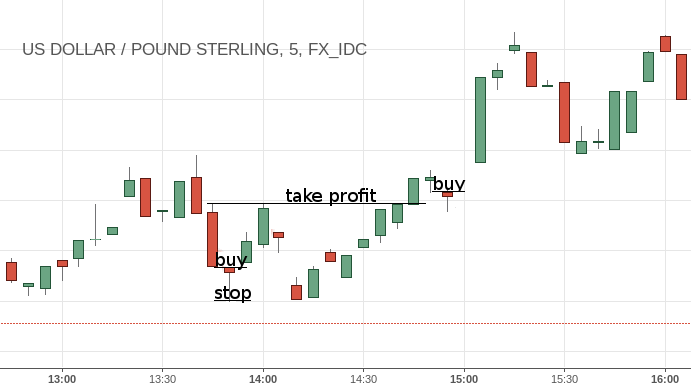
Here lies an almost psychological catch: you can lose even on slight price fluctuation. Even if it was possible to predict the further direction of the trend, the probability of loss is still very high if the rear bull or bear forces in the market were not detected in time.
Add to that emotional excitement and nervousness which are typical for most traders. Anxiety intensifies with each trade, and there are usually up to 200 of them per day.
Problems of pipsing strategies:
- Lack of stable earnings. When pipsing, a trader earns on the chaotic movement of prices or on fundamental volatility. And less often on a trend, which is logical: what kind of trader will close a profitable trade after catching the beginning of a trend? But then such a strategy is turning from pipsing into intraday. In long-term strategies a comprehensive analysis can predict the direction of the price with a probability of more than 50%, pipsing strategies in terms of profitability are unpredictable. Luck plays a big role.
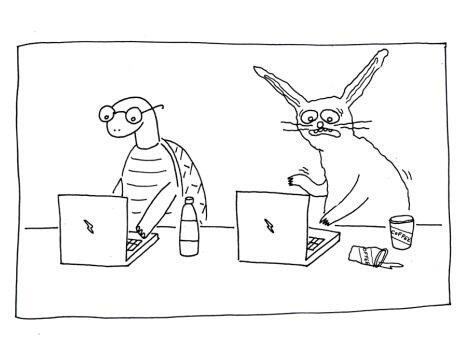
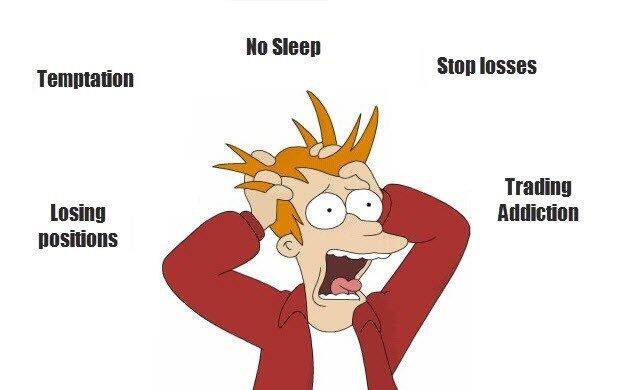
- Psychological and emotional overstrain. It makes no sense to keep only one open trade - time does not pay off. A trader must open several trades in different currency pairs at the same time, monitor them and close them when the time has come. It is exhausting. Greed, anger, regret - emotions distract, make it difficult to concentrate.
- The difficulty of trading during flat. In a calm market with a horizontal price movement, you will not earn much. Sometimes the amplitude of fluctuations is so small that earnings "eat up" the spread. The ideal trading moment for a pipser is volatility with large amplitude or a distinct trend.
- The inability to test strategies on historical charts. Its results will not correspond to what you will see on the real account. The only small advantage of testing is the ability to see the ratio of profitable and unprofitable trades.
- The psychological problem remains the main "drawback". Losses in pipsing on minute time frames are inevitable (the questions are: how many and how large), but accepting them is something that should be worked on before starting trading. Some tips from professionals:
- Do not display the deposit balance. Pipsers count profitable and losing trades by tracking their ratio. Information on the deposit distracts and demoralizes, pushing the trader to hold trades in the market longer, try to “win back”, etc.
- After a series of losses, stop trading. Take a break for 5-15 minutes. Determine the length of one session yourself.
Analyze losing trades at the end of the day. Despite the randomness of short-term price movement, you may find patterns. Remember that in high-speed trading, concentration is important. Nothing should distract and unbalance. This is already 50% of success.
Despite the fact that there are no pipsers among successful professionals, everyone should try pipsing. Many of those who have lost deposits through pipsing curse it, but still acquire a lot of new skills and knowledge, which now help them with scalping or positional trading. Pipsing is becoming easier and more profitable with the development of web technologies and automation, .
Pipsing is an accelerator of professionalism. Perhaps, you will lose all your money and nerves but you will become much more focused in your day trading. Two or three days of such self-flagellation and you are a Jedi.
Advantages of pipsing strategies:
- Compatibility with other types of strategies. Most often, traders choose intraday or long-term strategies as their main strategies. But signals for such strategies appear once in a couple of hours (on average). Pipsing on M1 in anticipation of signals on higher timeframes is an option for relaxation and entertainment. At least, this is how you need to set yourself up so that a possible momentary loss does not spoil the mood before the main trading session.
- The need for minimal knowledge of theory. A deep knowledge of technical analysis is not necessary here, you simply do not have time to apply it. There are enough simple indicators you can use as auxiliary ones. Fundamental analysis will come in handy for sure. However, there is a category of traders that simply catches price fluctuations in both directions, correctly placing orders and not going into the reasons for these fluctuations.
- The accumulation of experience. By practising the speed of placing orders and constantly monitoring the price movement, the trader delves deeply into the principles of his behaviour. He begins to feel it, to develop his intuition.
Pipsing in Forex is not so much a method of earning as a great simulator. After passing this stage, you can switch to more complex long-term strategies, increasing the deposit and trade volumes.
General pipsing strategy
- You can use pipsing in any direction, but it is better to follow the trend first. How to learn to determine the beginning and end of a trend is a topic of a separate review. And if you are interested in this topic, be sure to write about it in the comments.
- Fundamental analysis is pipser's best friend. Making money at the time of a flat is difficult because price fluctuations in some currencies are so small that they do not cover the spread. Significant fundamental news in most cases is never perceived in one way by all traders. Therefore, the price moves randomly in both directions in the first hour, but with an amplitude that allows you to earn.
- Do not try to cover several tools at once. Learn to feel the market through one pair. Analyze how the price behaves throughout different sessions, during various fundamental events, etc.
- The amount of your deposit should be 100-200-300 dollars, large deposits are not needed here. Since a pipser catches the slightest price change, the leverage here is used as much as possible.
Below is an example of the simplest strategy for pipsing using the moving average for a demo account, which can be taken as a basis for training and creating a working strategy.
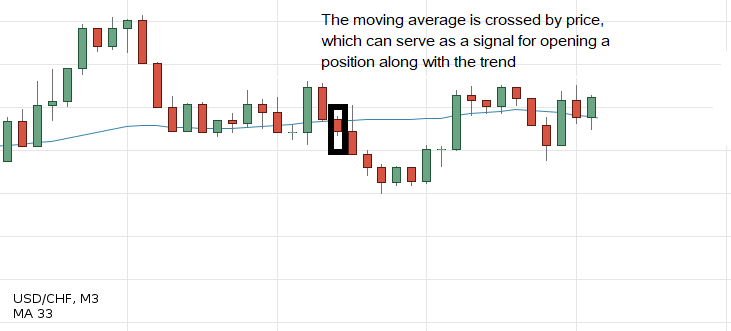
Open a position on the price pullback. Follow the trend on timeframes from M1 to M15. Exit with a loss of 5 points or a profit of 7. Position volumes should not be more than 5% of the deposit for 1 point.
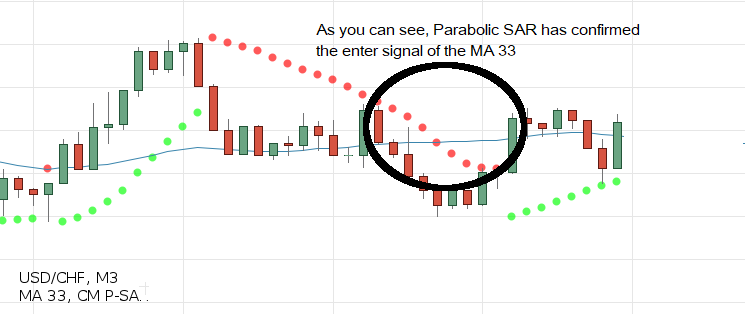
You can try to trade with experts, and with additional indicators for pipsing. MA performs quite well together with Parabolic SAR, but as with any other indicator, the question is, what parameters will be the right ones for this or that currency pair.
It’s not so easy with pipsing automatic advisors. Every second is important when you open and close trades, so the launch of trading advisors seems logical, but you need to keep in mind the following things:
- Not all brokers are “delighted” with the use of robots in pipsing strategies. Advisors send dozens of automatic requests to the server and they overload the server.
- Robots are “lost” at the moment of a fundamental surge. They look for signals according to the established algorithm, relying on similar situations in the past. They show the greatest number of false signals at the time of news releases.
The best alternative to trading advisors for pipsing is manual trading, but with the use of scripts that simplify it. For example, those that show information on several timeframes and different currency pairs simultaneously or those that close all orders, etc. That is, the task of scripts is to facilitate the trader's perception of information and save time but the trader must analyze the market situation and make a decision on his own.
What is important to remember:
- The recommended timeframes are M1-M15. You can also use higher intervals as auxiliary ones, for example, to search for a strong trend. But the main trading happens at minute timeframes.
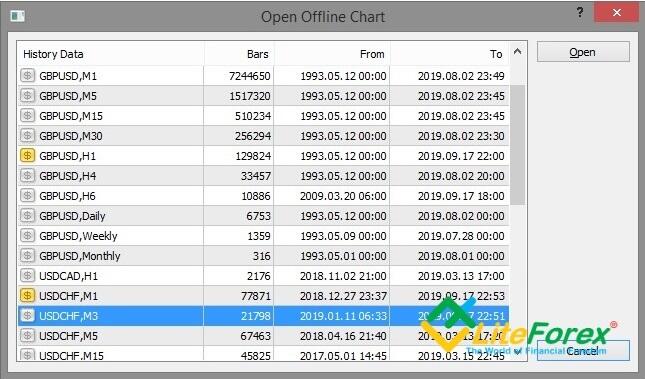
However, no one forbids using non-standard timeframes. This can be done using a script that is already embedded in MT4, but for some reason, few people know about it. For example, let's try to set the M3 timeframe:
- Go to the "Navigator" and find the PeriodConverter script.
- Drag the script to the chart of the currency pair - you will see a window with the settings.
- In the “Common” tab, set the settings as shown in the screenshot.
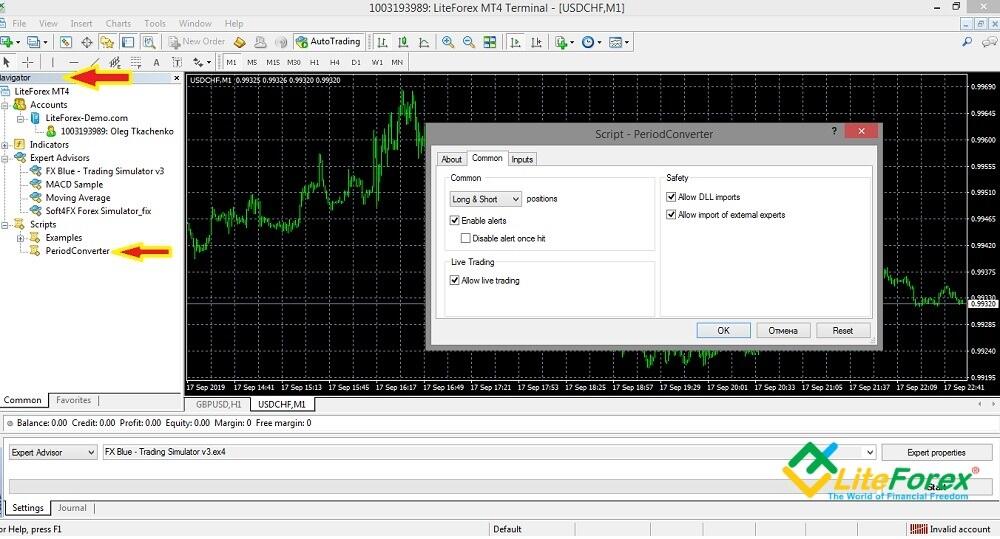
- In the tab "Inputs" indicate the period multiplier factor. For example, to get the M3 interval from M1, put "3". If the base period is M5 and you need to get M45, specify “9” (5 * 9 = 45).
- Open the menu "File/Open offline chart". There are existing currency pairs and timeframes in the window. Find the created period and run the script.
- Minimize risks. 200 trades is not an urgent daily rate, but rather a ceiling. Remember - quality is important, not quantity. The question is which trading style will you choose:
- Opening multiple trades on one pair during the day.
- Opening multiple trades on several instruments in a short period of time simultaneously.
The first option implies less strain on the eyes, emotions and mind. Sometimes a trader simply does not have time to keep track of several daily charts at the same time. The second option is more effective, although more difficult. For many instruments, at the moment of a fundamental surge (news release or major meeting), a direct or inverse correlation is clearly visible. You can open trades for several assets simultaneously. This also applies to commodity and stock markets.
- It is extremely important to execute orders quickly, so we trade on NDD and ECN accounts. There is a difficulty: demo-accounts are slower at executing orders. In addition, a demo account is just a market model for simplified trading. Therefore, a strategy used on a demo account will not work just as effectively on NDD/ECN accounts.
Use pipsing in calm markets - it works best at night, during the Pacific session. It also depends on the currency pair itself. Sometimes, traders show the best results on EUR/USD in the European session.
- Prefer floating spread to exit trades quickly and have minimal spread during low market volatility.
- Use pipsing on the main currency pairs - due to volatility and minimal spreads. On the "exotic" pairs with low liquidity pipsing will not work.
Conclusion. Any type of trading has two sides to it. Pipsing in Forex allows you to earn on insignificant price fluctuations, on the market noise which is considered an unpredictable factor for intraday strategies. On the other hand, the trend is less predictable on lower timeframes, and the need for a constant market watch is emotionally exhausting. Pipsing indicators do not solve the problem.
So:
- For beginners, pipsing in Forex is training endurance, reaction, mastering skills and gaining experience. Yet, it is not for earning.
- For professionals, pipsing in Forex is an exciting, gambling strategy, which can also turn out to be highly profitable. It quickly shows weaknesses in approaches to trading, allowing you to optimize your existing trading methods.
For anyone who is interested in strategies for pipsing and scalping, I recommend reading this article, where, apart from theory, screenshots and indicator templates, trading strategies are analyzed. And of course, if someone has tips or questions, join the discussion in the comments!
P.S. Did you like my article? Share it in social networks: it will be the best "thank you" :)
Useful links:
- I recommend trying to trade with a reliable broker here. The system allows you to trade by yourself or copy successful traders from all across the globe.
- Use my promo code BLOG to get a 50% deposit bonus on the LiteFinance platform. Simply enter this code in the appropriate field when funding your trading account.
- Telegram chat for traders: https://t.me/litefinancebrokerchat. We are sharing the signals and trading experience.
- Telegram channel with high-quality analytics, Forex reviews, training articles, and other useful things for traders https://t.me/litefinance

The content of this article reflects the author’s opinion and does not necessarily reflect the official position of LiteFinance broker. The material published on this page is provided for informational purposes only and should not be considered as the provision of investment advice for the purposes of Directive 2014/65/EU.
According to copyright law, this article is considered intellectual property, which includes a prohibition on copying and distributing it without consent.