Every beginner trader or investor eventually asks the question: how many trading days are there in a year? This figure is used, for example, to calculate annual returns and volatility. There are significantly fewer stock market trading days than the 365 calendar days in a year, and the exact number varies by country and exchange, depending on the applicable trading calendar. Understanding the trading calendar helps traders plan their trades more accurately, account for market closures, and manage their time more effectively when day trading or investing for the long term.
The US stock market, for example, has around 252 trading days per year on average, although this figure varies across the world's major exchanges. For accurate calculations, account for weekends, exchange holidays, and shortened trading days (half-days).
In this article, we will take a detailed look at how many trading days there are in a month, what factors determine an exchange's working days, and why 252 trading days has become a widely accepted benchmark in financial markets. Understanding these details is important for successful trading in international markets and effective risk management.
The article covers the following subjects:
Major Takeaways
On average, US stock exchanges have around 252 trading days per year. This figure is calculated by subtracting exchange holidays from the number of weekdays. The exact number of trading days varies from year to year depending on the calendar.
The number of trading days directly affects the calculation of portfolio returns, volatility, and risk metrics. For example, when annualizing average daily returns or volatility, 252 trading days are normally used rather than 365 calendar days. This provides a more accurate way to assess investment performance and compare results across different periods.
The figure of 252 has become widely accepted in financial practice as the average number of trading days in the US market per year. A typical year has around 260–262 weekdays, some of which fall on holidays.
To calculate the number of trading days yourself, use the calendar of the relevant exchange for the year in question. Start with the number of calendar days, exclude Saturdays and Sundays, and then subtract official holidays when the exchange is closed, such as New Year's Day, Independence Day, Christmas Day, and others. Some holidays may fall on weekends, in which case the holiday may be observed on the preceding Friday or following Monday.
The NYSE and Nasdaq are typically closed on New Year's Day, Martin Luther King Jr. Day, Presidents' Day, Good Friday, Memorial Day, Independence Day, Labor Day, Thanksgiving Day, and Christmas Day. The exchanges are also closed on Juneteenth in June (a US federal holiday commemorating the end of slavery). Some federal holidays, such as Columbus Day, are not exchange holidays, so trading continues as usual.
The number of trading days varies by country, exchange, and year. The London Stock Exchange, Tokyo Stock Exchange, Shanghai Stock Exchange, and European exchanges in Frankfurt and Paris follow their own trading calendars. National holidays and extended holiday periods affect the number of trading days, including Golden Week in Japan, Chinese New Year, and China's National Day.
How Many Trading Days in a Year?
Major US exchanges, including the New York Stock Exchange (NYSE) and Nasdaq, have an average of around 252 trading days per year. The number of trading days is calculated by taking the number of weekdays and subtracting official exchange holidays. Therefore, the number of trading days in a year depends on the specific trading calendar and may vary slightly from year to year.
Trading days are not always full trading days. On some days, exchanges have shortened trading hours and close earlier than usual, for example, before Independence Day or after Thanksgiving. However, Christmas Eve is not always a shortened trading day: trading hours depend on the day of the week and the calendar for that particular year.
For swing traders and investors, this distinction is important because weekends and exchange holidays create gaps between trading sessions. Futures and forex markets follow different schedules, with trading available almost around the clock on weekdays. If you need to calculate the number of trading days for your portfolio, the easiest way is to use the official trading calendar of the relevant exchange and exclude weekends and exchange holidays.

Major global markets follow their own trading calendars. For example, the London Stock Exchange LSE observes UK bank holidays and Christmas holidays. The Tokyo Stock Exchange has fewer trading sessions due to Golden Week and other national holidays. The Bombay Stock Exchange also observes Indian public holidays. Therefore, the exact number of trading days on these exchanges must be determined separately for each year.
Thus, the answer to how many trading days there are in a year depends on the specific exchange and calendar year. In the US, the number of trading days is affected by Presidents' Day, Good Friday, Memorial Day, Labor Day, Thanksgiving Day, Christmas Day, and other exchange holidays. Therefore, 252 trading days is not a fixed figure but a widely accepted annual average.
Why Trading Days Matter
The number of trading days directly affects volatility calculations and day trading strategies. Many metrics, including average daily returns and technical indicators, are calculated based on trading sessions. When working with historical data, it is important to account for non-trading days correctly and, where necessary, exclude weekends and holidays to avoid distorting analysis results.
Annualized volatility is often calculated from daily volatility by multiplying it by the square root of 252, the average number of trading days in a year. For swing traders who hold positions for several days, weekends pose additional risk: while the market is closed, macroeconomic conditions and other factors may change, potentially leading to a price gap when the market reopens.
The number of trading days in a month is also important when planning trades. However, it would be incorrect to assume that volatility is necessarily higher in months with fewer trading days, such as February or December. Volatility depends on many factors, not just the number of trading sessions.

Even in futures markets, where trading may take place almost around the clock on weekdays, the trading calendar remains an important reference for determining contract expiration dates and scheduling other operations. Extended trading hours increase the amount of time available for trading but do not increase the number of trading days. Traders also need to account for time zones, including Eastern Time.
For traders on the New York Stock Exchange, the regular trading session begins at 9:30 a.m. Eastern Time. When trading in international markets, traders need to account for differences in time zones and trading calendars, as the number of trading days may vary across exchanges. Understanding these differences helps traders plan their trades more accurately and manage risk.
Day trading is particularly dependent on the exchange schedule and market closing time, as positions are typically closed before the end of the trading session. Swing traders can use the trading schedule to account for the risks of holding positions over extended holiday periods. Therefore, the exchange trading calendar is an important factor when planning a trading strategy.
Why 252 Trading Days?
The figure of 252 trading days is not fixed but a widely accepted benchmark commonly used in financial calculations for the U.S. stock market. Where does it come from? A typical year has 365 calendar days. After excluding around 104 Saturdays and Sundays, approximately 261 weekdays remain. Official exchange holidays, such as New Year's Day, Independence Day, Christmas Day, and others, are then excluded as well. As a result, the actual number of trading days varies from year to year, while 252 trading days is used as an approximate annual average.

This figure is convenient for financial calculations. Many formulas, including those for annualized volatility and the Sharpe ratio, use 252 trading days as the standard number of trading sessions in a year.
The number of trading days may differ in other major global markets, such as those in Europe and Asia. Therefore, when analyzing a specific market, it is more accurate to use the relevant exchange's calendar, although financial models often use 252 days for standardization. However, it would be incorrect to say that annual returns are always calculated using 252 trading days: the calculation method depends on the data and financial instrument used.
The number of trading days in the US is affected by US holidays when exchanges are closed. These include Presidents' Day, Good Friday, Memorial Day, Labor Day, and Thanksgiving Day. These holidays reduce the number of trading days in a year.

Thus, 252 trading days is a benchmark representing the average number of trading sessions in the US stock market rather than an exact figure for every year. Futures markets have their own trading calendars and schedules, so 252 trading days should primarily be viewed as a standardized assumption used in financial calculations.
Shortened trading days still count as trading days, even though their sessions are shorter than usual. Thus, 252 trading days is a common standard used in financial market calculations, but actual trading days depend on the specific exchange and calendar year.
How to Calculate Trading Days
To find out how many trading days there are in a year on a specific exchange, use its official trading calendar for the year in question.
If you do not have the calendar at hand, you can calculate the number as follows:
Start with 365 calendar days, or 366 in a leap year.
Subtract weekends — Saturdays and Sundays. In a typical year, this leaves around 260–261 weekdays.
Exclude official exchange holidays. These may include public, national, and local holidays, depending on the country and exchange.
Account for shortened trading days. They still count as trading days, although the market closes earlier than usual — for example, in some years before Independence Day or after Thanksgiving. Christmas Eve may also be a shortened trading day, depending on the calendar.
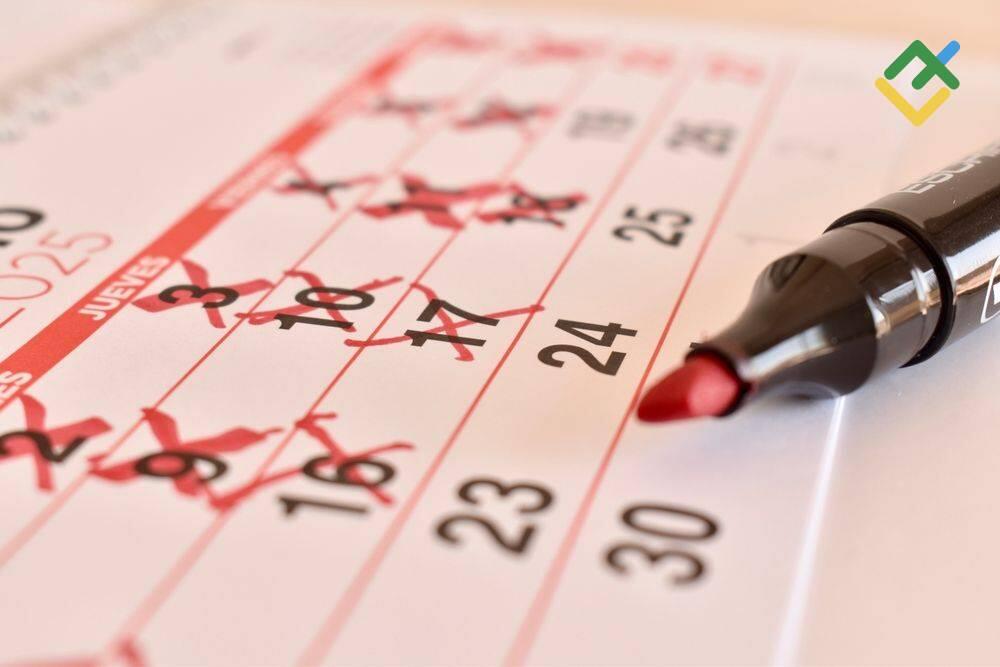
How do you calculate the number of trading days in a month? For a rough estimate, divide 252 by 12, which gives an average of 21 trading days. However, the actual number depends on where weekends and holidays fall in a particular month. Therefore, a month may have fewer or more trading days than the average. For an exact count, use historical data or the exchange's official calendar.
If you are a day trader, it is important to know the exact dates when the exchange is closed or closes early, as these schedule changes can affect liquidity and spreads. Futures markets have separate calendars and schedules that reflect the specifics of their trading sessions. You can also use online calculators to determine the number of trading days for a specific year and exchange.
When trading in international markets, account for differences between exchange calendars. Regular trading hours in the US stock market, such as 9:30 a.m. to 4:00 p.m. Eastern Time, differ from extended hours, which include pre-market and after-hours trading. These additional trading hours do not increase the number of trading days.
Another important point is that exchange holidays are not limited to Saturdays and Sundays. If a holiday falls on a weekend, the exchange may close on the nearest weekday, according to its calendar. Therefore, always check the relevant exchange's trading calendar for an accurate count.
Trading Days by Month
How many trading days there are in a month is an important consideration when planning your trades. The US stock market has around 21 trading days per month on average, although the actual number depends on where weekends and exchange holidays fall. Therefore, there is no fixed number of trading days in each month.
As a rough guide, the breakdown may look as follows:
January — around 20–22 trading days, excluding New Year's Day and Martin Luther King Jr. Day;
February — around 19–20 trading days due to the shorter month and Presidents' Day;
March — around 21–23 trading days;
April — around 20–22 trading days, excluding Good Friday when it falls in April;
May — around 20–22 trading days, excluding Memorial Day;
June — around 20–22 trading days, excluding Juneteenth;
July — around 21–22 trading days, excluding Independence Day;
August — around 21–23 trading days;
September — around 20–21 trading days, excluding Labor Day;
October — around 21–23 trading days;
November — around 19–21 trading days, excluding Thanksgiving Day;
December — around 20–22 trading days, excluding Christmas Day. Christmas Eve itself is not always a market holiday.
These variations matter when planning trades and managing risk. However, it would be incorrect to assume that volatility is necessarily higher in months with fewer trading days due to the concentration of trading volume. Volatility is influenced by many factors, including macroeconomic events, corporate news, liquidity, and market sentiment. For swing traders, the risk of price gaps after long holiday breaks may also be important.

Indian markets and the Tokyo Stock Exchange follow their own calendars, which account for national holidays, including Golden Week in Japan. In the US stock market, Thanksgiving has a notable impact on the trading schedule, as it falls on a Thursday. The following Friday is an early-close trading day: the regular session on the NYSE and Nasdaq typically ends at 1:00 p.m. Eastern Time. This means that during Thanksgiving week, three trading days have regular hours, one has shortened trading hours, and the exchanges are closed on Thursday.
For day traders, periods around major holidays require particular attention to potential changes in liquidity and spreads. Similar conditions may occur around Christmas. However, the number of trading days in December depends on the calendar for the particular year and does not necessarily fall to 18–19.
Historical data shows that the number of trading sessions in each month varies from year to year, so June, August, and October cannot definitively be described as the most active months, nor February and December as the quietest. Understanding these calendar-related differences helps swing traders and day traders adapt their strategies to the trading calendar.
US Stock Market Holidays
Exchange holidays are one reason there are fewer trading days in a year than calendar days. The New York Stock Exchange and Nasdaq are typically closed on the following holidays:
New Year's Day — January 1;
Martin Luther King Jr. Day — the third Monday in January;
Presidents' Day — the third Monday in February;
Good Friday — the Friday before Easter;
Memorial Day — the last Monday in May;
Juneteenth — June 19;
Independence Day — July 4;
Labor Day — the first Monday in September;
Thanksgiving Day — the fourth Thursday in November;
Christmas Day — December 25.

In addition to full-day closures, there are also shortened trading days. For example, trading may end at 1:00 p.m. Eastern Time before Independence Day, on the Friday after Thanksgiving, and on Christmas Eve, depending on the calendar for the particular year. On these days, regular trading hours are shortened, and liquidity and spreads may differ from normal levels. Day traders should take this into account when planning trades.
Traders should check weekends and exchange holidays in advance and account for them when managing positions and orders. Many US holidays when exchanges are closed fall on a specific day of the week.
For example, Memorial Day always falls on a Monday, creating a long weekend. Independence Day has a fixed date, but if July 4 falls on a weekend, the exchange may be closed on the nearest weekday, depending on its trading calendar. Good Friday is a movable holiday, and its date depends on the date of Easter.
All these factors should be taken into account when calculating the number of trading days. For accurate planning, traders should use the relevant exchange's official calendar for the year in question. However, not all US national holidays are official market holidays: trading continues on some federal holidays. However, the NYSE and Nasdaq are closed on Labor Day and Thanksgiving Day.
State holidays generally do not affect the US stock market schedule, as exchanges follow their own trading calendars rather than the federal holiday calendar. Market closures may also occur outside the regular calendar, for example, on days of national mourning, although such cases are rare. Therefore, knowing the exact dates of exchange holidays is important when trading in US financial markets.
Trading Days in Other Markets
How many trading days are there in a year on other major stock exchanges around the world? There is no single figure. Trading days differ across global stock exchanges, as each exchange follows its own calendar. The exact number also varies from year to year.
The London Stock Exchange observes UK bank holidays, including the Spring and Summer Bank Holidays, as well as Christmas holidays.
The Tokyo Stock Exchange is closed on a number of national holidays, including during Golden Week — a series of holidays in late April and early May — and on National Foundation Day.
Indian markets close on several public holidays throughout the year, including Diwali, Republic Day, and Gandhi Jayanti.
The Shanghai Stock Exchange also follows its own trading calendar. Extended trading breaks occur around Chinese New Year and National Day, among other holidays.
Thus, Indian markets, other Asian exchanges, and European exchanges follow different trading calendars. When trading in international markets, consider the trading calendars of all relevant exchanges. For example, Golden Week in Japan can affect the liquidity of certain instruments in the Asia-Pacific region. When trading futures or ETFs linked to foreign indices, traders should also consider the days when the underlying market is closed.
Different countries have their own local holidays, which fall on different dates. For example, India's Independence Day falls on August 15, but whether the exchange is open that day depends on its trading calendar. Labor Day, observed on May 1, is not necessarily a market holiday in India. Japan does not have Presidents' Day, but it does observe Coming of Age Day and Greenery Day.

Shortened trading days also vary by exchange. For example, the London Stock Exchange has shortened trading sessions on certain days before the Christmas and New Year holidays. Therefore, the trading calendar is an important tool for international traders.
National holidays fall on different dates in different countries, so the number of trading days varies across exchanges and from year to year. Each stock exchange publishes its own trading calendar, which traders should check when planning their trades.
Conclusion
Understanding the number of trading days is important for planning trades and financial calculations. The figure of 252 trading days is a widely accepted annual average for the US stock market, although the actual number varies from year to year. The number of trading sessions also varies across major global exchanges. To calculate returns and volatility accurately, traders need to account for exchange holidays, shortened trading days, and weekends.
A trading calendar helps traders plan their trades and account for periods when the market is closed or has shortened trading hours. Knowing how many trading days there are in a year on a particular exchange allows traders to make more accurate financial calculations and factor in risks associated with weekends and exchange holidays. Therefore, when developing trading strategies, check the relevant trading calendar and use the actual number of trading days.
FAQs
No. Forex operates 24 hours a day, five days a week, while the crypto market operates 365 or 366 days a year, including weekends. Therefore, the 252 trading days commonly used for the US stock market are not a universal standard for these markets.
There is no single figure. US stock exchanges have around 252 trading days per year on average, while on other exchanges the number varies. The difference is partly due to national holidays, so check the exact number using the relevant exchange's trading calendar.

The content of this article reflects the author’s opinion and does not necessarily reflect the official position of LiteFinance broker. The material published on this page is provided for informational purposes only and should not be considered as the provision of investment advice for the purposes of Directive 2014/65/EU.
According to copyright law, this article is considered intellectual property, which includes a prohibition on copying and distributing it without consent.