Paper trading is considered a throwback these days. Now there are already online terminals and forex testers, which help you significantly speed up market analysis and decision-making. On the other hand, paper trade helps the trader to discard the extra information flow from the indicators, news, and forecasts, typical for modern trading software, and focus on the main thing.
Currently, trading on paper is used to test a trading strategy. A trader writes down stock information and imitates making transactions but does not trade for real money.
The article covers the following subjects:
Paper Trading: Definition
Paper trading was widely used by advanced traders of the “first wave” due to the lack of online brokers and other technical tools for price analysis. Price information could only be obtained from a stockbroker or on the back page of a daily newspaper. The received data was recorded on paper, then traders analyzed the information and made trading decisions. The famous stock speculator Jesse Livermore wrote down the information on a special board, similar to a school one, and analyzed several instruments at once.
The decision was based on fundamental analysis, not technical, so the notes were used to find a more accurate entry signal within the expected global trend.
How to Paper Trade
In addition to pen and paper, you will need a source of information about stock prices. If the goal is self-learning and searching for patterns, then it is better to choose online sites where quotes are updated frequently. You can choose any timeframe, but record only the closing prices of the candles. To analyze the fundamental situation, it is enough to receive information about the closing price of an asset once a day.
To start paper trading, you will need the following data:
the initial balance of a paper trading account, a fictitious cash account. The change in the account balance will indicate the efficiency of the chosen trading strategy;
current asset price;
trade size — lot size or how many contracts are used in trade;
transaction parameters: direction (buy or sell), opening price, closing price, and financial result.
Using information about current prices, you can draw a chart and make decisions based on technical analysis.
Paper Trade Software
Instead of pen and paper, any spreadsheet software is suitable for keeping transaction statistics, such as MS Excel, and Google Spreadsheets, and their analogs.
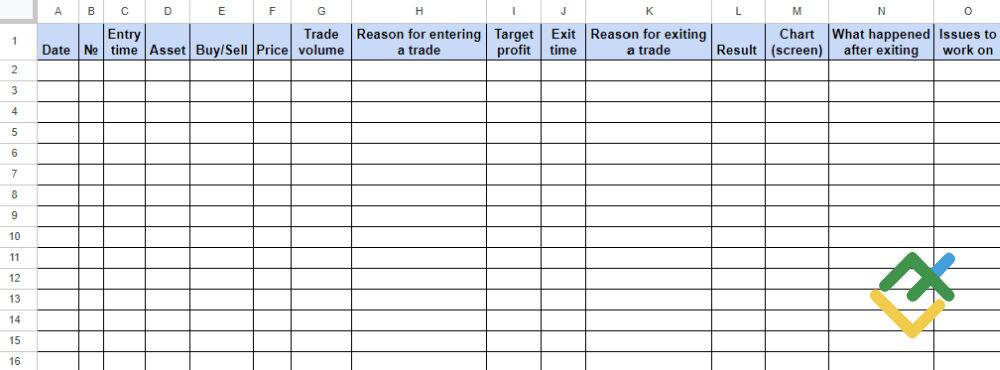
Figure 1. An example of a trader's diary in MS Excel
Trading skills from working with such programs will be useful in the future for keeping a trader diary of transactions with screenshots of opening and closing positions. Information about the prices of most instruments can be obtained from an online trading platform. For this, both standard platforms offering paper trade - MT4, MT5, Ninja Trader, and others - and browser-based web terminals are suitable.
LiteFinance web-terminal or mobile application
Web terminals as platforms for paper trade are the most convenient to use because the goal, in this case, is to get price information, not any kind of live trading. The web terminal does not require opening a demo account on your own or installing any programs. There are a large number of the same financial instruments that are available in classic trading software. Thus, a trader can choose to draw a chart on paper or transfer this function to the terminal and leave only statistics on a paper trading account for records.
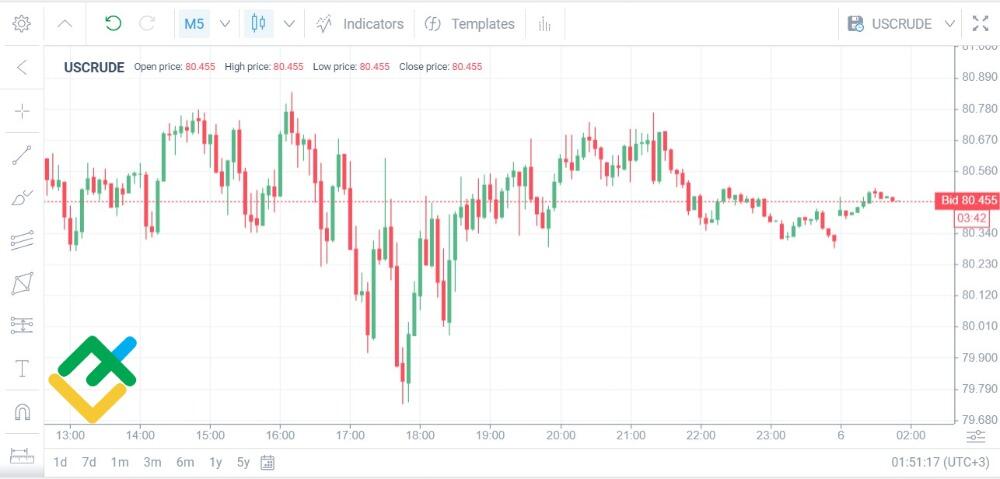
Figure 2. US crude chart in LiteFinance web terminal
Free applications for paper trading with smartphones can be used in the same way as a web terminal if you do not have access to a computer. However, you will need to open a demo account to use them. Conducting technical analysis will not be as convenient as when working on a computer, but access to online quotes will be stable
MT4 and MT5
The MT4 and MT5 are among the most popular paper trading platforms. These are standard software for desktop and mobile devices that have been proven over the years. For smartphones, this is one of the best free paper trading apps. It works more stable than the web terminal, but the interface will be more difficult for beginners to understand. Both platforms offer paper trading.
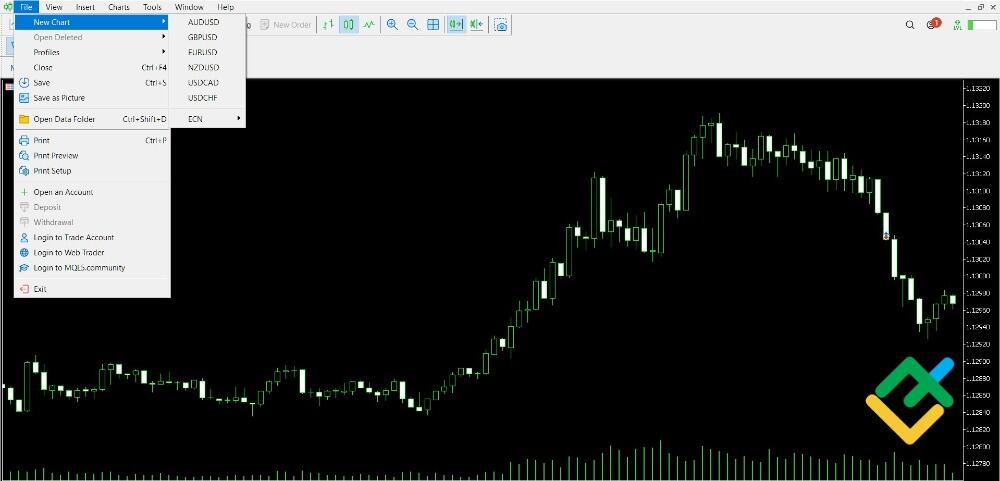
Figure 3. MetaTrader 5, adding available currency pairs
To receive quotes, you will need to open a demo account yourself, either within the program itself or through your personal account.
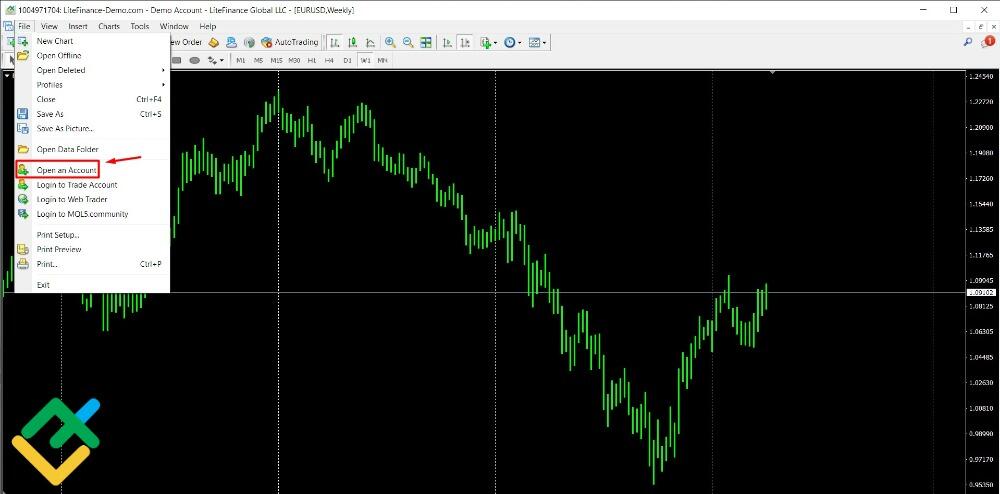
Figure 4. Metatrader 4, opening an account through the terminal menu
Programs can also be used to make paper trades for virtual money. In this case, after trading, data on closed positions can be transferred to the chart. This will allow you to take screenshots of transactions taking into account the market context. Thus, with MT4 and MT5, a trader can not only evaluate the profitability of a strategy but also study the validity of opening and closing a transaction in a given market situation.
NinjaTrader
NinjaTrader is one of the most popular simulated trading platforms. This online trading platform is used for trading stocks, futures, and other exchange instruments. NinjaTrader provides real-time quotes for instruments, it is possible to trade on a demo account, and a stock market simulator is also built-in. Therefore, this platform can be used both for paper trade and as a full-fledged alternative on PC. Also, this software allows you to evaluate how complex financial products are for a trader.
Advantages of Paper Trading
I am sure that 97% of traders will want to skip the paper trade stage, as it is not initially clear what benefit there is to “waste time” writing something down by hand. The mind is still not disciplined enough; beginners are usually set up for quick financial results. Paradoxically, manual recording effectively teaches the basics of trading, and traders “return to the beginning” only after a negative experience from an originally wrong approach :)
No risk
In paper trading, a trader does not risk real money because transactions are not made but simulated. At the same time, you can acquire valuable experience and trading skills for free, just like in real trading. There is no financial risk involved, and a trader is more emotionally protected, which allows them to focus on development and not on the negative of losing real money.
No stress
Imitation of trading allows you to make more informed decisions with a “cool head” and reduces the likelihood of non-systemic transactions. Thus, the share of system trades will be higher, which will allow us to evaluate the effectiveness of the trading strategy and not the “trading strategy + trader’s emotions” combination.
Developing discipline
Trading is a routine job that requires constancy in making trades according to a trading strategy. The reason for non-systemic transactions in the real stock market or Forex, as a rule, is the emotional response of the trader. The time devoted to paper trade pushes emotions into the background, and the trader learns to perform certain routine things methodically. As a result, emotions are no longer a priority when making trading decisions.
Attention focus on important things
When a trader has only a pen and paper, he/she will not have the time or desire to finish drawing indicators, lines, angles, and other tools that are not related to market information. Thus, all attention is objectively focused on the analysis of market data, which allows you to see the patterns of price movements quickly. If you can add a bunch of technical tools to the chart, attention will be scattered - the brain will see too many opportunities for analysis, but none of them will be able to process completely.
Experience is gained faster
This is difficult to explain logically, but when you manually draw charts and record statistics, experience is gained much faster. It can be compared to learning to chop wood or swim: if you constantly try, you will learn faster than if you look from the side. Paper traders tend to make more informed decisions during real trading. Also, it teaches trading fundamentals.
Probabilistic thinking training
One of the main false impressions at the initial stage is the feeling that financial markets can be predicted. As a result, the trader begins to endlessly switch between timeframes in the hope of understanding a clear trend direction. In paper trading, a trader has only one timeframe - the one that he/she draws on paper. This allows you to develop probabilistic thinking, i.e. allow both upward and downward movement after the opening of the position. Without a large number of timeframes, the trader's mind will not be able to collect enough evidence to form a UNIVERSAL forecast about future price movement.
Disadvantages of paper trading
The downside of trading on paper is related to the time of its invention. Now there are many more convenient, faster paper trading simulators, the functionality of which continues to improve. To choose trading on paper from this variety, you will need a certain effort of will :)
Time spent
In my opinion, writing a text by hand takes more time than using a computer. You will also have to keep statistics manually. I will assume that most advanced traders build trading strategies based on price charts and not on the values of quotes. Therefore, the drawing of charts will be added to the time costs.
Attachment to the place
It is quite difficult to trade on paper, for example, while traveling by train, plane, or car. A trader will most likely be forced to do this only in places where he/she can comfortably sit in front of a computer, at home, or in the office.
It is boring
This is a drawback for temperamental people who want action. I assume that even with an understanding of the advantages of trading on paper, they will quickly give up this idea. The paper trade is more suitable for leisurely traders who, by their nature, can deal with routine.
Little application to short-term strategies
In scalping or pipsing, when the average time of transactions is from several seconds to several minutes, even an advanced trader will not have time to keep records, especially when drawing a chart at the same time. The number of transactions in short-term trading in the real market can reach 100-200 per day. Therefore, simultaneously with recording indicators, a trader will have to analyze the market situation very quickly, and this is too much mental stress.
Out of date
Paper trading was relevant in those times when there were no alternatives. Now there are many more convenient and more versatile analogs of paper trade accounts for simulated trading - demo accounts, forex or stock market simulators, virtual diaries of a trader, etc. Such alternatives have wider functionality, and you can collect wider statistics in a shorter period of time.
Is Paper Trading Worth It?
You should at least try paper trading to decide if you personally feel the benefit from it. If a trader is active by nature and prefers short-term transactions, then they will hardly be able to practice trading on paper. For those who prefer to make trades less often, paper trades will give a better feel for the real market than any computer equivalent.
When is paper trading important? Thus, paper trading is important at the initial stage. But those who are predisposed to it will benefit more: traders will be able to train the necessary level of discipline, quickly identify market patterns that can be used in trading strategies, and also get used to keeping transaction statistics. For traders who prefer to trade intraday (difficult to simulate with manual records), I think it would be better to use alternatives. So, any software that supports downloading the history of quotes and simulating trading will do.
Conclusion
Paper trading is a great tool for gaining experience without risking real money. If you do it at the initial stage, before reading trading books and forums and studying trading terminals, you will develop the correct focus of attention - exclusively on price movements. The insight a trader gains from paper trading experience will save them years of learning attractive but unprofitable trading methods.
Trading on paper may not be suitable for people of a certain temperament, as well as for certain trading styles. In this case, it is better to use alternatives. Digital simulators also allow you to keep transaction statistics, analyze quotes, and trade with virtual money.
Paper Trading FAQs
No, as transactions are not made on a normal real money account. The trader is engaged in trading simulation: he/she writes down transaction parameters on paper and then compares them with the current price of the asset and determines the financial result. At the same time, this method allows you not to lose actual money at the stage of learning to trade.
Any object of sale and purchase - currencies, stocks, cryptocurrencies, derivatives, and other financial instruments - available to the trader. It is better to focus on timeframes from M5 so as not to get confused in the records due to haste.
If you ask, is paper trading good? I will answer - Yes. Based on the results of paper trading, the trader will have real transaction statistics that can be analyzed, and the quality of the trading strategy determined. In addition, the trader gains valuable experience without losing money on losing trades.
First, you should decide on the asset whose chart you will analyze. You need to choose a timeframe depending on how long you plan to keep the position open - the longer the period, the larger the timeframe. Next, you monitor the price chart and record the parameters of potential transactions: entry price, stop loss, and take profit levels.
The content of this article reflects the author’s opinion and does not necessarily reflect the official position of LiteFinance broker. The material published on this page is provided for informational purposes only and should not be considered as the provision of investment advice for the purposes of Directive 2014/65/EU.
According to copyright law, this article is considered intellectual property, which includes a prohibition on copying and distributing it without consent.