The Forex market is open 24 hours a day due to exchanges in different time zones. When one exchange closes, another in a different part of the world opens. The market is generally divided into four main sessions: Pacific, Asian, European, and American. Each session differs in terms of trader activity, trading volume, liquidity, and volatility.
This review will introduce you to the characteristics of each trading session and show you how to determine market hours based on various time standards—GMT, UTC, EET, AEST, and EST. You will also learn how to use trading sessions in your strategies and find out the best times for Forex trading, as well as find answers to frequently asked questions about Forex trading sessions.
The article covers the following subjects:
Major Takeaways
Main thesis | Conclusions and key takeaways |
What are trading sessions? | A trading session is a time period during which banks and exchanges in the same geographical area actively trade on the foreign exchange market. The four major sessions, in order of opening, are: Pacific (Sydney), Asian (Tokyo), European (London), and American (New York). |
Forex market hours | The market operates according to the schedule of the exchanges where quotes are formed. Currencies are traded 24 hours a day, except on weekends and international holidays. Cryptocurrencies are traded around the clock, seven days a week. Stocks are traded according to the intraday schedule. |
Features of the Pacific session | Trading starts at 21:00 GMT+0 on Sunday. Calm price moves without sharp surges. Traded currencies: AUD, NZD, JPY |
Features of the Asian session | A relatively calm session with the best currency pair for trading being USD/JPY. There is a possibility of forming a flat range, which may turn into a "London breakout" – a sharp increase in volume at the opening of the next session. |
Features of the London session | The largest trading volumes. The narrowest spreads on EURUSD and GBPUSD due to maximum liquidity. The largest trading volume is recorded when London and New York trading sessions overlap. Frequent impulse trends and eventual drastic reversals. |
Features of the American session | High trading volumes. Most of the US macro statistics are published at this time, which greatly affects the rate of the "majors" in USD pairs. |
What is the best time to trade on the Forex market? | The best trading time depends on your strategy, trading asset, and risk tolerance. For active trading, such as scalping, the best time is when the New York and London sessions overlap. For fundamental analysis-based trading, the New York session is most suitable. For intraday channel and wave trading, the Sydney and Tokyo Forex sessions work well. |
Where can I find the schedule of trading sessions and Forex market hours? | Keep in mind that some countries switch to summer or winter time in different months, while others may only switch to one or the other, and some don’t change their clocks at all. To avoid any confusion, it’s important to check the schedule of each instrument monthly in its specification. |
What are the Forex market hours?
The global Forex market is the largest international decentralized currency market, where trades are conducted through exchanges, banks, ECN platforms, or directly between market participants. ECN platforms provide tools for executing transactions. However, the key intermediaries are exchanges, through which the liquidity of banks, funds, broker clients, and others flows. Exchanges set the currency quotes that are transmitted to CFD brokers. Although Forex CFD brokers do not work directly with currency, they depend on these quotes.
Round-the-clock Forex trading is made possible by the continuous operation of currency exchanges. These exchanges are located in the world’s largest cities, covering different time zones. When an exchange closes in one city, another opens in a different time zone, "taking over the baton." As a result, there is always at least one Forex trading session open. However, there are periods of downtime when the market is quiet and trading volume is low.
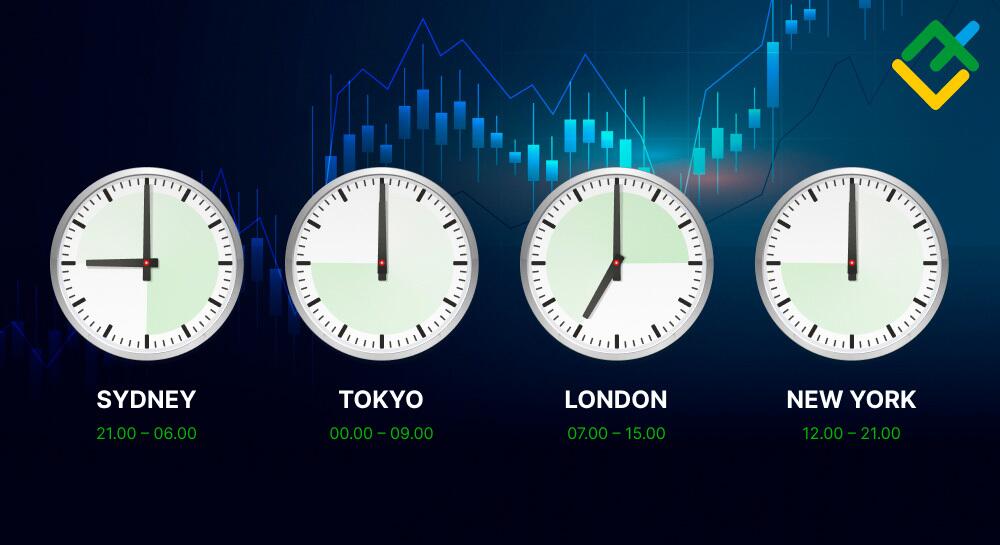
Sessions are categorized based on which financial center processes client transactions at a given time. The four major Forex trading sessions are: Pacific – Sydney, Asian – Tokyo, European – London, and American – New York.
The schedule of trading sessions provides answers to three key questions:
When is the Forex market the least predictable? (The first trading hours after the weekend.)
When is the market most active? (When the European and American sessions overlap.)
When is the market least active? (During the Pacific session and just before the weekend close.)
To become a successful trader, understanding that trading at the right time is one of the most important factors is crucial. Technical indicators are most effective during short time periods, such as high volatility or flat periods, which can be identified by testing a strategy in various trading sessions.
Key Differences of Trading Sessions:
Coverage of different time zones: Four sessions cover all 24 time zones. Since each session lasts nine hours, they partially overlap.
Different trading activity: The American and European sessions partially overlap. As Europe and the US have the largest number of traders, trading volumes are highest when both sessions are open at the same time.
Different volatility and liquidity: For the same reason, the European session experiences the highest volatility. The Pacific session is the calmest, showing the least volatility.
Different leading assets: For example, the US is "asleep" during the Asian session, making yen traders the most active. During the European session, the EUR/USD pair sees the highest trading volume.
Do daylight savings times affect Forex trading hours?
Yes, daylight savings times affect the regular Forex market operating hours due to changes in time zones. However, not all countries observe daylight saving time, meaning some specific trading sessions are affected differently.
For example:
Tokyo does not observe daylight saving time.
In London, winter time is GMT+0. On the last Sunday of March, the clocks are moved forward by one hour, making London's summer time GMT+1.
In New York, daylight saving time begins on the second Sunday of March.
- Sydney, on the other hand, switches to winter time in April, moving the clocks back.
In general, the trading session schedule for GMT+3 looks like this:
1. Summer time (open-close):
Session | Local time | GMT+3 |
Sidney | 07:00 – 16:00 | 00:00 – 09:00 |
Tokyo | 09:00 – 18:00 | 03:00 – 12:00 |
London | 08:00 – 16:00 | 10:00 – 18:00 |
New-York | 08:00 – 17:00 | 15:00 – 00:00 |
2. Winter time (open-close):
Session | Local time | GMT+2 (time change considered) |
Sidney | 07:00 – 16:00 | 23:00 – 08:00 |
Tokyo | 09:00 – 18:00 | 03:00 – 12:00 |
London | 08:00 – 16:00 | 11:00 – 19:00 |
New-York | 08:00 – 17:00 | 16:00 – 01:00 |
For example, if you live in Moscow, where the time is always GMT+3, the Tokyo session (the Asian trading session) will open at the same time in both winter and summer, since Tokyo also does not observe daylight saving time.
In March, London and New York move their clocks forward by an hour, meaning the start of these sessions for a trader in Moscow will shift back by one hour. Additionally, when Sydney transitions to winter time in April, the Pacific session for a trader in Moscow will begin one hour later.
Start trading with a trustworthy broker
When does the Forex market open: 4 Forex Sessions and Trading Times
The trading session schedule is provided in several formats: international time standards and local time.
Time standards:
GMT (Greenwich Mean Time) is the mean solar time of the meridian passing through the former location of the Greenwich Observatory near London. The designation GMT+9 means a shift forward by 9 hours. Winter time in London is GMT+0.
UTC (Coordinated Universal Time) is an international time standard used to regulate clocks and time worldwide. It was introduced in 1972, replacing the outdated Greenwich Mean Time (GMT).
EET (Eastern European Time) is a time zone used in some European, North African, and Middle Eastern countries. It corresponds to GMT+2. During summer, Eastern European Summer Time (EEST) is used—GMT+3.
EST (Eastern Standard Time) is a time zone used in the eastern part of North America, including the eastern United States, Canada, and some countries in the Caribbean and Central America. It corresponds to GMT-5. During daylight saving time, Eastern Daylight Time (EDT) is used—GMT-4.
AEST (Australian Eastern Standard Time) is a time zone used in eastern Australia (Australian Capital Territory, New South Wales, Tasmania, Victoria, and Queensland). It corresponds to GMT+10. During daylight saving time, it shifts to GMT+11.
Brief summary:
GMT and UTC are effectively the same.
GMT+0 is the time in London during winter. If you are in the GMT+6 time zone and want to know the time in London, subtract 6 hours from your time. To know the time in a GMT+9 zone, add 3 hours.
EET = GMT+0 + 2 hours.
EST = GMT+0 - 5 hours.
AEST = GMT+0 + 10 hours.
Tip: Check the trading session schedule for your region in the trading instrument specifications to avoid confusion.
Here's what you should do to find trading schedules in LiteFinance' Client Area. No registration is required for that.
1. Press "Trade" and click on a desired trading asset.
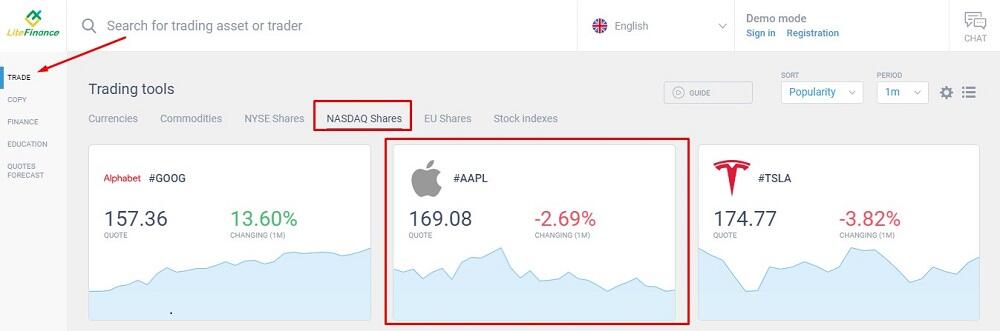
2. Go to the "Info on the instrument" tab. The schedule time corresponds to the trading server hours at LiteFinance: GMT+3 in summer and GMT+2 in winter.

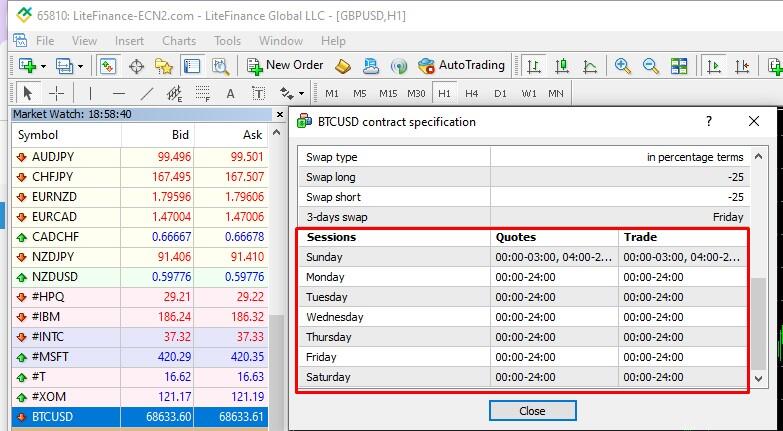
Here's an algorithm for searching trading sessions on the Metatrader 4 and 5 platforms:
1. Open the "Market Watch" window by using the CTRL+M key combination or through the Menu: View > Market Watch.
2. Right-click on the instrument and select "Specification" in the tab that appears.
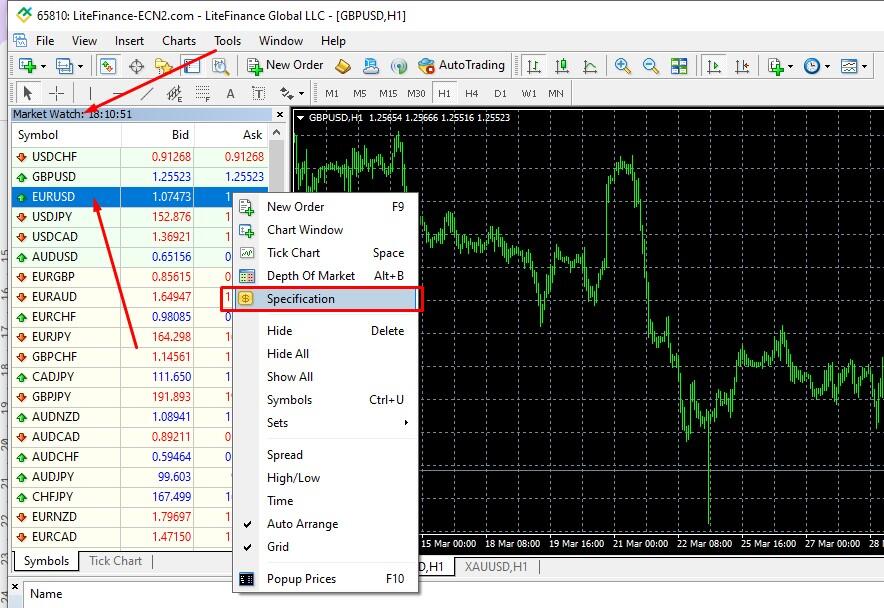
3. You will see a chart of trading sessions aligned with the server time.
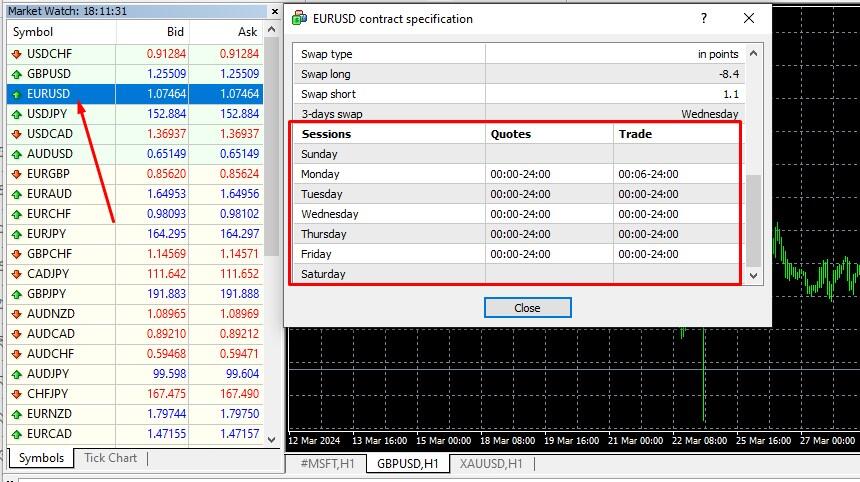
In this example, the trading server time is linked to the GMT+3 time zone, so the trading session starts at 00:00. The first six minutes of Monday are used to update quotes and transmit them to the trading platform.
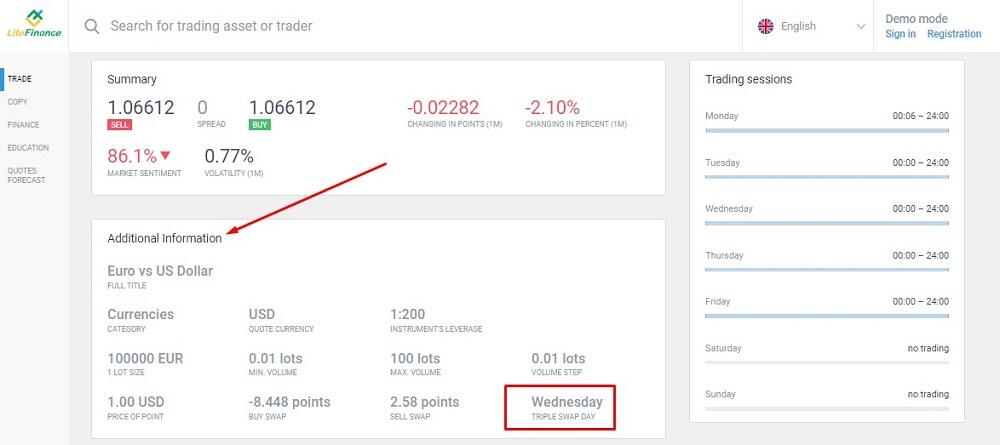
Attention! A broker can charge swaps – a fee for carrying a trade over to the next day. Using leverage in trading increases swap costs. On weekends, when the Forex market is closed and opening positions is impossible, brokers charge a "triple swap."
Two key points:
Triple swaps are charged on Wednesday night. All transactions are settled on the second business day following their execution. When transferring an open position from Wednesday to Thursday, the asset is scheduled for delivery on Saturday. However, since Saturday (and Sunday) is a non-business day, the asset delivery is postponed to the next business day—Monday.
The swap is charged at 21:00 GMT+0, unless otherwise specified in the broker's trading terms.
The broker is not responsible if the trader has not read the offer, specifications, or fully understood the trading conditions.
Clarification of the term "Forex Market":
In theory, the Forex market is an over-the-counter international currency market.
Two key points:
Although the financial market is over-the-counter, it operates based on the trading schedule of exchanges. Exchanges are also participants in transactions, and market makers—such as banks, institutional investors, etc.—work through them. Exchanges do not operate on weekends, and as a result, Forex brokers provide only limited services during weekends.
Forex brokers offer trading services via CFDs – contracts for difference. Traders do not own the underlying asset but speculate on the price difference. In addition to CFDs on currencies, brokers also offer CFDs on stocks, stock indices, and cryptocurrencies.
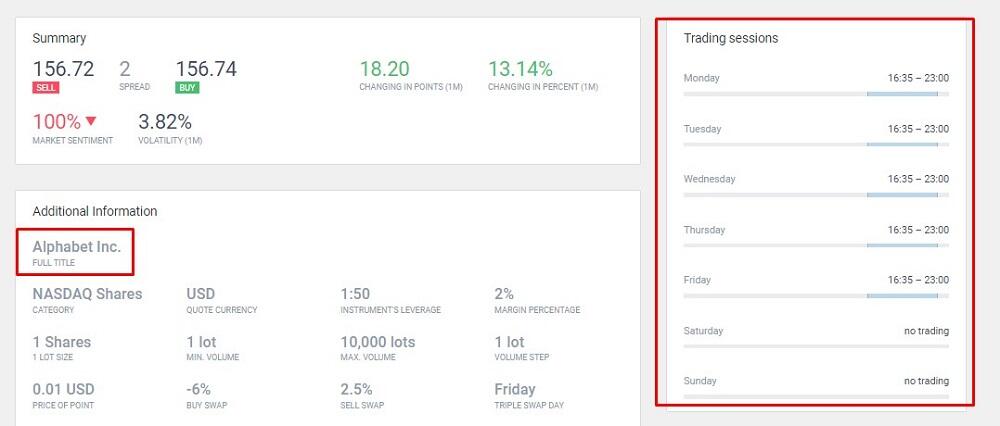
Forex brokers align their trading schedule with the exchange schedule. Therefore, each financial instrument has its own trading session schedule:
Currencies: Trades are conducted 24 hours a day, 5 days a week. No trading occurs on holidays or weekends.
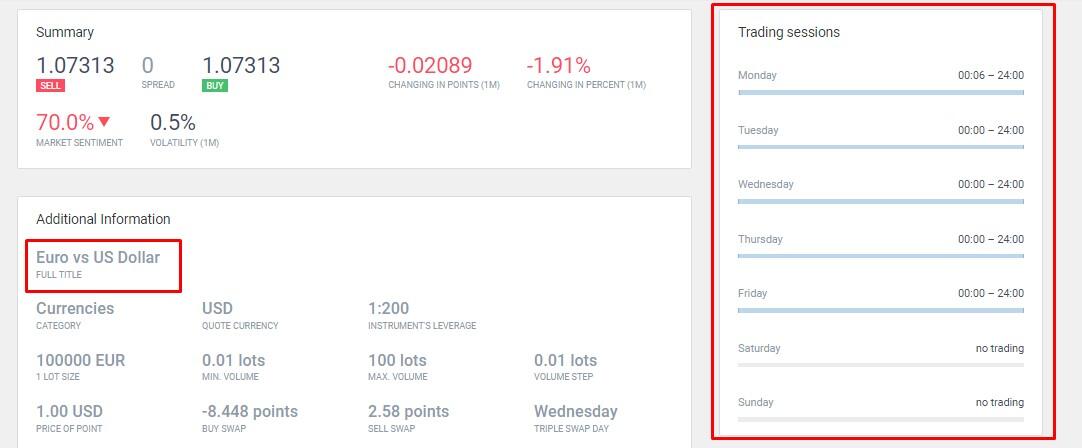
CFDs on cryptocurrency: the market is open 24 hours, with no holidays or weekends. You can trade at any time. However, there may be short breaks on weekends according to the broker's trading conditions.
CFDs on shares: Intraday trading. The duration varies depending on the country. For example, in the USA, the main market hours, excluding pre-market and post-market hours, are from 9:30 to 16:00 (New York time, GMT-4).
Another useful tool is information indicators, which color each trading session differently on the price chart.
Advantages:
You can conveniently analyze the price movement history. Each color-coded zone reflects price dynamics, showing the period's maximum and minimum values, volatility, drawdown depth, candlestick body sizes, and trading volumes.
There's no need to constantly monitor the time. When speed or scaling is important, using color-coded zones is more convenient.
You can customize indicator parameters to align with your preferred time standard.
An example of such an indicator for MT4/MT5 is i-Sessions.
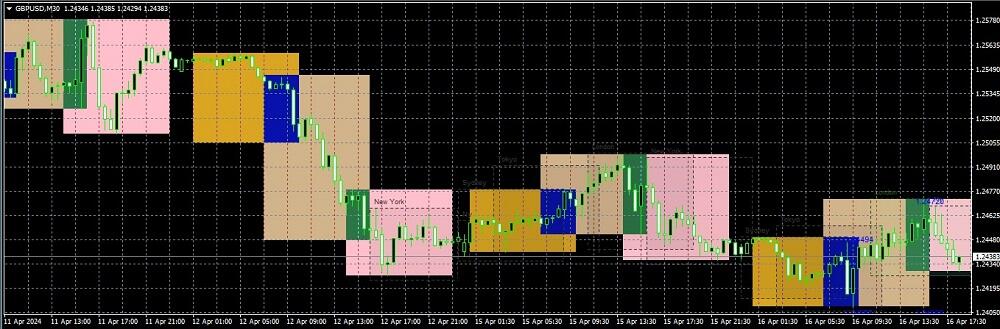
Please note: Data on opening and closing times may vary between sources. Therefore, below we provide the trading session times according to GMT+0.
Sydney session
The Forex market opens in Sydney. The Pacific or Sydney trading session is the first to open in the global Forex market. It starts at 21:00 and closes at 06:00 GMT+0, representing extended trading hours.
During winter, Sydney operates in the GMT+10 time zone. The Sydney session opens at 07:00 local time and closes at 16:00 local time. Wellington is also included, with time shifts based on GMT.
| Opening | Closing |
Coordinated Universal Time, UTC (corresponds to GMT). | 21:00 | 6:00 |
Eastern Standard Time, EST | 16:00 | 1:00 |
Australian Eastern Standard Time, AEST | 7:00 | 16:00 |
East European Time, EET | 23:00 | 8:00 |
Local time | 7:00 | 16:00 |
Tokyo session
The Asian or Tokyo trading session opens at 00:00 and closes at 09:00 GMT+0.
Tokyo operates in the GMT+9 time zone. According to local time, the Forex trading session opens at 09:00 and closes at 18:00. There is no transition to daylight saving time. Hong Kong and Singapore are also included, with time shifts based on GMT.
| Opening | Closing |
Coordinated Universal Time, UTC It corresponds to GMT. | 0:00 | 9:00 |
Eastern Standard Time, EST | 19:00 | 4:00 |
Australian Eastern Standard Time, AEST | 10:00 | 19:00 |
East European Time, EET | 2:00 | 11:00 |
Local time | 9:00 | 18:00 |
London session
The European or London trading session opens at 07:00 and closes at 15:00 GMT+0.
During winter, London operates in the GMT+0 time zone. The Forex market opens at 07:00 local time and closes at 15:00. This is the only session that lasts 8 hours, although some sources may list its duration as 9 hours. Frankfurt, Zurich, and Paris are also included, with time shifts based on GMT.
| Opening | Closing |
Coordinated Universal Time, UTC It corresponds to GMT. | 7:00 | 15:00 |
Eastern Standard Time, EST | 3:00 | 11:00 |
Australian Eastern Standard Time, AEST | 18:00 | 2:00 |
East European Time, EET | 10:00 | 18:00 |
Local time | 7:00 | 15:00 |
New York session
The American or New York trading session opens at 12:00 and closes at 21:00 GMT+0. During winter, New York operates in the GMT-5 time zone. The New York session is open from 08:00 local time and closes at 17:00 local time. Chicago is also included, with time shifts based on GMT.
| Opening | Closing |
Coordinated Universal Time, UTC It corresponds to GMT. | 12:00 | 21:00 |
Eastern Standard Time, EST | 8:00 | 17.00 |
Australian Eastern Standard Time, AEST | 23:00 | 8:00 |
East European Time, EET | 15:00 | 0:00 |
Local time | 8:00 | 17.00 |
Please note the following:
Trading hours may vary depending on the region's transition to winter and summer time.
Different countries switch to summer or winter time in different months, which affects the schedule of Forex trading sessions.
One country may have multiple time zones.
Legislative changes could occur, potentially canceling the transition to summer or winter time.
One country may switch to summer time while another switches to winter time.
Check the session schedule for each asset in the contract specification. Brokers usually notify traders of changes in trading hours through newsletters or news on their websites.
Get access to a demo account on an easy-to-use Forex platform without registration
Why is the Forex market open over a 24-hour period?
Forex operates 24 hours a day because:
Forex is the largest decentralized financial market in the world. It does not have a single trading center where transactions are conducted and controlled or where trading volumes are recorded. Market participants buy and sell currency on various exchanges with the help of banks, on ECN platforms, or directly with each other (OTC market - Over The Counter).
Interesting fact: The ability to conduct transactions on Forex across different platforms without being tied to a central platform is the basis for the Arbitrage trading strategy. Each platform has its own quote provider and model for updating quotes. Due to delays or other reasons, asset values may vary. Arbitrage traders speculate on these differences.
Our planet is divided into 24 time zones. The average duration of a currency exchange session is 8 hours. Financial centers are distributed globally so that when exchanges in one region close, exchanges in another are already open. This creates four major trading sessions that overlap as they "connect to the network."
For example, the Currenex ECN platform is connected to more than 70 banks and exchanges, meaning that every connected trader has access to all currency pairs at any time. Most currencies are traded more actively during the sessions corresponding to their respective countries.
Trading session overlap chart
A session overlap implies an increase in trading volumes and liquidity, with a possible rise in volatility. The overlap occurs when traders from one region are still active while traders from another region have already begun trading in the financial market. Price surges and increased volumes during a session overlap are often utilized in trend strategies. Notably, the Forex market is usually most active when the market hours overlap between sessions.
Trading session overlap (GMT/UTC+0):
Session | Overlap time (GMT/UTC) |
Sydney/Tokyo | 00:00-07:00 |
Tokyo/London | 07:00-08:00 |
London/New York | 12:00-16:00 |
New York/Sydney | 21:00-22:00 |
Forex trading holidays
Trading holidays in the Forex market occur when all major exchanges around the world are closed simultaneously. These holidays include Saturdays, Sundays, and international holidays such as New Year’s Day and Catholic Christmas. There are also regional holidays, during which exchanges in specific regions are closed. This can partially affect trading volume and brokers' working hours—liquidity decreases, and volatility may also change.
Information on Forex trading holidays can be found in a holiday calendar, such as the one available on LiteFinance's website. The broker's Forex trading holidays calendar provides trading schedules for almost all countries for up to 365 days in advance. It helps you determine opening and closing times in specific regions.
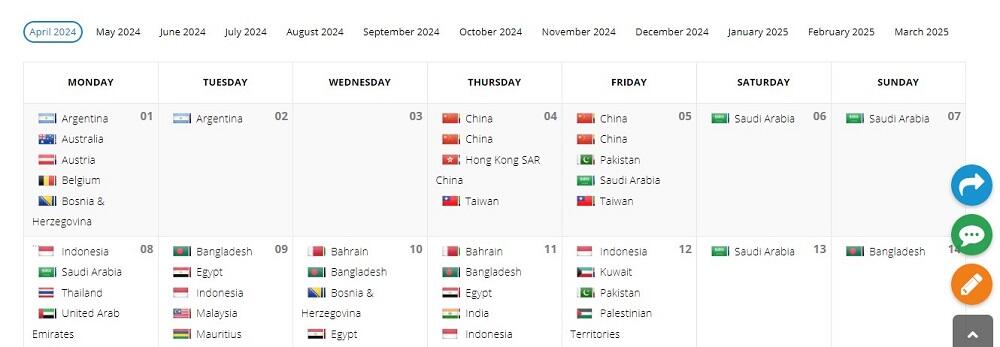
Let me remind you: cryptocurrency exchanges do not have days off. Therefore, trading CFDs on digital assets continues on weekends, unless otherwise stipulated in the broker's trading terms.
Exploring Forex Trading Sessions
Each trading session has its own features based on the specifics of time zones, regions and local currencies.
1. Pacific session.
The most active regions—the USA and Europe— are inactive at this time. This session is considered the calmest, with low volatility and liquidity levels. The most traded currency pairs are AUD/USD, NZD/USD, and USD/JPY.
2. Asian session.
A relatively calm trading session. The USD/JPY pair is the primary currency pair traded during this time. Trading activity in European currencies is low. Recommended strategy: channel trading on the M15-M30 time frames.
3. London session.
During this trading session, the market is the most active, with high volatility levels. The highest liquidity most often guarantees the tightest spreads for major pairs and cross rates. Trend strategies, pending orders, and swing trading also work well.
One of the strategies, London Breakout, suggests that European currencies (particularly the euro and the pound sterling) trade within a flat range during the Asian session. When the London session opens, the market experiences a surge in liquidity, and traders may encounter dramatically increased trading volumes. Once the price reaches its peak during the Asian session and breaks through it, a position can be opened in the direction of the trend.
4. New York session.
The highest trading activity is observed during the overlap of the London and New York sessions, which lasts for about 4 hours. During this time, continued trends and increased volatility in both directions can be observed.
Session features:
Macroeconomic statistics for the United States are most often released during this session, driving additional market activity. This is a good time to profit from news trading.
- Market makers, such as institutional investors, funds, banks, etc., are most active during the London and New York sessions. They can set trends that any trader can profit from.
Scalping and trading by use of fundamental analysis work well, too.
Try to control trades during the "thin" market — the transitional period between sessions when liquidity is not enough to maintain a stable price chart. This can lead to strong impulse moves that might significantly impact a trading account that is not protected by a stop order.
When is the best time to trade Forex and why?
Peculiarities of Trading in Various Trading Sessions:
Monday and Friday typically show lower trading volumes compared to other days. The peak trading volumes occur on Wednesday and Thursday; by this time, discernible intraday market trends have usually formed after the weekend.
The first few hours of Monday are often the most volatile, with potential price gaps. Fundamental factors that could significantly reverse the market may have emerged over the weekend. On Monday, the results of the previous week are reassessed, and plans for the near future are made considering the news background.
The most active trading occurs during the overlap of the European and American sessions. At this time, the market has the highest number of participants trading the most liquid pairs, such as EUR/USD, USD/GBP, and cross rates.
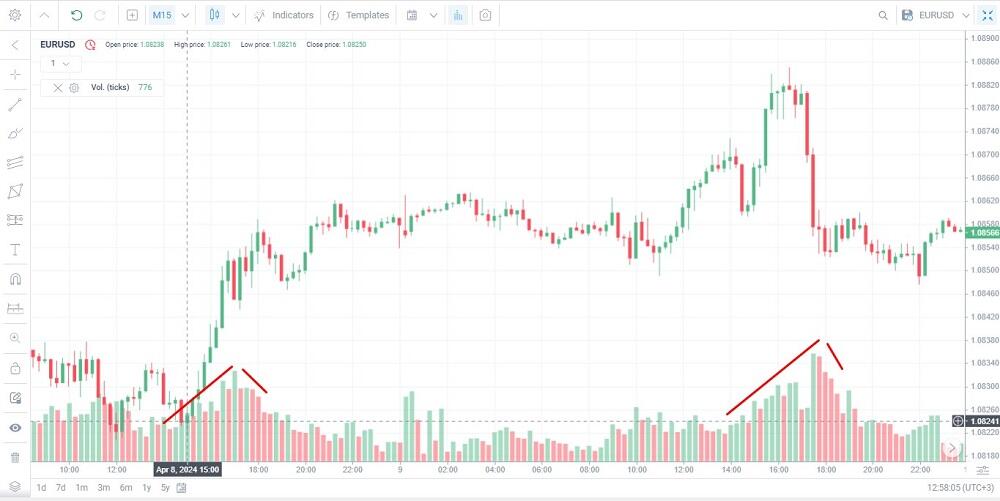
In the GMT+3 time zone, the London and New York sessions overlap from 15:00 to 19:00 (summer time). The EUR/USD chart above shows that daily trading volume is highest during this period.
This is characterized by strong trend movements displayed on the chart. However, while the first scenario may show a clear upward trend, the second scenario often features high volatility with price movements exceeding 25 points in both directions within a few hours. Therefore, the overlap of the London and New York sessions is an opportune time for traders who are prepared for significant drawdowns, can quickly determine the trend direction, and are willing to take risks for potentially high returns.
At the end of Friday, trading volumes typically decrease as most traders close their positions before the weekend. In the latter half of Friday, trend movements often turn into a flat range, which is clearly visible on the chart below.
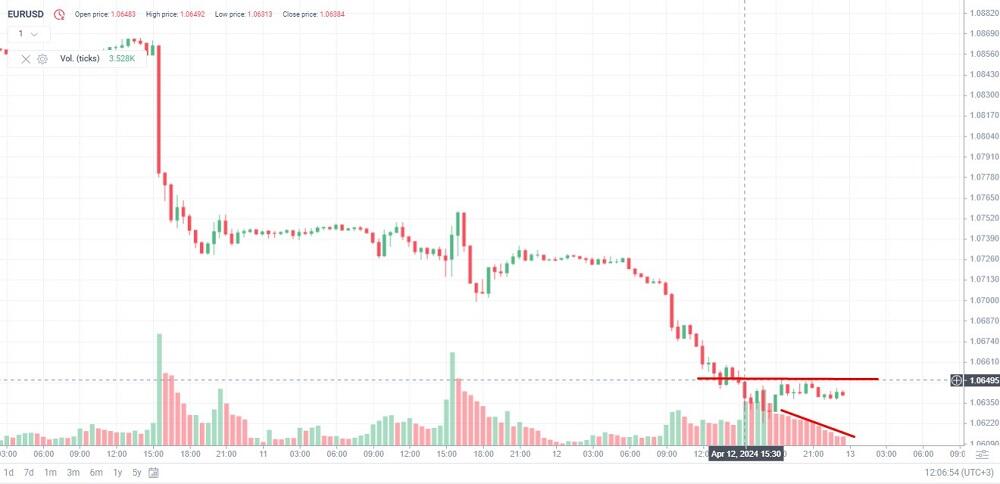
On Thursday, April 10, negative data on US inflation caused the EUR/USD rate to drop by more than 120 points. This is a good example of how fundamental factors can influence exchange rates more significantly than trading sessions. After 15:00-15:30 on Friday (GMT+3, Moscow time), the chart shows a transition to a horizontal range, with a decrease in candle body sizes and trading volumes.
Regarding the dependence of volatility on the Forex trading session, each currency pair has its own volatility level in different sessions. Forex traders typically prefer to trade their local currency because they have a better understanding of internal fundamental factors. For example, USD/JPY tends to be more volatile during the Asian session, while AUD/USD and NZD/USD show increased volatility in the Pacific session.
The table below displays the volatility in points of the main currency pairs and cross rates for each trading session on Forex.
| Sydney | Tokyo | London | New York |
EUR/USD | 32 | 28 | 56 | 34 |
GBP/USD: | 49 | 44 | 81 | 43 |
AUD/USD: | 41 | 35 | 55 | 29 |
NZD/USD | 41 | 33 | 52 | 27 |
USD/CHF: | 36 | 31 | 58 | 38 |
USD/JPY | 90 | 68 | 87 | 55 |
USD/CAD: | 35 | 33 | 66 | 32 |
GBP/JPY | 99 | 63 | 91 | 52 |
EUR/CHF | 24 | 19 | 39 | 25 |
EUR/GBP | 20 | 18 | 30 | 20 |
These are average values, and volatility may vary across different time frames. Additionally, specific fundamental factors not related to trading session schedules may also impact volatility. Consequently, the figures should be used as a reference rather than as exact values.
The table indicates that the London session is the most active. However, for example, the highest volume of trades in the Japanese yen occurs during the Sydney session. Therefore, the best time to trade on Forex depends on your trading strategy and risk tolerance.
Conclusion
A CFD broker relies on exchange quotes, so CFDs on currency pairs are traded 24 hours a day on weekdays, while CFDs on cryptocurrencies can be traded 24/7. However, specific trading hours may still depend on the terms set by a particular Forex broker. CFDs on shares are traded intraday.
Trading volumes, volatility, and liquidity vary by trading session. The overlap of trading sessions and the opening and closing hours of the Forex market are also important factors.
The session schedule can be complex, as different countries transition to daylight saving time at different times and may use various time standards (GMT, EET, EST, etc.). Therefore, it is essential to check the trading session schedule for each asset in advance in the contract specification, which also considers the broker's trading terms.
While the Forex market is influenced by fundamental factors and institutional investors, understanding the trading session schedule can help in building an effective trading system by considering periods of market activity, volatility, and liquidity.
Forex Trading Hours FAQs
The Forex market is open 24 hours a day, five days a week. The market closes before weekends and holidays and opens at the beginning of the first working day. The trading start time is on Sunday at 21.00 (GMT+0). Trading begins with the Pacific session in Sydney, where local time is 07.00 (GMT+10). If your time zone is GMT+3, trading will start at 00.00 on Monday. Depending on the broker and summer/winter time, there may be time shifts of 1-2 hours. For CFDs on stocks, the session lasts 6.5 hours. CFDs on cryptocurrencies are traded around the clock, without holidays and weekends.
There are four main trading sessions: Pacific (Sydney), Asian (Tokyo), European (London), American (New York).
Depends on your trading strategy, risk tolerance and trading style. For scalping, fundamental trading and trend strategies, the European and New York sessions are best suited. For practicing and testing trading strategies, the intersection of the Pacific and Asian sessions.
The transition from "late Sunday" to "early Monday" (the period between the opening of the Pacific session and the opening of the Asian session) represents a key intersection between the New York and London sessions. Additionally, the American session is influenced by the release of macroeconomic statistics.
There are no fixed guidelines regarding the optimal timing of trades. The optimal trading strategy depends on the chosen strategy, trading asset, and the duration of holding a trade in the market. For example, if you have a long-term strategy, there is no need to adhere to a specific trading day. The main recommendation for intraday traders is to avoid strong volatility in the first 2-3 hours after the opening of the Monday session. In addition, it is important to consider the decrease in liquidity and the high probability of flat trading in the last few hours before holidays and weekends.
Given that the higher trading volume, estimated at 28-35% of the total, is concentrated on the EURUSD currency pair, and that an additional 11-13% is traded on the GBPUSD pair, it is evident that the American and European trading sessions are the most volatile and experience a higher trading volume.
The most active market is during the European session, as almost half of the major currency pairs such as EURUSD, GBPUSD, and USDCHF are traded during this major market session. The American session is the second most active trading session, commencing when the European session has concluded. The overlapping trading sessions represent the period of the most active trading.
There may be a significant increase in volatility in currency pairs with European currencies. During the Pacific and Asian sessions, demand for European currencies is relatively low. Consequently, the opening of the London (European) session is characterized by a surge in trading volumes after a period of stability. This creates an environment where trends are formed and key levels are vulnerable to breakouts. The London breakout strategy is designed to capitalize on this effect.
The American session closes at 21.00 GMT/UTC+0. For the GMT+3 time zone, the session closes at midnight, at 00.00.
The American session opens when the European session is in full swing. At the moment of their crossing, the market sees the maximum trading volumes, thanks to the inflow of liquidity, during this period the tightest spreads on European pairs and cross rates.
The time zone of Sydney (Australia) is GMT/UTC+10. The time zone of New York (USA) is GMT/UTC-4. The time difference is 14 hours. When in New York it is 11.00 am, Tuesday, in Sydney, it is 01.00 am, Wednesday.
The Forex market operates 24 hours, 5 days a week. Trading sessions align with the opening hours of major stock exchanges, offering uninterrupted access to the market.
It is best to trade during the period when European and American trading sessions overlap: in summer time, it is 15.00 to 19.00 (GMT+3). It is also recommended to trade on Wednesday and Thursday as on these days, trading volumes are the highest, and there are more trading opportunities.
International stock exchanges open early in the morning. Due to time zone differences, opening times are stretched throughout the day:
- Australian Stock Exchange opens at 21.00 GMT+0;
- Tokyo Stock Exchange opens at 00.00 GMT+0;
- London Stock Exchange opens at 07.00 GMT+0;
- New York Stock Exchange opens at 12.00 GMT+0.
The American trading session opens at 12.00 GMT+0. At this time the most active trades with US dollar pairs are made. All important news and reports that can seriously affect the price movement are also published.
The London Stock Exchange opens at 07.00 GMT+0. During this period, the euro, Swiss franc and British pound are the most traded.
Price chart of EURUSD in real time mode
The content of this article reflects the author’s opinion and does not necessarily reflect the official position of LiteFinance broker. The material published on this page is provided for informational purposes only and should not be considered as the provision of investment advice for the purposes of Directive 2014/65/EU.
According to copyright law, this article is considered intellectual property, which includes a prohibition on copying and distributing it without consent.