This article deals with the relationship between the Forex market and inflation expectations. You will also learn about the connection between interest rates and inflation. These factors play an essential role in the fundamental analysis of forex pricing factors.
The article covers the following subjects:
Fisher Equation
Interest rate parity law explains the pricing of FX futures rates. Purchasing power parity law explains how a cash rate of a currency pair is made up. Inflation expectations law, named after Irving Fisher, a famous economist of XIX – XX, Fisher equation, also called fisher effect, explains the real and the nominal interest rates, as well as their relationship (fig.1).
The theory of the relationship between nominal and real interest rates is based on the fact that the borrower and the lender build their relations on the basis of real interest rates and the expected level of inflation. The logic of the Fisher equation is quite simple: the lender, wanting to make a profit, does not want to lose money due to inflationary depreciation, therefore, the expected rate of inflation is included into the lender’s income.
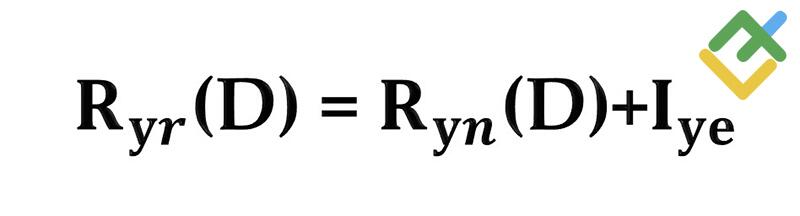
Fig.1: Fisher Equation
Ryr(D) denotes the real interest rate for term D;
Ryn(D) is the nominal interest rate for term D;
Iye(D) expected change in prices for term D or inflation expectations.
According to the equation, the real interest rate Ryr (D) in country Y, for a loan with a term of D days, is equal to the nominal interest rate Ryn (D), plus the expected change in the price level in country Y after time D. It is also assumed that investors form rational expectations regarding future inflation.
Applying the Fisher equation to ideal conditions of the global economy, we can assume that in the absence of trade barriers and restrictions on capital flows, real interest rates for all countries will gradually equalize as globalization develops, and changes in inflation expectations will lead to changes in exchange rates. Actually, we now see this when the central banks, following each other, begin to change their monetary policy.
However, we live in a world where trade barriers, as well as restrictions on capital flows, are applied in an increasing volume, which is reflected in exchange rates, and thus influences the decisions in forex trading.
Central banks and inflation expectations
In the U.S., and in the EU, as a medium-term inflation target, a target indicator, usually calculated for the perspective of up to two years, is used. In the US and the EU, the medium-term inflation target is 2%. In Russia, the inflation target is 4%. In Canada and some other countries, inflation target level is at 2%, but there is a target range from 1% to 3%. This leaves the Bank of Canada room for maneuver depending on the inflation expectations.
As reference indicators, the central bank usually uses different indicators of consumer inflation, moreover, these data can vary significantly in their characteristics. For example, the European Central Bank conducts its policy based on the Harmonized Index of Consumer Prices (HICP). The HIPC index includes 12 indicators of various goods and services: food, alcohol and tobacco, clothing, rental costs of housing and utilities, furniture, healthcare, transport, communications, culture, training, restaurant and hotel prices, other goods and services.
In its turn, the U.S. Federal Reserve Bank considers the so-called Core Inflation Rate indicator as an indicator, which does not include food and fuel expenses, since these costs, according to the regulator, are subject to significant short-term changes, which distorts real picture.
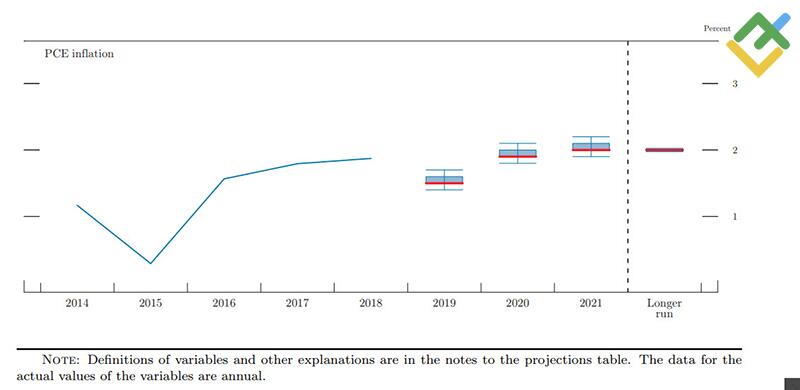
Fig.2: US Fed’s projection for the U.S. inflation in June
Typically, the central bank tightens monetary policy if inflationary expectations rise and loosens it inflationary pressure declines, regulating liquidity in the banking system, thereby stimulating economic growth due to cheaper money. Besides, it should be understood that the central bank makes a decision on its policy regarding the dynamics of inflation over a period of observation, usually for six months. Thus, current data can cause short-term fluctuations in the exchange rate, but at the same time they will not force the bank to change its monetary policy, because the regulator studies situation as a whole and can solve problems other than meeting the inflationary expectations.THe current Federal Reserve interest rate is equal 2.5%.
One of the main tools of regulating monetary policy is changes in the key interest rate. Usually, this is the lowest possible rate for borrowing, for the shortest time. For the USA, Japan, Canada and the UK, the shortest possible loan term is one day, the so-called “overnight” operations. For the Eurozone, the minimum possible rate is for refinancing operations for a period of two weeks. By adjusting the key rate, the central bank sets the interest value for instruments with longer maturities, and also changes the liquidity level in the banking system and the money supply.
In general, the higher is they key interest rate set by the bank, the more expensive is the currency issued by the bank; the less is the interest rate, the cheaper is the currency. Therefore, the higher is the inflation rate and the inflation expectations, the more expensive is the currency, the lower is the inflation, the cheaper is the currency. Thus, when you know the interest rates and the inflation expectations, you can analyze trading opportunities for a particular currency pair.
However, a forex trader should remember that foreign exchange rates are affected by different, often oppositely directed factors, nor only by the inflation pressure. You should also remember that a currency pair consists of two currencies. Therefore, the greatest impact on a fx rate is made by the difference between the interest rates of the currencies, included into a currency pair. At the same time, the spread between the key interest rates, although it has a significant effect on the exchange rate, is not the only factor that determines the quotes of the currency pairs. For example, traders should take into account the difference in the profitability of short-term and long-term instruments for different countries, but with the same level of reliability - treasury bills and bonds, as well as commercial rates Libor, Euribor, etc.
I should also note the central bank policies regarding the exchange rates of the currencies they issue. Maintaining the exchange rate, along with maintaining inflation, for example, is the task of the Bank of England and the Bank of Canada, but is not the direct responsibility of the European Central Bank and the U.S. Federal Reserve. In turn, the Reserve Banks of Australia and New Zealand always comment on the value of their currencies, the Fed does it sometimes, and the ECB, on the contrary, never comments on the euro value. Therefore, unlike inflation indicators, maintaining exchange rates is not always a primary goal for central banks. On the contrary, banks rather try to avoid direct influence on exchange rates and do this only in case of urgent need, coordinating their efforts with central banks of other countries.
Inflation expectations and Treasury bonds
Treasury bonds play a very important role in the financial system of any country, not only providing budget funding, but also identifying the minimum profitability level of the investment in the currency of a given country, acting as a benchmark for determining the return on investment.
The modern world financial system is the system of the U.S. dollar. That is why the US Treasury bonds play a very important role in the world’s finances; and their yield is a benchmark for multiple dollar-denominated instruments. The world financial system is basically the system of the U.S. government debt, formed to serve the U.S. debt.
Taking an investment decision, and investor from the Eurozone compares the yield on European treasury bonds and bills with the yield on similar instruments in the United States, thereby appreciating or depreciating the euro against the dollar according to the Interest Rate Parity law.
Furthermore, in the United States, there are Treasury securities that allow one to accurately identify the inflation expectations of investors. These are Treasury Inflation-Protected Securities (TIPS). These securities are indexed based on the inflation to protect investors from negative effect of the price rise. The major utility of the TIPS is that its yield is rising following the inflation rise. At the same time, comparing the yield of TIPS with the yield on the fixed-income bonds, one can determine the inflationary expectations of investors.
For example, according to the U.S. Department of Treasury, on July 11, 2019, the yield on the 10-year US Treasury bonds was 2.13%. At the same time, the yield on 10-year Treasury Inflation-Protected Securities was 0.875%, which suggests that investors assumed an average inflation of 1.255%, clearly lower than the target suggested to the US Federal Reserve by law. The difference between the yield on 5-year securities was 1.380%, which is slightly higher than that of bonds with a maturity of 10 years.
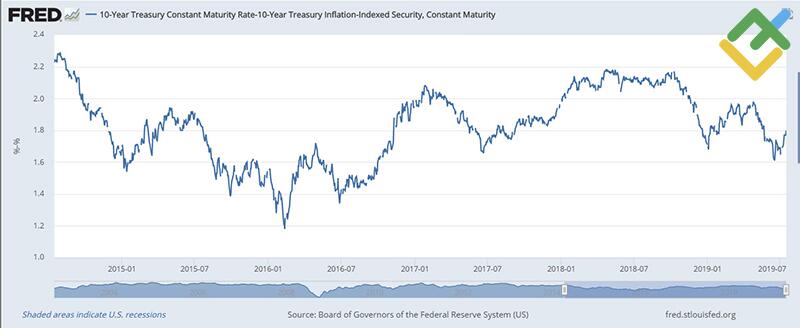
Fig.3: Difference between 10-year Treasury constant maturity rate and 10-year inflation-indexed security
The price and the cost of government bonds may be affected by other factors as well, however, we are rather interested not in the yield itself, but in its change over a particular period of time, for example, over a year. Knowing this information, an advanced trader, after an analysis of the difference in bond yields, can anticipate what actions the central bank will take and how they will affect the exchange rate of a particular currency pair of interest (Fig. 3), and adjust the trade strategy. As can be seen from figure 3, at present, inflationary expectations of investors have been declining for a long time, which may be one of the factors that may encourage the US Federal Reserve to lower its interest rate at one of the next meetings.
Conclusion
There are three principal forex fundamental laws that play an important role in the analysis of fundamental elements of FX rates. They are the Interest Rate Parity law, the Purchasing Power Parity law and Fisher equation.
However, traders should remember that the primary information is learnt from the price chart, i.e. you one shouldn’t abandon technical analysis; and, even if your assumptions seem really convincing, a lack of information can engage a high risk for your deposit. It doesn’t mean that fundamental analysis is useless. When you understand the principles, according to which the market operates, you will have quite many advantages, especially when a fundamental trends change. Nonetheless, if you trade on the timeframes that are shorter than four hours, you should be extremely careful when taking decisions based on fundamental analysis.
Be attentive and careful, observe the rules of money management.
P.S. Did you like my article? Share it in social networks: it will be the best "thank you" :)
Useful links:
- I recommend trying to trade with a reliable broker here. The system allows you to trade by yourself or copy successful traders from all across the globe.
- Use my promo code BLOG to get a 50% deposit bonus on the LiteFinance platform. Simply enter this code in the appropriate field when funding your trading account.
- Telegram chat for traders: https://t.me/litefinancebrokerchat. We are sharing the signals and trading experience.
- Telegram channel with high-quality analytics, Forex reviews, training articles, and other useful things for traders https://t.me/litefinance
Price chart of EURUSD in real time mode

The content of this article reflects the author’s opinion and does not necessarily reflect the official position of LiteFinance broker. The material published on this page is provided for informational purposes only and should not be considered as the provision of investment advice for the purposes of Directive 2014/65/EU.
According to copyright law, this article is considered intellectual property, which includes a prohibition on copying and distributing it without consent.