This overview will explain the relations between the Forex and commodity markets and how a price change in one market affects the asset values in the other. You will also learn the purchasing power parity theorem, an important fundamental factor for trading in financial markets.
The article covers the following subjects:
Commodity market and foreign exchange market – the connection between them. How does it work?
Traders who trade in the foreign exchange market constantly encounter such expressions: the strengthening of the dollar led to a decrease in the price of gold, or, for example, the euro supported the price of oil. Although such explanations are often given after the event has occurred, the connection between the commodity and foreign exchange markets is felt by us regardless of whether we trade in the forex market or have nothing to do with it.
In theory, inflation is the link between commodities and currencies, and it doesn’t matter what you have in your wallet, dollars, euros, rubles, British pounds or Indian rupees. If you refueled your car at 0.40 dollars per gallon a week ago, and now the petrol price is 0.50 dollars per gallon, then the dollar value has lost 25% in petrol terms, and petrol, on the contrary, increased in value. If gold cost 30 US dollars per gram in June 2009, and in June 2019, gold costs 43 US dollars, then this means that over 10 years the value of gold in US dollars has increased by 43%, and the dollar, on the contrary, fell in price.
These are simple examples of the relation between commodities and currencies. But how can this be used in trading and why is the relation between the commodity and the Forex market is a fundamental law, determining the currencies’ values? Let us try to find out together.
What Is Purchasing Power Parity?
Purchasing power parity theory says, “The price of goods in one country cannot exceed the price of goods in another country more than the value of the transport cost for the goods between two countries”
In addition, the transportation costs include the normal profit of the merchant, and the conversion of the standards of one country into the standards of another country (Fig. 1). Also, it is theoretically assumed that artificial trade barriers do not exist.
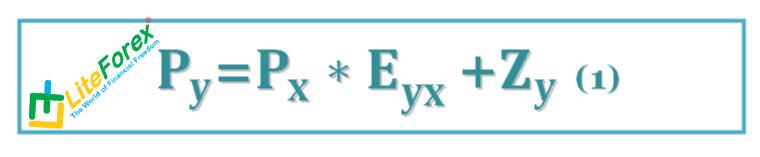
Fig. 1: Purchasing Parity Power formula
Where Py is the cost of a good in currency Y; Px is the cost of a good in currency Y; Eyx is the exchange rate of currency Y and X; Zy is transport costs, merchant's return and so on.
If we assume that the profit rate of a merchant in both countries is approximately equal, i.e. Zy = Zx, then equation (1) on parity can be further simplified by reducing the rate of return. Then, ideally, the exchange rate will be equal to a simple ratio - the price of goods in country x divided by the price of goods in country y.
Eyx = Py/Px (2)
It is clear that equation (2) displays an ideal currency in the ideal world, where there are no trade barriers, with the interest rate equal in both countries; but, despite all its simplicity, it perfectly reflects the dependence of the exchange rate on commodity prices.
From ideal world to real dollar
In 1944, when Europe and most of Asia were ruined, there took place a conference in the resort town of Bretton Woods where was created the agreement that determined the world’s exchange rates for nearly a quarter of century. The Bretton Woods agreement established a new global monetary system. It replaced the gold standard with the US dollar as the global currency. After Bretton Woods, each member agreed to redeem its currency for U.S. dollars, not gold. The United States held 70% of the world's supply of gold and due to World War 2 it took the dominant position in the world economy. No other currency had enough gold to back it as a replacement. The dollar's value was 1/35 of an ounce of gold.
The Bretton Woods system collapsed in 1971, when the US president Nixon unilaterally abandoned the agreement. On March 16th, 1973, there was established an international agreement known as Jamaica Accord that originated foreign exchange market, to Forex. According to the Jamaica Accord, the exchange rates started to be determined by free market, i.e. by supply and demand. However, the dollar is still the major world’s reserve currency and maintains its position as the world’s leading currency in the calculations for energy resources, commodities and gold, as well as the major currency used in numerous financial instruments.
The current position of the US currency is quite accurately described by the word “Petrodollar” and the bulk of commodity trading, including oil and gold, is traded on the US exchanges, such as NYMEX, COMEX, CME and ICE. The United States leads in terms of trading volumes in oil, gold, grain and many other commodities, and commodity resource quotes are determined in US dollars: - oil / dollar (WTI / $), gold / dollar (GOLD / $), wheat / dollar (Wheat / $), corn / dollar (Corn / $), coffee / dollar (Coffee / $), etc.
To determine the value of the commodity market or groups of commodities, there are various commodity indices. The most famous of them are: Thomson Reuters / CoreCommodity CRB Index (CRY) and Deutsche Bank Commodity Index, calculated on the price parameters of futures traded on the above exchanges (Fig. 2). The exception is the price of aluminum and nickel, determined by the quotations of the London Metal Exchange, but again, by the prices are expressed in US dollars. Gold prices are also denominated in US dollars.
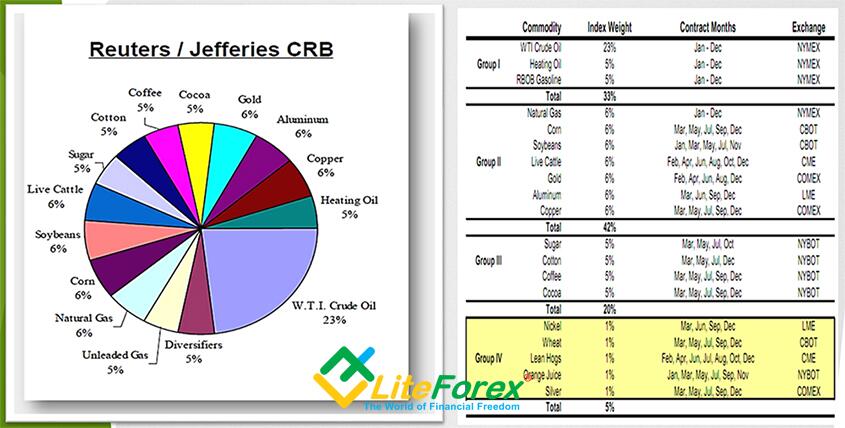
Fig. 2: Structure of commodity index Thomson Reuters / CoreCommodity CRB Index (CRY)
In addition, the rates of foreign currencies are also calculated through the dollar: euro/dollar (EUR/USD) pound / dollar (GBP / USD), dollar / franc (USD / CHF), dollar / ruble (USD / RUB), dollar / yen (USD / JPY), etc. To estimate the value of the dollar against a basket of foreign currencies different US dollar indexes are applied.
The most famous of these is the US Dollar Index (USDX) calculated against a basket of six currencies: Euro (57.6%), Japanese Yen (13.6%), British Pound (11.9%), Canadian Dollar (9.1 %), Swiss Franc (3.6%) and Swedish Krona (4.2%). The starting point of this index is 100% of the value of the US dollar as of 1971. Thus, the current quotation of the index 97, says that the US dollar, in relation to the basket of the above currencies, is 97% of the level recorded in 1971. Absolutely insignificant change in 48 years! However, this was not always the case, and in previous years, the index changed significantly, from the level of 70% in 2009 to the level of 128% in 1985 (Fig. 3)
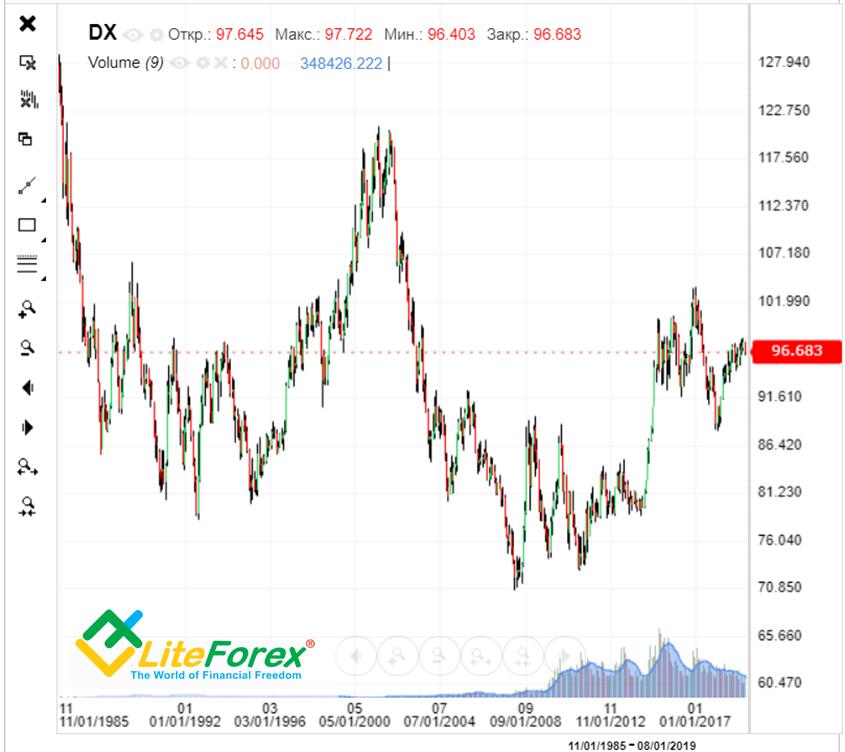
Fig.3: USD index chart
Say oil – mean dollar?
As you see, the quote currency for all commodities and currencies is the US dollar, except for inverse currencypairs, but this is only mathematical casuistry for the convenience of quoting these currencies. It is logical to assume that when the dollar rate rises, the exchange rate of currencies and commodities decreases, and vice versa, a decline in the dollar rate leads to an increase in the prices of currencies and commodities. (Fig. 4).
As you see from diagram 4, in the period from July 2014 to July 2017, oil and the dollar correlated with each other by a factor of -0.75, i.e., they were in inverse correlation. At the same time, the linear correlation between the EURUSD and Brent oil rates can reach a coefficient of 0.9, i.e., be very high in particular periods of time.
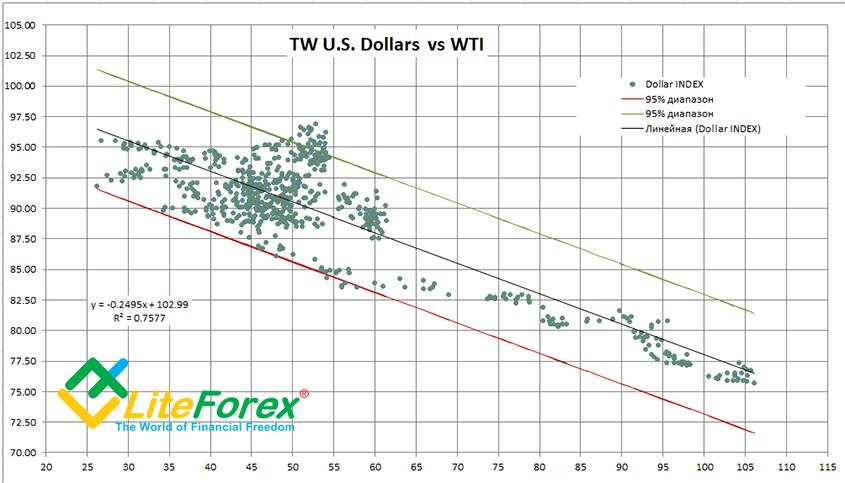
Fig. 4: Correlation of Dollar Index and WTI oil price
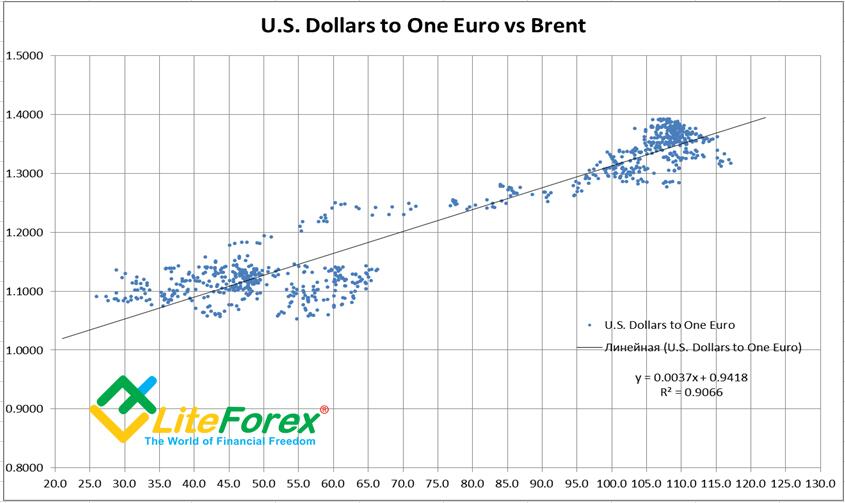
Fig.5: correlation of EURUSD and Brent oil
In the previous paragraph, I deliberately highlighted the phrase “in particular periods” . The ability to identify the periods when a particular factor influences the quotes depends the trading skills and the level of training. There are no definite examples and schemes; everyone will have to go through this path independently. However, it should be noted that the influence of oil prices on foreign exchange rates increases during the periods when the interest rates differential is narrow, as it was in the 2014–2017 period, and decreases when the interest rates differential widens, as it could be observed in the 2018–2019.
When analyzing the relationship between commodity prices in commodity exchanges, oil and forex trade, it should be noted that it is hardly efficient to study the correlation between these assets. Traders who will still decide to independently investigate this issue should focus on analyzing quotes using oscillators, for example, such as the Stochastic or RSI, that allow one to shift from absolute values to the percentage changes in some assets relative to other assets.
We live in hydrocarbon economy and oil, as well as oil products, are the main commodities, whose prices affect all other sectors of the economy. Saudi Arabia is one of the major oil exporters. This is indicated in commodity indexes. As it follows from diagram (2), energy products make up 33% of the composition of the Thomson Reuters / CoreCommodity CRB index, and this is excluding natural gas. As part of the Deutsche Bank Commodity Index, oil and oil products account for about 50%.
Therefore, a changes in oil price result in price changes in the whole commodity market, based on which, we can define a relation: depreciation of the dollar leads to an increase in oil price and an increase in the rate of foreign currencies; and vice versa, the growth of the dollar value leads to a decline oil price and a decline in the value of foreign currencies.
It is impossible to identify the start and the end of this relation. For example, the euro value may decline which will lead to the rise in the US dollar price, which, in its turn will press down oil price. Or, oil may start rising in price, pressing down the dollar value, and the dollar fall will result in the euro growth.
Gold and foreign exchange rates
After gold ceased to be the equivalent of value in 1973, its interaction with the foreign exchange market became much more complicated. Transforming into just a commodity, gold, at the moment, is significantly dependent on the US dollar exchange rate, and is subject to the decisions of the COMEX-CME speculators, as well as the sentiment of Exchange-traded Funds ETF, mainly from the USA. Gold may be traded in different ways, in addition to physical gold, gold bullion and gold coins, gold future contracts are also widely traded.
However, this was not always the case, for example, in the period 2009 - 2015, the price of precious metal closely correlated with the Japanese yen and hardly correlated with the U.S. dollar or other currencies. The correlation coefficient between the yen and gold was then 0.9, while the correlation between the euro and gold was no higher than 0.25.
I cannot say why gold price behaves this way. However, long-term observations of gold price changes allow me to assume that the value of gold is less dependent on demand from technology and central banks and more tends to seasonal growth, on lunar New Year’s Eve, and significant price fluctuations in case of a change in the demand of North American investment funds.
China’s attempts to create an oil pricing center independent of the USA, denominating oil futures in yuan, with the possibility of converting it into gold, already in the first year of trading, led to the fact that the Shanghai International Energy Exchange trades about 20% of the volume of crude oil trading in New York and Chicago. This is a direct challenge to the petrodollar, which so far has been dominating in payments for energy, but this is not enough yet.
Oil trading denominated in yuan is a huge but still only the first step towards the global competition with the dollar and a partial return to the “gold standard” in financial circulation. However, at this stage, it seems to me that it is too early to draw statistical conclusions from the relation of the yuan and gold price, although I do not exclude such a possibility in the future.
And once again about Purchasing Power Parity
The purchasing power parity theory describes a world, where there is no single reserve currency, suggesting multiple world trade centers, which does not correspond to the current situation. However, the crisis of the dollar-based global currency exchange system, and the trade wars unleashed by President Donald Trump, force the governments of the emerging markets to look for a gradual replacement of the US dollar as the universal equivalent of value.
For example, in commodity settlements in Asia, the Chinese yuan has already overtaken the Japanese yen and is gradually replacing the US dollar. At the St. Petersburg Economic Forum, held in early June, China and Russia agreed to exclude the US dollar from mutual settlements, Iran and Turkey follow the same plan.
The trend of abandoning the US dollar is just starting to develop, but it can’t be stopped. The more tariffs are imposed by the USA and the more barriers are created to the US dollar-based financial activities, the sooner the dollar will lose its function of a universal unit of account in the world trade. Trade wars will inevitably lead to the division of the world economy into separate currency and customs zones, where the Purchasing Power Parity theory will work, avoiding the intermediate link in the form of the US dollar. No one knows when this will happen, but no one doubts that the petrodollar system will collapse.
The purchasing power parity ppp theory, along with the interest rate parity theory, is the fundamental law of the foreign exchange market. In addition, the study of relation between commodities and currencies is an element of the “true” fundamental analysis, in contrast to the analysis of various news publications, the “fundamental” economic indicators, which an individual trader simply cannot explore, primarily because of the limited knowledge and resources. However, knowing how it works, an inquiring mind will always find how to apply the forex fundamental laws to taking profits from controversial situations. Seek and you shall find!
P.S. Did you like my article? Share it in social networks: it will be the best "thank you" :)
Useful links:
- I recommend trying to trade with a reliable broker here. The system allows you to trade by yourself or copy successful traders from all across the globe.
- Use my promo code BLOG to get a 50% deposit bonus on the LiteFinance platform. Simply enter this code in the appropriate field when funding your trading account.
- Telegram chat for traders: https://t.me/litefinancebrokerchat. We are sharing the signals and trading experience.
- Telegram channel with high-quality analytics, Forex reviews, training articles, and other useful things for traders https://t.me/litefinance
Price chart of EURUSD in real time mode

The content of this article reflects the author’s opinion and does not necessarily reflect the official position of LiteFinance broker. The material published on this page is provided for informational purposes only and should not be considered as the provision of investment advice for the purposes of Directive 2014/65/EU.
According to copyright law, this article is considered intellectual property, which includes a prohibition on copying and distributing it without consent.