Gold can generate returns of over 100% for long-term investors. In 2025 alone, gold prices rose by more than 70–75%. In 2026, gold dropped by more than 10% twice within a few days, offering opportunities to go long during corrections.
Gold is a safe-haven asset, but its volatility allows traders to profit even within a single day. In this overview, we will look at how to trade gold, what alternative instruments are available, and how to choose a broker.
The article covers the following subjects:
Major Takeaways
Gold is a safe-haven asset, and its market price typically rises during periods of economic and geopolitical instability. However, its value may decline in the short term.
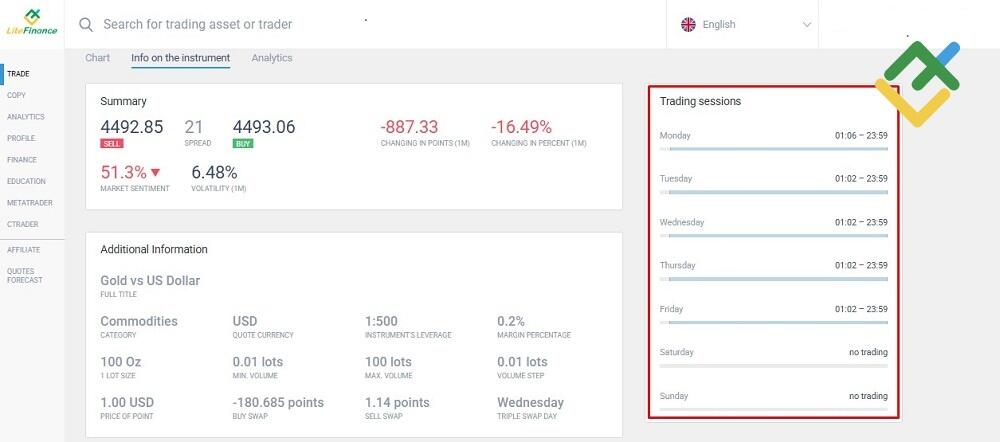
Gold trading on exchange and over-the-counter markets takes place almost 24/7, with only a one-hour technical break. However, some local exchanges may have their own trading schedules.
Ways to trade gold online include long-term investment in physical metal stored in specialized vaults. Short-term trading options include exchange-traded futures, over-the-counter CFDs, shares of gold mining companies, specialized exchange-traded funds, and tokenized instruments.
Trading via an ECN broker suits beginner traders with smaller capital. Exchange trading is more suitable for investors with larger capital.
What Is Gold Trading?
Many traders are not familiar with how XAU/USD trading works in financial markets. Let's take a closer look at what gold trading is and how it works.
Gold trading involves buying or selling the metal against a currency. The main trading pair on both exchange and over-the-counter markets is XAU/USD.
A long position (buy) in XAU/USD means buying gold using US dollars. If the price rises and the position is closed, a profit is made. However, if the price declines, the position results in a loss.
A short position in XAU/USD means selling gold. In practice, a trader borrows the metal, sells it at the current market price, and later buys it back at a lower price.
For example, if XAU/USD trades at 4,510.00, it means that one troy ounce of gold (31.1035 grams) costs 4,510 USD.
Ways to trade XAU/USD:
Physical gold: bullion, bank gold, collector coins, and jewelry. Participants include banks and licensed institutions.
Futures and contracts for difference (CFDs).
Other derivatives, such as gold-backed tokens and options.
Online gold trading involves earning from the difference between the opening price and the closing price. If the price movement is predicted correctly, a profit is made.
How to Read a Gold Price Chart
Let's take a look at the chart.
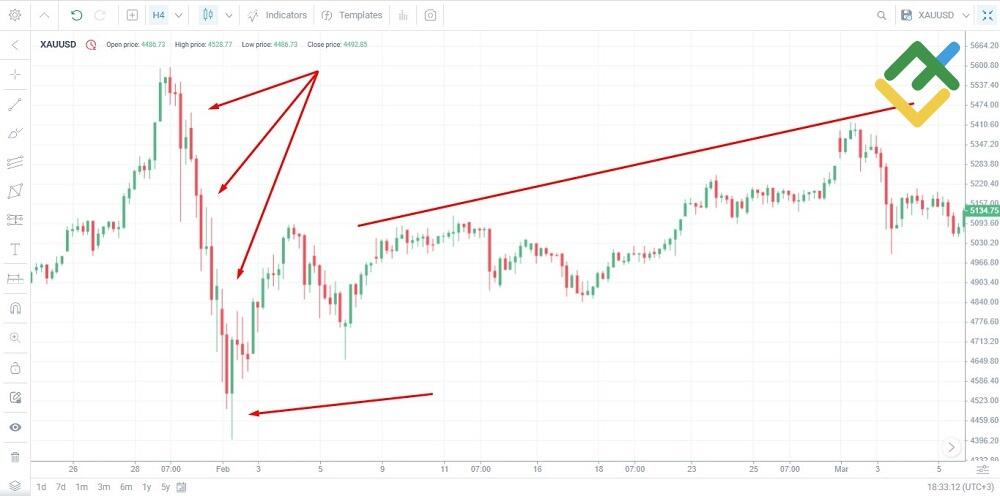
Technical analysis: The H4 timeframe means that each candle reflects the gold price movement over 4 hours. A red candle indicates that the price declined over the 4-hour period, while a green one shows growth. The open and close prices form the candlestick's body. The wicks represent the high and low over the same period.
Fundamental analysis: A series of large bearish candles indicates the impact of a strong fundamental factor that triggered a sell-off. In this case, it was the escalation of the geopolitical conflict in Iran. A long wick on a green candlestick signals the end of the downtrend, after which prices begin to recover.
How to buy/sell gold on the LiteFinance platform – quick guide:
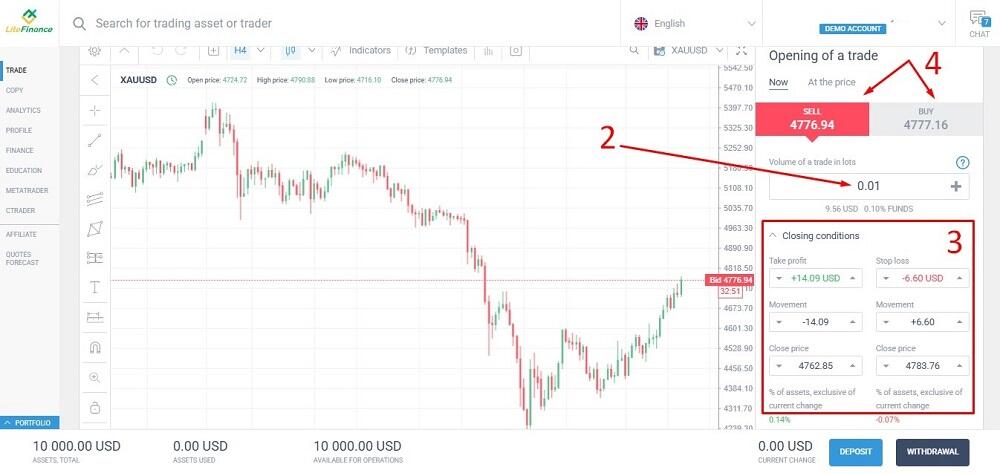
Check the gold price forecast for tomorrow.
Choose the trade volume (position size). The minimum lot size is 0.01. To reduce the trade size, you can use leverage.
Set Stop Loss (optional but highly recommended) and Take Profit levels.
Click "Buy" or "Sell." The trade will close automatically via Stop Loss/Take Profit, or can be closed manually.
Key investment rules:
Your deposit is the amount you are willing to risk to make a profit.
Diversify your portfolio. Do not invest 100% of your deposit in gold alone. There is a correlation between stocks and gold, so consider it when allocating funds. Pay attention to top-performing stocks across different sectors.
When actively trading gold online, always use Stop Loss and follow risk management rules: risk no more than 1–2% of your deposit per trade and no more than 10% across all open positions.
When trading gold on Forex, it is important to consider the following factors:
Factors | Impact on gold prices |
Monetary policy | Higher interest rates tend to reduce gold prices, as investors shift to higher-yielding assets. |
USD exchange rate | Gold is priced in US dollars. When the USD weakens, gold tends to rise. |
Inflation | Rising inflation supports XAU/USD growth. |
Geopolitical risks | Wars, sanctions, and political crises drive investors toward safe-haven assets, including gold. |
Global supply and demand | New mining projects increase supply. Gold demand is driven by industrial use. |
Speculative pressure | Buying and selling by market makers and investment funds can impact prices in the short term. |
Is it worth investing in gold? Yes, the precious metal tends to provide steady growth over the long term.
How Does the Gold Market Work?
The spot gold market and the broader commodities market form a global, decentralized system in which the metal serves as both a raw material and a financial asset. This system includes both exchange-traded and over-the-counter markets.
The London Bullion Market Association (LBMA) is the main global center for physical gold trading. It sets the London fixing, which occurs twice a day — a benchmark gold price used by market participants worldwide.
COMEX (New York) is a leading venue for trading gold futures. It determines prices for "paper" gold, which often drives short-term trends.
China (Shanghai Gold Exchange) — the largest physical hub, reflecting global demand for precious metals in Asia.
Market participants:
Central banks, which use gold as a reserve asset.
Mining companies and industrial consumers, which shape supply and demand in the physical gold market.
Traders, investors, and investment funds — speculative participants who profit from price differences.
Gold Trading Hours
On cryptocurrency exchanges, gold-backed tokens and coins can be traded 24/7 from anywhere in the world.
Exchange brokers do not operate 24/7 as they follow trading sessions and breaks set by the exchange. OTC brokers set their own schedules based on technical capabilities. Trading hours are usually indicated in GMT+0 (UTC) or EET (GMT+2/GMT+3). Exchange and OTC brokers do not operate on weekends.
1. Trading hours of exchange brokers:
According to CME Group, gold futures trading on the Globex platform follows this schedule (GMT-4):
Sunday to Friday: from 18:00 to 17:00 the next day.
Daily technical break: from 17:00 to 18:00.
London (LME): electronic trading is available from 01:00 to 19:00 London time (GMT+1). Peak liquidity occurs during the London session (08:00–17:00).
Shanghai (SGE): three sessions: morning (09:00–11:30), daytime (13:30–15:30), and night (20:00–02:30 the next day), Beijing time (GMT+8).
2. OTC brokers typically operate 23 hours a day with a break around midnight (about 1–2 hours).
The trading schedule for gold can be found in the XAU/USD contract specifications at LiteFinance:
What Instruments Can You Use for Gold Trading Online?
If we are talking about trading rather than investing, there are several options:
Contracts for difference (CFDs): Online gold trading via a Forex broker on OTC markets using contracts linked to gold prices.
Gold futures: Trading derivatives on exchange markets.
Gold ETFs: Buying shares of ETF funds that invest in gold in various ways.
Gold mining stocks: Although not directly tied to gold prices, they often show a strong correlation with gold prices during certain periods. When gold rises, mining stocks tend to increase as well.
Tokenized instruments are derivative crypto assets whose value is tied to the price of gold.
Another option is unallocated metal accounts opened by a bank. However, this option is more suitable for long-term investing.
CFD Gold Trading
CFD (contracts for difference) on gold. This derivative financial instrument allows gold traders to profit from price fluctuations without actually owning the asset. The investor earns from the difference between the opening and closing prices of a trade. Gold is traded on the over-the-counter market through a Forex broker.
Advantages of gold CFDs:
Simple and fast verification with a broker.
Low entry threshold. 50–100 USD is enough to get started.
Leverage allows traders to significantly increase the lot size. However, this also increases risk due to the higher one-pip value.
They are one of the most convenient options for beginner gold traders: fast verification, the ability to profit from gold price movements and to trade from anywhere in the world, multiple withdrawal methods, and free technical analysis tools.
Gold Futures
A gold futures contract is an exchange-traded agreement that obligates the buyer to purchase or the seller to sell a specific amount of gold at a predetermined price on a set future date. It is "paper gold" (a derivative) used for speculation on price differences or for hedging risks. It does not require physical ownership of gold bars.
Advantages:
High transparency and fair pricing. Trading takes place on centralized exchanges such as COMEX. All participants see the same quotes and volumes in real time, which eliminates broker-side manipulation.
No swap fees for holding positions overnight.
Strict regulation.
The trading logic of futures trading is similar to that of CFD trading. The main difference is that futures are exchange-traded instruments and can only be traded through an exchange broker. Disadvantages: a relatively high entry threshold and higher commissions if trading volumes are small.
Gold ETFs
Gold exchange-traded funds are investment funds managed by professional portfolio managers. The fund issues its own shares, which are traded on an exchange under a specific ticker. Investor funds are allocated across assets. A gold ETF invests all or most of its capital in physical gold and manages the investment portfolio, charging investors a relatively small fee.
Advantages for investors:
"Buy and forget." The fund handles diversification, adjusts position sizes, etc. Diversifying the portfolio with other precious metals or shares of gold mining companies helps reduce volatility risk.
Fund shares can be bought and sold on the exchange at any time.
Examples of the largest gold ETFs by market capitalization:
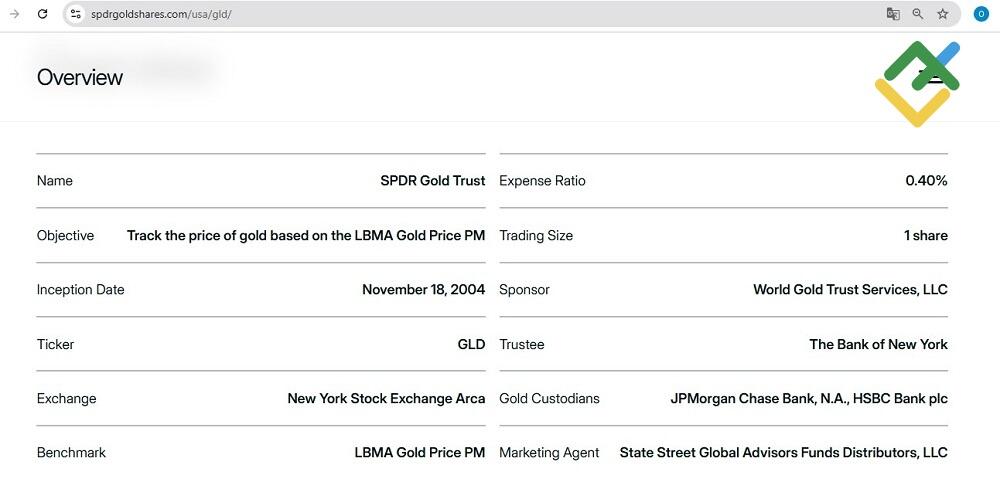
SPDR Gold Shares (GLD). One of the largest ETFs by assets under management and the largest among gold ETFs. It invests exclusively in gold, making it an alternative to buying physical metal. The fund's fee is 0.4% per year.
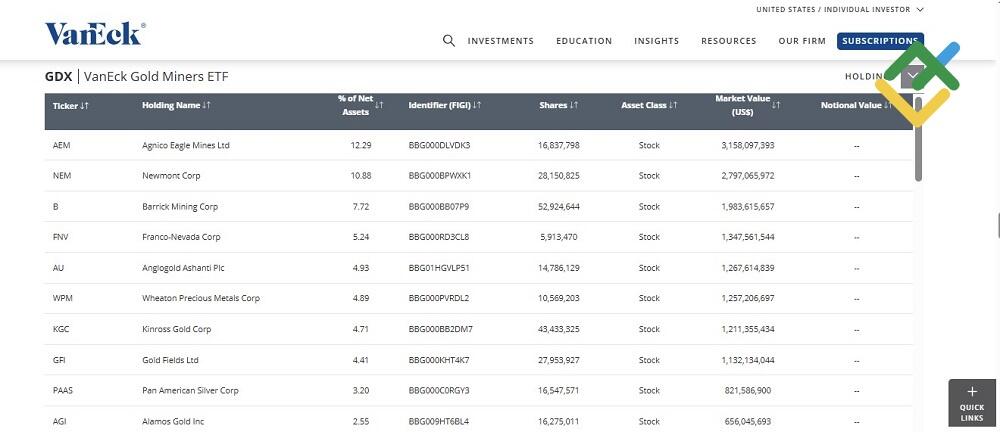
- VanEck Gold Miners ETF. One of the top 100 largest funds in the world. It invests in major gold mining companies that have a strong positive correlation with gold prices. The fund's fee is 0.51%. Although the fund has shown a slight loss (less than 1%) since the beginning of the current year, its average annual return over the past five years has been around 31%.
Gold Mining Stocks
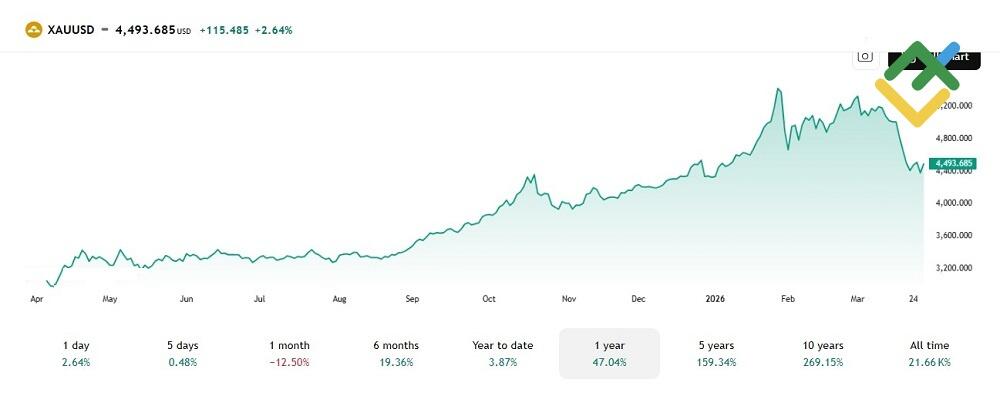
Shares of gold mining companies are indirectly correlated with gold prices. For example, over the past year (as of March 28, 2026), gold has risen by 47.04% amid geopolitical uncertainty. As of January, this figure exceeded 70%, but a correction followed. Shares of the largest gold mining company, Newmont Corporation (NEM), increased by 112% over the same period.
Annual gold price performance:
Annual Newmont Corporation share price performance:
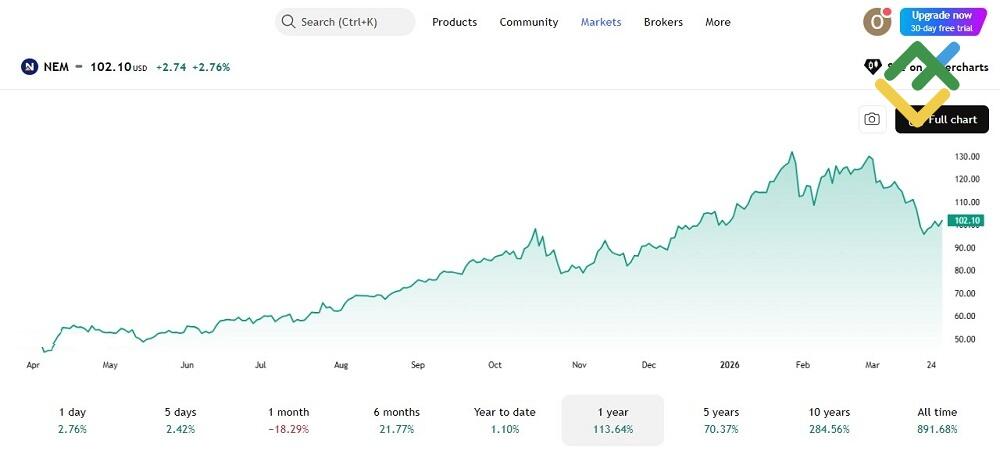
On the annual chart, peaks and declines largely coincide, indicating a strong correlation. However, over five years, gold has shown significantly higher growth. This suggests that the close relationship between gold and mining stocks is not always consistent. In most cases, the reason lies in different fundamental factors. However, signals from one instrument can be used as a "guide" when trading another asset.
Advantages:
Dividend income (though not all companies pay dividends).
Influence of additional fundamental factors. When gold rises by 5%, stocks may increase by 10%. But this also works in reverse: stocks may show weaker growth or even decline.
Tokenized Instruments
Another alternative is available via blockchain. Some startups offer stablecoins pegged to gold. The price of these coins changes in real time. You do not buy gold or contracts. Instead, you buy a stablecoin linked to gold and backed by it.
Examples of tokenized assets:
PAX Gold (PAXG). One of the most reliable tokens issued by Paxos. Each token is backed by one troy ounce of gold stored in London vaults and is listed on Binance. The token can be redeemed for physical gold bars.
Tether Gold (XAUT). Issued by TG Commodities Ltd (affiliated with Tether). The token represents ownership rights to physical gold stored in Switzerland.
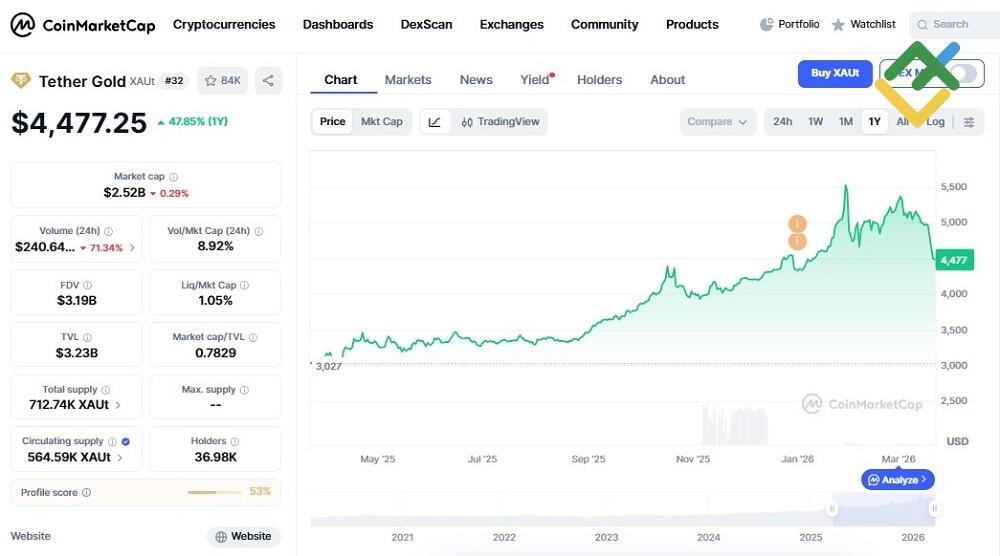
Advantages: Binance or ByBit have strong reputations as reliable exchanges and hold licenses in multiple jurisdictions. There are also no swap fees. Risks: In theory, the stablecoin is backed by gold, but in practice, there is no guarantee that the startup will continue operating.
Choosing the Right Broker for Gold Trading
The algorithm for choosing an exchange or over-the-counter broker is almost the same:
License. It is mandatory as it confirms that the broker is regulated. However, it does not provide a 100% guarantee. There have been cases where exchange brokers went bankrupt due to violations of account segregation rules. CFD brokers often prefer offshore licenses, which are largely symbolic.
A key nuance: in the event of a CFD broker's bankruptcy, recovering funds is almost impossible. If an exchange broker goes bankrupt, there is a chance to recover funds through state-backed insurance systems.
Tip: always verify the existence and status of the license on the regulator's official website. Make sure the company name in the license matches the one in the public offer.
Number of trading instruments. In addition to gold, it makes sense to include other correlated assets, such as gold-mining stocks and silver. The wider the selection, the better, as it allows a quick switch to other instruments if prices fall.
Commission. For CFD brokers, this includes the spread and swap. For exchange brokers, this includes transaction fees (which may depend on volume), exchange fees, market data subscription fees, etc.
Analytical and technical tools. It is important to be able to add additional analysis instruments to the trading platform: scripts, expert advisors, software for identifying chart patterns, indicators, etc.
Reviews can help form an opinion. However, opinions are often subjective and may not provide an objective assessment. They may also be unreliable or commissioned. Therefore, it is better to focus on reviews that contain specific details.
Payment methods. The more options available, the better.
For trading tokenized assets, choose top-tier cryptocurrency exchanges. In addition to licensing, they also offer additional income opportunities such as staking and farming.
Advantages and Risks of Gold Trading
Advantages:
High liquidity. The asset can be bought or sold at any time in any form. As a result, gold typically has a relatively tight spread, while slippage and gaps are rare.
A clear mechanism for how the supply and demand ratio is formed. Changes in gold prices reflect developments in the economies of major countries and in stock and currency markets.
Constant industrial demand and limited supply, as extraction costs gradually increase, support price growth.
In the long term, gold shows steady price growth, with returns exceeding inflation.
Risks:
Geopolitical uncertainty. On the one hand, investors tend to move into safe-haven assets during periods of uncertainty. The example of gold rising by more than 70% in 2025 confirms this. On the other hand, when economic uncertainty becomes critical, investors may sell their assets, including gold. Example: a drop of 18.5% from the February 2026 peak. Reason: the military conflict in Iran.
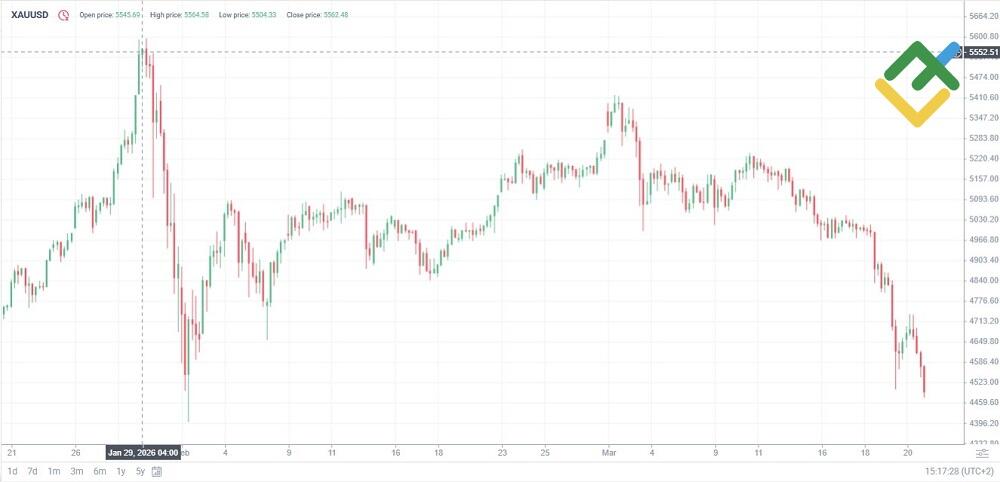
High market volatility. Under the influence of news, the price can rise or fall sharply in a short period. A clear example is shown in the screenshot above. According to the volatility calculator, gold prices fluctuate much more than major currency pairs.
Currency risk. Gold is primarily traded in USD. When the US dollar strengthens, the price of gold declines.
Monetary policy of the Federal Reserve. Rising interest rates reduce investor interest in gold.
Gold is an asset with its own specifics. It is almost an ideal instrument for generating steady, moderate returns over 10+ years. This is confirmed by the gold forecast for 2026.
Conclusion
Gold is a safe-haven asset, and its price tends to rise steadily in the long term. The reasons are limited supply and strong gold demand from both the industry and the financial sector.
Physical gold bars are suitable for long-term gold investing. Trading in gold and silver via CFDs is an optimal option for beginner traders. Tokenized assets are suitable for both long-term investing (no swap fees) and short-term trading, but require verification on a cryptocurrency exchange. Exchange-traded futures are a complex instrument intended for professionals. Shares of gold-mining companies and ETFs are effective instruments for portfolio diversification.
Start trading gold on a demo account at LiteFinance! Registration takes no more than two minutes and requires no verification or deposit.
Get access to a demo account on an easy-to-use Forex platform without registration
Gold Trading FAQs
Yes. It is one of the simpler trading instruments, with moderate volatility and clear pricing factors. It is a safe-haven asset that shows steady long-term growth. During periods of market instability, returns can exceed 50%.
According to the specification, the minimum contract size is 0.01 lots, while a full contract is 100 units. This means the minimum investment amount is 4,574.90 USD. With leverage of 1:100, 46 USD is enough. Do not use leverage to increase position size and follow risk management rules.
Position value = Current price × Contract size. According to the specification available on the trading platform, the contract size is 100 units. Price of 1 lot = 4,574.90 USD (per troy ounce) * 100 = 457,490 USD.
No. When trading futures on an exchange or CFDs on the over-the-counter market, owning a physical asset is not required. You profit from price differences by buying or selling a digital contract. Physical gold is mainly suitable for long-term capital preservation.
Price chart of XAUUSD in real time mode
The content of this article reflects the author’s opinion and does not necessarily reflect the official position of LiteFinance broker. The material published on this page is provided for informational purposes only and should not be considered as the provision of investment advice for the purposes of Directive 2014/65/EU.
According to copyright law, this article is considered intellectual property, which includes a prohibition on copying and distributing it without consent.