Compared to CFD trading, spread betting allows you to earn much more. Provided some risk management, the profitability of spread bets can be ten times higher than the amount of the bet. This is not possible in CFD trading, even with leverage. But a wrong forecast can cost you the entire deposit.
What is spread betting, can you make money on it, what is the difference from CFD trading - you will find answers to these and other questions in this review.
The article covers the following subjects:
Similarity of spread betting and CFDs
CFD trading allows you to earn on the difference between the buy and sell prices of the underlying asset. In spread betting, a trader bets on which direction the price will move.
In essence, CFD trading and spread betting are quite similar:
There is no real delivery of goods. Both contracts for difference and spread betting involve investing in the forecast. The investor does not receive the actual asset and does not become its owner. For example, stock CFD trading does not give the investor the right to vote at shareholder meetings. Naturally spread betting doesn’t either.
Unlimited gain or loss. In both cases, the investor earns while the price is moving in the direction of the forecast. The further the price moves away from the point of the position (bet) opening, the more the trader earns. The loss in both cases is limited by the amount of the deposit or the stop order. Both types of trading allow early closing of the trade.
Leverage. Available in both cases.
Most of the vocabulary is the same. In both CFD trading and spread betting, most of the terms are the same: long and short positions, stop loss, pip, etc.
CFD trading is earning on the difference in quotes in over-the-counter markets. Spread betting is also based on the forecast, but is more like a game of chance.
Difference between spread betting and CFD trading
Spread betting vs. CFDs. The fundamental difference between these two types of trading is in the approach to calculating the volume of the position involved in the transaction. Namely, it’s the amount of potential income / loss and the risk level. The following example shows this difference:
You have 10 USD, which you invest in opening a long position in the EUR/USD pair. The current buy rate is 1.0135.
Financial spread betting. You bet 10 USD that the EUR/USD rate will go up and it does. You close the trade at the sell price of 1.0160. The amount of profit is calculated as the difference between the buy and sell prices multiplied by the bet amount and adjusted by the number of points. The difference will be 0.0025 USD or 25 points. 10 USD is the bet corresponding to a 1 point movement. The capital gain is (1.0160 - 1.0135) × 10 = 250 USD. The bet amount is 10 USD.
CFD trading. The minimum allowable position volume is 0.01 lots. To open such a position, you need 0.01 × 100,000 × 1.0135 = 1,013.50 USD. The point value will be 0.1 USD, the profit at the closing price from the previous example is 2.5 USD.
Difference between spread betting and CFD trading. In the first case with a bet of 10 USD, the profit will be 250 USD. In the second case with the smallest possible investment of 1,013.50 USD, the profit is only 2.5 USD.
However, the reverse side of the coin is the possibility of a wrong forecast. The average daily volatility of the EUR/USD pair is 80-100 points, so a movement of 25 points within a day is standard. Forecast error will bring a loss of 250 USD in a few hours. In theory, the risk of loss could be reduced by betting, for example, 1 cent. But then the potential profit/loss would be the same 2.5 USD as in the case of CFDs. Also spread betting platforms do have minimum bet amount requirements, just like CFD brokers.
Sometimes spread betting is compared to binary options, which also involves betting. But the risk of losing money with options is lower, because the investor knows in advance the amount of income and possible loss. On the other hand, in spread betting the result depends on the length of the price movement (the price difference between the open and closed trade).
Differences between spread betting and CFD trading:
Trade opening mechanics. In CFD trading, the trade volume is calculated in lots and it determines the value of a point. With CFDs, a trader "buys" an asset or part of an asset. In betting, the trader determines the value of a point by the amount of the bet on the value of an asset going up or down.
Risk level. With the same trade amount, the possible losses in spread betting are much higher compared to CFD trading.
Leverage. The roles of leverage in betting and CFD trading are slightly different. In both cases, it can be used to increase the position/bet size. For example, in betting with a leverage of 1:10, the bet amount increases from 10 USD to 100 USD, where 10 USD is the investor's money. In CFD trading, the volume of the lot increases from 0.01 to 0.1 in the same way. But in CFDs, leverage is also used to reduce the broker's margin for an equal position size. This is necessary to comply with risk management rules.
Dividend adjustment. This is a concept from CFD stock trading, which involves the investor receiving a dividend when opening a long position. In the case of a short position, the dividend adjustment is deducted from the investor's profit. When betting on stock quotes, no dividends are taken into account.
Tax. In theory, any trading or betting income is taxable. But the tax rate may vary depending on local laws. For example, CFD trading can be classified as financial transactions, while betting can be classified as gambling. In practice, it all depends on whether the broker is a tax agent. If yes, then the broker calculates the tax amount and deducts it from the trader’s profit at the moment of withdrawal of money. But most CFD brokers, let alone betting platforms, are not tax agents. And the traders themselves are in no hurry to give money to the state. They also bear the responsibility for this. In exceptional cases, CFD trading may be exempt from taxes.
Another key difference is the technical implementation of the trading process. A CFD broker is an intermediary that places a trader's trades on the real market. Brokers are subject to financial legislation. Spread betting is classified as gambling, which means that the service is provided by betting companies. The investor's profit here is generated from the loss of the betting company’s clients.
Spread betting
Spread betting (funding charge) is a form of investment in which an investor places a fixed bet on which direction the asset will move. In this case, spread means the difference between the price at the current moment and the price at the time of the transaction closing. Funding rate is the amount that a trader bets per point of price change.
The financial result is calculated according to the following formula:
Financial result for a long position = (trade closing price - trade opening price) × bet amount.
- Financial result for a short position = (trade opening price - trade closing price) × bet amount.
The price difference is converted into points.
Here is an example of a long position in spread betting. The price of an Apple share is $173.00. A point is the minimum price change value, which in this case is equal to 0.01. You bet 5 USD that the price will go up. The price increases by 0.5 USD or 50 points. The amount of profit at the closing price: 50 × 5 = 250 USD. If the stock goes down by 0.5 USD, you get a loss of 250 USD.
It goes without saying that before placing the bet, you need to have 250 USD in your account. Otherwise, the platform will close the trade earlier when the deposit reaches zero.
Advantages Of Spread Betting
There are two advantages to spread betting. The first is the ability to quickly earn a lot of money (but also quickly lose a lot). The second advantage is that you do not need to calculate the position volume in lots. The term "rate" is more understandable for beginners, since it is immediately expressed in money without the need to calculate the cost of a price change point, which the trader sets. This could also be considered a downside: the apparent simplicity can encourage the trader to ignore the risk management rules.
Disadvantages Of Spread Betting
Disadvantages of spread betting:
High financial risks. The risk of losing money is always higher where the potential return is higher.
High regulatory risks. Since transactions in spread betting are carried out within the company (analogous to the B-Book of CFD brokers), there is a high probability of manipulation by the betting company.
Extremely short-term trading. No deposit can withstand long-term trading.
Due to the high risks and betting aspects of spread betting, the number of platforms offering the service is limited.
CFDs
A contract for difference (CFD) is a derivative financial instrument, which constitutes an agreement between a buyer and a seller to transfer the difference between the current price of the asset and the price at the end of the transaction without the transfer of the asset itself.
Example. The current buy price of Apple shares CFD is 173 USD. You predict that after the publication of the financial statements, the price will go up, because amid the company's growing profit there will be more people willing to buy the securities. You open a long position of 10 lots. According to the CFD contract specification, 1 lot = 1 share. Without leverage, the transaction amount will be 1,730 USD.
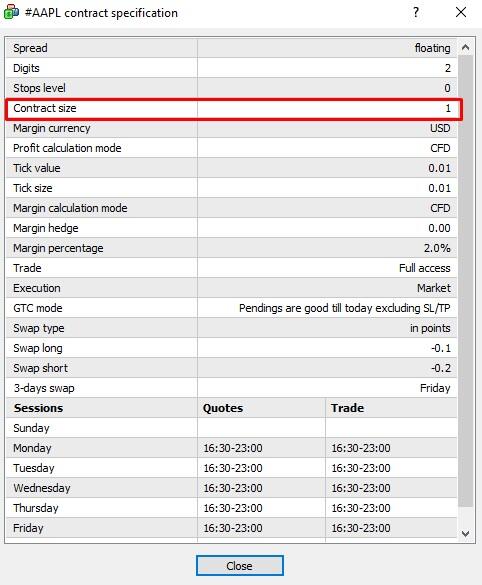
A week after the publication of the report, Apple shares are actually going up. Due to the demand, the price rises to 190 USD. There are still many traders who want to buy shares even at this price. But you are afraid that as the price rises, there will be fewer, so you sell your 10 shares. There is no actual transfer of securities, but you earn 170 USD = ((190 - 173) × 10) on the price difference.
In CFD trading, the broker acts as an intermediary moving money to liquidity providers or ECN platforms. In the former case, the counterparty to the transaction is investment banks that supply liquidity. In the latter case, counterparties are traders making the opposite forecast. In theory, a situation may arise when all traders forecast growth and open buy positions. In this case, slippage will occur: the price will go up until the one that suits both the buyers and the sellers is established on the market.
Advantages Of CFDs
Advantages of CFD trading:
Low entry threshold. Many brokers have a minimum deposit of 10-50 USD. With a leverage of 1:100, this is enough to open trades complying with risk management rules for many assets.
Large selection of underlying assets. From currency pairs and cross rates to stock derivatives and cryptocurrencies.
Free access to an unlimited number of analytical tools. Indicators, Expert Advisors, strategy testers, graphical tools, packages of market volume analysis tools, etc.
- Passive investment products. For example, you can connect your account to a professional trader's account.
Another advantage is the opportunities for novice traders. Stock brokers have a qualified investor rule, which involves testing and high requirements for start-up capital. CFD brokers and betting platforms have looser policies. But the investment risks are borne by the retail investor in any case.
Start trading with a trustworthy broker
Disadvantages Of CFDs
Disadvantages of CFD trading:
High risks. If someone earns, someone else loses the same amount. The OTC market is balanced. Therefore, in order to trade successfully, you must be better than others. In high market volatility, it’s quite easy to lose money when closing a position.
- High entry threshold for professional trading. Despite the fact that the minimum deposit is 10-50 USD, this amount is not enough to make a profit comparable to a salary on any other job. If you want to make money on Forex as your main source of income, you need more serious investments.
Another drawback is that the trader's interests are less protected in comparison with trading on the stock market. The same drawback applies to betting platforms. A license from a regulator does not guarantee that a private investor will be protected in the event of a conflict of interest with a broker. Language issues, multi-jurisdictional issues, financial fees for handling a claim - in most cases all this makes the process of filing a complaint with the regulator pointless. Many regulators explicitly indicate that they do not consider claims from individuals.
CFD trading vs. spread betting table:
CFD | Spread betting | |
Asset type | All assets: currency pairs, stock assets, commodity market assets, cryptocurrencies | All assets: currency pairs, stock assets, commodity market assets, cryptocurrencies |
Trading mechanics | A position is opened in lots; the cost of a point (profit or loss) is determined by the volume of the position | A position is a bet that determines the price movement by 1 point. Movement by 3 points in the direction of the forecast means a 3x profit, in the opposite direction - a 3x loss |
Available trading instruments | Any | Any. Disadvantage: fewer custom and underlying instruments compared to CFDs |
Leverage | Available | Available |
Initial investment | From 50-100 USD on standard accounts | Depends on the conditions of the company. There may be a minimum bet amount requirement |
Permitted strategies | Scalping, swing trading, intraday, medium- and long-term strategies | Short term strategies. The deposit cannot withstand other types of strategies |
Regulation | Regulated by Central Banks, regulators and authorized bodies. There is a risk associated with licenses from offshore regulators | There is regulation, but much depends on local legislation. Almost all risks are borne by the investor |
Access | Highly accessible in many countries of the world, with the exception of isolated countries and countries where restrictions apply | Relatively few platforms providing the service |
Profitability | Medium | Relatively high |
Risk level | Medium | Relatively high |
Conclusion
Comparative characteristics of CFD trading and spread betting:
Entry threshold. Low for betting, average for CFDs. In betting you can bet as little as 1 USD, CFD brokers usually have a higher entry threshold.
Risk level. High for CFD trading, very high for betting.
Typical strategies. Scalping is typical for spread betting. In CFD trading, you can use any strategy.
Difficulty. Analysis tools are the same in both cases: an investor can use any technical and fundamental analysis tools to determine the direction of price movement. CFD trading is more complicated, since the volume of a position is in lots, while in spread betting the investor indicates the value of a point in currency.
Regulation. CFD brokers comply with financial legislation; the regulators are the Central Banks and authorized bodies. Spread betting is a kind of gambling.
The problem with spread betting is that the actual organizer is the betting platform itself. It is unlikely that they are interested in their clients making a profit all the time. In CFD trading, trades are placed on the international market, which is more transparent in this respect. So which is better: CFD and/or spread betting? The choice is yours!
Spread betting vs CFDs FAQ
A type of earnings that involves betting on each point of change in the value of an asset without its direct acquisition. A bet can be made both on the growth of the exchange rate and on its decline.
Let’s assume you place a bet in the amount of 2 USD on the price increase. If the price increased by 1 point and you closed the trade, your profit is 2 USD. If you closed the trade after 5 points, your income is 10 USD. However, you need to take into account the time it takes for the price to cover this distance. For example, for Apple shares, 5 points is the difference between 173.05 and 173.10 USD, which the price passes in a few seconds.
Depends on your goals. If your goal is the excitement and pleasure of short-term investing, if you are not afraid to lose money quickly, spread betting is suitable for you. If your goal is risk minimization and long-term trading, choose CFDs.
Yes. If you are proficient in technical and fundamental analysis, know how to calculate risks, and are emotionally stable, you have every chance to make money on spread betting.
Yes. Unlike CFD trading, here the value of a point is determined by the size of the bet. A change in price by several points, which will cost a few cents with a minimum trade volume in CFD, in financial spread betting will be equal to the amount of the bet. For betting platforms, the minimum bet is from 1 USD. In other words, the risk in spread betting is ten times higher than in trading.
Under equal initial conditions, spread betting is more profitable. In CFD trading, the investor is forced to buy an asset for its full value. The larger the position, the higher the value of the point and the greater the profit. In spread betting, the investor indicates the value of a point by the amount of the bet. Therefore, betting requires a much smaller deposit to get the same profit as in CFD trading.
The content of this article reflects the author’s opinion and does not necessarily reflect the official position of LiteFinance broker. The material published on this page is provided for informational purposes only and should not be considered as the provision of investment advice for the purposes of Directive 2014/65/EU.
According to copyright law, this article is considered intellectual property, which includes a prohibition on copying and distributing it without consent.