

CFDs and futures contracts are two popular types of financial derivatives. Although they have many common traits, these are two different financial products. This is why many traders get confused and can’t decide which to include in their investment portfolios.
This article will explore the difference between futures and CFD trading, their main features, advantages, and disadvantages so that you can choose the most suitable form of investing and achieve success in the financial market.
The article covers the following subjects:
Major Takeaways
- A futures contract is a standardized agreement to buy or sell an underlying asset at a predetermined price on a specified future date.
- Futures are widely used for both speculation and hedging against market risks.
- Each contract has a fixed expiration date, after which it ceases to trade or is settled.
- Futures are traded on exchanges, providing standardized contract terms and high liquidity.
- Opening a futures position requires only a margin deposit rather than paying the full contract value upfront.
- Unlike equity perpetual contracts, futures are generally unavailable for trading outside exchange hours or on weekends.
What Are Futures Contracts and How to Trade Them
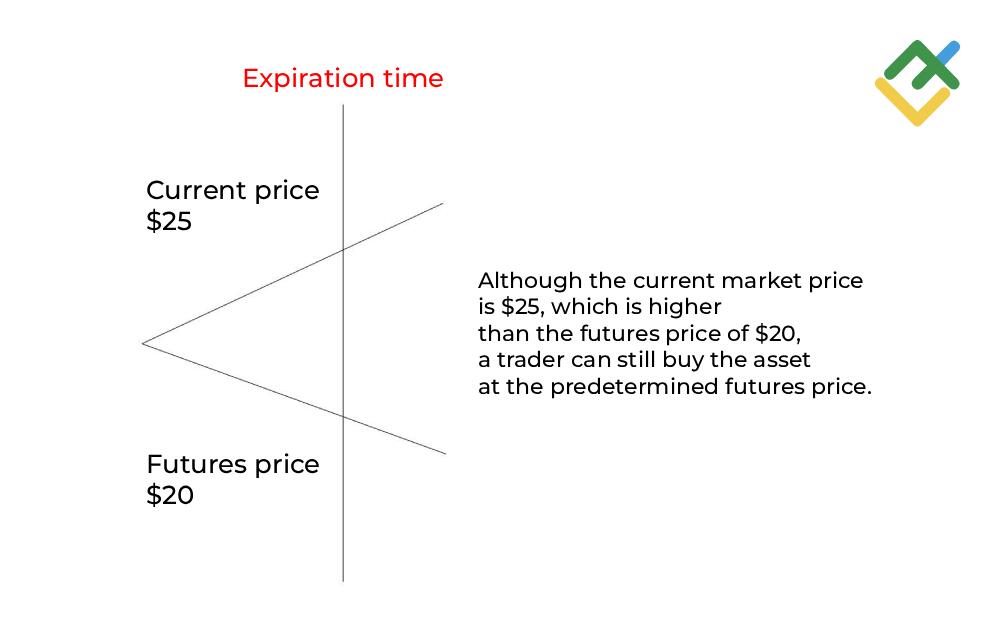
A futures contract is a deal between two or more parties to purchase (long position) or sell (short position) a particular asset at a specific price and at a set time in the future. While the buyer undertakes to purchase the underlying asset when the contract expires, the seller is obliged to provide the buyer with the agreed asset at the specified future date.
Futures contracts are usually present in various financial markets such as:
- currencies;
- indices;
- commodities;
- agriculture;
- energy;
- metals (precious and industrial);
- Forex currency pairs;
- bond futures, etc.
There are two main types of investors in the futures contract market, not including investment banks:
- Speculators. They take the risk and try to benefit from favorable price fluctuations. These traders purchase when expecting the asset price to grow and sell when anticipating a drawdown. Speculators play a crucial role in the market—they foster liquidity.
- Hedgers. They own or are willing to purchase the inventory of a commodity. Thus, in contrast to speculators, they use futures trading to protect themselves from price movements. They purchase or sell to establish a favorable price for the assets they want to buy or sell later in the cash market.
A single futures contract is one of the most liquid financial instruments that allows buying/selling an asset in the future at the price predetermined today.
Futures trading is primarily used to hedge against the high risk of loss and secondary — for speculating.
After each closed trading session, the exchange publishes reports, analyzing which, you can check the actions of the exchange itself. Forward means that the contract will be executed at a predetermined future settlement date and price. As you see, futures trading is suitable and beneficial for all futures market participants.
Features of Futures
Each underlying asset has different conditions for futures trading, though there is some similarity in the same group of trading instruments (currencies, different types of oil, stock indexes, and so on).
Each single futures contract has the following characteristics:
- name;
- expiry date;
- minimum price fluctuation;
- the amount of the underlying asset in the contract;
- minimum price fluctuation;
- point value;
- margin requirements;
- product code (ticker);
- contracts listings (quarterly, monthly);
- settlement;
- trading hours.
As the transaction involves two sides, you can take part as a buyer or seller, but any exchange contract always involves two sides.
Example of Futures Trade
Here is an example of a futures contract trade in the crude oil market. Let's say it's May and the contract expiration date is in July. The oil price is $60 per barrel. If the speculator expects the price to go up until July, he can buy the contract at $60. If he wants to take control of 1,000 barrels, it doesn't mean he needs to pay $60,000. He will only have to provide a 5% margin (in futures trading, it's usually 5% or 10%), thus $3,000. If the futures contract is closed in July at an oil price of $65 per barrel, the investor wins $65,000-$60,000 = $5,000. If his expectations are not met and the oil price falls to $55, he will incur a $5,000 loss.

Futures Pros
- Transparency. Since futures are traded on official exchanges, they are highly standardized. This makes futures trading more transparent in terms of regulations and pricing.
- Liquidity. The majority of the futures markets are highly liquid, which allows investors to enter and exit the market at the time they want.
- Risk management. Futures allow individual investors and companies to implement hedging strategies to protect themselves against potential risks.
Futures Cons
- Timing issues. Futures have a predetermined expiration date, so as it approaches, the asset's price can decline and become less favorable to others.
- Leverage. It is both a merit and a drawback of futures trading. It can be the reason for increased profits and magnified losses. Thus, traders should have a robust strategy to avoid losing money rapidly from their retail investor accounts.
- Entry barrier. Since futures are traded on large exchanges, their minimum contract size is large and relatively rigid, making it more challenging for small investors to enter the market.
- Regulations. A vast number of different regulations make the process of opening an account in the futures market much more complicated.
Types of Futures Contracts
There are many different types of futures contracts in both financial and commodity markets. Here are the most widespread of them with examples:
Financial | Commodity |
Forex Futures
| Grains Futures
|
Interest Rate Futures
| Metal Futures
|
Index Futures
| Energy Futures
|
Single Stock Futures | Soft Futures
|
| Livestock Futures
|
Financial Futures
Financial futures trading usually refers to speculating on interest rates, stocks, stock indices, and currencies. Financial futures contracts are the most liquid financial instruments that allow buying/selling an asset in the future at the price predetermined today.
Forex Futures
These are exchange-traded currency derivatives. They operate close to regular futures contracts, meaning that the contract parties are obliged to buy and sell the asset at an agreed price on a predetermined date. However, FX futures are not traded on a centralized exchange; instead, they are available on various exchanges worldwide.
Interest Rate Futures
These futures contracts imply that the buyer and the seller agree on the future delivery of any interest-bearing asset. When trading interest rate futures, investors can either speculate on changes in interest rates or use hedging strategies against them. However, it’s important to remember that the interest rate futures price changes inversely to the interest rate itself.
Single Stock Futures
Single Stock Futures, or SSFs, suggest that a seller and a buyer exchange a particular number of stocks at a previously agreed price. Since the buyer expects to profit from an increase in the stock price, he is considered a long party, while the seller, who benefits from a decrease in the price, is called a short party. The first SSF trade took place in the US in 2002. Nowadays, single-stock futures are available in a wide range of financial markets worldwide, including those in India and Spain.
Index Futures
Index futures imply that parties agree on the future delivery of an underlying index. Index futures are usually based on equity indices such as the S&P 500, the NASDAQ-100, the AEX, and others. This type of futures contract can be used by both speculators to profit from price movements and by portfolio managers to hedge their equity positions against potential losses in stock indices.
Commodity Futures
Commodity futures usually refer to price speculation on oil, natural gas, gold, silver, wheat, corn, and more.
Grains Futures
Grain futures are contracts between two or more parties defining the delivery of the grains at an agreed price and predetermined date in the future. These contracts have standardized quality, quantity, time, and place of delivery. The only changing parameter is the price. The most widely used grain commodities include wheat, corn, oats, rice, etc.
Metal Futures
Metal futures are agreements between parties on the delivery of the metal at a specified price and date. Such contracts let investors avoid holding the physical metal but use the same leverage benefits to enter the futures market. Most popular metal futures markets include:
- gold futures;
- silver futures;
- copper futures, etc.
However, it's crucial to remember that, despite offering significant profits and inflation-hedging benefits, trading in the metal futures market carries high risk.
Energy Futures
Energy futures have energy products as an underlying market asset. The most common energy products include crude oil, natural gas, and electricity. This type of futures contract is available on formal exchanges or in over-the-counter (OTC) markets. Unlike other types of commodity futures, it doesn't have a long history. Energy futures were first traded in the 1970s as a tool to control volatility in the futures market.
Softs Futures
These futures are one of the oldest to be traded. They are based on agricultural products, such as sugar, coffee, and cotton. Softs futures are usually used either by farmers who act as hedgers or by investors who speculate on price movements in the product. Softs futures are more volatile than energy or metal futures because it's difficult to predict weather conditions and other farming-related risks.
Livestock Futures
Livestock futures are standardized agreements in which the underlying asset is livestock. The only futures market in the US that trades livestock futures is the Chicago Mercantile Exchange (CME) located in Chicago, Illinois. These futures contracts were first introduced in the 1960s and underwent changes to help livestock producers better manage their risks.
Futures Trading and Margin Requirements
To discuss the margin requirements for futures, we first need to understand what margin is in general and the types of margin used in the futures market.
Initial Margin
This is the equity required to initiate a futures position. This is not a credit or a loan; it is neither the payment for an asset. Unlike a margin loan, it doesn't suggest borrowing money at an interest rate. Margin is the amount of money you should have on your futures accounts before you open a position. It guarantees the exchange that you are solvent and financially reliable.
If you do not have enough funds on your futures accounts for the initial margin, you can't initiate a trade for a futures contract.
For example, you have $4,000 in your trading account. You want to buy a euro futures contract at the exchange rate of 1.1160. The Initial Margin is now $2,200 per contract. Accordingly, when you open a long position with one contract, $2,200 is blocked on your account. Next, if you continue holding your long position, profit is added to this amount if the price is rising, or, if the price is falling, the loss is deducted, depending on market conditions.
Differently put, the initial margin is a particular amount of money that you should have on the day of the position opening (first clearing), multiplied by the number of open contracts. In our example, the remaining free margin is $4,000 - $2,200 = $1,800.
Maintenance Margin
If the holding time of your position in your retail trading accounts goes beyond the second trading session, then you have to comply with the maintenance margin. It is the amount of money you must have in your account to maintain a futures position, like an overnight margin. It is usually less than the initial margin by some percentage points.
Let's return to the example of the EUR futures trade. For example, we decided to hold on to the trade through the third trading session. Since the transfer date, a $2,000 maintenance margin has been applied.
We bought at 1.1160. At some point, the price fell by 50 points. At the time of the second clearing transfer, the futures price was at 1.1110. Therefore, we have a loss of 50 * 12.5 (point value) = $625. Our deposit was $4,000 - $625 = $3,375.
Point value is the amount of currency that the trader's deposit changes by if the price rises or falls by one point. The actual value can be found in the contract specifications on the exchange/broker's official website.
The next day, the price fell again, this time from 1.1110 to 1.0990. The loss is 120 points (or 120 * 12.5 = $1,500). After the clearing, our deposit was $1,875. This is already less than the maintenance margin, so what's next? Shall we expect a Futures Margin Call from the exchange?
A margin call is a message from your broker asking you to deposit more money into your account so that your margin balance (account balance) reaches the maintenance margin level again within 3 days. Otherwise, futures positions that do not meet the conditions will be forcibly closed.
If you receive a margin call, you can:
- Increase the amount of capital in the account, release funds from other positions;
- Close a part or all of your futures position
- Just do nothing, thinking that everything will be settled down by itself if you pray to the god of the market.
Intraday Margin and Intrasession Margin
This type of margin is specified by the broker only for futures day trading, traders will not transfer their positions through clearing. It is usually much less than the maintenance margin, being about 10% of it. Although different firms may provide different terms and conditions.
The intraday margin is valid throughout the entire trading session until the last minute. Operating with such a type of margin, the trader agrees to independently close positions before clearing, otherwise, the transactions will be forcibly closed by the broker as the deposit doesn’t match to the size of the maintenance margin.
In general, this type of margin is used by many traders who do not trade big amounts of money. They fail to roll their positions over to the next day, they can’t also make profits from the gaps. So, they must carefully consider whether such trading is worth it.

When is the Margin Returned to the Account?
- When an offsetting transaction is executed.
- When a position is forcibly closed by the broker/exchange, minus the amount of uncovered losses from the free funds of the trader.
An offsetting transaction is a transaction opposite to the original position. For the buyer, the offsetting is a sale. For the seller, it is a purchase. When a transaction is offset, no margin will be charged.
What is CFD and How to Trade it
CFD, or Contract For Difference, trading is a type of financial derivative that lets speculators profit from asset price fluctuations between the opening and closing prices. Trading CFDs provides investors with a wide range of financial products, including stocks, commodities, Forex currency pairs, and indices. Moreover, they can be traded on more than 15,000 markets worldwide.
Here are some of the most important CFD features to be aware of.
Investors never own the underlying asset; they profit from changes in the asset's price.
CFDs don't have a fixed expiration date.
CFD trading, like futures trading, comes with an opportunity to use leverage.
CFDs are considered OTC products and are not available for trading in the US.
An equity perpetual contract is a type of CFD that, unlike a traditional futures contract, has no expiration date. This allows traders to keep positions open without rolling them over into a new contract. Depending on the broker, perpetual stock contracts are available for trading 24/7 outside regular exchange hours, including on weekends, providing nearly continuous market access.
Example of CFD Trade
CFD traders benefit from the price difference. They buy the asset if the market is expected to grow (going long) and sell it if the market is predicted to fall (going short).
If an investor wants to buy 1,000 stocks for $50 per share of a company that he expects to do well in the market, he doesn't need to pay $50,000. It's necessary to provide only the initial margin; in our example, let's take 5%, so $50,000*5% = $2,500.
- If his expectations are correct and the share price increases to $55, his profit will be ($55-$50)*1,000 = $5,000.
- If the asset price goes down despite the prediction and the investor closes the trade at $48 per share, his loss will be ($50-$48)*1,000 = $2,000.
Yet, it's crucial to remember that the loss may exceed the initial investment. It's all about the leverage. On the one hand, it allows investors to significantly increase profits, but on the other hand, it carries the risk of losing more than their initial investment. This is because both profits and losses are calculated by using the total size of the position.
CFDs Trading: Pros
- Flexibility. CFDs provide investors with great flexibility. They come with smaller contract sizes and cover a wide range of financial products (indices, commodities, crypto, Forex, etc.)
- Easy entry. One CFD usually equals one share. It means that it’s easy to open a trading account without huge money investments.
- No expiration date. CFD trading allows investors to exit the trade when the value of the asset goes in the opposite from the expected direction.
- Liquidity. Since traded directly by brokers, who often act as market makers, when you trade CFDs you can benefit form higher liquidity.
CFD Trading: Cons
- Geography. Being an OTC product, CFDs are not allowed in some countries, including the US.
- No centralized exchange. CFDs are not usually traded on official exchanges. Thus, since they are provided by brokers, there are no standardized regulations, which can be very confusing.
- Leverage. As in the case with futures, CFD traders can enjoy the same leverage benefits as well as suffer from the same tremendous losses caused by this tool.
Comparison Between Trading CFD vs Futures Contracts
Parameter | Futures contract | CFD |
Regulation | More regulated | Less regulated |
Leverage | Yes, up to 1:15 | Yes, up to 1:1000 |
Contract size | Large | Small |
Flexibility | Less flexible | More flexible |
Expiration date | Yes | No |
Trading on weekends and outside exchange hours | No | No (standard CFDs) / Yes (equity perpetual contracts) |
Spread | Yes | Yes |
Liquidity | Liquid | Very liquid |
Markets | Central exchanges | More than 15,000 markets worldwide |
Going short and going long | Yes | Yes |
Conclusion
CFDs and futures are similar types of derivatives. However, each has its own features, advantages, and drawbacks. CFDs are more flexible. They don't have an expiration date. Moreover, they offer a high level of liquidity and a great variety of financial products.
Futures, in contrast, are better regulated and can be traded on official exchanges; however, they come with more complex account-opening requirements. Understanding the differences between CFD and futures contracts will help you choose the most suitable trading instrument and build a robust investment portfolio.
Equity perpetual contracts deserve special attention. This newer type of CFD has no expiration date and can be traded around the clock, including outside regular exchange hours. As a result, they eliminate one of the main limitations of standard stock CFDs, which typically follow the trading sessions of the underlying exchange.
Futures Contracts vs CFDs FAQ
Futures and stocks are distinct investment instruments with different characteristics, advantages, and risks. Stocks provide ownership in a company and are generally suited for long-term investing. Futures are more suitable for short-term trading, offering leverage opportunities and potentially lower transaction costs.
CFDs are over-the-counter (OTC) derivative instruments and are subject to varying levels of regulation depending on the jurisdiction. They are not available to retail traders in the US due to regulatory restrictions. However, traders in other countries can access CFD markets through regulated brokers, including CFDs based on US assets.
CFDs do not have an expiration date or a fixed delivery date, unlike futures contracts. This allows investors to maintain open positions for as long as their capital, margin requirements, and trading conditions allow.
Yes, you can. Successful CFD trading requires experience, discipline, and a well-developed strategy. However, CFDs are highly volatile and carry significant risks. To protect your capital and improve your chances of success, it is essential to apply effective risk management and maintain a consistent trading approach.
Futures contracts are standardized agreements with settlement dates set by the exchange, while forward contracts are customized and typically settled at the end of the contract term. Futures are traded on regulated exchanges, whereas forwards are over-the-counter (OTC) instruments.
Trading futures requires a brokerage account and a margin deposit, rather than the full contract value. Traders specify contract size, expiration date, and other terms when placing orders. Costs typically include transaction fees and, depending on the broker, charges for maintaining or rolling positions.
Before a futures contract expires, traders can take three actions: netting, rolling over, or settling. Netting closes the position without physical delivery, while rollover transfers it to a new contract. If neither occurs, the contract is settled through physical delivery or cash settlement, depending on the contract terms.
Unlike a stock futures contract, an equity perpetual contract has no expiration date, eliminating the need to roll positions over into a new contract. Its price tracks the underlying stock, while trading is available around the clock, including outside regular exchange hours.
The content of this article reflects the author’s opinion and does not necessarily reflect the official position of LiteFinance broker. The material published on this page is provided for informational purposes only and should not be considered as the provision of investment advice for the purposes of Directive 2014/65/EU.
According to copyright law, this article is considered intellectual property, which includes a prohibition on copying and distributing it without consent.