Forex is the global over-the-counter (OTC) foreign exchange market, with average daily trading volume exceeding $7 trillion. Its participants include banks, brokers, institutional investors, ECN traders, and retail traders who seek to profit from changes in currency exchange rates.
Getting started requires only a $50 initial deposit, basic knowledge, and a willingness to learn. In this beginner's guide, you'll discover how the Forex market works and the key steps to start trading currencies.
The article covers the following subjects:
Major Takeaways
Forex is a decentralized, over-the-counter, international foreign exchange market. Market participants include central banks and commercial banks, institutional investors, major market makers, brokers, ECN systems, and retail traders.
Types of currency pairs on Forex: majors, crosses, and exotics.
Retail traders can access the FX market through CFD brokers, which typically offer not only currency pairs but also CFDs on stocks, commodities, indices, and cryptocurrencies.
Advantages: low entry threshold (as little as $50), transparent trading costs, and 24/5 market access.
Disadvantages: it requires solid knowledge and experience, can be emotionally demanding, is influenced by unpredictable market events, and operates under varying levels of regulation depending on the broker.
Risks of Forex trading: sharp market volatility, technical failures, broker fraud, and emotional decision-making that can lead to losses.
How to trade Forex: learn the theory, test various basic Forex strategies on a demo account, and develop a trading plan. Later, provided you adhere to risk management principles, you can open a live account and start trading.
What is Forex?
The Forex market is a global over-the-counter (OTC) marketplace where one currency is exchanged for another at a freely determined market price. Unlike stock exchanges, Forex has no central physical location. Instead, it operates through a global electronic network of banks, brokers, and financial institutions, providing 24-hour trading from Monday to Friday.
Forex market participants:
Central banks control the supply of their national currencies and influence exchange rates through monetary policy decisions.
Commercial banks form the interbank market and handle the largest share of FX transactions. They provide liquidity, execute orders for major clients, earn profits from bid-ask spreads, and often act as counterparties and liquidity providers for brokers.
Institutional investors—including banks, investment funds, and other large financial organizations—can significantly influence currency prices due to the scale of their transactions.
Brokers provide retail traders with access to the decentralized foreign exchange market through trading platforms and other technical infrastructure.
ECN systems are electronic communication networks that connect currency buyers and sellers directly without traditional intermediaries. They combine quotes from major banks, brokers, and funds into a unified price feed.
Another category of market participants is retail traders, who access the foreign exchange market through brokers. Depending on their account type, they may trade directly through liquidity providers or via the broker's system.
What is Forex Trading and How Does Forex Trading Work?
Thanks to the internet, traders can access the Forex market and potentially profit from currency price movements from almost anywhere in the world. A broker acts as an intermediary between buyers and sellers, providing access to a trading platform where users can place buy and sell orders based on real-time market quotes.
How Forex trading works:
1. Registration. As a retail trader, you choose a broker that provides access to the external foreign exchange market and executes your orders. You register, open an account with the broker, and download and install the trading platform.
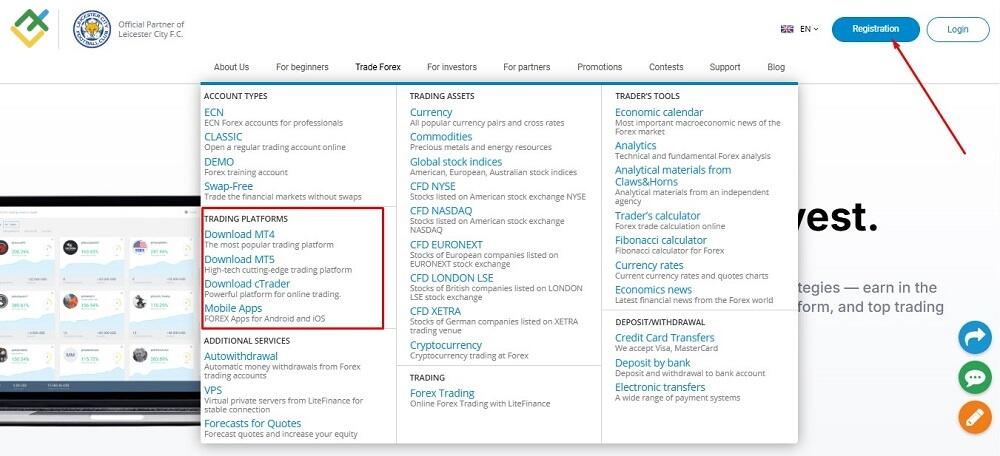
2. Placing a market order. After analyzing a currency pair's chart, you decide whether to buy or sell. You place an order through the trading platform, and your broker receives an instruction to execute the trade for a specific volume at the specified price.
Example: You expect the euro to strengthen and open a buy trade on the EUR/USD. Your position size is 1 lot at a price of 1.08500. The exchange rate rises by 5 pips to 1.08505, and you close the position by selling the amount you bought. Your result is calculated as: (1.08505 - 1.08500) × 100,000 = $5 Forex trading profit. If the price moves in the opposite direction, the same movement results in a $5 loss.
3. Order execution. Your broker sends your order to a liquidity provider or routes it through an ECN network. If a counterparty or the liquidity provider is willing to sell the asset at the requested price, your trade is executed. If not, your order is filled at the closest available price, which is known as slippage.
Closing a trade works the same way: you place an opposite order, which is executed at the current market price or the nearest available price.
Key Forex Terminology
Let's continue exploring how Forex market works. You can find the most essential terms for Forex trading explained below:
1. Currency pair. A trading instrument in the Forex market consisting of two currencies. The first is the base currency, and the second is the quote currency. The price shows how much of the quote currency is required to buy one unit of the base currency. For example, the EUR/USD indicates how many US dollars are needed to purchase 1 euro.
2. Trend. The general direction of price movement in the market. A trend can be upward (bullish), downward (bearish), or sideways (flat).
3. Position. A trade opened in the market. A long (bullish) position means you buy an asset expecting its price to rise, while a short (bearish) position means you sell an asset expecting its price to fall. An open position is an active trade with an unrealized profit or loss. A closed position is a completed trade with a realized result.
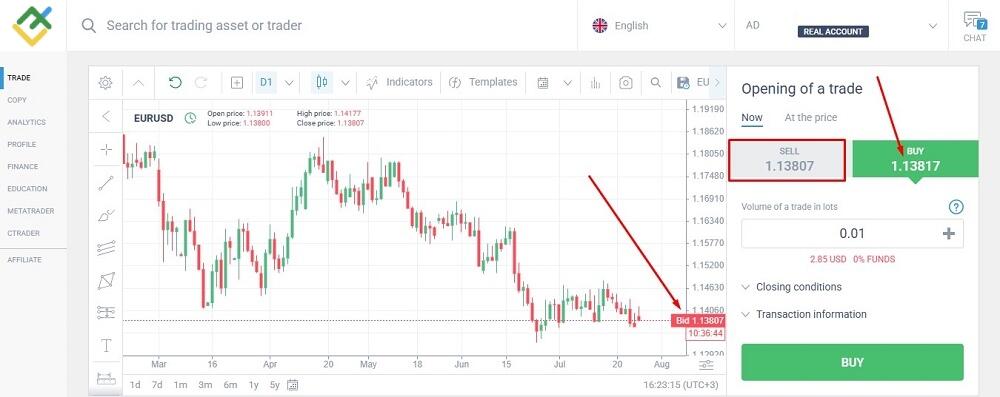
4. Bid and Ask. Every market quote consists of two prices: Bid is the price at which the counterparty is willing to buy the currency from you. This is the price at which you sell—either by opening a Sell position or closing an existing Buy position. The Bid price is always lower than the Ask price. Ask is the price at which the counterparty is willing to sell the currency to you. This is the price at which you buy—either by opening a Buy position or closing an existing Sell position. The Ask price is always higher than the Bid price.
By default, most currency trading platforms display the Bid price on the chart. This is the price used when opening a Sell position.
This screenshot displays Bid and Ask prices on the LiteFinance web platform.
5. Point. The smallest price movement in the market. For most currency pairs, one point represents a change in the fifth decimal place (0.00001).
6. Spread. The difference between the buy price (Ask) and the sell price (Bid) of a currency pair. A markup is an additional charge added by the broker to the raw market spread or the liquidity provider's price as a source of revenue.
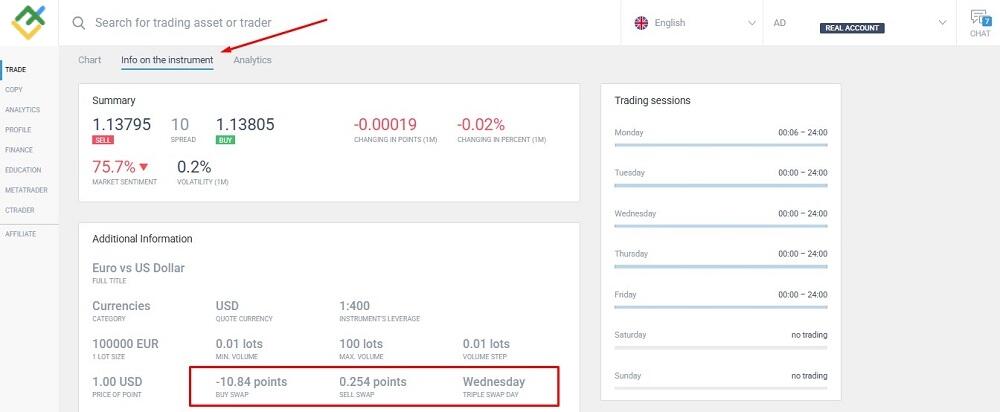
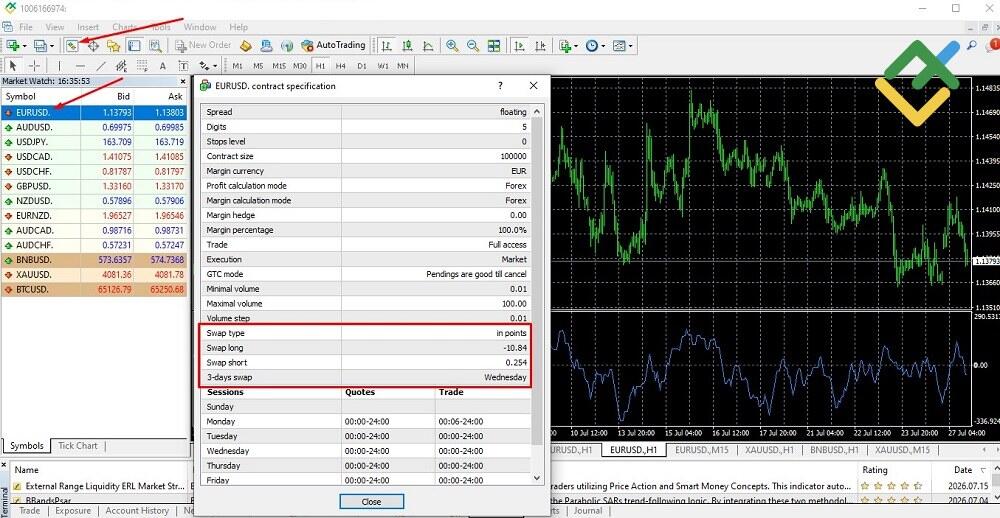
7. Swap. A fee charged for keeping an open position overnight. It is based on the difference between the interest rates of the two currencies in the pair. The swap rate for each instrument is provided in its trading specifications.
Example on the LiteFinance platform:
MT4 example: In the Market Watch window, right-click the symbol and select "Specification" to view the instrument's specifications.
8. Lot. The standard unit used to measure the size of a trading position. In Forex, 1 standard lot equals 100,000 units of the base currency. For example, buying 1 lot of EUR/USD at 1.12345 means purchasing 100,000 EUR for 112,345 USD. For other assets, the size of 1 standard lot may differ and is specified in the instrument's specifications.
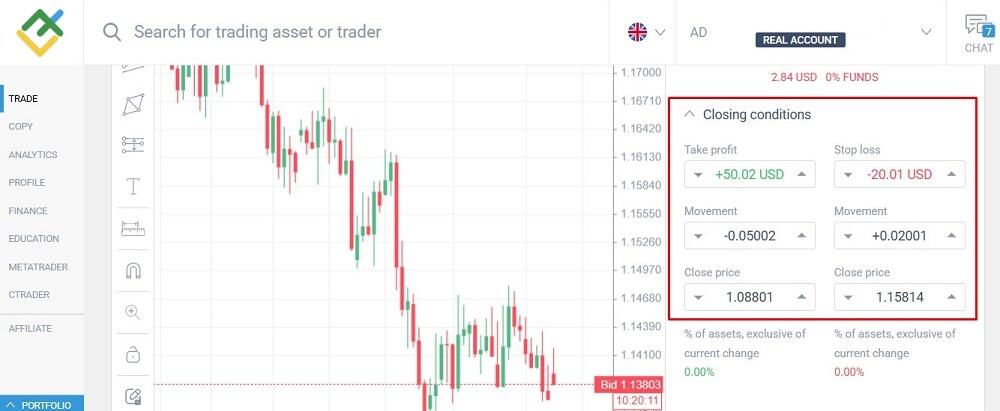
9. Stop-loss. A protective order that automatically closes a position when a predefined loss level is reached. It helps limit potential losses and protect your Forex trading account. A trailing stop is a dynamic stop-loss that follows the price when a trade moves in your favor and stops adjusting when the price reverses.
10. Take-profit. An order that automatically closes a position when a predefined profit target is reached, allowing you to secure gains.
Placing stop-loss and take-profit orders on the LiteFinance platform:
Placing stop-loss and take-profit orders in the MT4 platform:
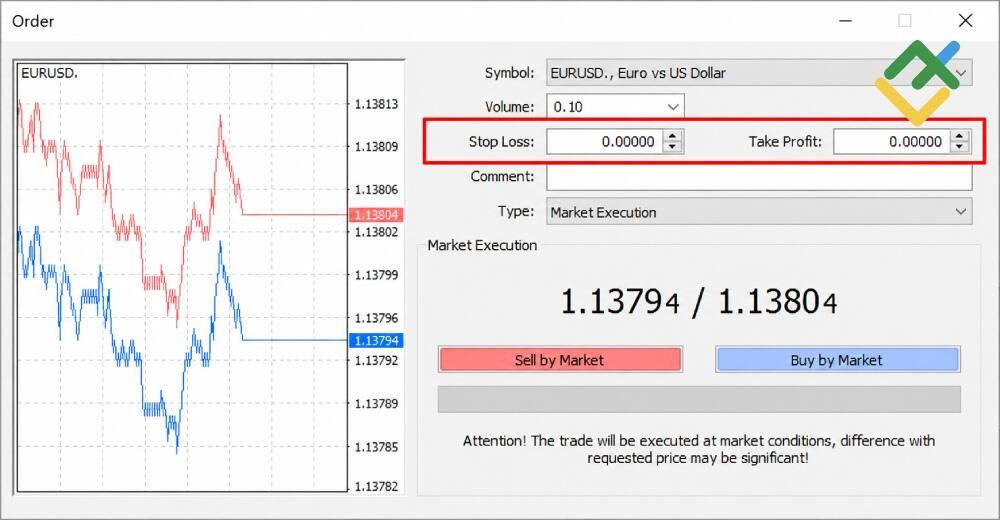
You can set stop-loss and take-profit levels before opening a trade and adjust them while the position is open. Although these orders are optional, using them is highly recommended for risk management.
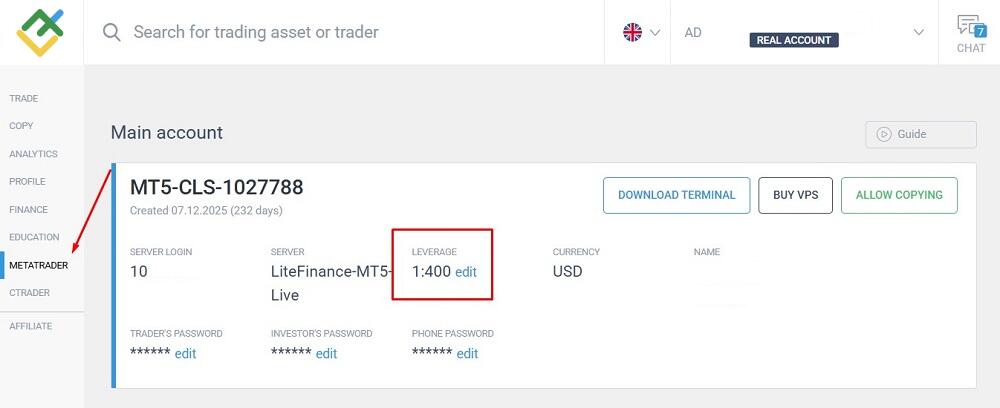
11. Leverage. A tool that allows you to open positions larger than your available capital. For example, 1:100 leverage allows you to control a $10,000 position with only $100 of your own funds. However, leverage also increases risk and can lead to rapid losses if the market moves against your position.
You can change your leverage in the account settings in your Client Profile on LiteFinance:
12. Technical analysis. A method of forecasting price movements based on historical price data, trading volume, and past market behavior. Its main tools include support and resistance levels, chart patterns, and technical indicators based on mathematical and statistical calculations.
13. Fundamental analysis. A method of evaluating economic, political, and social factors that influence a country's economy and, consequently, the exchange rate of its currency.
14. Margin. The amount of funds reserved by the broker as collateral when you open a leveraged trade. The required margin depends on the leverage level. If your account no longer has enough margin to support open positions, the broker may automatically close them through a stop-out.
15. Time frame. A fixed period used to display one chart element, such as a candlestick or bar. Time frames range from one minute (M1) to one month (MN). For example, on the H1 time frame, each candlestick represents one hour of price movement.
Types of Forex Market
The Forex market can be classified by the types of trades and their lifespan:
Spot market. The largest segment of the Forex market by trading volume. Transactions are settled immediately or within two business days under the T+2 settlement rule. The spot market is where current exchange rates are established.
Forward market. An over-the-counter (OTC) market where participants agree to buy or sell a specific amount of currency at a predetermined exchange rate, with settlement taking place on a future date, such as in 3, 6, or 12 months.
Futures market. An exchange-traded segment of the Forex market with standardized contracts for volume and expiration dates. Unlike forwards, futures are traded on regulated exchanges, such as the CME Group. Although Forex is primarily an OTC market, exchange-traded currency contracts are also part of the global foreign exchange system.
Options market. A market where participants buy or sell the right, but not the obligation, to execute a currency transaction at a predetermined price within a specified period. Forex trading options are often used to manage risk and limit potential losses from unfavorable exchange rate movements.
Swap market. A market involving combined transactions in which one currency exchange occurs on a spot basis and the opposite exchange takes place on a future date through a forward contract.
A trader who buys and sells CFDs on currency pairs receives spot market quotes from the broker.
Types of Currency Pairs
There are three main groups of currency pairs: major pairs, minor pairs (cross rates), and exotic pairs.
1. Major currency pairs. These are the most widely traded and liquid currency pairs, all of which include the US dollar (USD). They account for approximately 70–80% of global Forex trading volume. Examples include EUR/USD, GBP/USD, USD/JPY, USD/CHF, USD/CAD, AUD/USD, and NZD/USD.
Characteristics: tight spreads, high liquidity, and relatively predictable price movements. Volatility is usually moderate and depends largely on fundamental factors. Advantages: extensive market information, high liquidity, and strong transparency. Major pairs are generally considered suitable for Forex trading for beginners.
2. Cross-currency pairs. These are currency pairs that do not include the US dollar and usually consist of two major global currencies. Examples include EUR/GBP, EUR/JPY, EUR/CHF, GBP/JPY, GBP/CHF, AUD/NZD, and CAD/JPY.
Characteristics: lower liquidity compared with major pairs, wider spreads, and the ability to trade the relative strength of two economies without direct USD influence. Cross pairs can be used in arbitrage strategies or trading approaches based on positive and negative correlations.
3. Exotic pairs. These pairs combine one major global currency (most commonly the USD) with the currency of an emerging market economy. Examples include USD/TRY, USD/ZAR, USD/MXN, USD/BRL, USD/THB, and USD/IDR.
Characteristics: lower liquidity, wider spreads, higher volatility, and strong sensitivity to political and economic developments. Exotic currencies may also be subject to exchange rate controls, have limited market data availability, and carry higher risks related to pricing and execution quality.
You can compare all three main groups of currency pairs in the table below:
Characteristic | Majors | Crosses | Exotics |
USD in the pair | Yes | No | USD or EUR against emerging-market currencies |
Share of global trading volume | 70–80% | 10–20% | Below 5% |
Liquidity | Very high | High/Medium | Low |
Spread | Low | Medium | Wide |
Slippage | Almost none | Rarely on the news | Frequent and deep |
Sensitivity to news | High, but the movement is often predictable | High; it depends on two economies | Very high; particularly sensitive to political events and central bank actions |
Analysis | Latest news and forecasts | Available data is often enough | Lack of data complicates analysis |
Suitable for | Beginners, intraday traders, scalpers, and algorithmic traders | Seasoned Forex traders looking to diversify their risks | Experienced traders who are prepared to tolerate increased risk and engage in long-term fundamental trades |
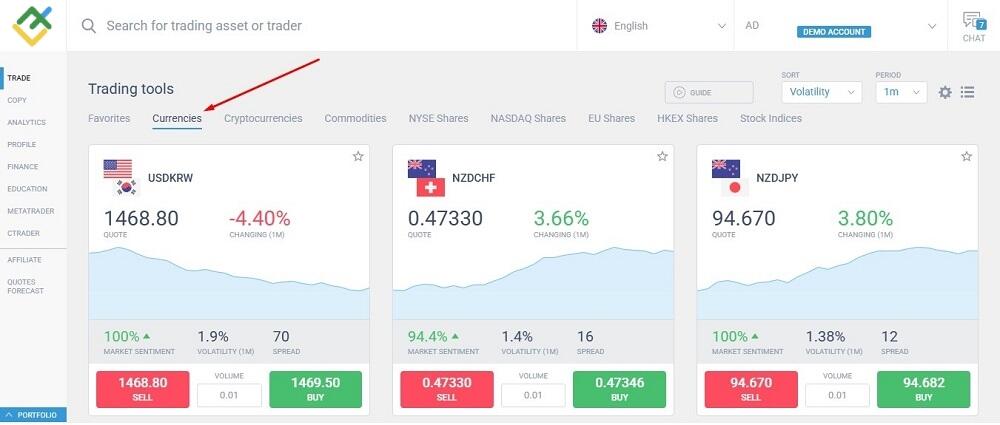
You can find currency pairs available for trading in the Trade tab on the LiteFinance web platform:
How to Start Forex Trading
In general, the following steps apply:
Learn the theory. You need to understand how the Forex market works, the risks involved, and the most common mistakes. Explore technical and fundamental analysis, asset classes, and so on.
Carefully review the broker's trading conditions.
Start with a demo account. At this stage, the choice of strategy or broker is less important. Explore the trading platform, practice opening positions, and understand how the trading process works.
Choose a broker and continue practicing on a demo account.
Develop several trading strategies for different time frames, instruments, and market conditions. Basic strategy examples are widely available online. Learn how to use a strategy tester and evaluate your systems. Only consider moving to a live account after your trading approach demonstrates consistent results. Building experience and finding a suitable strategy can take 3–6 months or longer.
Once you have a tested trading system and sufficient knowledge and experience, you can fund a live account and begin your journey to becoming a successful trader. Starting with a cent account can be a practical way to transition from demo trading to real market conditions with lower risk.
Real Forex Trade Example
Let's look at an example using the LiteFinance web platform:
In the left-hand panel, open the Trade tab and select the asset you want to trade, such as the EUR/USD. For simplicity, let's skip the steps of choosing a time frame and analyzing the chart.
On the right side of the screen, you will find the order window (or trade ticket), where you can specify the trade direction, position size, and set a stop-loss level.
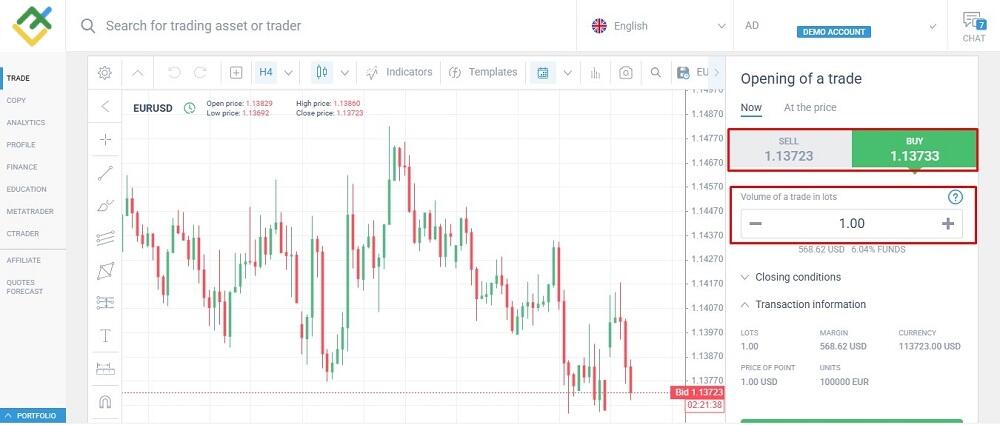
The Transaction Information section displays the price of one point and the required margin—the amount of funds reserved by the broker when you open a trade.
A position opened with a market order will appear in the "Portfolio" section, where you can also monitor its floating profit or loss.
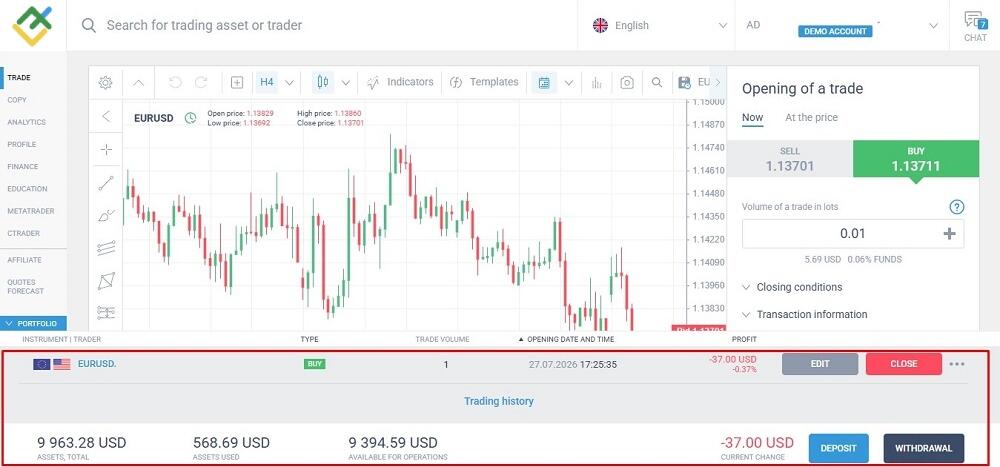
When you have an open position, you can adjust the stop-loss and take-profit levels or close the trade manually. The floating profit or loss will be immediately reflected in the Assets Total field.
In MT4/MT5, the process for opening a trade is similar: open the order window, specify the trade size, and set stop-loss and take-profit levels. Open the trade and, if necessary, adjust the SL and TP levels. You can close the trade at any time.
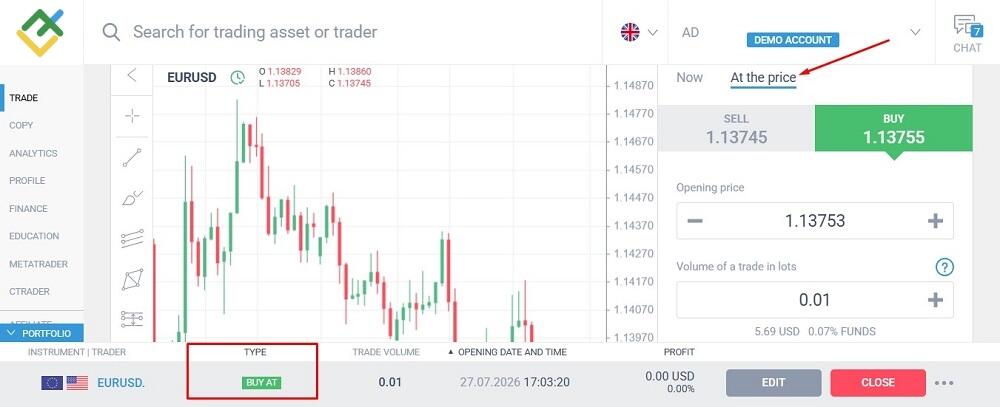
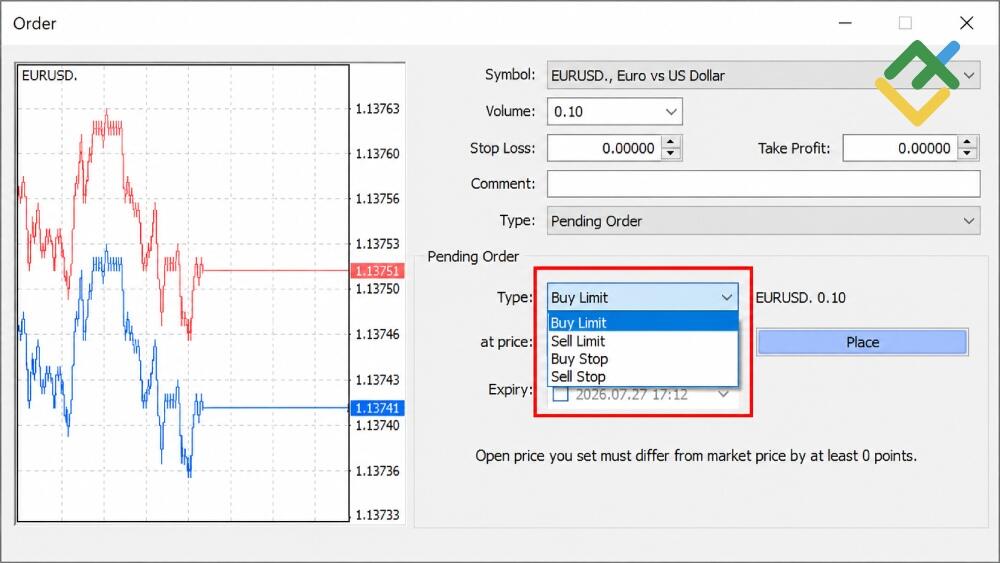
In the order window, in addition to placing a market order at the current price, you can also set pending orders. A pending order is an instruction to the broker to buy or sell an asset automatically when the price reaches a specified level in the future.
Example on the LiteFinance platform:
Example in the MT4 platform:
What Moves Currency Prices
Currency is a tradable financial asset, and its price is determined by the balance between supply and demand. When demand for a currency increases, buyers are willing to pay higher prices, causing its value to rise. When selling pressure dominates, the price declines as sellers compete to attract buyers. If supply and demand are balanced, the market remains in equilibrium, and the price typically moves sideways within a range.
Factors affecting the balance of supply and demand in the foreign exchange market:
1. Monetary policy of central banks:
Interest rates. Higher interest rates usually make a currency more attractive to investors because they increase the potential return on assets denominated in that currency. For example, if the Fed raises its benchmark interest rate, the US dollar may strengthen, causing the EUR/USD exchange rate to decline.
Currency interventions. Central banks can directly buy or sell currencies to influence exchange rates. When a central bank sells its own currency, it increases its supply in the market, which can weaken its value. For example, if the Fed sells US dollars through commercial banks, the USD may weaken, and the EUR/USD may rise.
Money supply. An increase in the money supply can reduce a currency's value and spur inflation.
2. Macroeconomic indicators (economic indicators):
Inflation. Countries with lower inflation rates have stronger currencies.
GDP. GDP growth indicates a strong economy; economic growth attracts foreign investors and strengthens the national currency.
Labor market. Unemployment and employment data (such as the US Nonfarm Payrolls, or NFP) reflect economic health. A decline in unemployment is a positive signal for foreign investors.
Other important macroeconomic indicators include the trade balance, public debt levels, the purchasing managers' index, etc.
3. Geopolitical factors. Military conflicts, sanctions, and any global upheavals force traders to seek refuge in safe-haven assets such as the Swiss franc or gold.
4. Speculative trading. In the short term, large market participants can influence price movements through significant order flows. For example, they can move the price toward a key level to trigger pending orders and grab liquidity.
In addition, exchange rates often react not to the news itself, but to how the actual outcome compares with market expectations. For example, if investors expected a 0.5% interest rate hike but the central bank raises rates by only 0.25%, the currency may weaken instead of strengthen.
Advantages and Disadvantages of Forex Trading
For illustrative purposes, the advantages and disadvantages of Forex trading are presented in the following table:
Advantages | Disadvantages |
The barrier to entry is low compared to the exchange market. You only need $50 to start trading CFDs. The exchange market is generally geared toward larger investors. | High risk of losing money. According to statistics, 70–85% of retail traders lose their entire deposit within the first three months primarily due to a lack of experience, the absence of a proven trading strategy, poor risk management, and the misconception that Forex is "easy money." |
Clear and transparent fees: markup, swap, and ECN account fees. For stock exchange brokers, fees vary by security type, country of listing, and trading volume. There are also depository fees and exchange fees. | Complicated analysis and forecasting. Consistently profitable foreign exchange trading requires a solid understanding of both technical and fundamental analysis, as well as regular monitoring of market developments. One of the most common mistakes novice traders make is underestimating the importance of this knowledge. |
Forex currency pairs are traded 24/5. Cryptocurrency trading continues even on weekends. The stock market does not operate around the clock, which can lead to price gaps. | Emotional stress. Fear, greed, and the urge to recover losses quickly can cause traders to abandon their trading plans, make impulsive decisions, and incur unnecessary losses. |
A wide selection of different types of assets. A Forex broker's main range of CFD assets includes currency pairs, stocks, commodities, and cryptocurrencies. Futures may also be available. | Weak regulation. Most Forex brokers are licensed by offshore regulators that may offer fewer protections for retail traders. |
As you can see, there are a lot of benefits of trading Forex. Many of Forex's advantages and disadvantages are subjective. Some traders enjoy the fast pace and excitement of the financial market, while others find active trading emotionally demanding. With the right approach, many of the challenges can be effectively managed. The market offers dozens of basic Forex trading strategies, allowing you to choose one that matches your goals, risk tolerance, and trading style.
Forex Trading Risks and Risk Management
Key risks of Forex trading:
Risk | Cause | Mitigation Strategy |
Leverage | Attempting to increase the trade size using leverage raises the cost per pip. Accordingly, the risk of losing your deposit if your forecast is incorrect is higher. | Use leverage to reduce the required margin rather than to increase your position size. Open trades only within the risk limits defined by your risk management rules. |
High volatility | Sharp price fluctuations may occur during news releases, at the start of the London and New York trading sessions, and when institutional investors enter the currency markets. | Use stop-loss orders, reduce position size ahead of major news events, and avoid trading during periods of extreme market volatility. Choose highly liquid assets to avoid slippage and widening spreads when volatility increases. |
Gap | A price gap occurs due to fundamental factors at the start of a new trading session. During a gap, a trade may be executed with slippage, meaning the position can be closed at a price beyond the initial stop-loss level. | Try to close your trades before the weekend, taking into account any major upcoming news releases. |
Psychological factor | Greed, fear, and the desire to recoup losses (tilt) can lead to impulsive, emotionally driven trading decisions. A state of euphoria may cause you to underestimate risks, while FOMO can push you to enter a trade at the worst possible moment. | Try to remain calm in any situation, whether positive or negative, and follow your trading plan. If you feel that your emotions are affecting your decisions, stop trading. Do not be afraid to close losing positions. |
Technical malfunction | No internet, no electricity, trading platform crashes, etc. | For algorithmic strategies and copy trading, rent a VPS server. If your connection is lost and you need to close a trade immediately, try contacting your broker's client support by phone. |
Fraudulent broker | Refusal to process withdrawals, manipulated quotes with unnatural price spikes on candlestick charts, delays in order execution, and other unfair practices. | Work with brokers licensed by reputable regulators such as the SEC, FCA, CySEC, or BaFin. Try to document every important action using screenshots or screen recordings. |
Remember that investing involves risks, and it is impossible to completely eliminate all of them. However, having a proven trading system, gaining experience on a demo account, following risk management rules, and maintaining emotional discipline can significantly reduce those risks.
Conclusion
Forex is the international over-the-counter foreign exchange market. Trading Forex allows you to profit from price movements in currency pairs, stocks, stock indices, oil, gold, and cryptocurrencies. You can start with as little as $100, but this amount is mainly suitable for gaining experience on a live account rather than generating meaningful profits.
It is best to begin trading currencies on a live account only after developing a proven strategy with consistent results, steady equity growth, and controlled drawdowns. A strategy tested with a backtester, combined with experience gained on a demo account, is essential. Building a trading system and gaining the necessary skills can take 3–6 months or longer. The keys to success are patience, regular practice, continuous learning, discipline, and emotional control.
Start trading Forex on a LiteFinance demo account to gain practical experience in a risk-free environment. Stay focused on your goals, keep learning, and build your skills step by step.
Get access to a demo account on an easy-to-use Forex platform without registration
What is Forex FAQs
According to regulatory statistics, around 70–85% of novice traders lose money. Success requires persistence, continuous learning, experience, and the ability to learn from mistakes. Whether Forex trading becomes profitable ultimately depends on your knowledge, discipline, strategy, and risk management.
You do not need money to gain experience and test strategies on a demo account. To go live, $50 is enough to open positions using leverage and the minimum lot size. To generate meaningful income, a larger account balance of $500–$1,000 or more is typically required.
Generally, yes. However, several factors matter: your country of residence, your location, the broker's regulatory jurisdiction, and the type of license it holds. In some cases, weak regulation may make it difficult or impossible to protect your rights.
Forex trading is a profession that requires continuous learning, experience, and self-improvement. Luck may affect individual trades, but long-term success comes from developing skills, managing risk effectively, and maintaining emotional discipline.
Learn to consistently generate profits on a demo account. Study trading theory, follow risk management rules, and gain practical experience. Many successful traders are self-taught and have mastered Forex trading without paid courses. On average, developing the necessary skills takes 3–6 months.

The content of this article reflects the author’s opinion and does not necessarily reflect the official position of LiteFinance broker. The material published on this page is provided for informational purposes only and should not be considered as the provision of investment advice for the purposes of Directive 2014/65/EU.
According to copyright law, this article is considered intellectual property, which includes a prohibition on copying and distributing it without consent.