Peculiarities of the “Expanding top (bottom)” pattern
Examining price/action patterns, I often come across various kinds of their names. For example, Three Indians by Linda Raschke were called “Three steps” in harmonious trading and “Three mountains/rivers” in candlestick analysis. The Turtle Soup trading strategy by the author of Street Smarts: High Probability Short-Term Trading Strategies had much in common with the harmonious pattern Shark which was also used by Victor Sperandeo in his famous 2B trading system “Bottom/top”. Different analysts saw the same regularities in market movements and called them different names. That shouldn’t surprise us. What is important is to borrow their wisdom to increase the efficiency of trading. In this respect, finding Expanding Wedge on the pages of Encyclopedia of Chart Patterns was a true gift for me.
Using the 1-2-3 pattern in my own strategy for quite a long, I found out that the market would rewrite extremums and trigger stop orders. First, I thought it was a trap of a big player for plankton but as I continued my observations, a new pattern was detected, and it was more efficient than the base pattern, in my opinion. I called it Expanding wedge and was so surprised to find out that Thomas Bulkowski spoke of the same thing, calling it “Expanding Top” and “Expanding bottom” on the pages of his best-seller! To my mind, his observations prove to be quite useful both when identifying a pattern and forming a trading strategy.
According to the author of Encyclopedia of Chart Patterns, the necessary conditions for pattern formation are the following: first, an obvious trend; second, at least two upward peaks and 2 downward bottoms.High and wide graphic patterns work the most efficiently. On the contrary, the lower the pattern and the faster its occurrence, the fewer chances for profitable trading. Bulkowski called those “dancing” extremums “chaos” from which order is born. His research shows that the pattern is quite efficient on falling volumes.
Expanding top pattern on the AUD/JPY daily chart

In my opinion, the alternation of growing maximums and falling minimums indicates a fight between bulls and bears for initiative. A trader’s main task is to wait for the winner and side with him. The first sign of the buyers’ weakness will be falling volumes in the wave 3-4. One needs to get ready for an uptrend.
Thomas Bulkowski’s approach to determining a target under the Expanding top/bottom pattern looks quite interesting. His suggests measuring the distance from the highest point of the pattern (4) to the lowest one (5) and moving the projection below the support or above the resistance lines (breakout levels). As the example of AUD/JPY shows, this method can be efficient.
Identifying a target using the Expanding top pattern
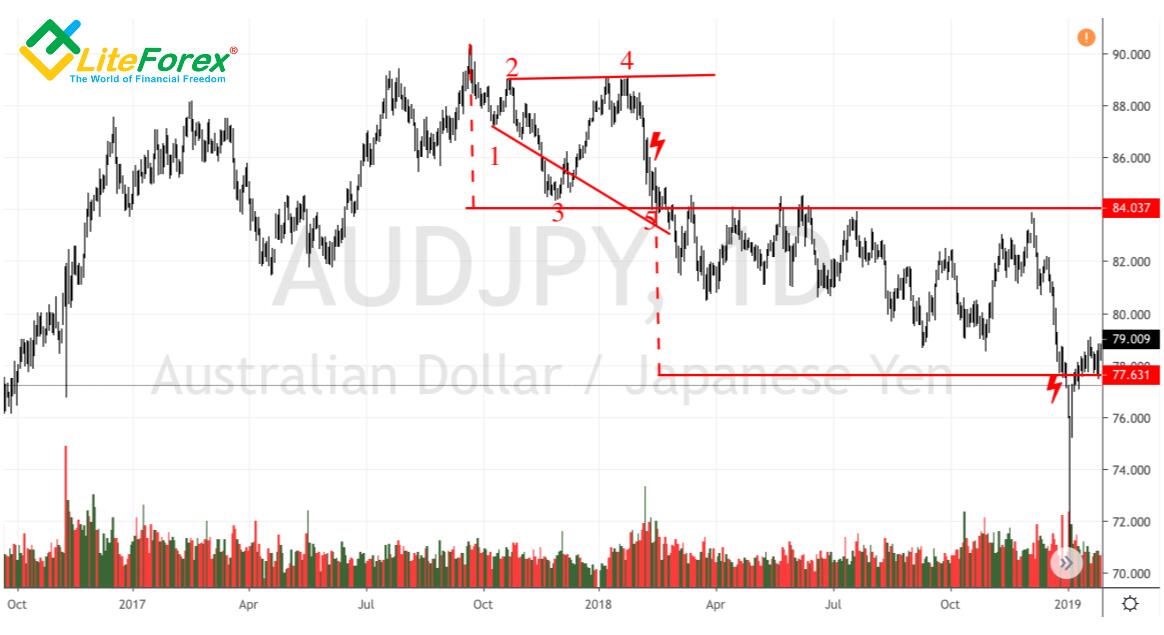
Unfortunately, Bulkowski’s approach to defining a trade entry point isn’t formalized enough in my opinion. He recommends selling once the prices roll back from the upper trend line (2-4) or start growing after having jumped back from the lower trend line (3-5). In the former case, the pattern hasn’t formed fully yet, in the latter case there’s no clear level to entry a position. The use of Fibonacci levels, triangles, and other tools of technical analysis helps solve this problem. Anyway, the experience of other analysts will be useful for us. We only have to borrow the most valuable points.
P.S. Did you like my article? Share it in social networks: it will be the best "thank you" :)
Useful links:
- I recommend trying to trade with a reliable broker here. The system allows you to trade by yourself or copy successful traders from all across the globe.
- Use my promo code BLOG to get a 50% deposit bonus on the LiteFinance platform. Simply enter this code in the appropriate field when funding your trading account.
- Telegram chat for traders: https://t.me/litefinancebrokerchat. We are sharing the signals and trading experience.
- Telegram channel with high-quality analytics, Forex reviews, training articles, and other useful things for traders https://t.me/litefinance
Price chart of AUDJPY in real time mode

The content of this article reflects the author’s opinion and does not necessarily reflect the official position of LiteFinance broker. The material published on this page is provided for informational purposes only and should not be considered as the provision of investment advice for the purposes of Directive 2014/65/EU.
According to copyright law, this article is considered intellectual property, which includes a prohibition on copying and distributing it without consent.