Day trading means profiting from quick price movements by opening and closing trades within a day. This article explores popular day trading patterns, such as the Cup and Handle, Triangle, and Flag. These patterns help traders identify potential entry and exit points. Learn how to recognize them on charts, combine them with technical indicators, and apply them to strategies on 5-minute and higher time frames.
This beginner-friendly guide covers the 10 best day trading patterns, offering practical insights for both new and experienced traders. It also includes real trade examples and essential risk management tips to help you trade more effectively and profitably.
The article covers the following subjects:
- Major Takeaways
- 10 Common Day Trading Patterns
- Trading Chart Patterns Summed Up
- What Is Day Trading?
- Why Are Chart Patterns Important
- How Forex Chart Patterns Work
- Trading Pattern Recognition
- How to Read Chart Patterns
- Pattern-Based Trading Strategies for Short-Term and Intraday Trading
- Best Tips for Using Day Trading Patterns
- Conclusion
- Day Trading Patterns FAQs
Major Takeaways
- Day trading is speculative trading conducted within a single day, with no positions held overnight. It includes scalping (1–30 minutes) and news trading (15 minutes and longer).
- Day trading patterns repeat across time frames and help identify short-term price movements. They work best on candlestick charts when combined with trend analysis, volume indicators, and key support or resistance levels.
- The main types include reversal patterns such as Head and Shoulders, Double Top and Bottom, and the Rising Wedge, as well as continuation patterns like the Flag, Pennant, Triangle, and Falling Wedge.
- To spot these patterns, use M5–H1 time frames, focus on key levels, wait for breakouts and retests, and confirm signals with indicators.
- Strategies include entering trades after confirmation, setting targets based on a pattern's height, and placing stop-loss orders in line with risk management rules. Always backtest your strategy on historical data and adjust it to your trading style.
- Stay disciplined, avoid traps and impulsive trades, and monitor the news. Patterns tend to work best in liquid and volatile markets, but because they are not always reliable, it is wise to practice on a demo account first.
10 Common Day Trading Patterns
This section analyzes the top 10 day trading candlestick patterns that appear most often on the chart when trading intraday.
Cup and Handle
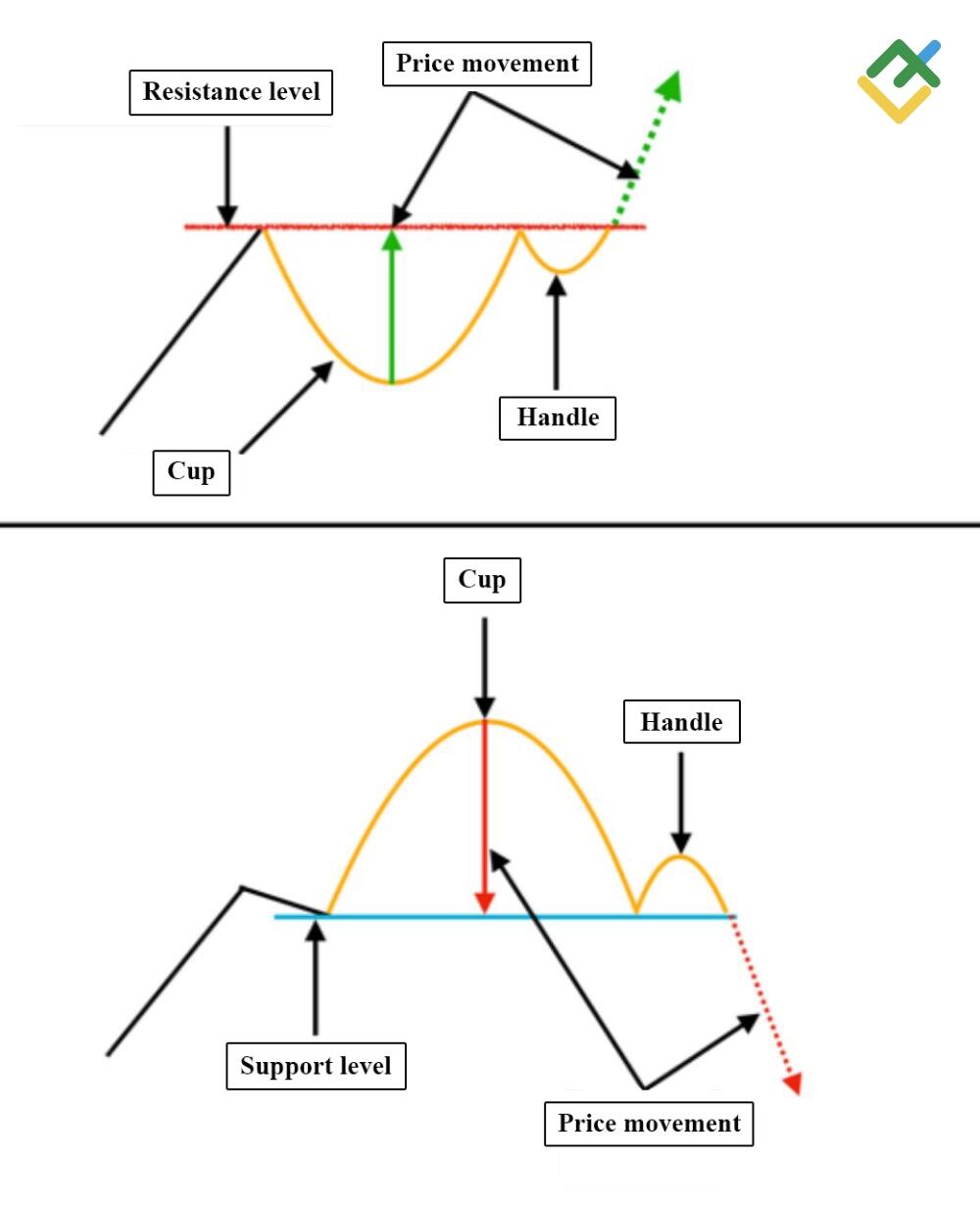
The Cup and Handle pattern occurs on various time frames and is suitable for intraday trading. The pattern appears in nearly all financial markets.
This formation is typically a bullish continuation pattern that appears in an uptrend, although its inverted version can signal a bearish reversal.
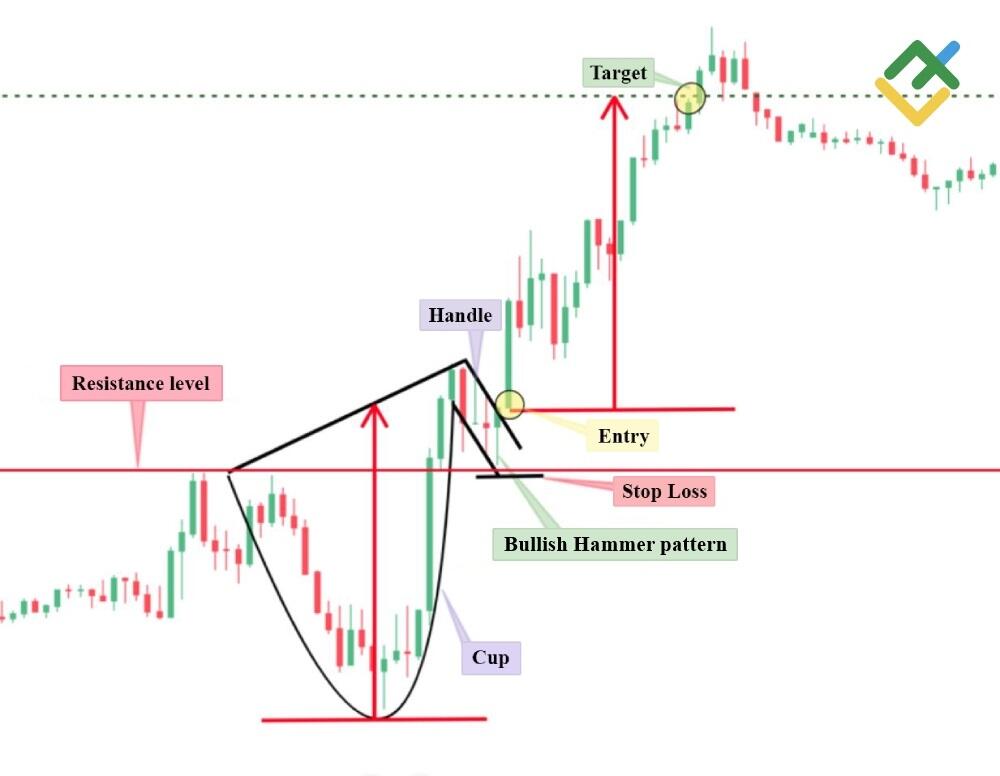
The 15-minute EURUSD chart below shows an example of a Cup and Handle pattern. Once the pattern formed and the price retested the resistance level, a long trade was opened. Afterward, the resistance became a support level, and a Bullish Hammer candlestick pattern formed above it. The price broke out of the handle, giving a buy signal. The price target equals the distance from the cup's bottom to the resistance level projected from the breakout point. The stop-loss is placed below the new support level.
Triangles
Triangle chart patterns can be tricky to interpret since they come in three types, each signaling a different price direction.
Symmetrical Triangle
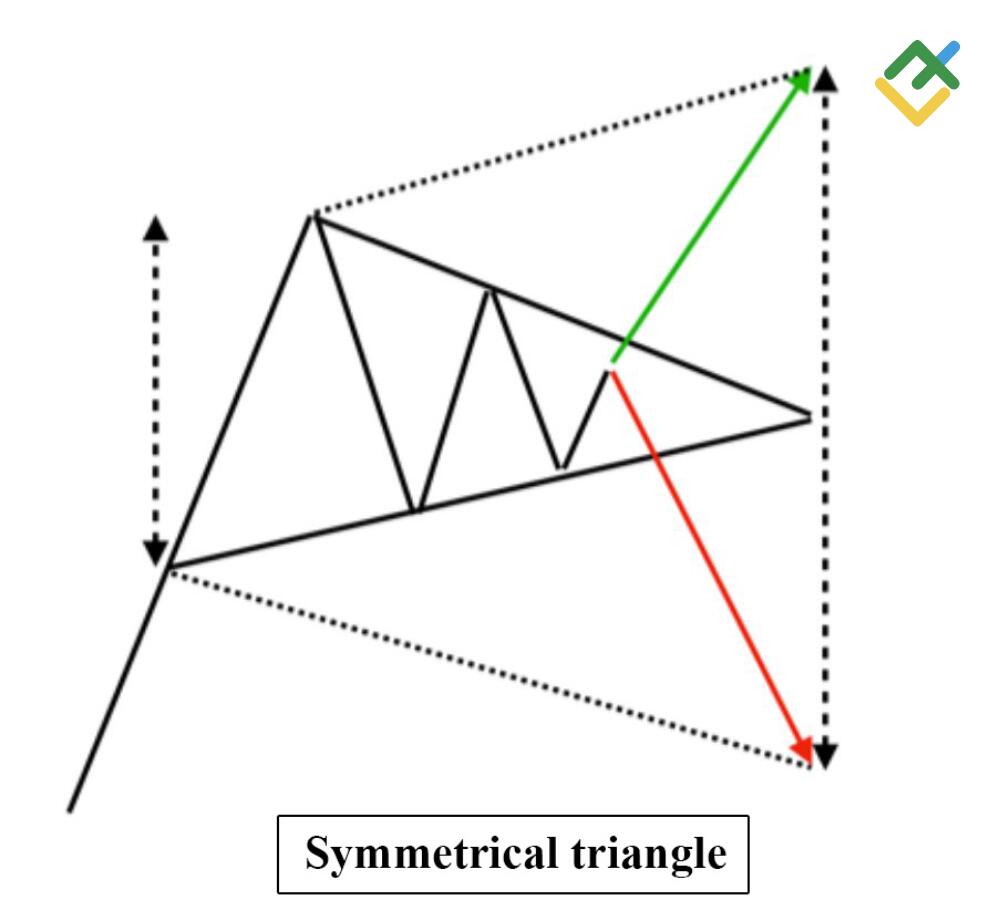
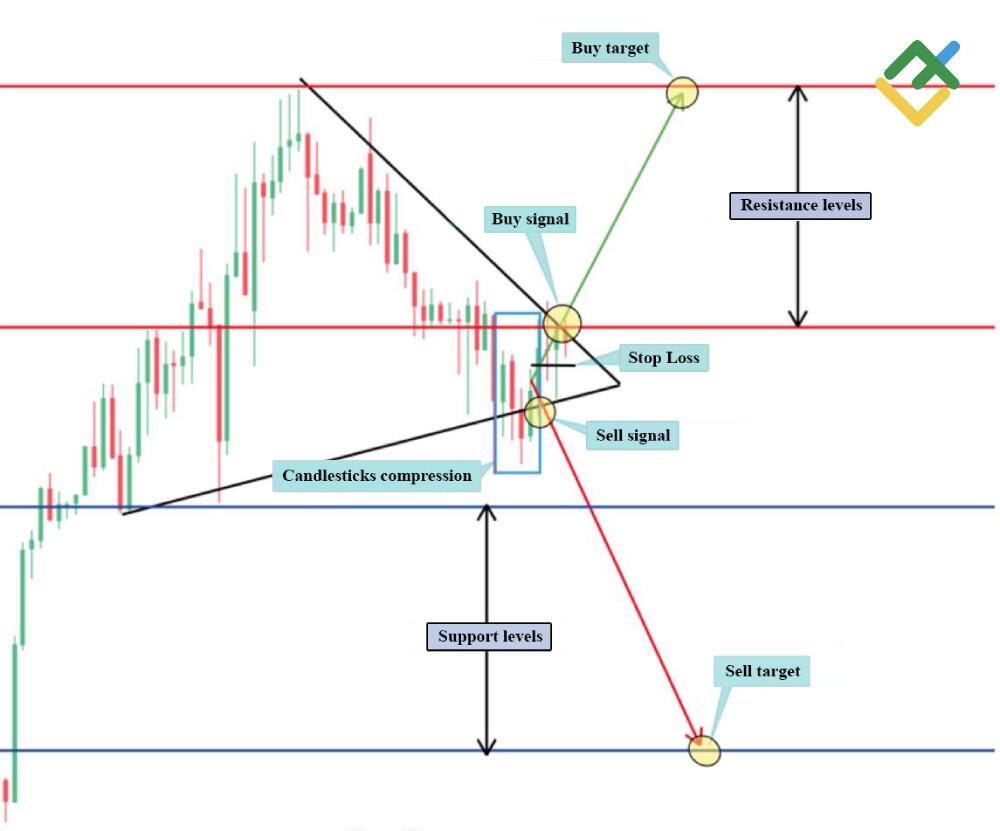
A Symmetrical Triangle is a continuation pattern formed by narrowing swing highs and swing lows. It can be challenging to predict the price direction while the pattern is developing. False breakouts are common, so it is essential to wait for confirmation. The price should break through the Triangle's boundary, retest it, and then settle beyond the pattern.
Within the pattern, the price moves symmetrically, forming lower highs and higher lows.
The 30-minute UKBRENT chart below demonstrates a Symmetrical Triangle. You can see false bullish and bearish breakouts. Thus, before making a decision, wait until the breakout is confirmed. A stop-loss order should be placed in the middle of the narrowing channel. For more accurate analysis, use a Japanese candlestick chart.
The price attempted to break below the lower boundary of the triangle, but bulls managed to hold it above that level, forming a bear trap.
In this case, you can open a trade once the price settles beyond the pattern.
Ascending Triangle
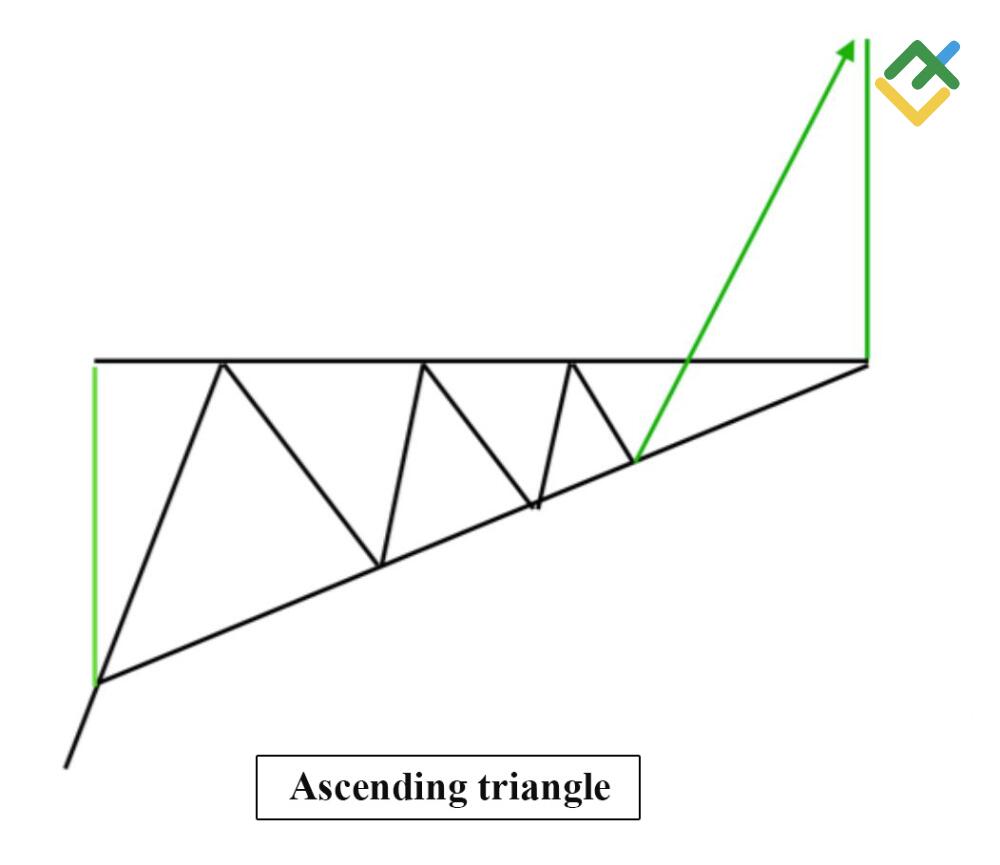
An Ascending Triangle is a continuation pattern that has a clear resistance level. Each time the price reaches resistance, it pulls back slightly, forming higher lows as buyers gain strength. After a period of consolidation, the price typically breaks above the resistance line and continues to advance. The upward move is approximately equal to the pattern's height.
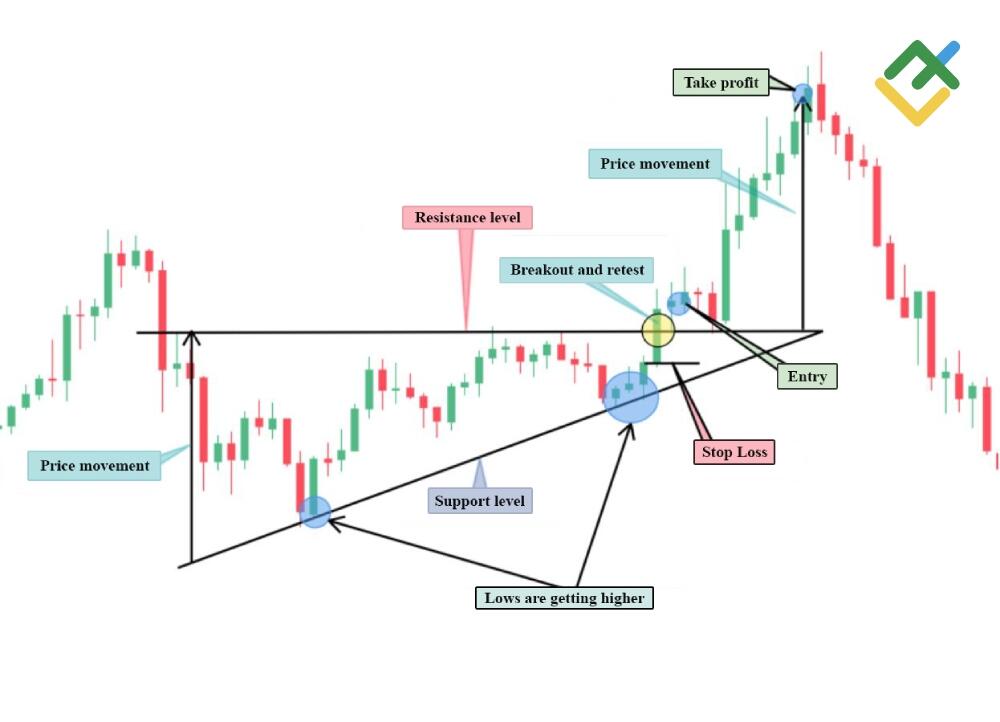
This 30-minute BTCUSD chart below shows an example of an Ascending Triangle with the resistance level and higher lows.
The price breaches and settles above the resistance level. Once this level is tested, traders can open a long trade, setting the price target by projecting the Triangle's height from the breakout point. A stop-loss order should be placed below the last higher low formed before the breakout.
Descending Triangle
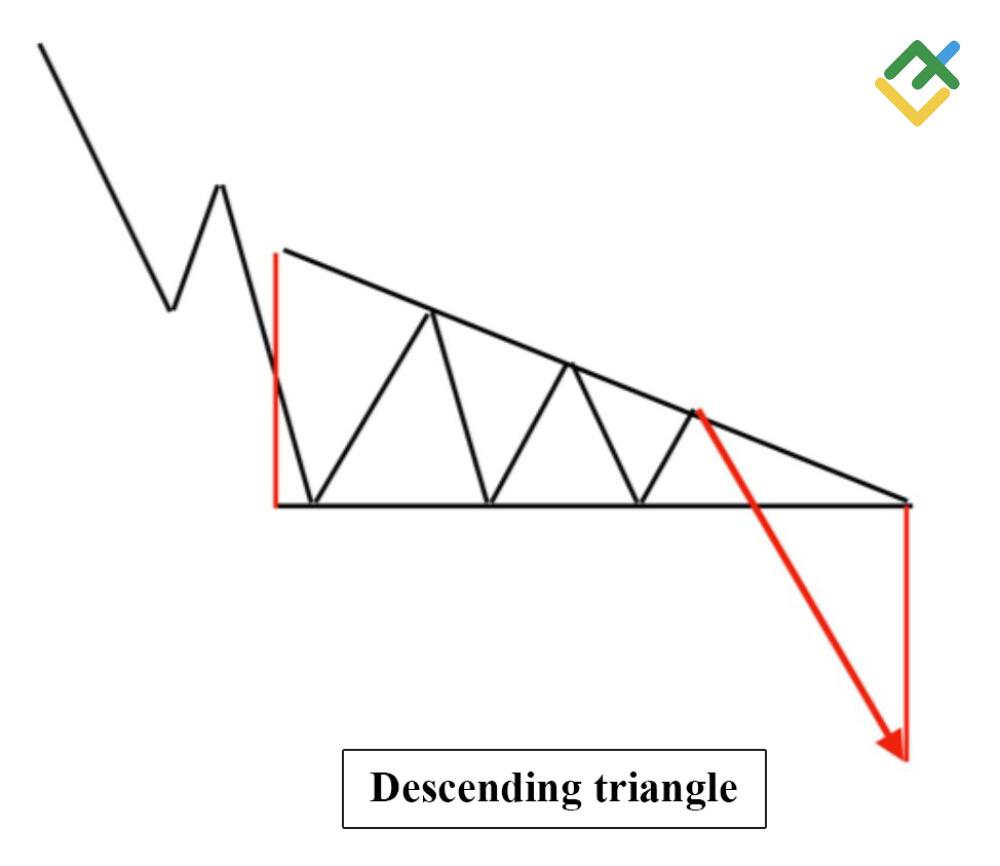
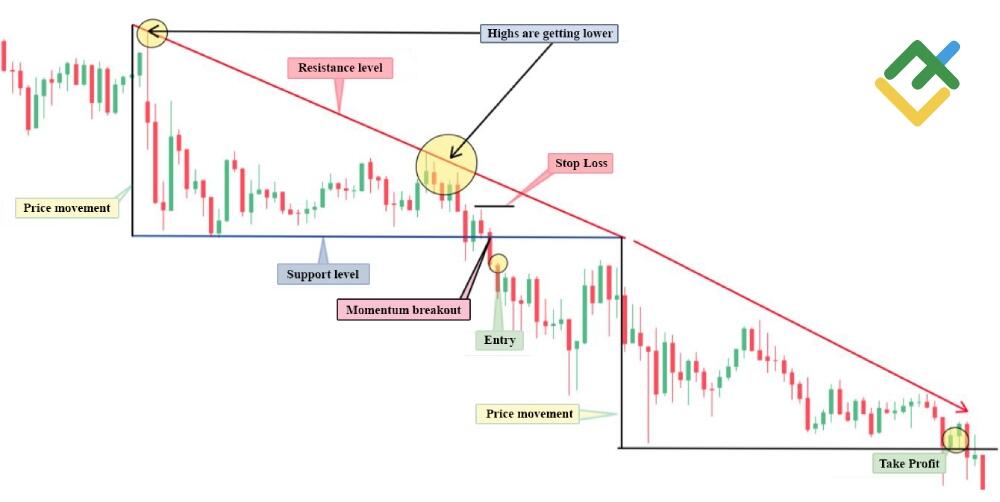
A Descending Triangle is a continuation pattern that mirrors the Ascending Triangle. It features a clear support level and a series of lower highs. A valid breakout occurs when the price breaks and closes below the support level, confirming the bearish signal. The price continues to decline by a distance roughly equal to the height of the Triangle.
The 15-minute XAUUSD chart below demonstrates a Descending Triangle. The price tries to penetrate the support level several times, forming lower highs. After the consolidation phase, the price finally breaks below the support level. In this case, a short trade can be open when the asset settles below the support level. A take-profit order should be set by a distance equal to the height of the triangle. A stop-loss order is placed above the support level.
Flag
A Flag is a continuation pattern that can be either bullish or bearish.
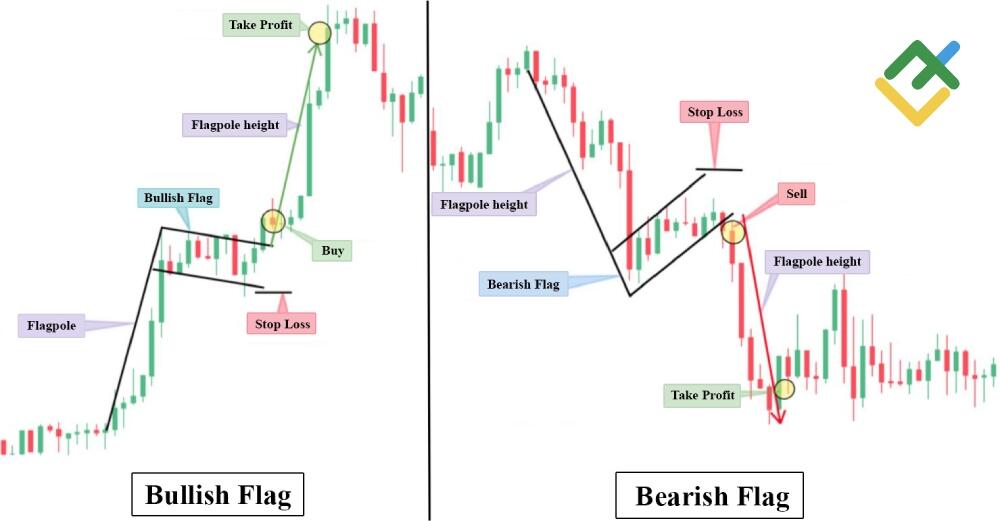
The pattern begins with a price impulse forming the flagpole, followed by a brief consolidation that creates the flag. Once the price breaks out of the Flag pattern, it typically moves in the same direction by a distance roughly equal to the height of the flagpole.
This candlestick formation is one of the best day trading patterns, suitable for intraday trading on 5, 15, or 30-minute time frames.
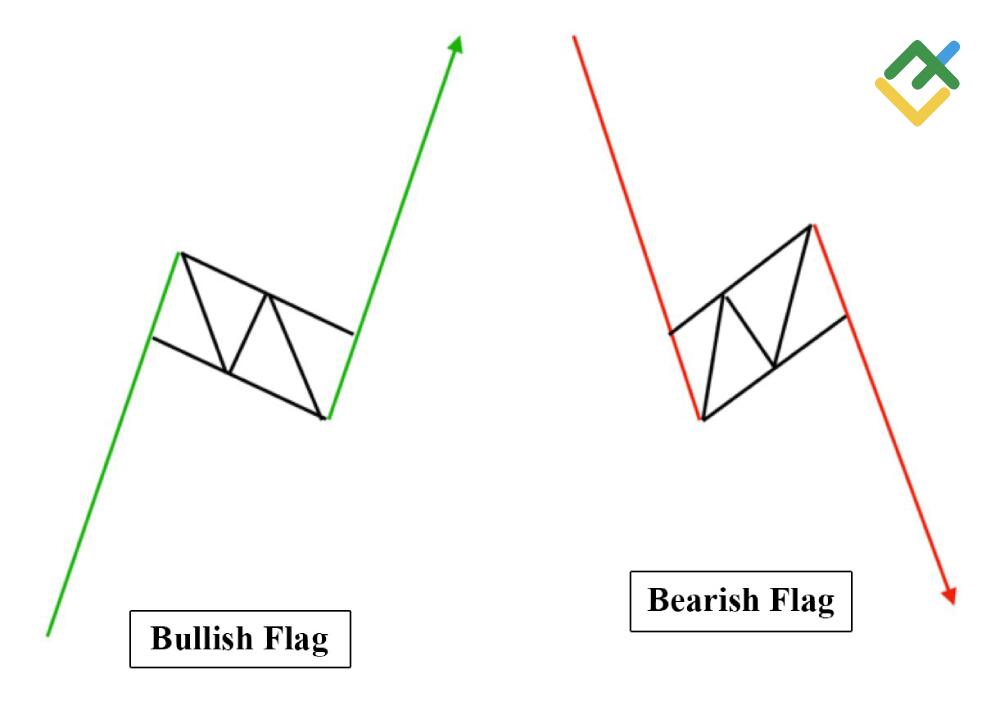
The 30-minute USDJPY chart below illustrates two types of Flag patterns. Each pattern consists of a sharp price move, known as the flagpole, followed by a short consolidation forming the flag. In a Bull Flag, the initial move is upward, while in a Bear Flag, it is downward. You can open a long or a short trade only after the price breaks through the pattern. A stop-loss order should be placed just below or above the Flag itself, depending on whether it is bullish or bearish. A take-profit order is placed at a distance equal to the height of the flagpole.
Double Top
You can spot Double Top patterns on charts of any time frame.
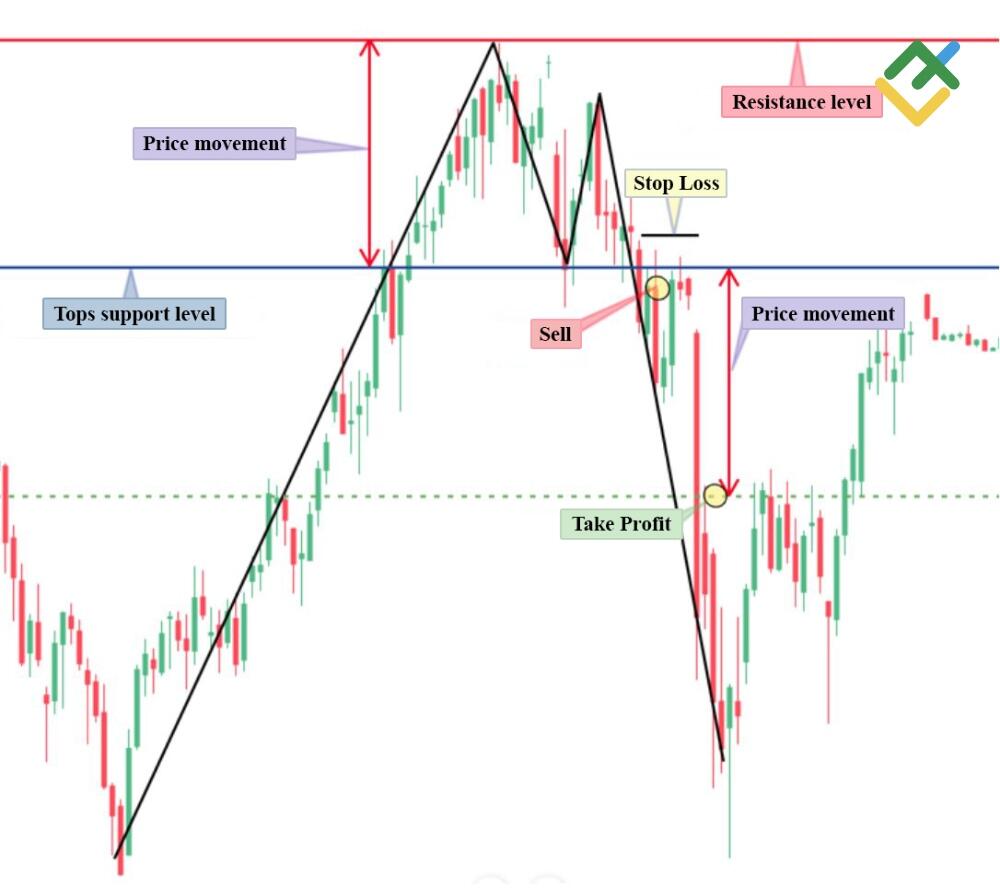
In a Double Top pattern, the price moves within a channel between support and resistance levels. After a second failed attempt to break above the resistance level, the price reverses and breaks below the neckline, or the support level. Following a breakout and a retest of this level, which becomes resistance, the price continues to decline, completing the pattern.
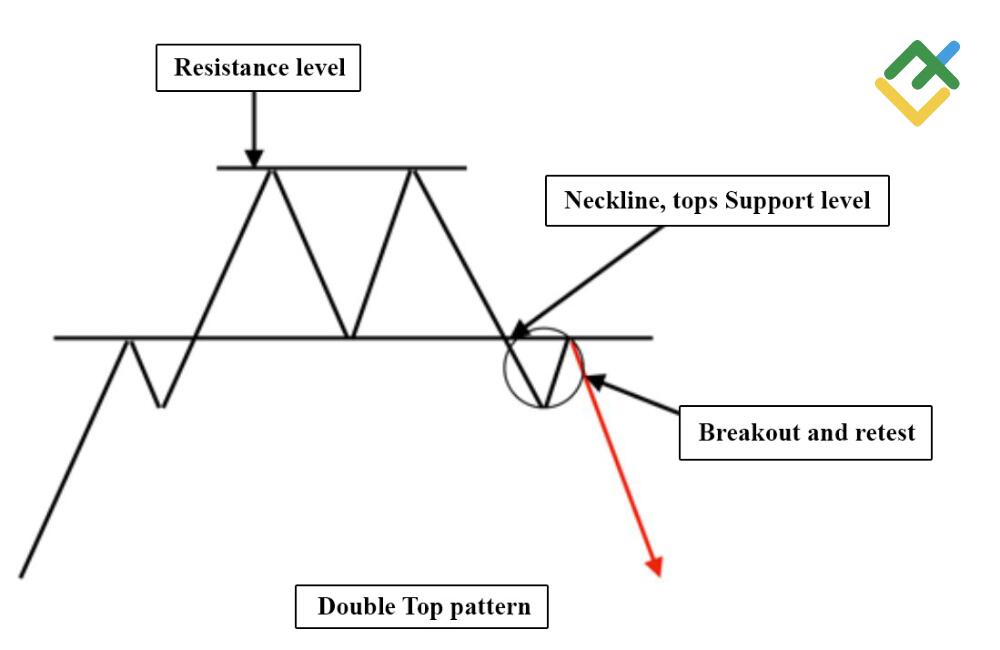
Let's analyze this pattern on the 30-minute USCRUDE chart below.
The price forms two peaks and breaks below the support level. After the breakout, the former support acts as new resistance. The price pulls back slightly and retests this level, providing an entry opportunity below the neckline. The target level is set according to the standard risk-to-reward ratio and money management rules.
The target level is set at a distance equal to the height of the pattern. A stop-loss order is set above the support level to protect against a false breakout.
The Double Top pattern appears across different time frames and helps traders identify possible market reversals.
Double Bottom
The Double Bottom pattern is the opposite of the Double Top formation and signals the start of a new uptrend. It usually forms at the bottom of a downtrend, where the price tests the support level twice. Once the pattern is complete, the price breaks above the resistance level, then retests it as new support. Once the breakout is confirmed, the price typically rises by a distance equal to the height of the range between the support and resistance levels.
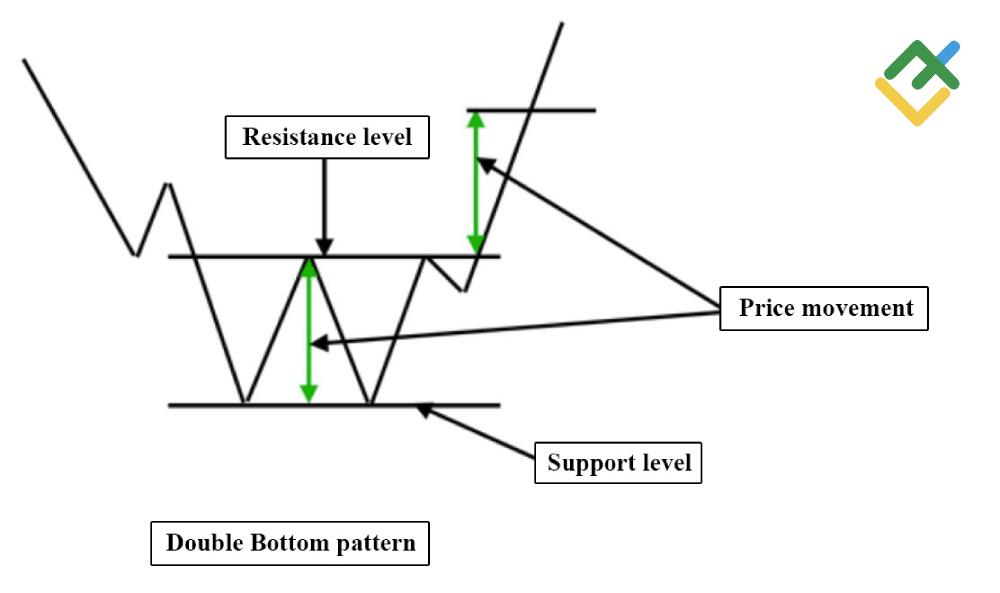
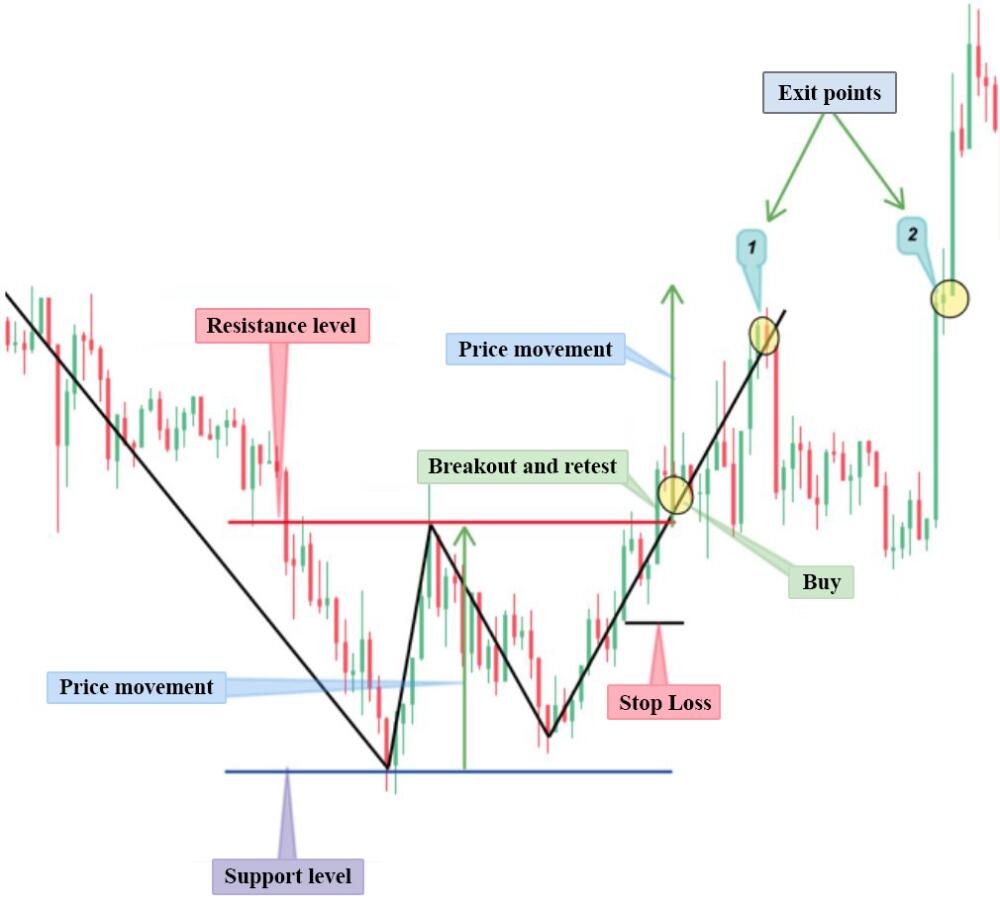
This pattern is illustrated on the 30-minute ETHUSD chart below.
After the price slides to the second trough, it climbs back to the resistance level, breaks above it, and retests the level while consolidating higher.
Once the asset settles above the resistance, a long trade can be opened. The target is calculated based on the pattern's height, measured from the support and resistance levels.
In this case, the trade could be closed at two target levels. A stop-loss order is placed below the support level in accordance with risk management rules.
Bullish Hammer
A Hammer is a bullish reversal pattern. This candlestick formation is one of the most suitable for intraday trading. It forms at the end of a downtrend and signals buyer dominance in the market. When trading this pattern, a trader needs to focus on the broader market context.
If the downward movement preceding the pattern is strong, the subsequent rise will be equally powerful. When trading this pattern, it is crucial to consider nearby support and resistance levels to assess price behaviour more accurately.
The color of the Hammer is not critical, but what matters most is the structure of the candlestick itself. However, a green candlestick indicates stronger buying pressure. The pattern's shape resembles a hammer, as it has a small body and a long lower shadow.
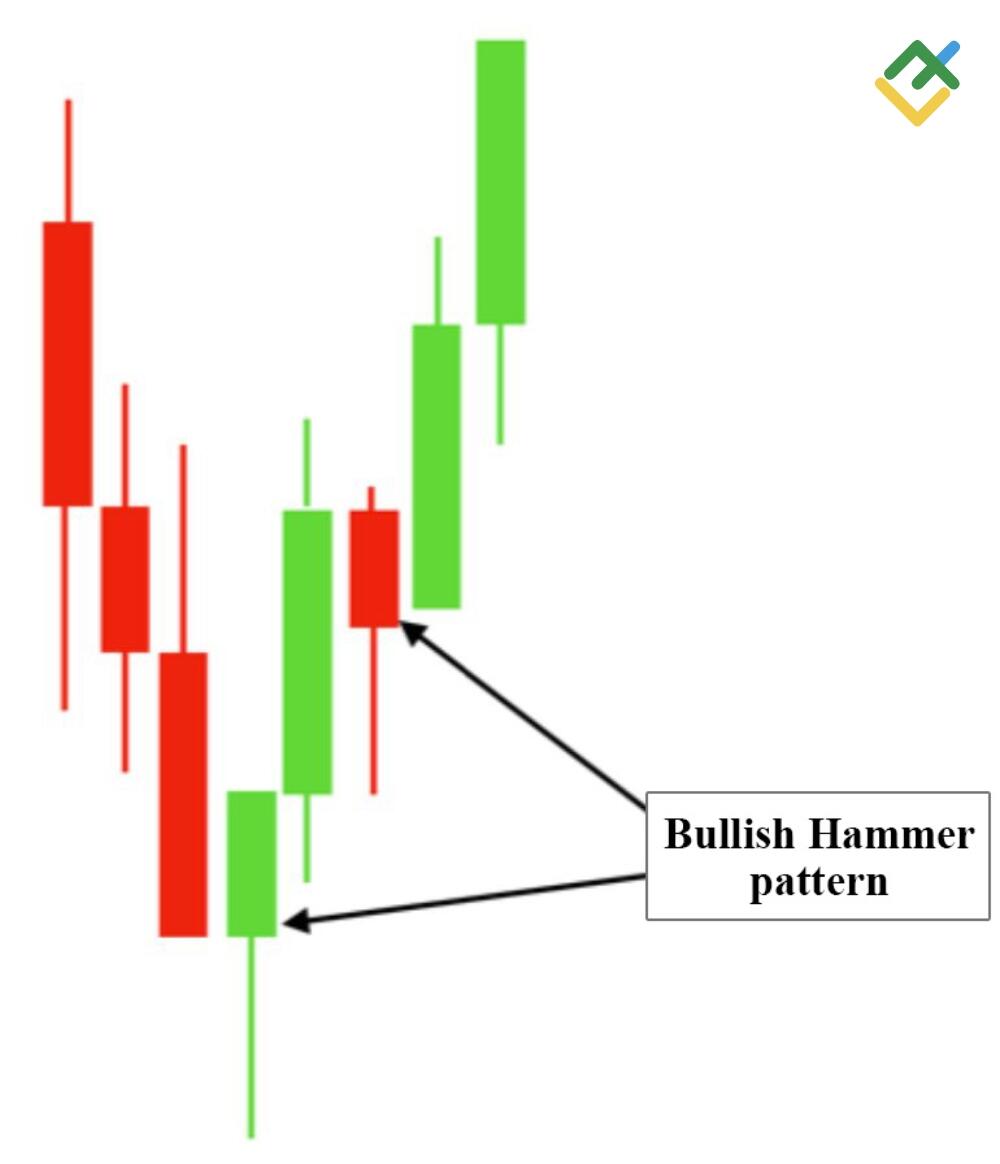
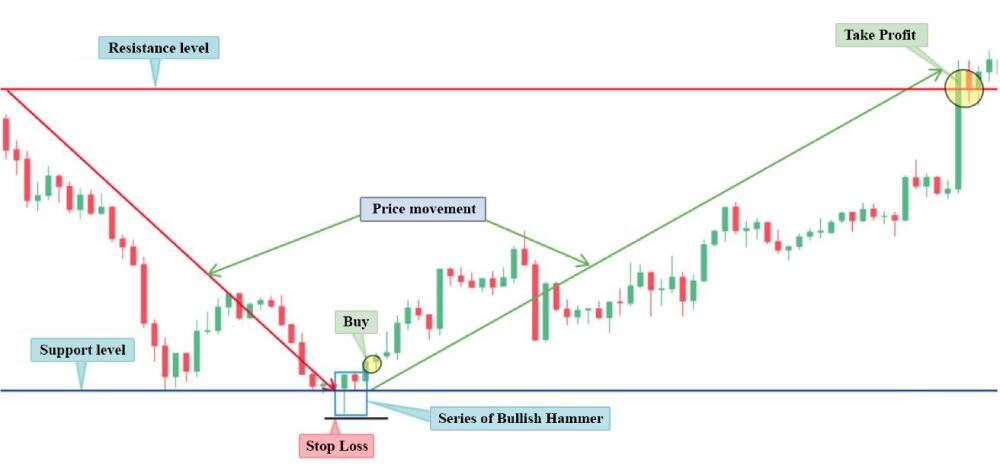
The 15-minute CADJPY chart below shows how the pattern was traded within a single day.
When a Hammer pattern appears, it shows that buyers are stepping in at a support level and pushing back against sellers. The decline stops where the previous drop began, creating resistance above. After a strong downward move, the rebound often turns into a powerful bullish reversal.
On the chart below, a series of Bullish Hammers forms, after which the asset reverses. Once the second Hammer appears, a long trade is opened. A stop-loss order should be placed just below the pattern's low.
Head and Shoulders
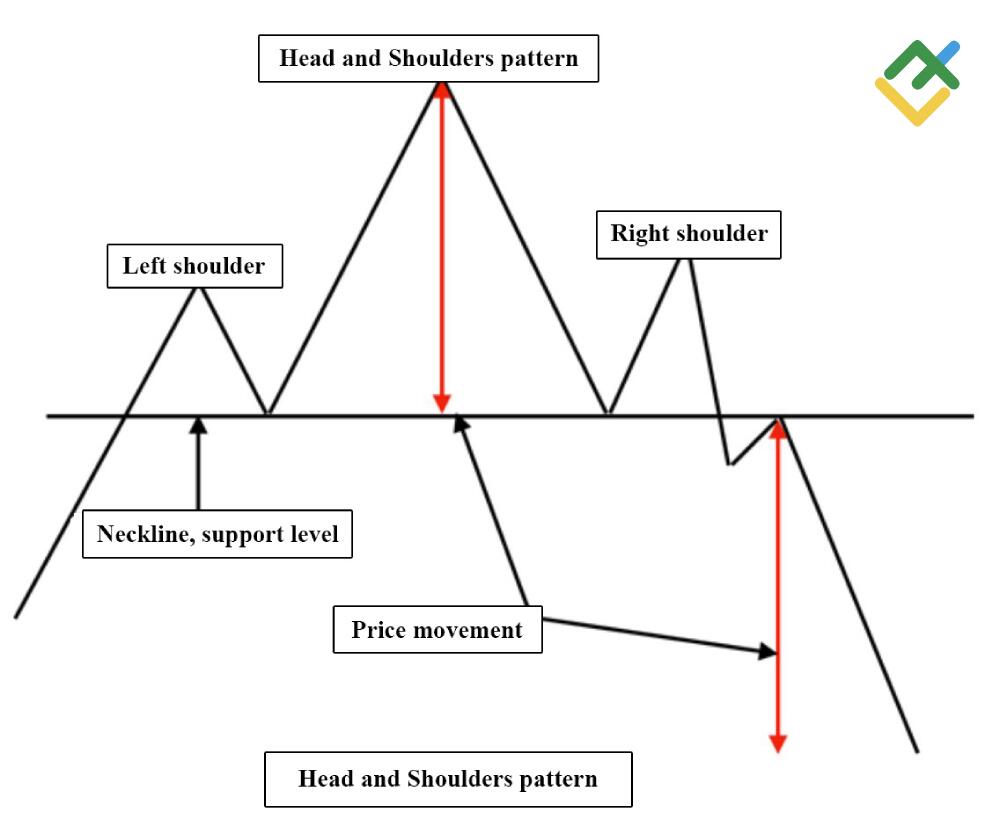
The Head and Shoulders pattern is a reversal formation that occurs less frequently than other chart patterns. It consists of three peaks, with the middle peak (the head) rising above the two shoulders. The neckline acts as the support level at the base of these peaks. A short trade can be opened once the right shoulder completes and the price breaks below the neckline, confirming the breakout. The right shoulder is usually slightly higher than the left one, although this is not always the case.
After the breakout, a short-term upward correction may occur as the price retests the newly formed resistance.
The price target is calculated by measuring the distance between the neckline and the head and projecting it downward from the breakout point.
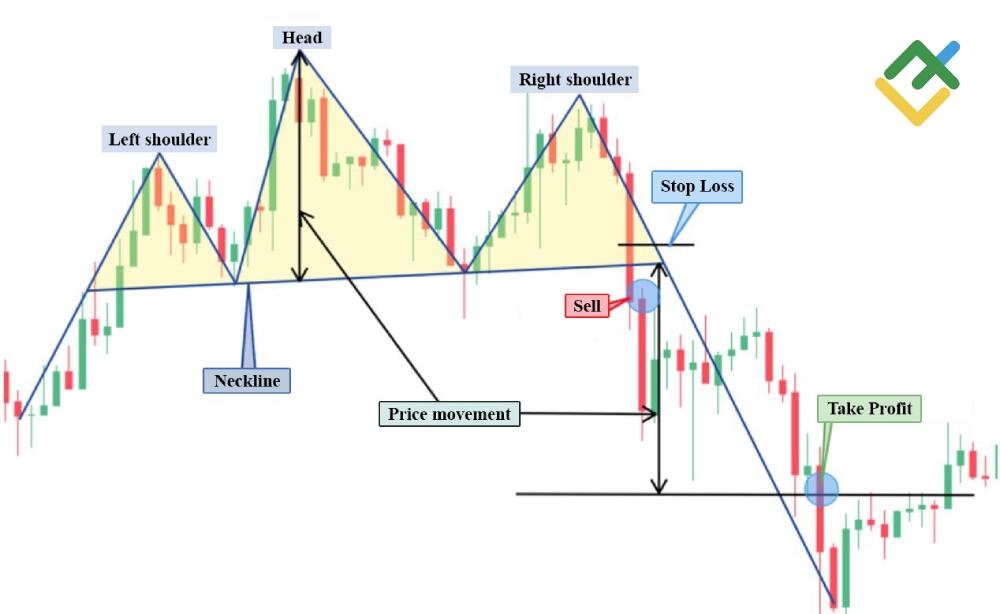
The 15-minute BTCUSD chart below shows the classic Head and Shoulders pattern.
Once the price breaks and settles below the neckline, a short trade can be initiated. A take-profit target is determined by measuring the distance from the neckline to the head and projecting it downward from the breakout point. In this setup, a stop-loss order should be placed slightly above the broken support level, which now acts as resistance.
Diamond
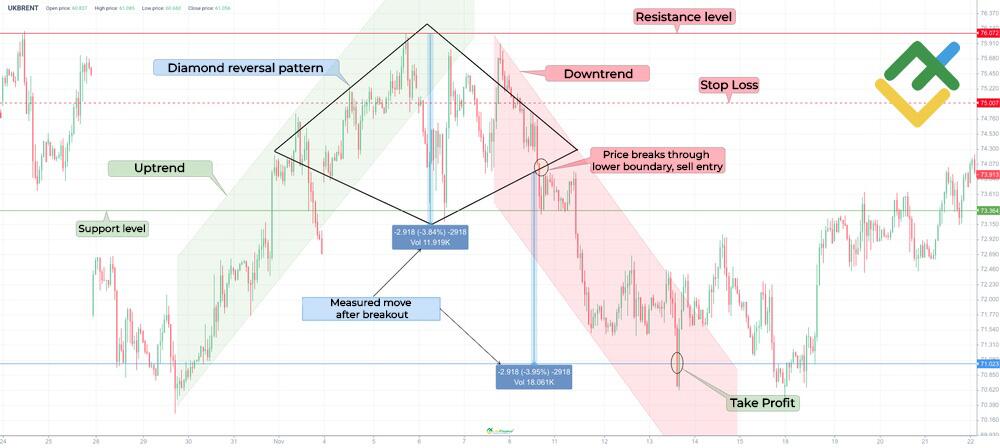
A Diamond pattern is a reversal chart formation that occurs when price action first expands and then contracts, forming a shape that resembles a diamond. The pattern reflects a battle between buyers and sellers.
Traders should wait for the pattern to complete before taking action. In an uptrend, the price should break below the lower boundary of the diamond. Likewise, in a downtrend, it should break above the upper boundary. Importantly, the breakout candlestick should close beyond the pattern to confirm the signal.
If the price pierces the lower boundary, you can open a short trade, setting a stop-loss order above the upper boundary of the Diamond. If the price breaks above the upper boundary, you can open a long trade, placing a stop-loss order below the lower boundary of the pattern. The profit target will be the distance between the highest and lowest points in the diamond formation, added to the breakout point.
Morning Star and Evening Star
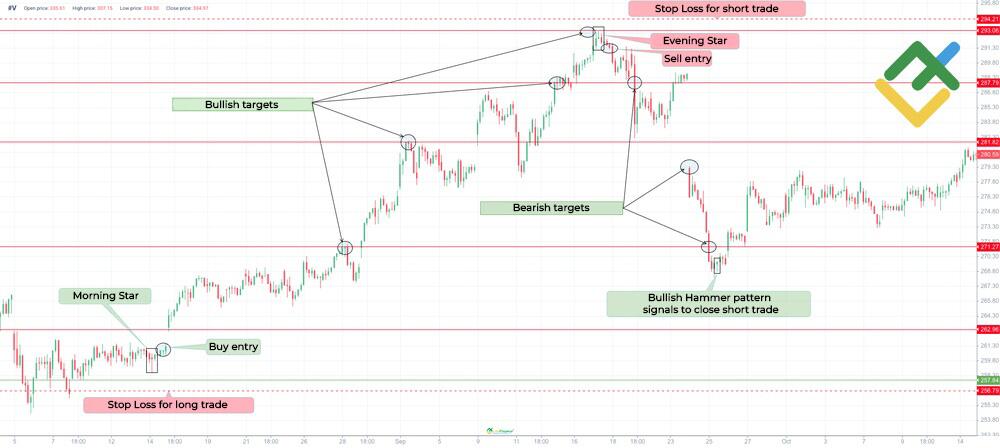
A Morning Star and an Evening Star are candlestick patterns that signal an imminent trend reversal. The Morning Star pattern forms during a downtrend. It begins with a large red (bearish) candlestick, followed by a small candlestick, often a Doji or a Spinning Top, and concludes with a large green (bullish) candlestick. The small candlestick reflects market indecision, while the final green candlestick indicates that selling pressure is weakening.
The Evening Star pattern develops during an uptrend. It is composed of a large green candlestick, a small green one, often a Doji or a Spinning Top, and a large red candlestick. The small candlestick reflects hesitation among market participants, while the final red candlestick confirms that buying momentum is fading. You can open a trade once the reversal is validated and place a stop-loss order beyond the pattern's boundary.
Harami
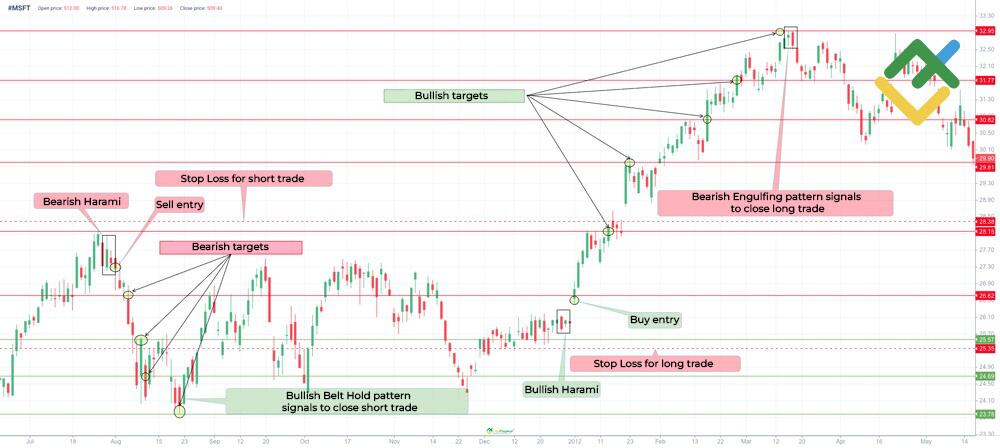
Harami is a candlestick pattern that indicates a possible trend reversal. The pattern consists of two candlesticks. The first large candlestick engulfs the second small one. A Bullish Harami appears in a downtrend, while a Bearish Harami emerges in an uptrend. Notably, the smaller candlestick is fully enclosed by the body of the larger candlestick.
To trade this pattern, you need to confirm the price reversal. For example, when a Bullish Harami forms, the next candlestick should open with an upward gap.
If the second candlestick in the Harami pattern becomes a Doji or a Spinning Top, it provides a stronger reversal signal. You can place a stop-loss order beyond the highest or lowest point of the pattern, depending on the trend. Moreover, it is crucial to consider the broader market context and use additional technical indicators to confirm the signal before entering a trade.
Trading Chart Patterns Summed Up
Chart patterns are essential tools in technical analysis that allow traders to swiftly identify potential trends. The table below provides an overview of the key features of popular trading patterns. This information will help you quickly pinpoint these patterns on price charts and utilize them in trading.
Pattern | When It Forms | Trend |
Cup and Handle | After a short-term consolidation | Bullish |
Symmetrical Triangle | During market uncertainty | Bullish/Bearish |
Ascending Triangle | Near the resistance level | Bullish |
Descending Triangle | At the support level | Bearish |
Head and Shoulders | At the end of an uptrend | Bearish |
Inverse Head and Shoulders | At the end of a downtrend | Bullish |
Double Top | After two equal highs | Bearish |
Double Bottom | After two equal lows | Bullish |
Flag | During a short-term consolidation | Bullish/Bearish |
Wedge | Ahead of a trend reversal or continuation | Bullish/Bearish |
What Is Day Trading?
Day trading means trading financial markets within a trading day. Open positions are not carried overnight but rather opened and closed within one day.
The time frame depends primarily on the day trading strategy. Professional day traders usually avoid time frames shorter than 15 minutes.
There are two types of day trading methods:
- Scalping implies using time frames from 1 to 30 minutes.
- News trading is a type of intraday strategy where traders factor in market-moving news alongside technical and fundamental analysis. Professional traders understand how global events influence price movements and adjust their positions accordingly. The most common time frames for this approach are 15-minute, 30-minute, and 1-hour charts.
Why Are Chart Patterns Important
Chart patterns are important in trading because they are closely intertwined with the psychology of price action. Price chart analysis first appeared in the 17th century.
It is more convenient to analyze patterns on a candlestick chart, since Japanese candlesticks provide more information, including opening and closing prices, price movement, and highs and lows. It is crucial not to confuse chart patterns with candlestick patterns, which consist of only one or a few candles.
Candlestick patterns are generally cyclical and tend to repeat, forming recognizable price formations. By analyzing these patterns, both professional traders and beginners can anticipate future price movements and open trades with clearly defined targets.
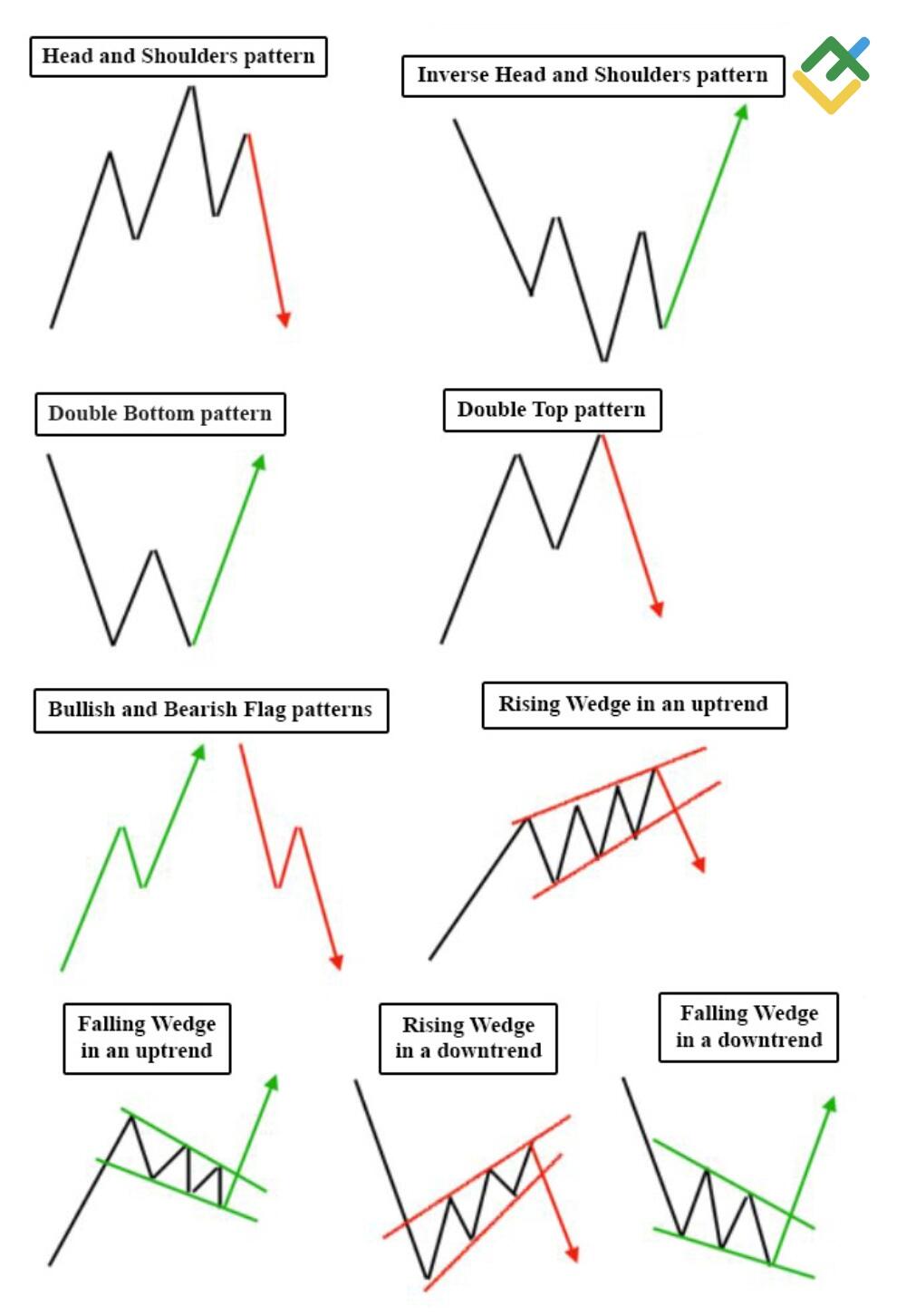
Examples of chart patterns include the Double Bottom, Double Top, Head and Shoulders, Inverse Head and Shoulders, Rising and Falling Wedges, Flags, and Ascending and Descending Triangles.
Chart patterns are an essential tool for traders to analyze market movements and make informed decisions. These patterns provide insights into the psychology of market participants and help traders identify potential trends and reversals.
How Forex Chart Patterns Work
Day traders use chart patterns to identify the direction of prices based on past movements. The goal is to find signals for opening long or short positions and make profitable trades using historical and current data.
Trading Pattern Recognition
Recognizing trading patterns requires traders to stay vigilant and adopt a systematic approach to analyzing charts.
The first step is to choose a suitable time frame. Lower time frames like M5 or M15 are ideal for day trading. Higher time frames, such as H1 and above, are better for spotting global market trends.
The next step is to determine key support and resistance levels, the areas where various patterns most often form.
Study the price movement carefully, paying attention to recurring structures: highs, lows, consolidations, and sharp swings. Besides, it is advisable to combine chart analysis with volume and volatility indicators. This will help you spot patterns more accurately and increase your chances of making profitable trades.
How to Read Chart Patterns
Chart patterns can be easily identified on candlestick, bar, or line charts. These formations are usually classified into two main types:
1. Reversal Bearish and Bullish Patterns:
- Head and Shoulders, Inverse Head and Shoulders;
- Double Top and Double Bottom;
- Rising Wedge in an uptrend, and others.
2. Trend Continuation Patterns:
- Rising Wedge in a downtrend;
- Falling Wedge in an uptrend;
- Bullish and Bearish Rectangle;
- Bearish and Bullish Pennant;
- Symmetrical, Ascending, Descending Triangles and others.
Pattern-Based Trading Strategies for Short-Term and Intraday Trading
In day trading, you can apply all of the above chart patterns. The recommended time frames for market analysis are 5-minute, 15-minute, and 30-minute charts. For short-term trades lasting one to two days, use the hourly chart.
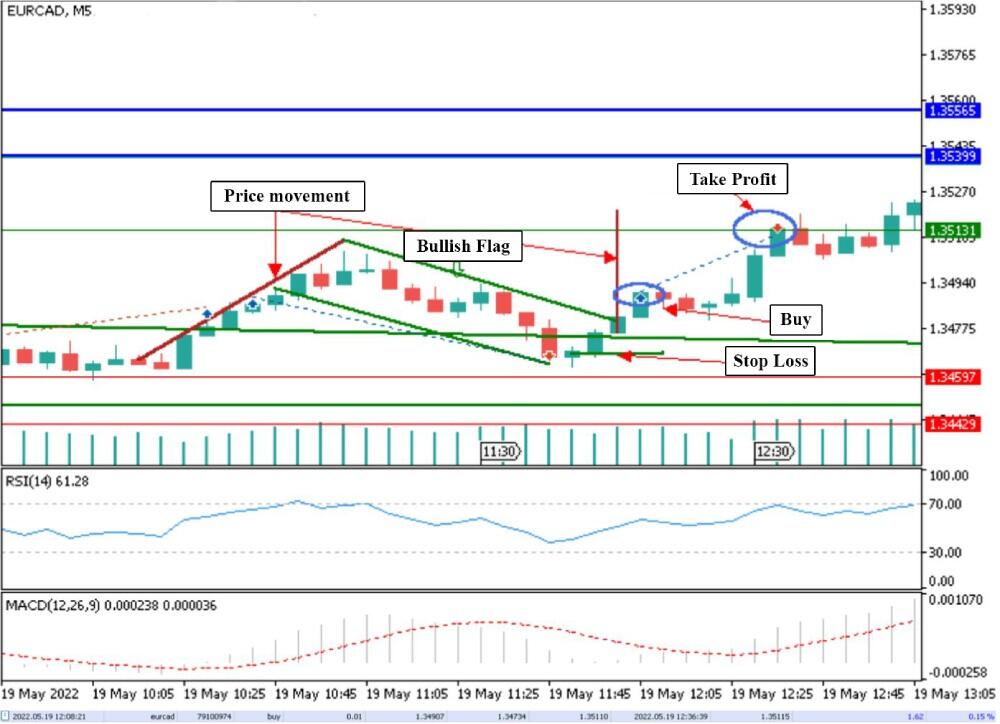
The 5-minute EURUSD chart below illustrates a Bull Flag pattern. Once the price breaks out of the formation, a long trade of 0.01 lots is opened. The stop-loss is set within the flag, near the point where the upward movement began. About 30 minutes later, the trade closes with a profit of $1.62.
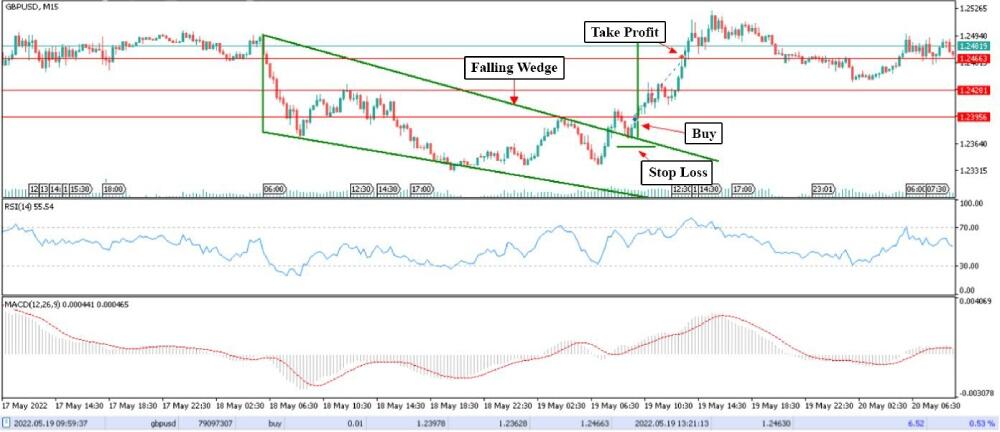
The 15-minute GBPUSD chart below shows a Falling Wedge.
Once the price pierces and tests its upper boundary, a long trade of 0.01 lots is opened.
According to the trading strategy, the profit target is set at a distance equal to the height of the wedge, measured from its widest part and projected upward from the breakout point. The stop-loss is placed just below the broken resistance level, in line with risk management rules.
Afterward, the trade is closed intraday with a profit of $6.52.
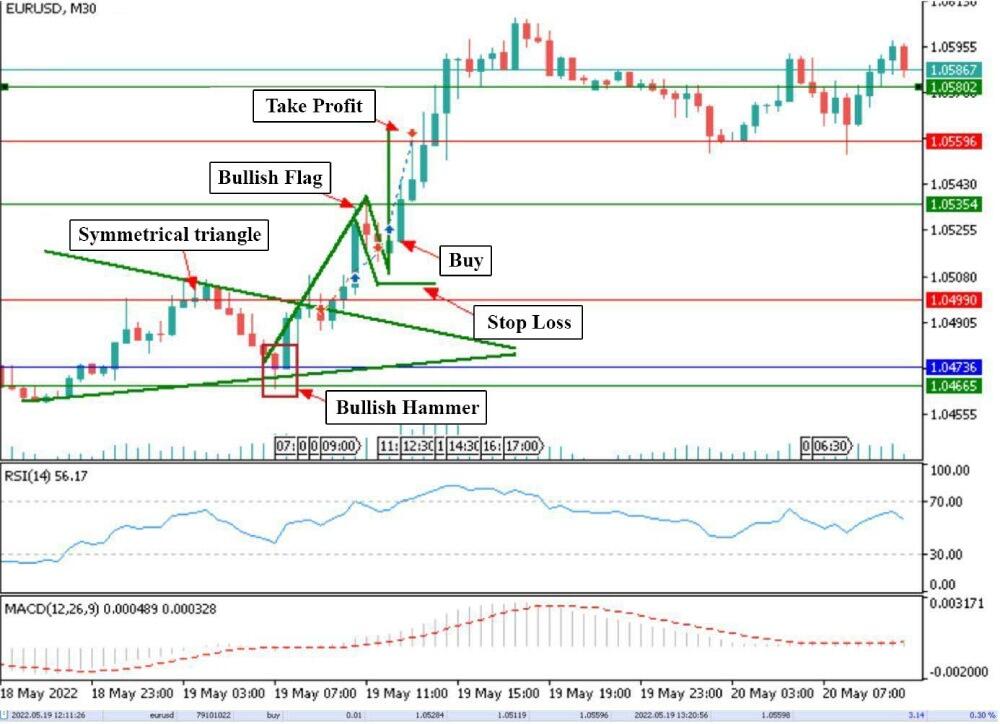
Let's now analyze the price movement on the 30-minute EURUSD chart. A Symmetrical Triangle forms on the chart, suggesting the price can go both up and down. Therefore, a price breakout should be confirmed.
Furthermore, a Bullish Hammer appears at the bottom of the Triangle before the asset starts to rise, providing additional confirmation of buyers' strength. The impulsive breakout from the Triangle forms a Bull Flag. Once the price breaks out of the Flag, a long trade of 0.01 lots is opened. The target level is set at a distance equal to the height of the flagpole, and a stop-loss order is placed below the Flag.
The target is reached 1.5 hours after the trade is opened, bringing the profit of $3.14.
Start trading with a trustworthy broker
Best Tips for Using Day Trading Patterns
Day trading carries a high level of risk and can lead to rapid losses. Thus, before you start trading, keep these tips in mind:
Determine the Market Sentiment on Different Time Frames
Before you begin day trading, it is important to conduct investment research and gauge market sentiment by analyzing various time frames ranging from 5-minute to daily charts. This will help you understand the overall trend and make better trading decisions.
Use Technical Indicators in Conjunction with Price Action Analysis
Use classic technical analysis indicators such as the RSI, Stochastic, or MACD in conjunction with price action analysis. This approach will help you identify patterns and potential trading opportunities.
Wait for Patterns to Fully Form and Identify Profitable Entry Points
After identifying a chart pattern, it is essential to wait for it to complete before entering a trade. This approach helps increase the likelihood of success. In addition, choosing the right entry point is essential for maximizing potential profits.
Implement Risk Management Strategies
To protect your capital, always set stop-loss orders and follow a risk management plan that matches your personal risk tolerance. This helps minimize potential losses and safeguard your funds. Before entering the live market, you can start trading on a demo account, which most brokers and trading platforms offer for practice.
Stay Up-to-date with News Background
When trading intraday, monitor price movements and stay up-to-date with market news. This will help you identify potential high risks and trading opportunities that may affect the price direction.
Beware of Bull and Bear Traps
Bull and bear traps are common chart patterns in day trading and can lead to significant losses if not identified correctly. These traps occur when the market appears to be moving in one direction, but suddenly reverses and goes in the opposite one. These traps can happen on lower time frames, where price movements can be more erratic.
Keep Calm and Avoid Impulsive Decisions
Finally, stay calm and avoid making trading decisions based on emotions. Emotional trading can cloud your judgment and lead to losses. By keeping a clear mind and following a well-defined trading plan, you can greatly improve your chances of success in day trading.
Get access to a demo account on an easy-to-use Forex platform without registration
Conclusion
Intraday trading requires quick decisions and precise timing. The most effective patterns are identified on lower time frames, such as 5-minute and hourly charts. Using proven technical analysis tools helps traders make profitable trades within a single day.
The article also covers practical trading strategies for several patterns tested in real market conditions.
Price pattern analysis can be applied to a wide range of instruments, including currencies, cryptocurrencies, and stocks.
You can practice trading on the financial markets without risking real money by opening a LiteFinance demo account.
Day Trading Patterns FAQs
Three to five trading patterns are enough to build a profitable trading strategy. You should know how to identify these patterns on the chart and interpret their signals. Your trading success depends on your knowledge, discipline, and how well you adjust your strategy to market conditions.
Chart patterns work on any time frame, including intraday trading. However, it is crucial to gain experience and learn to recognize chart patterns to avoid losing money.
The best chart patterns for day trading include the Triangle, Flag, Pennant, Wedge, and Bullish Hammer.
To spot chart patterns in intraday trading, use time frames of up to one hour. Zooming out slightly helps you see the full formation. Make sure you have solid technical analysis skills, understand how to use indicators, and follow sound risk management, as false patterns can lead to losses.
Effective candlestick day trading patterns include reversal patterns like the Hammer, Inverted Hammer, Morning and Evening stars, Piercing Line, Dark Cloud Cover, Hanging Man, Bullish and Bearish Engulfing.
A wide variety of stock chart patterns are used in modern trading, covering both candlestick and chart analysis.
The content of this article reflects the author’s opinion and does not necessarily reflect the official position of LiteFinance broker. The material published on this page is provided for informational purposes only and should not be considered as the provision of investment advice for the purposes of Directive 2014/65/EU.
According to copyright law, this article is considered intellectual property, which includes a prohibition on copying and distributing it without consent.