One of our recent articles explained the golden cross pattern, a bullish formation where two moving averages cross. A golden cross is formed when a short-term average crosses from below to above the other moving average.
The death cross pattern is the opposite of a golden cross.
How to use a death cross signal when trading in financial markets? How to calculate a death cross on a chart and interpret death cross calculation correctly? Let's look at how to identify the death cross pattern on a price chart and what a death Cross shows.
The article covers the following subjects:
What is a death cross pattern?
A death cross is a bearish pattern in which two moving averages cross near an asset's local or new peak. The death cross pattern indicates market weakness, meaning the price has reached a certain limit that bulls aren't able to break out. This pattern is likely to signal an upcoming trend reversal.
The technical indicators used to identify a death crosse are Simple Moving Averages (SMA):
50-day short-term MA;
200-day long-term MA;
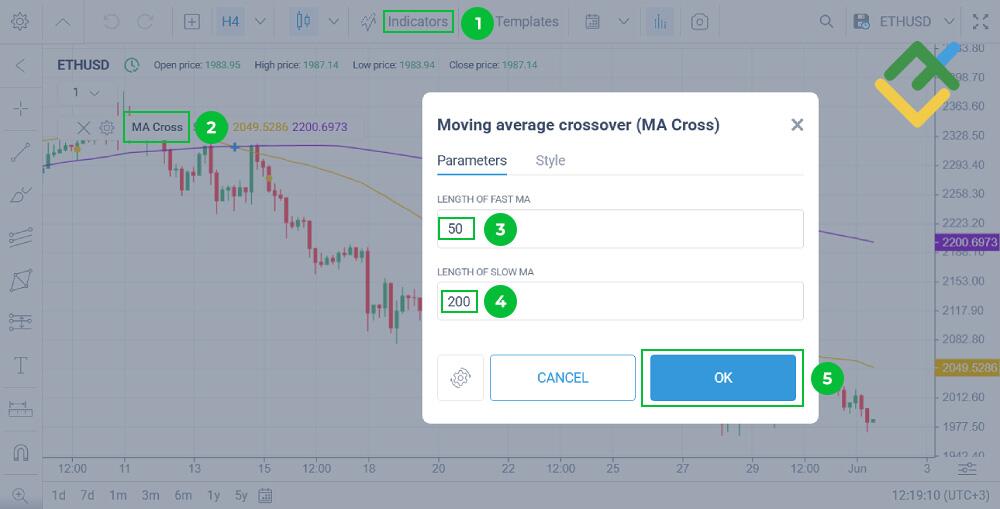
To add this indicator onto a price chart, look for "Moving Average Crossover (MA Cross)" in the "Indicators" section. Then, enter the short- and long-term MA values mentioned above and save them.
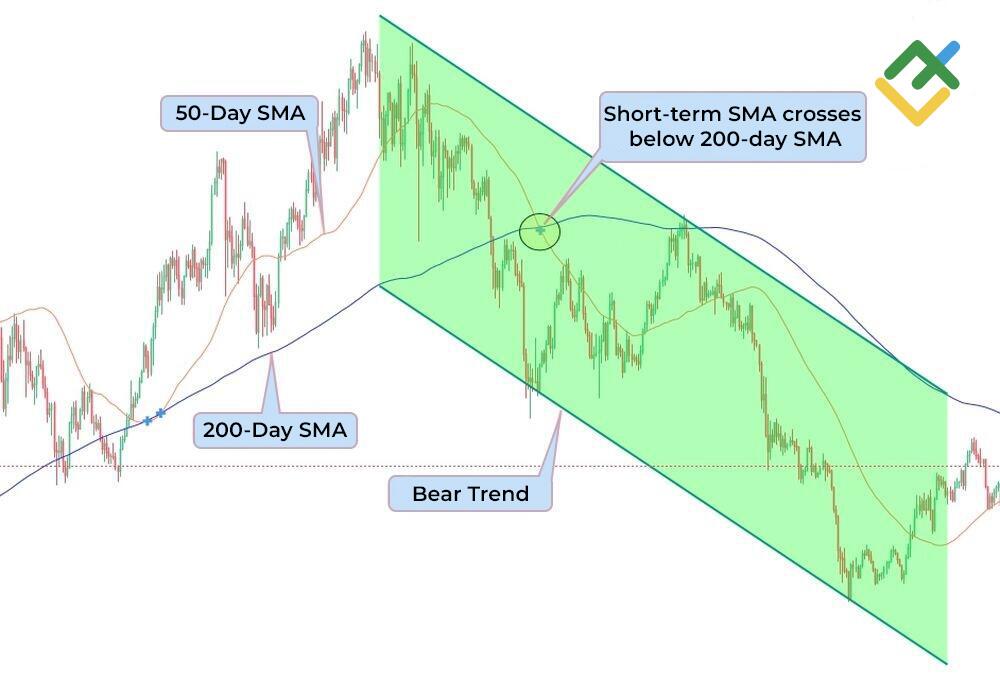
A death cross is formed when a 50-day moving average crosses from above to below the 200-day MA.
The death cross pattern can emerge in the following financial markets:
stock market;
commodity market;
cryptocurrency market;
Forex.
This pattern can also occur on different time frame charts, but longer time frames tend to produce more accurate signals for a reversal and the beginning of a long-term downtrend.
While trading a death cross on time frames smaller than H4, a trader can experience a lot of market noise, which can produce false signals and get them caught in bull and bear traps. So, we'd better use other, more appropriate patterns for intraday trading.
Death cross signals
Market participants and analysts understand a death cross as a final trend reversal to the downside for a specific asset, a stock index, or the whole market.
The pattern owes its fearful name to its X-like shape formed by two SMAs’ crossover. "Death" symbolizes a strong long-term move downwards that will come in the near time in the future. However, that doesn't always mean that a bull trend will reverse soon.
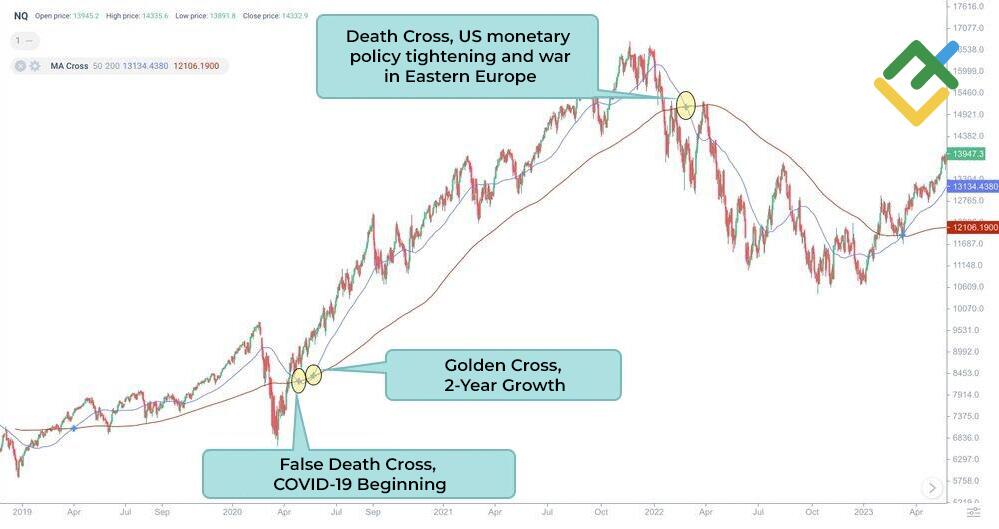
A death cross suggests a slowdown in short-term dynamics in the financial market or for a specific asset. The pattern sometimes precedes a regular correction move, after which quotes reverse again. Let's examine an example of the NASDAQ100's daily chart.
During the 2020 pandemic and lockdown there formed a false death cross. At that time, many economic sectors shrank. Almost all logistic chains were ruined, affecting raw material extraction and processing companies and factories. One could think that was the beginning of a big crisis, but that wasn't true.
Conversely, energy consumption and demand for medicines increased, and a technology boom started. The company engaged in those sectors didn't allow the crisis to burst out. The financial markets saw a 2-year rally that confirmed the golden cross pattern.
Moreover, many regulators eased monetary policy and poured trillions of dollars into the global economy. As a result, inflation started growing worldwide in 2021-2022, leading back to tightening. The 2022 military conflict in Eastern Europe aggravated the geopolitical situation. A death cross occurred on the chart and triggered a true downtrend.
Death cross and Golden cross
A golden cross and a death cross are opposite patterns that indicate a major trend reversal. The table below shows the difference between them.
Golden cross | Death cross |
Bullish pattern | Bearish pattern |
Short-term MA crosses from below to above 200-day SMA | Short-term MA crosses from above to below 200-day SMA |
Forms at the bottom | Forms on the top |
Indicates faster short-term dynamics and buyers' strength | Indicates slower short-term dynamics and sellers' strength |
Death cross phases
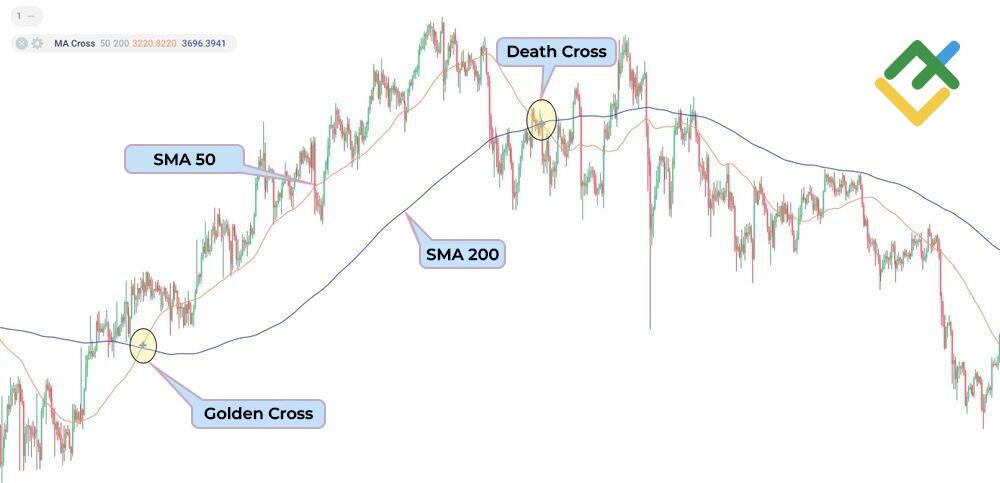
There are three phases of death cross development on a chart.
1. Long-term growth and growth peak phase
The price rises actively until it reaches a strong resistance level. Once a local or new high is reached, buying momentum becomes weaker as more sellers appear.
2. Bear phase: death cross formation
During this phase, quotes start declining and form a death cross. The 50-day MA crosses from above to below the 200-day SMA.
3. A bull trend turns into a bear trend, and selling momentum grows
The formation of the pattern signals a long-term bear market. A death cross is a trigger to close long positions and go short.
Once a death cross occurs, trading volumes usually start growing, meaning that the pattern is confirmed and market participants sell an asset.
How to identify a death cross on the chart
Identifying a death cross on a chart is easy if you rely on the following criteria in your technical analysis:
The 50-day SMA is located above the 200-day SMA during an uptrend. The price reaches its peak, and bears reverse it down. The two moving averages cross.
Then, the short-term moving average crosses from above to below the long-term SMA. That's a signal of a bear market. At the same time, once a death cross is formed, the MAs expand significantly.
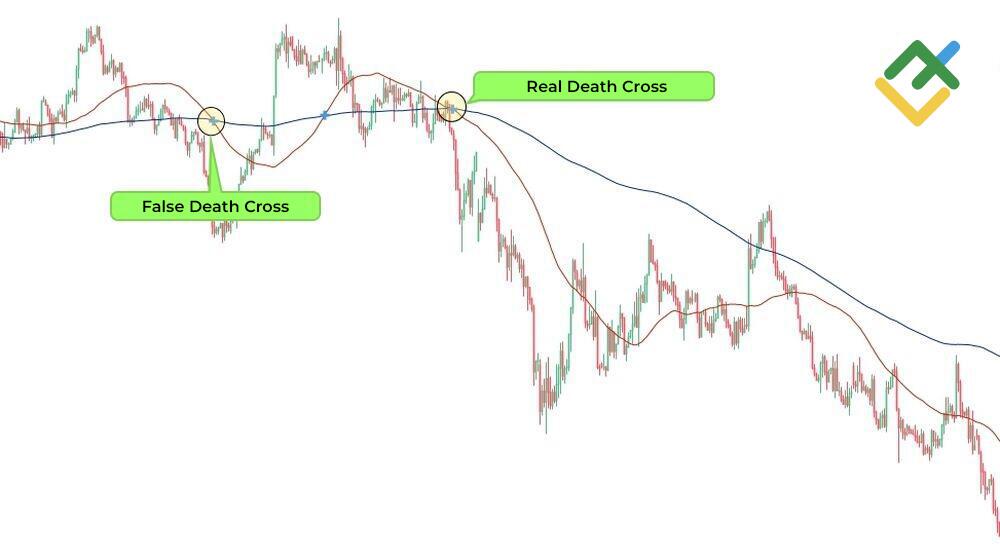
The 50-day SMA is below the 200-day MA during a downtrend, indicating the beginning of a bear trend. But that can also be a correction that looks like short-term momentum, after which the price can reverse. It's a false signal, then.
We need confirmation from other patterns and technical indicators when trading the death cross pattern. Once the death cross pattern is confirmed, we can consider it as real and prepare for long-term selling momentum.
Is a death cross a lagging indicator?
A death cross is a lagging pattern that occurs in a weak market because SMAs are based on historical data. Moving averages just track the behavior of an asset's price. That's why other technical indicators should be combined with the death cross pattern:
Analysis of such stochastic indicators as RSI, MACD, and Stoch.
For example, candlestick patterns such as Hanging Man, Shooting Star, Bearish engulfing, and others warn traders about a trend reversal in advance.
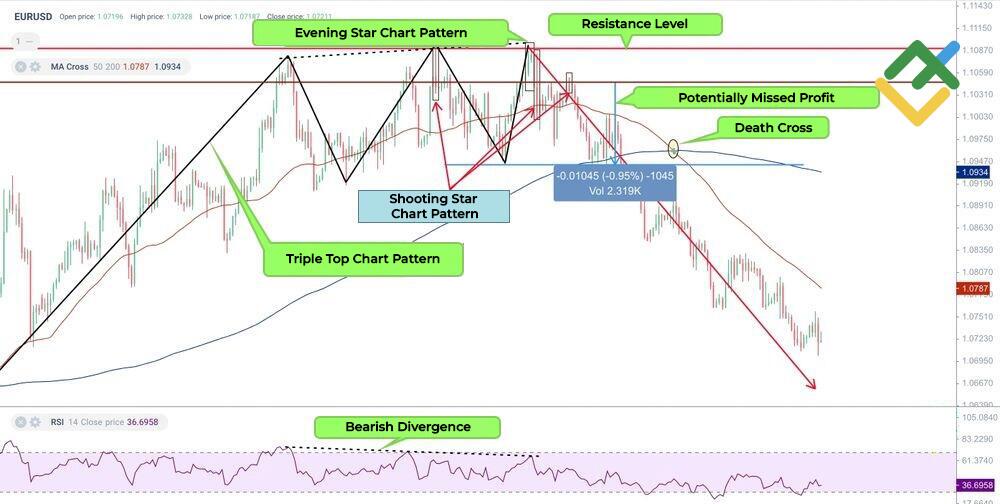
Let's have a look at an H4 chart of the EURUSD pair. The picture below shows a large chart pattern called "Triple Top." This pattern occurs on the top, signaling a trend reversal to the downside. The RSI indicator shows a bear divergence. Moreover, we have the Evening Star and the Shooting Star reversal patterns on the tops.
The combination of these signals points to a reversal at 1.1059 - 1.1087. A death cross occurred at 1.0934 later and became a final signal of a bearish phase. So, if a trader had opened a short trade near a death cross, they would've missed 1,045 profit points.
Death Cross trading strategy
A trading strategy based on the death cross pattern suggests going short after the crossover of moving averages. A death cross indicates that bullish momentum is exhausted, and investors expect an asset's price to fall.
It's recommended to use this pattern with long time frames. We will examine a Death Cross trading strategy combined with candlestick analysis on a long time frame chart. Our example will be Amazon Inc. stocks.
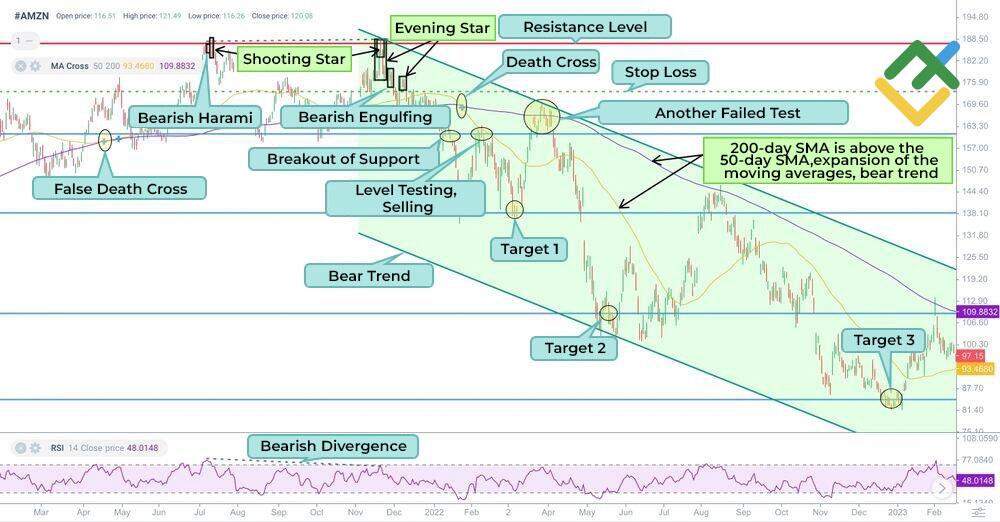
As seen in the daily chart below, the quotes reached a new peak at around 188.50. The buyers attempted to break out the new resistance level twice but failed.
In April 2021, the first death cross produced a false signal to open short positions. Then, a golden cross occurred, and the price reached a new high, after which we saw the first candle indicating overboughtness — a bearish harami, followed by a shooting star. The quotes declined to support at 163.30, where the price tested the buyers’ support twice.
Meanwhile, the 50-day SMA was above the 200-day SMA. The bulls managed to withstand a bearish attack and started buying actively again, pushing the price to 188.50. At that moment, the RSI indicator started showing a bearish divergence, giving the second signal of an upcoming trend reversal and growing selling pressure.
Then, the Evening star reversal pattern formed. The buyers could not resist another bear attack, and the price reversed. Next, we see the formation of two more reversal patterns — Bearish engulfing and Evening star — the third signal.
Before the second death cross occurred, the sellers broke out a strong support level that had withstood selling pressure earlier. The price moved to around 138.10 in February 2022. It's when a death cross formed completely, and the price reversed to test the broken support level, which was the fourth confirmation of a trend reversal.
In that case, a short position could be opened at 163.30 with targets at 138.10, 109.88, and 85.13 after the level was tested. A Stop Loss should be placed above the crossover of moving averages at 173.76.
Once the asset reached the first target, the price reversed again. The bulls retested the level of 163.30 and failed. A bull trap formed, and the price reversed down once and for all.
After a death cross formed, the 200-day moving average was above the 50-day MA. Moreover, there was a significant expansion of two MAs, confirming the final trend reversal and the beginning of a bear trend.
Double Death Cross
The double death cross trading strategy uses other moving averages. In particular, one more indicator — the 100-day SMA — is added onto the chart. It allows us to predict the formation of the main death cross.
A short trade can be opened once the 50-day moving average crosses the 100-day and the 200-day moving averages. These crossovers will confirm the beginning of a bear trend or a long market correction.
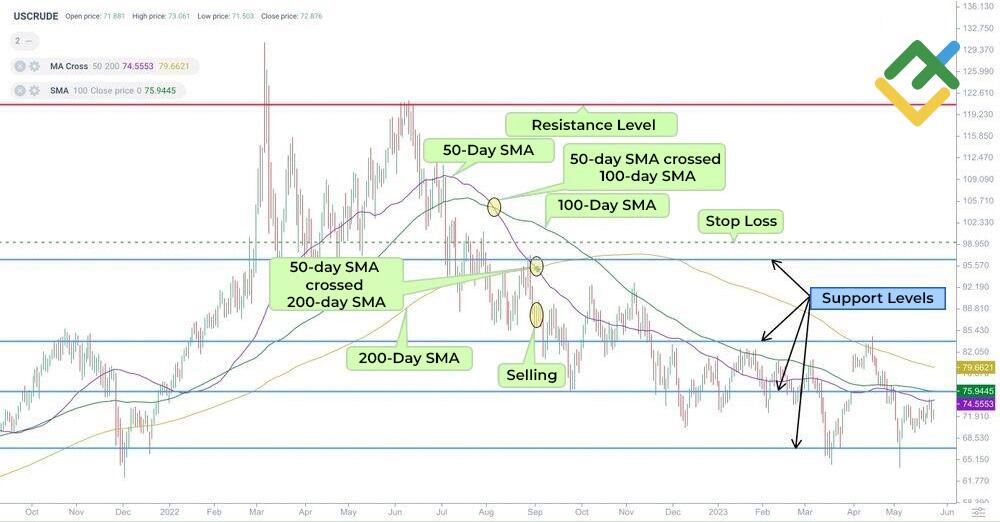
Look at the USCRUDE's daily chart for an example of trading a double death cross. The picture below shows that the asset reached a local high at around 119.23 - 129.37. The quotes formed a larger price reversal pattern — Double Top.
After a second high formed, the 50-day moving average crossed the 100-day MA, building the first death cross. The asset's price saw an impulsive drop. The second death cross formed when the "neckline of the double top pattern was broken out at 95.57 as the ultimate confirmation of a bear trend. A short position should then be opened at around 89.00, with targets at 83.61, 76.14, and 67.27. A Stop Loss should be placed above the first death cross at 98.95.
It’s possible to reach the two targets after shorting the asset before it corrects to the upside. That's a high-risk trading method where a big Stop Loss is used. However, two-thirds of the position would be closed with a big profit. The rest of the position can be brought to a breakeven level, with the third target left.
Death Cross Pattern Examples
As a death cross is a lagging indicator, it should be used with another technical instrument. The death cross pattern does not necessarily indicate a shift to a bear trend. It sometimes predicts a long correction that buyers are ready to buy.
A death cross usually occurs when a short-term move to the downside has finished and a bullish reversal has already occurred in the market. Let's examine a few death cross examples for different assets.
Death cross on Apple stock chart
Here's a death cross on Apple stock's H4 chart.
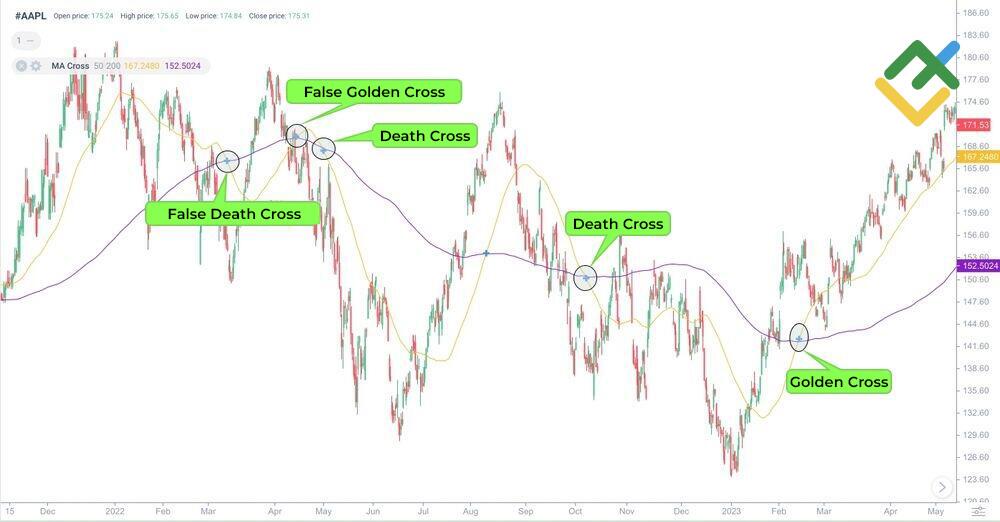
Before forming a real death cross, the asset deceived market participants two times. First, a false death cross emerged, and bulls decided to buy a drop at the level of its formation.
Before forming a real death cross, the asset deceived market participants two times. First, a false death cross emerged, and bulls decided to buy a drop. Then, a false golden cross emerged, making a bullish trap for buyers. Finally, the price reversed, and the 50-day moving average crossed the 200-day moving average, confirming a short-term bear trend for Apple Inc.
Death cross on Dow Jones index chart
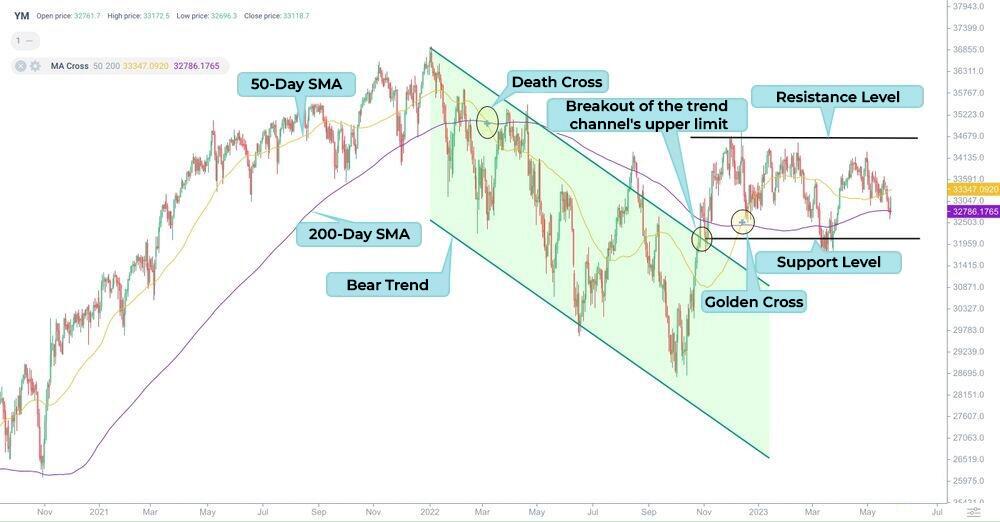
The daily chart of the Dow Jones industrial index shows the formation of the death cross pattern, which started a long-term move to the downside. It lasted from March to November 2022. Then, the bulls broke out the trend channel's upper line, stabilized above it, and formed a new springboard for further growth. Besides, there formed a golden cross. To confirm it, the buyers need to stabilize above the resistance level of 34679.0.
Death cross on Bitcoin chart
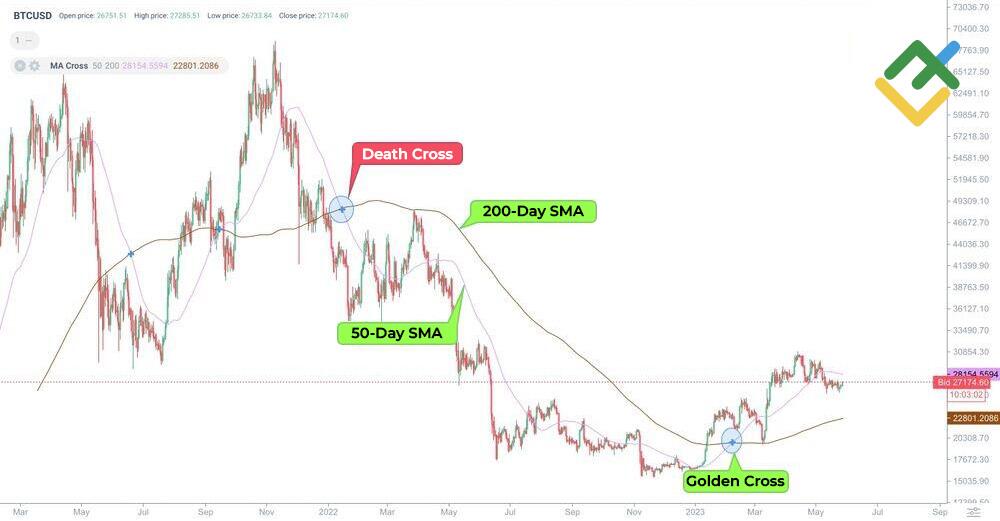
Besides the stock, indexes, and Forex markets, a death cross can emerge in cryptocurrency charts. For example, the pattern formed in the daily chart of Bitcoin in January 2022 as a response to the Fed's policy tightening that strengthened the dollar against all currencies, including cryptos.
After the death cross formation, the asset dropped in price by almost 33,000 dollars within a year. The longer-term moving average was above the short-term MA during that period.
Bitcoin's rate fluctuates at around 27,000 USD as of summer 2023. Also, a golden cross emerged, signaling a bull run.
Death cross on S&P 500 chart
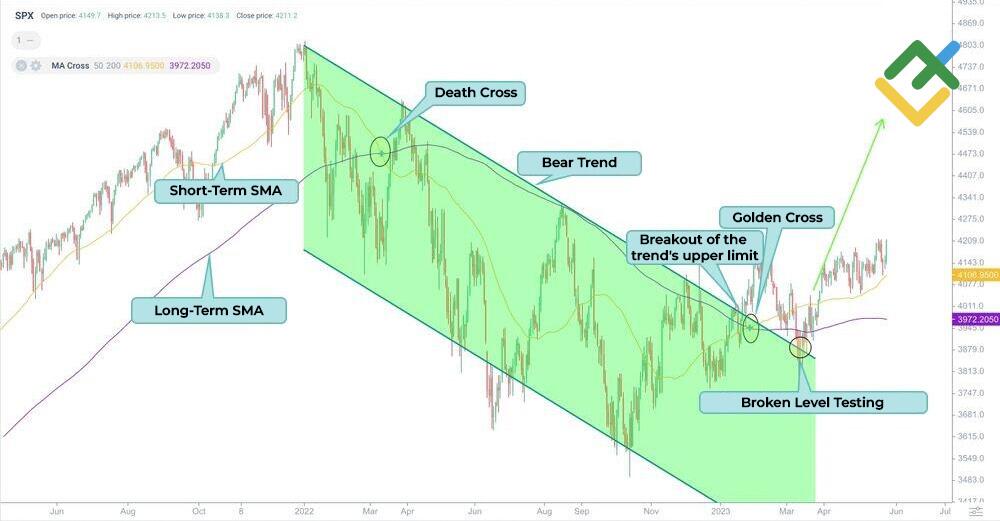
A death cross formed in the daily chart of the S&P 500 index in March 2022, predicting a long bear trend. That happened because of global inflation growth and the measures taken by regulators.
After its formation, the 200-day SMA was above the short-term moving average for almost one year. In February 2023, the asset built a golden cross and broke out the downtrend's upper boundary. In March 2023, the price tested the broken level and finally reversed up.
Death cross on Tesla chart
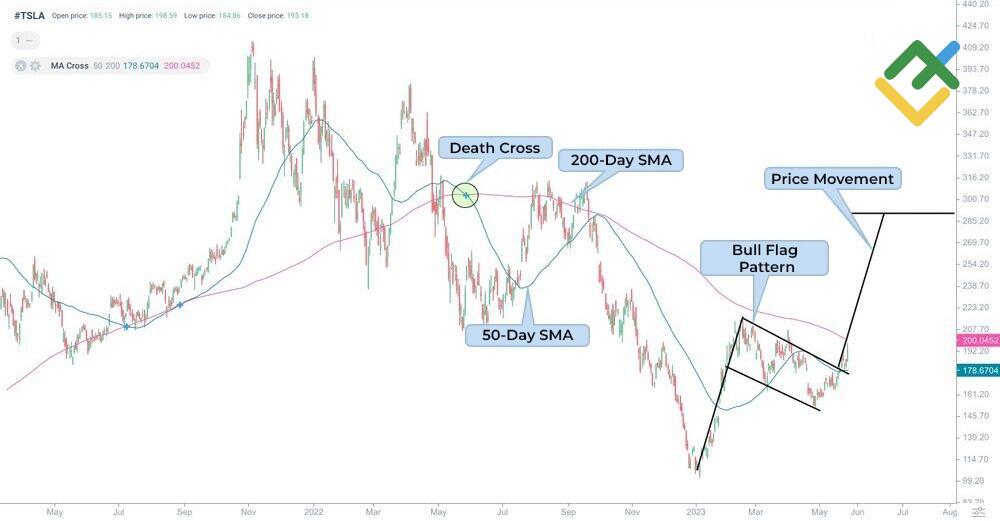
In May 2022, the quotes of the tech giant Tesla formed a death cross in the daily chart. A bear trend continued up to January 2023.
As we see, the long-term moving average is still above the 50-day SMA, indicating that the bear trend has not reversed yet. However, there's another pattern worth noting here: a bull flag that signals an upcoming trend reversal. Furthermore, the moving averages’ contraction predicts a golden cross on the chart.
The Pros and Cons of Trading the Death Cross
The death cross pattern is a perfect indicator for determining a trend reversal point. Like most patterns, a death cross has its unique features and vulnerabilities.
Pros
Experts single out the following advantages of the death cross pattern:
it signals a trend reversal;
it can form in any financial market and any time frame chart;
it allows determining an exit point for long positions and trading opportunities for short positions;
it is easily identified by the use of SMAs;
it can be used independently or combined with other indicators and patterns.
Cons
The disadvantages of this pattern include the following:
as a lagging indicator, a death cross provides information based on historical data;
it often produces false signals on small time frames (smaller than H4);
it requires confirmation from other indicators and patterns;
it makes a more accurate reversal signal on time frames starting from H4;
it also signals corrective moves, which can lead traders astray.
Conclusion
A death cross is a strong trading signal. The crossover of a short-term moving average below a long-term MA on a chart indicates a bear trend. This pattern can predict a big trend reversal on the top and a regular correction to the downside, but it can also produce false signals. So, the death cross pattern should be combined with other technical indicators and patterns.
Try to identify a death cross on a chart opening a trade on LiteFinance's user-friendly platform. Use your registered email to create a profile with the broker. You can also use a demo account to train yourself without risking real money.
Death cross trading FAQ
The death cross pattern shows that a bullish trend changed to a downtrend, and market participants can go short.
Yes, it is. A pattern that is the opposite of the death cross pattern is a Golden cross.
No, it can't. The pattern's name suggests the answer, where "death" means that an asset is being sold and that can continue for a long time.
A death cross is an excellent indicator based on historical data. It's better used with H4 time frames and longer.
A death cross is a forerunner of a bear market. The longer the time frame it is used for, the longer the period during which a signal is triggered. The pattern also predicts a bearish correction that lasts less than a trend.
It's important to note how deep a price fall is. The signal is confirmed if an asset's price has declined by more than 20% and a death cross occurred in a chart. Such signals are correct on big time frames in most cases.
An asset must be short-sold after a death cross has emerged and been confirmed by other technical analysis patterns or indicators. Stop Loss should be placed above the crossover of moving averages.
A double death cross occurs when the 50-day MA crosses the 100-day and the 200-day SMAs.
A death cross in the stock market is a pattern used in technical analysis. It emerges when a short-term moving average crosses below a long-term SMA, indicating a trend reversal to the downside.
The formation of a death cross in cryptocurrency charts means that an asset has moved to a bear market and can be there for an indefinite period.
A death cross in the gold chart indicates that a bullish trend is exhausted. Buyers are losing strength and cannot hold their positions any longer. At the same time, sellers are gaining momentum in a bear market that has already emerged.

The content of this article reflects the author’s opinion and does not necessarily reflect the official position of LiteFinance broker. The material published on this page is provided for informational purposes only and should not be considered as the provision of investment advice for the purposes of Directive 2014/65/EU.
According to copyright law, this article is considered intellectual property, which includes a prohibition on copying and distributing it without consent.