TD Differential, TD Anti-Differential, TD Reverse Differential
Dear friends!
I continue describing the collection of Thomas DeMark’s forex indicators.
In this article, I am going to deal with short-term trading tools developed by Thomas DeMark.
In the previous articles, I described the application of such DeMark's tools as:
- TD Trend Factor and TD Propulsion (see here).
- TD Retracements (see here).
- TD Lines of demand and supply.
- TD D-Wave (see here).
- TD Sequential and TD Combo (see here).
- TD REI and TD POQ (see here).
- TD DeMarker 1 and 2, TD Pressure, TD ROC, TD Alignment (see here).
- TD Moving Averages (see here).
- TD Range Projection (see here).
- TD REBO and TD Channels (see here).
Today, I am going to explain the application of the following indicators:
- TD Differential – it helps to anticipate the short-term trend reversal
- TD Reverse Differential – signals the continuation of the short-term trend
- TD Anti-Differential – signals the trend reversal when the price is at the high or at the low.
Today we review the calculation formula, necessary conditions, properties, signals, theory and practice of application of DeMark differential indicators
TD Differential indicator
TD Differential attempts to compare buying and selling pressure over a two-bar horizon to identify the possible future price direction. Taking into account that the method is designed to make short-term projections, it should be used on the timeframes that are not shorter than four hours, but it is better to be applied to daily or weekly timeframes.
Buying pressure is defined as the difference between the close of the current price bar and its true low. Respectively, selling pressure is represented by the difference between the close of the current bar and its true high.
Besides, the true low is the lesser of either the current bar’s low or the previous price bar’s close. Respectively, the true high is the greater of the current price bar’s high or the previous price bar’s close.
TD Differential Up Arrow
If the differential study is followed by an upward arrow, it suggests that the high of the next price bar will be greater than the high of the current price bar, or at the very least, that the next price bar’s close will be above the current price bar’s close.
Conditions necessary top a TD Differential Up Arrow:
- There must be two consecutive closes, each one less than the one prior,
- Buying pressure for the current price bar must exceed buying pressure from the previous price bar, and
- Selling pressure for the current price bar must be less than selling pressure from the previous price bar

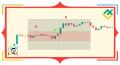
In the daily BTCUSD price chart above, there is a Differential Up Arrow. Let us study it in more detail as an example.
First, there are two consecutive closes, each one less than the one prior. Let us calculate the buying pressure from the current price bar:
- Close price (CP) - 10 883 points
- The true low (min) is the bar’s low, as it is less than the previous close. The true low is 9718 points.
By calculating the difference between the close and the true low, we can identify the buying pressure (BP).
BP1 = 10883 – 9718 = 1165.
The buying pressure from the previous bar is:
CP = 10658;
min = 10079;
BP2 = 10658 – 10079 = 579.
Therefore, the buying pressure from the current bar is greater than the buying pressure from the previous bar, that is,
BP1 > BP2, and so, the second condition is also met.
Let us see the difference between the selling pressure from the current and the previous price bars.
Let us define the selling pressure (SP) form the current bar:
CP = 10 883;
True high (max) = 10968;
SP1 = 10968 – 10883 = 85.
Next, we calculate the selling pressure (SP2) form the previous bar:
CP = 10 639;
max = 11228;
SP2 = 11228 – 10639 = 589, and so,
SP1 < SP2
Therefore, the third condition is also met, as the selling pressure from the current bar is less than the selling pressure from the previous bar. So, we can safely define the Differential Up Arrow. And, in fact, the next bar’s high was much greater than the last analyzed bar, and so, the projection was accurate.
TD Differential Down Arrow
When a down arrow appears after a TD Differential study is applied it suggests the low of the next price bar will be less than the low of the current price bar, or at the very least, the next price bar’s close will be beneath the current price bar’s close.
Conditions necessary to produce a TD Differential Down Arrow:
- There must be two consecutive closes, each one greater than the one prior,
- Selling pressure for the current price bar must exceed selling pressure from the previous price bar, and
- Buying pressure for the current price bar must be less than buying pressure from the previous price bar.

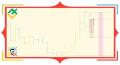
There is a down arrow in the daily chart of the BTCUSD. Let us make detailed calculations.
You see that there are two consecutive closes, and each one is greater than the one prior. Let us define the selling pressure from the current bar:
- Close price (CP) - 12558 points,
- True high (max) is the current bar’s high as it is less than the previous bar’s close. True high is 12813.
By calculating the difference between the close and the true high, we define the selling pressure (SP):
12813 – 12558 = 255.
Selling pressure for the previous bar:
CP = 12300;
max = 12383;
SP = 12383 – 12300 = 83.
So, the selling pressure from the current bar is greater than the selling pressure from the previous bar. Therefore, the second condition is met.
Let us define the difference between the values of buying pressure.
Let us define the buying pressure (BP) for the current bar:
CP = 12558;
True low (min) = 12099;
BP = 12558 – 12099 = 459.
Next, we shall define the buying pressure from the previous bar:
CP = 12300;
min = 11310;
BP = 12300 – 11310 = 990.
As the buying pressure from the current bar is less than the buying pressure from the previous bar, we can state that the condition is also met.
In practice, I rarely carry out such complex calculations to define up and down arrows. You can often compare the levels of buying and selling pressure visually, and thus make the market analysis easier. It is much simpler, especially if you perform a complex analysis with multiple tools.

As you see up and down arrows appear quite often. However, the forecasts for the price rise or decline suggested by TD Differential do not always come true.
So, I prefer using this tool as another indirect evidence for the entry/exit point, in addition to other indicators developed by Thomas DeMark.
TD Reverse Differential indicator
TD Reverse Differential is similar to TD Differential, described above. However, whereas TD Differential is a near-term trend-reversal pattern, TD Reverse Differential is a near-term trend-continuation pattern
TD Reverse Differential defines buying and selling pressure in the same way as TD Differential. That is, you calculate the difference between the true low and the close price, or between the true high and the close price.
TD Reverse Differential Down Arrow
A TD reversal down arrow suggests that the true low of the next bar will less than the current low, or at least, that the next price bar’s close will be lower than the current close. The following conditions are necessary to produce a reverse differential down arrow:
- There must be two consecutive closes, each one less than the prior close,
- The current price bar’s buying pressure must be less than the previous price bar’s buying pressure, and
- The current price bar’s selling pressure must be greater than the previous bar’s selling pressure.
As you see the methodology to define reverse arrows is almost the same as that of defining the usual differential up and down arrows. So, I won’t present detailed calculations in the next examples.
In the BTCUSD daily chart, there are TD reversal down arrows. They are marked with red down arrows. Green checks above suggest that the forecast was completely met afterwards, and the red cross suggests the opposite.
In all the five cases, the following conditions are met: there are two consecutive closes, and each one is less than the prior close; the buying pressure from the bar, marked with an oval, is less than the buying pressure from the previous bar; and the selling pressure from the indicated bar is, on the contrary, less. In addition, this indicator, like other tools, doesn’t guarantee that the projection is 100% accurate. Based on my own experience, errors most often occur during the time of low market stability resulted from fundamental factors.
TD Reverse Differential Up Arrow
A reverse differential up arrow suggests that the high of the next price bar will be greater than the high of the current price bar, or at the very least, that the next price bar’s close will be above the current price bar’s close. The following are the conditions necessary to produce a TD reverse Differential up arrow:
- There must two consecutive higher closes, each one above the prior close,
- The current price bar’s buying pressure must be greater than the previous price bar’s buying pressure,
- The selling pressure for the current price bar is less than the selling pressure for the previous bar.

There are reverse differential up arrows in the daily BTCUSD chart. They are marked with red up arrows. Green checks above suggest that the forecast was fully met afterwards.
In all cases, the following conditions are met: there are two consecutive higher closes, each one above the prior close; the buying pressure from the bar, marked with an oval, is greater than the buying pressure from the previous bar, and the selling pressure is less.
An interesting situation is at the second bar marked on the left. On the one hand, the next bar’s close marked below. On the other hand, its true high is greater than the high of the marked bar. And so, the differential forecast was met.
TD Anti-Differential indicator
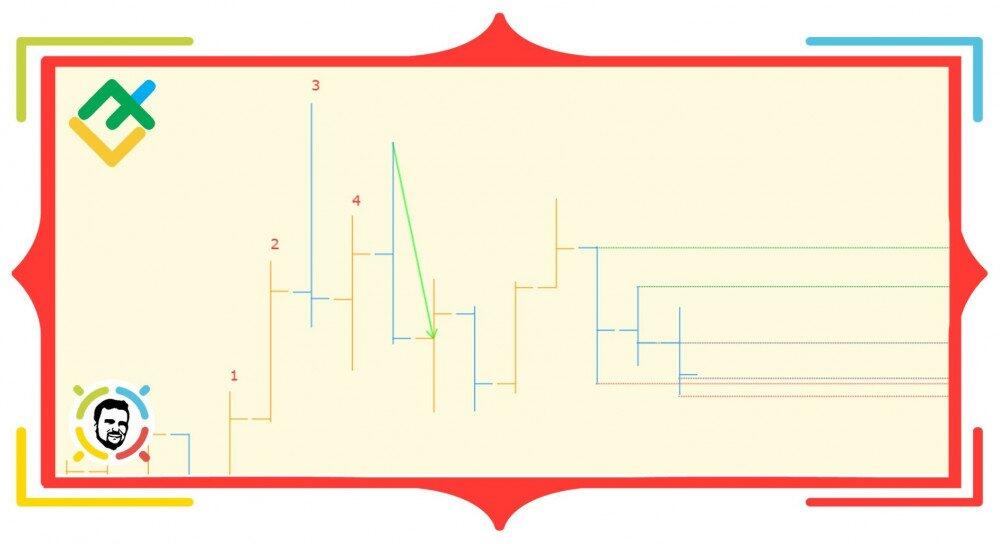
When the marked reaches the prospective market bottom, there may appear the so-called TD Anti-Differential Up Arrow pattern. Respectively, when the prospective market top is reached, there appears the TD Anti-Differential Down Arrow pattern. Let us study both cases in more detail.
TD Anti-Differential Up Arrow
An anti-differential up arrow occurs if the price has reached the prospective market bottom, which, for example, can be determined by means of a nearby strong support level. Three conditions must be satisfied to generate a TD Anti-Differential down arrow:
- There must be two consecutive higher closes, each of which is higher relative to the previous price bar’s close, followed by
- There must be close that is lower than the close of the previous price bar, and then
- There must be a close that is higher relative to the close of the previous price bar.
A TD Anti-Differential up arrow suggests that the bearish trend is exhausting and that the price should soon reverse and start rising.
To explain better, I’ll describe an example:

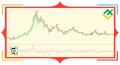
The BTCUSD daily chart displays a prospective market bottom. Bar 1 closes lower than the previous bar’s close. A similar situation is with bar 2. The next bar, bar 3, closes much high than the previous one. And the last of the bars studied, bar number 4, closes below the previous bar. So, we can suggest a TD Anti-Differential up arrow.
By the way, you may have noticed that the trend reversed only two bars later. Maybe, it is not the best situation to illustrate the rule, but this happens quite often in my own practice. I would say, that the tool projects a prospective situation, rather than indicates an immediate change in the market sentiment.
TD Anti-Differential Down Arrow
Heading into a prospective market top, three conditions must be satisfied to generate a TD Anti-Differential down arrow. To generate a TD Anti-Differential down arrow, there must be:
- Two consecutive higher closes, each of which is higher relative to the previous price bar’s close, followed by
- A close that is lower than the close of the previous price bar, and then
- A close that is higher relative to the close of the previous price bar.
TD Anti-Differential down arrow suggests the bullish trend be exhausting and the price may reverse down and start declining.

In the BTCUSD daily chart above, there is a prospective market top. Bar 1 closes higher than the previous bar, bar 2 close is greater than the close of bar 1. Next, bar 3 closes lower than the close price of the previous bar. And the last of the bars studied, bar number 4, closes higher than the previous bar. So, we can suggest a TD Anti-Differential down arrow. The forecast completely worked out as the trend reversed on the next day after bar 4 closed.
As usual, I suggest analyzing the current BTCUSD market situation.

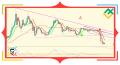
For the practical application, I use the weekly chart (figure above), where I tried to apply the indicators described above to the current btc market situation.
As you see, in the second half of July, there appears TD Anti-Differential Down Arrow, where the first and the second bar exceed the previous bar’s high, the third bar closes lower than the previous close, and the fourth bar closes higher than the close of bar 3; in other words, all the three conditions have been met, which suggests a soon end of the bullish trend after the top is reached.
As you see from the above chart, this reversal has occurred in fact. It is not a real bearish trend, as the current situation looks more like a trading flat. However, the signal was accurate as it has excellently performed its task and indicated the local high of the trend.
In addition, if we study the last two weeks, the conditions of neither TD Differential, nor TD Reverse Differential are satisfied.
This is because, the sellers’ pressure from the last bar is too weak to extend the bearish trend, and the buying pressure is too weak for a bullish reversal.
As a result of both powers’ weakness, the market is balanced, and so, I can surely say that then new week doesn’t suggest any strong trend movements; rather, there will be volatility within a long sideways trend.
Well, that is all for today. In my next article, I will describe some more technical indicators developed by Thomas DeMark.
Subscribe not to miss anything new!
I wish you good luck and good profits!
PS. If you agree with my ideas, write “+” in the comments; if you don’t agree, put “-”. If you liked the post, just write thank you, and don’t forget to share the post. It is easy for you and I will be very pleased :)
Stay informed on the latest cryptocurrency news, follow my posts on the blog.
Useful links:
I recommend trying to trade with a reliable broker here. The system allows you to trade by yourself or copy successful traders from all across the globe.
Telegram channel with high-quality analytics, Forex reviews, training articles, and other useful things for traders http://t.me/litefinance.
Price chart of BTCUSD in real time mode
The content of this article reflects the author’s opinion and does not necessarily reflect the official position of LiteFinance broker. The material published on this page is provided for informational purposes only and should not be considered as the provision of investment advice for the purposes of Directive 2014/65/EU.
According to copyright law, this article is considered intellectual property, which includes a prohibition on copying and distributing it without consent.