Although EUR/USD bears have loosened their grip, they still dominate the market. Declines in oil prices and Treasury yields appear to be temporary, and the S&P 500 is unlikely to resume rapid growth anytime soon. Let's examine the situation and develop a trading plan.
The article covers the following subjects:
Major Takeaways
- The Fed discussed potential rate hikes.
- NVIDIA is driving the US stock market higher.
- Global oil reserves are declining at a record pace.
- Short trades on the EUR/USD pair can be opened below 1.16.
Weekly Fundamental Forecast for Dollar
The Fed did what it was supposed to do—it began discussing a rate hike. The minutes from the April FOMC meeting showed that most officials will support raising the federal funds rate if US inflation remains stuck above the 2% target for an extended period. This rhetoric calmed the bond market—the central bank is determined to prevent uncontrolled price growth. As a result, EUR/USD bears can be confident about a bright future.
The euro posted its second advance in the past seven sessions, supported not only by lower Treasury yields but also by a decline in the probability of a Fed rate hike in 2026, which fell from 57% to 52%. Meanwhile, Brent crude recorded its sharpest drop in two weeks after Donald Trump stated that negotiations with Iran were in their final stages.
The rally in stock indices, fueled by NVIDIA Corporation's impressive earnings results, added further momentum to the EUR/USD advance. The world's largest company reported first-quarter revenue of $81.6 billion, up 85% from a year earlier, while net profit more than tripled to $58.3 billion. Improved global risk appetite provided additional support for the euro.
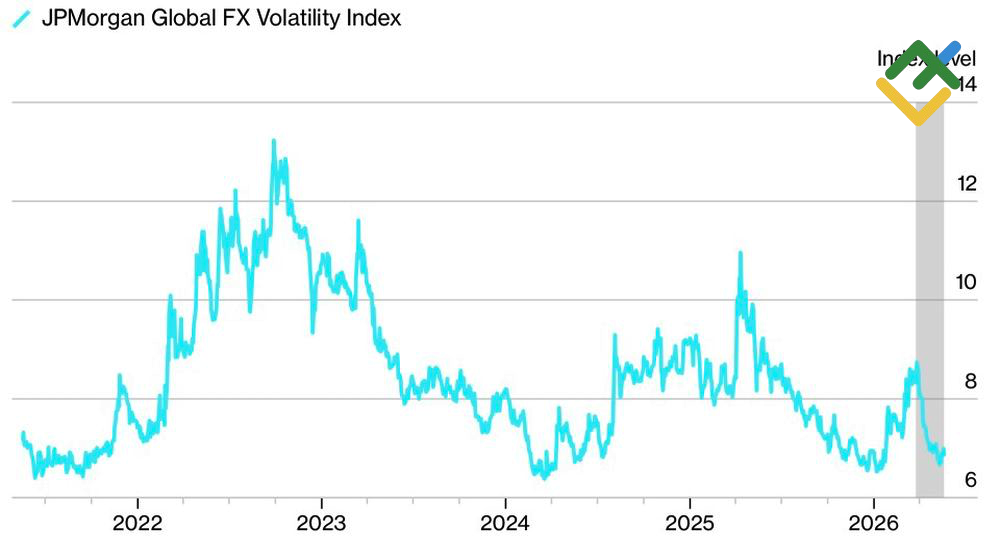
Forex Volatility Index
Source: Bloomberg.
However, high-yielding currencies—including the US dollar—should, in theory, benefit the most from the S&P 500 rally. The US economy is increasingly tied to the artificial intelligence boom, and if equity markets are gaining from that theme, the greenback should logically strengthen as well. Nevertheless, investors continue to favor the traditional correlation, under which rising stock prices stimulate hedging flows and put pressure on the USD index.
All the better for the US dollar. Earnings season is coming to an end, and investors are beginning to worry about stagflation and rate hikes. At the same time, the S&P 500 rally is unlikely to continue; either consolidation or a correction is likely to follow.
Despite all of Donald Trump's tough rhetoric, the Strait of Hormuz remains closed, while Iran continues to promise a harsh response to US threats of renewed bombing. Meanwhile, Goldman Sachs notes that global oil inventories are declining at a record pace. In May alone, inventories fell by 8.7 million barrels—twice the pace seen since the outbreak of the conflict in the Middle East. Any further escalation or prolongation of the conflict is likely to push Brent prices even higher.
At the same time, the Fed has calmed the bond market by signaling its willingness to tighten policy if necessary. However, the prospect of higher interest rates remains a medium-term bullish factor for the US dollar. The widening yield spread between US and European bonds also continues to buoy the greenback.
Weekly Trading Plan for EUR/USD
The US dollar's fundamental strengths remain firmly in place, while the pullbacks in oil prices and Treasury yields, along with attempts by stock indices to resume their advance, appear to be temporary. Against this backdrop, the current rise in the EUR/USD pair looks more like a corrective rebound than the start of a sustainable uptrend. A reversal from the 1.1655–1.168 resistance zone, or a move back below 1.16, could provide attractive opportunities to open short positions.
This forecast is based on the analysis of fundamental factors, including official statements from financial institutions and regulators, various geopolitical and economic developments, and statistical data. Historical market data are also considered.
Price chart of EURUSD in real time mode

The content of this article reflects the author’s opinion and does not necessarily reflect the official position of LiteFinance broker. The material published on this page is provided for informational purposes only and should not be considered as the provision of investment advice for the purposes of Directive 2014/65/EU.
According to copyright law, this article is considered intellectual property, which includes a prohibition on copying and distributing it without consent.