Using interest rates to combat rising oil prices makes little sense. However, the second-order effects of higher energy costs could eventually push core inflation higher, meaning the Fed may need to remain patient and cautious. Still, the situation could evolve differently. Let's examine the issue and develop a trading plan for the EUR/USD pair.
The article covers the following subjects:
Major Takeaways
- The eurozone economy is slowing dramatically.
- Markets are reassessing the ECB's capabilities.
- The Fed will not counter rising oil prices by raising interest rates.
- Short trades on the EUR/USD pair can be opened on a rebound from 1.1645 and 1.168.
Weekly Fundamental Forecast for Dollar
What caused the dollar to lose ground? Everything was going in favor of EUR/USD bears. The trend in European purchasing managers' indices pointed to a significant economic slowdown. The European Commission lowered its economic forecast for 2026. Business activity in the US, on the other hand, was encouraging. Iran has no intention of giving up its uranium reserves. What else does the USD index need to rally? Nevertheless, it instead went on a rollercoaster ride.
Trading divergences is a classic Forex strategy. The PMI data highlighted the divergence between the US and Eurozone economies. The Eurozone saw its composite PMI slow to 47.5 in May, the worst reading since the fall of 2023. The US manufacturing PMI, on the other hand, soared to a 4-year high. The divergence in economic growth is evident, which should support the EUR/USD pair.
Euro-Area Purchasing Managers' Indexes
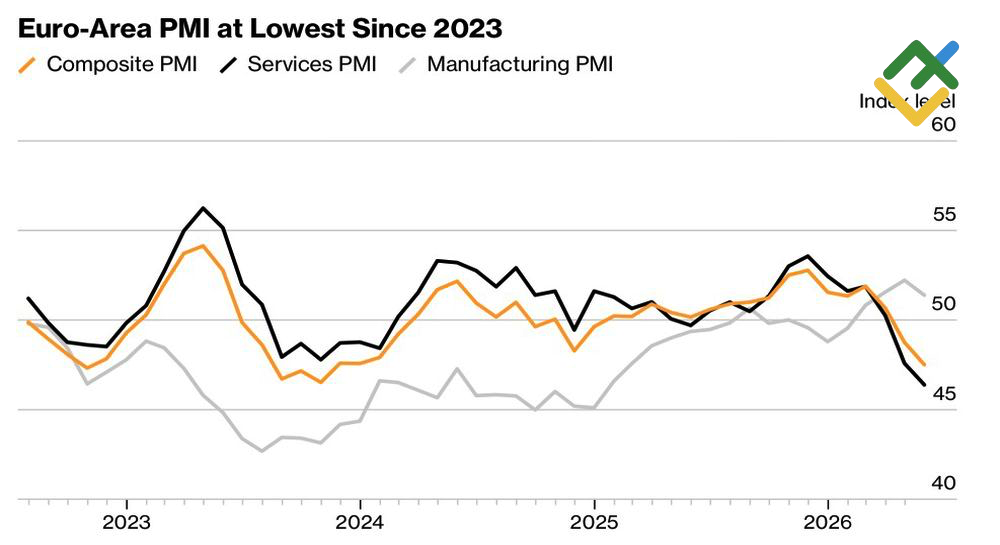
Source: Bloomberg.
Pressure on the euro intensified after the European Commission revised its 2026 eurozone GDP growth forecast down from 1.2% to 0.9%, while simultaneously raising its inflation forecast to 3%. This points to an increasingly stagflationary environment, which could make it difficult for the European Central Bank to pursue aggressive monetary tightening. Against this backdrop, futures market expectations of two to three ECB rate hikes in 2026 appear excessive. A gradual scaling back of tightening expectations could pave the way for EUR/USD quotes to move lower.
In contrast, the derivatives market appears to be underpricing the extent of potential Fed tightening. The probability of a Fed rate hike briefly climbed to 60% before falling back below 50%, putting downward pressure on both Treasury yields and the US dollar.
Fed Interest Rate and Treasury Yields
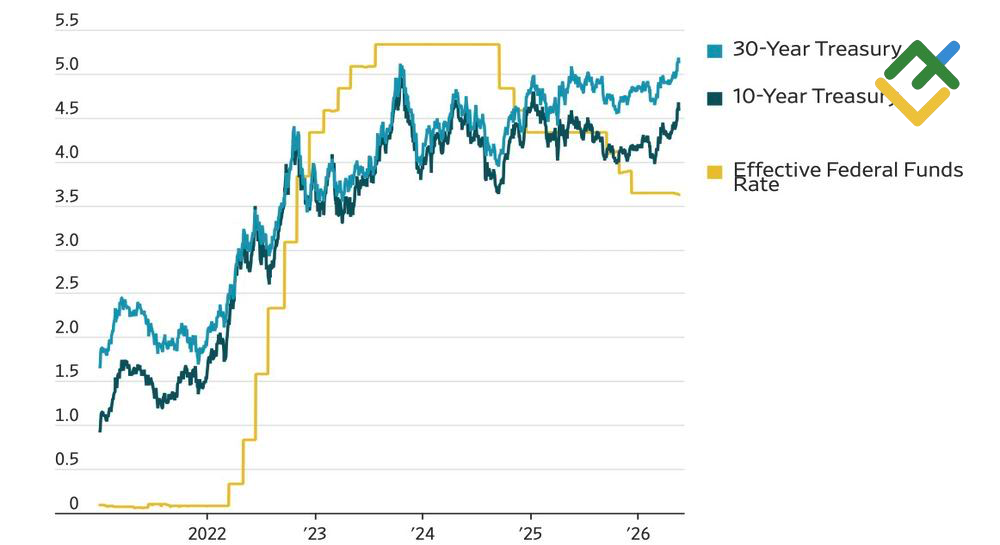
Source: Wall Street Journal.
Meanwhile, Richmond Fed President Tom Barkin likely caught investors' attention by arguing that monetary tightening is an ineffective tool for combating supply shocks. Raising interest rates will not lower oil prices. Instead, the Fed's focus should remain on secondary effects that could eventually push core inflation higher. Since this process typically unfolds gradually, a rapid tightening of monetary policy is unlikely in the near term.
In reality, however, events may develop much faster. Rapidan Energy Group forecasts that the Strait of Hormuz could remain closed until mid-July. In that scenario, Brent crude may surge to $130 per barrel, fueling a new wave of inflationary pressure across the global economy.
Thus, the divergence in economic growth between the US and the eurozone, the gradual increase in the likelihood of a Fed rate hike, and the ECB's easing of monetary restrictions suggest that the downward trend in EUR/USD quotes is likely to persist.
Weekly Trading Plan for EUR/USD
In this connection, the EUR/USD pair can be sold on a rebound from resistance levels of 1.1645 and 1.168.
This forecast is based on the analysis of fundamental factors, including official statements from financial institutions and regulators, various geopolitical and economic developments, and statistical data. Historical market data are also considered.
Price chart of EURUSD in real time mode

The content of this article reflects the author’s opinion and does not necessarily reflect the official position of LiteFinance broker. The material published on this page is provided for informational purposes only and should not be considered as the provision of investment advice for the purposes of Directive 2014/65/EU.
According to copyright law, this article is considered intellectual property, which includes a prohibition on copying and distributing it without consent.