In the global financial environment, one of the key indicators is the intrinsic value of a company, business, or investment project. Determining intrinsic value is a standard practice as fundamental to business as drafting purchase or sale agreements.
It is no longer feasible to envisage a significant business transaction, or to invest in a business, without first determining the intrinsic value of the transaction. Market participants buy or sell stocks, currencies, or commodities on the stock exchange based on their appraised value. Accurate determination of an intrinsic value allows the investor to understand how much they should pay for an asset, or conversely, whether they are paying less than the market value.
The article covers the following subjects:
Major Takeaways
Main Thesis | Insights and Key Points |
What is intrinsic value | Intrinsic value measures the value of a financial asset, taking into account current market risks and other financial performance indicators. |
What is the difference between the intrinsic value of an asset and an option contract | For an option contract, intrinsic value is the actual estimate of future yield after expiration. For an asset, intrinsic value is the amount of future net cash flow. |
Why it is important to understand the intrinsic value | Understanding intrinsic value is necessary to determine whether an asset is undervalued or overvalued when compared to its current price. |
How to calculate intrinsic value | As a rule, the calculation of the intrinsic value is made with the discounted cash flow method. |
How to determine the intrinsic value of an asset | The intrinsic value is determined by adding up the discounted value of future cash flows over a specified period. |
Where intrinsic value is applied | Intrinsic value is a term that describes what an asset is worth, which can then form the basis for stock market M&A transactions. |
Pros and cons of intrinsic value | The main advantage of intrinsic value is the ability to estimate not only the current price, but also the potential rate of return in the future. On the other hand, the intrinsic value of an investment is an approximate parameter that requires constant reassessment. |
Time periods for estimating the intrinsic value | Time value is calculated for small periods of 1 to 5 years, as longer time horizons can have a significant margin of error. |
Risk assessment | In order to reduce the margin of error, the following methods are often used in calculations: increasing discount rates, introducing additional discounts, applying conservative forecasts. |
Intrinsic Value Definition

Intrinsic value is the actual value of the assets that underpin the value of a company or an asset, calculated factoring in their financial performance.
The concept of intrinsic value varies depending on the field in which it is applied. The intrinsic value of a company represents the value of its underlying assets, which is typically different from its market value.
The intrinsic value of an exchange-traded asset is the difference between the market price of an asset at which it could be sold and the actual value of an asset. This definition is particularly relevant to options trading, as the intrinsic value of an option can be either positive or negative.
The intrinsic value of a product is its net value that changes as the economic cycle progresses, reaching its peak when the product is realized.
Why is Intrinsic Value Important?
Value investors use a company's intrinsic value to estimate the return from an investment in it. In essence, intrinsic value demonstrates to the investor the extent to which the value of a stock or company aligns with its present value.
This value is calculated based on a number of key metrics that assist the investor in making informed decisions.
Intrinsic value provides an estimate of company's future cash flows;
Intrinsic value takes into account the discounting process;
By comparing intrinsic value to the current price, investors can ascertain whether a stock or company is undervalued or overvalued.
How to Calculate Intrinsic Value?
There are four main methods for calculating an asset's intrinsic value, which combine all the key aspects of income generation by the asset:
Discounted Cash Flow (DCF) analysis
Asset-based valuation
Analysis based on a financial metric
Dividend Discount Model (DDM)
We will examine these methods in detail and perform a comparative analysis of their results. To this end, we will require an asset on which to base our calculations. In recent times, shares of companies engaged in the development of artificial intelligence have become increasingly sought-after. Therefore, Apple Inc. would be an appropriate choice for this purpose.
To perform the calculations, we will require the fundamental data from the company's financial statements.
- Market capitalization: $2.639 trillion
- Free cash flow: $99.58 billion
- Free cash flow per share: $7.37
- Cash flow growth rate over the last 5 years: +9.2%
- Current share price: $213
- Valuation period: 5 years
- P/FCF ratio: $26.5
Start trading with a trustworthy broker
Discounted Cash Flow Analysis
This discounted cash flow analysis is the most time-consuming but also the most accurate method. The fundamental principle is to deduct future cash flows using the discount rate.
The entire calculation process can be divided into three stages. Initially, we determine future cash flows, then estimate the cost of capital in the final period, and finally, we discount the result to obtain the final intrinsic value.
Future cash flows = free cash flow * (1+ growth rate %) and in our case it is = 99.58*(1+9.2%) = 99.58*1.092 = 108.74 for the second period. For the third period, it will be = 108.74*1.092 = 118.74 and so on. We will end up with values of 99.58, 108.74, 118.74, 129.67, and 141.59.
At the end of period 5, the estimated value of the stock = period 5 cash flow (per share) * P/FCF. Here we get an estimated value per share = $10.46*26.5 = $277.19.
Finally, we need to discount the future cash flows by the value of the discount rate. The discount rate is usually equated to the 10-year US Treasury bond yield, representing a risk-free rate of return. In this case, it will be equal to 4% per year.
Thus, the discounted cash flow will be equal to the sum of cash flows for all periods divided by 1 + discount rate. In our case it is: 99.58/1.05 + 108.74/1.10 + 118.74/1.15 + 129.67/1.21 + 141.59/1.27 = 94.83 + 98.85 + 103.25 + 107.16 + 111.48 = 515.57.
As a result, the discounted intrinsic value of the stock after 5 years = (total cash flow + terminal value)/ number of shares. In our case, it is (515.57 + 115.68)/15.288 = 41.29. This means that the intrinsic value of the stock price could be approximately $41 in 5 years, which is $172 lower than the current value.
Dividend Discount Model
Another method for determining the intrinsic value of shares is the dividend discount method. This method is based on the principle of discounting free cash flows, but instead of using the free cash flow value, it uses the value of dividends paid by the company.
There are several methods of dividend discounting, but the most popular is the Gordon Growth Model or GGM. This method is the simplest because future projected dividends grow at an equal rate. The intrinsic value formula for dividend discounting using GGM is as follows:
where:
- P – intrinsic value
- g – the expected dividend growth rate
- r – the required rate of return
- D1 – the expected dividend
If we calculate the intrinsic value of Apple's shares using this model, we get the following result:
P = 1.05/(0.08 - 0.04) = 26
The intrinsic value of the stock, taking into account both current and future dividends, is $26. In the market, the stock price is $213. If we disregard any information about the company, we can draw two conclusions: the company is either highly overvalued or pays dividends at a very low rate. In this particular instance, the latter is likely to be the case. Notably, this model is highly dependent on the size of dividend payments, which could be a significant drawback in practice.
Asset-Based Valuation
When determining the intrinsic value of a business or a company, investors use an asset-based valuation method. This method is the simplest and its formula looks like this:
Intrinsic Value = Sum of Assets - Sum of Liabilities
A company's assets should include all tangible and intangible assets, which can often be complex to ascertain as investment flows are frequently not transparent. Liabilities refer to a company's debts.
If we calculate the intrinsic value of Apple stock using this method, we obtain the following result:
$352.5 billion - $62.37 billion = $290.13 billion
The calculated value is then divided by the number of shares outstanding. We get the following: $290.13/15.28 = $18.98 per share.
This valuation method has one significant drawback: it does not consider future prospects. It relies solely on current indicators, limiting its ability to provide forecasts for several years ahead.
Analysis Based on a Financial Metric
Another way to define intrinsic value of a company's stock hinges on financial metrics. The simplest metric is the ratio of a company's price to its earnings, or P/E ratio. The formula for such a calculation is as follows:
Projected share price = EPS * (1+r) * P/E
According to the price to earnings model, Apple's intrinsic value will be equal to:
Projected share price = 6.16 * (1+ 0.092) * 27.8 = 187
Based on the aforementioned earnings data and the value of the company, the intrinsic value of Apple stock is $187. The result is the closest approximation to the current stock price of $213. However, this method does not take into account future cash flows and may not be applicable to companies with a less stable earnings growth curve.
Risk Adjusting the Intrinsic Value
When assessing the intrinsic value, it is necessary to take risks into account. Among the risk assessment parameters, the volatility of future cash flows is often considered, which depends on many perceptual factors that should be assessed separately. As a result, when adjusting for risk, two main methods are used:
Risk-adjusting the discount rate. This method can end up with a much higher time value than without risk adjustment. This is because greater risk always leads to greater potential returns. With this method, the risk is simply added to the discount rate and the rest of the calculation formula remains the same.
Adjustment using a probability factor for future cash flows. This method differs from the previous one as it does not adjust the discount rate, but changes the value of the expected cash flow by introducing a special reduction coefficient. The coefficient itself is calculated as the ratio of the value of net proceeds for the period to the expected value of net proceeds. In practice, the value of the coefficient ranges from 0.99 to 0.6, and its introduction can significantly reduce the final value of the estimated value.
Intrinsic Value of Options Contracts
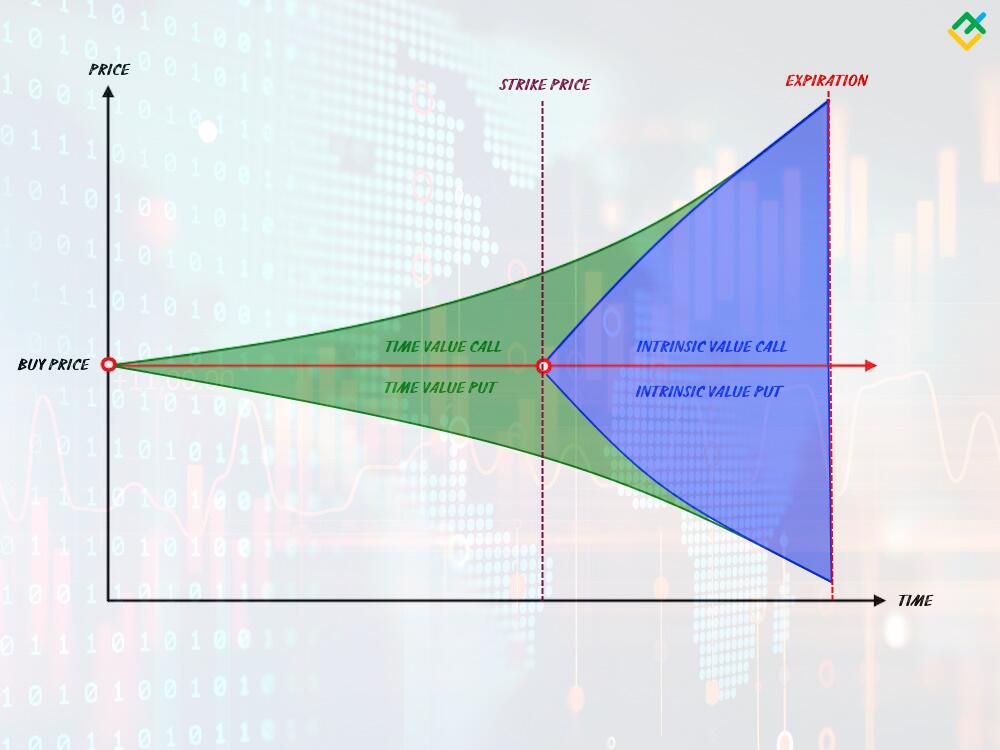
The intrinsic value of an options contract is a critical factor in determining the profitability of an option.
The essence of an option contract, which allows market participants to buy or sell the underlying security at a preset price called the strike price, is that it has a model of two prices or two values built into it. The first value is temporary, and it exists until the option expires. The second value is also temporary, and it becomes active the moment the price crosses the strike price of the option. In fact, it means intrinsic value is an indicator of the profitability of an option, and if it is positive, the option is profitable, and if it is negative, the option is unprofitable. At the same time, there is no intrinsic value when the strike price and market price are equal.
Depending on the type of option, the intrinsic value takes on different values, but in general, the intrinsic value of an option is the difference between the strike price and market price of the option.
If we are dealing with a European or US option, let's use the following formula to measure intrinsic value of stock options:
CALL Value = (Current Market Price - Strike Price) * number of contracts
PUT Value = (Strike Price - Current Market Price) * number of contracts
However, this formula is only valid for an option at the time of expiration. If it is necessary to calculate the intrinsic value of an option before expiration, the time value of the option must be added to the formula, as it will still be present at that time.
Get access to a demo account on an easy-to-use Forex platform without registration
Example of an Option's Intrinsic Value
Let's take a look at how a stock options contract works. For our example, let's use the already familiar Apple stock.
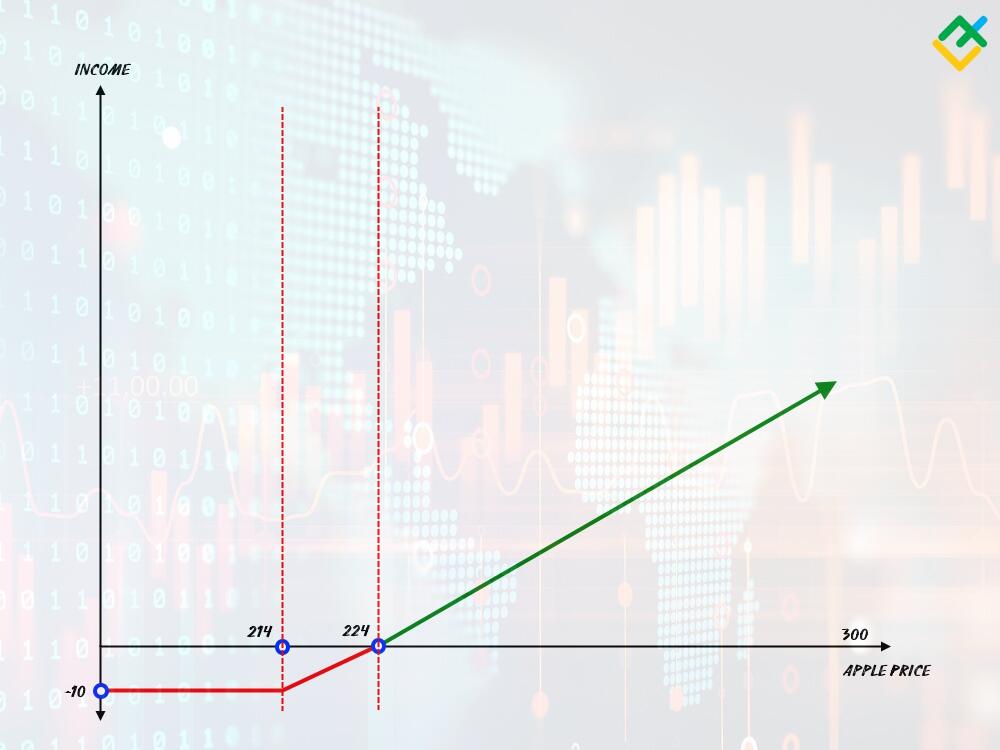
Suppose we assume that a company's stock will grow in the future, and we decide to buy a growth option. To do this, we need a CALL option. The important parameter of the option is called the strike price. This is the point above which our option will be in-the-money, i.e. start to make a profit. Intrinsic value is also used in options pricing to determine how in-the-money an option is.
For example, the current value of 1 share of Apple is $200. We want to buy 1 lot of the CALL option and set the strike price to $214. Unlike futures, an option has an initial price that we pay when we buy it. At the same time, the initial cost automatically ensures that we will not incur a loss above this limit. Thus, the cost of such an option is $10.
As a result, we purchased one call option with a strike price of $214 for $10. The resulting income curve will be as illustrated in the above chart. Until the market price reaches the strike price, our options contract will result in a $10 loss. As soon as the market price exceeds the strike price by $10, the option will reach a break-even point and have intrinsic value. Next, each dollar of price movement will generate one dollar of income. Upon reaching a price of $300, the intrinsic value of the option will be: $300 - $224 = $76.
The intrinsic value of a PUT option is calculated in a similar manner, but it generates a profit from a price drop.
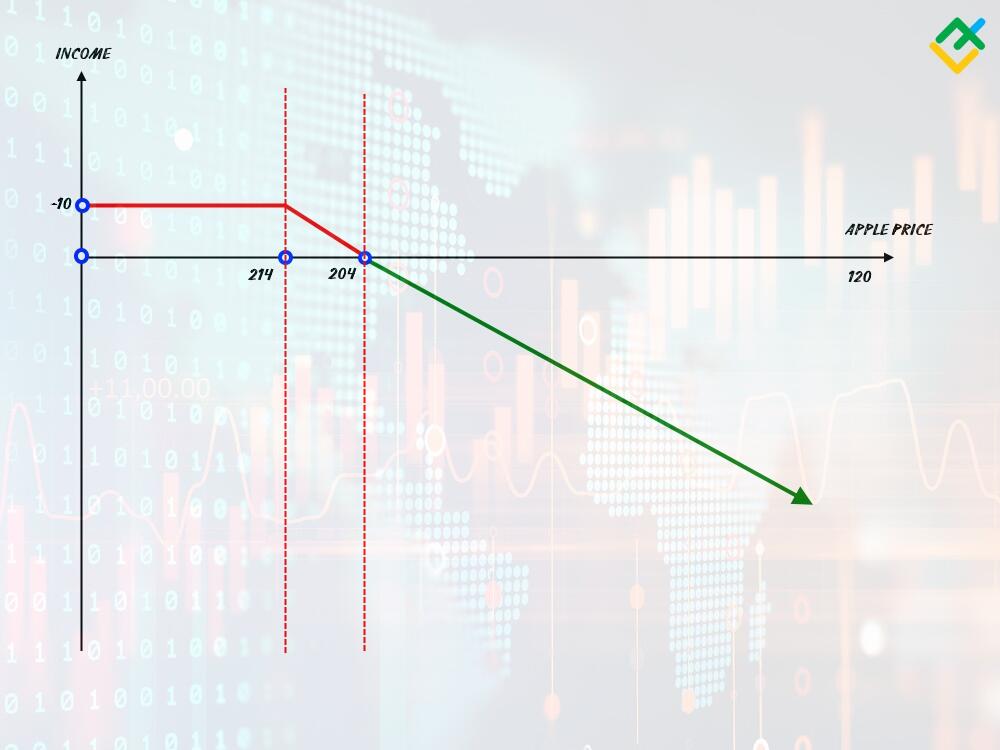
In essence, it is similar to a regular trade on Forex. However, there are two important differences:
The loss is always limited to the initial value of the option, and even if the stock price drops to $100, you cannot lose more than $10.
The profit depends on the volume. If you buy 10 lots, you will pay $100, and the net profit will be 76*10 = $760. As you can see, it is much higher than the income potential of a regular futures contract.
What Are the Pros and Cons of Intrinsic Value?
While the intrinsic value measure is ubiquitous in the financial world, it is not without significant shortcomings. The most significant drawback of intrinsic value methods is their reliance on input data, which fails to account for the speculative aspects inherent in financial analysis.
For instance, ten years ago, such valuation was considerably more precise and logical. However, in today's market environment, where companies have substantial free-floating shares, any fundamental shift can result in price swings that cannot be anticipated through objective calculations alone.
The advantages of intrinsic value assessment: | Disadvantages of intrinsic value assessment: |
|
|
What Are the Other Forms of Valuation?
In addition to traditional intrinsic value estimation methods, there are other methods that are more tailored to investor's risk tolerance and input data. If the investor has a deep knowledge of analyzing price charts, a technical analysis method is more suitable, while if the investor is familiar with the market and similar projects, they may use the cost approach or the relative valuation method.
Technical Analysis
Nowadays, the technical analysis method is often employed to ascertain intrinsic value. The fundamental objective is to analyze the chart of the company's price over the specified period. In this approach, chart pattern formations or long-term forecasting strategies, such as Elliott Wave Theory, can be used. The primary distinction between this method and conventional valuation techniques is that it incorporates an element of speculation, while excluding financial indicators.
Relative Valuation
The relative valuation method is most commonly referred to as the comparative method. It entails a comparison of the value of a specific asset to that of other investments. In essence, it can be likened to purchasing a commodity in the market. If other investors have purchased the asset at the price that you are interested in, it can be deemed undervalued, and you may wish to consider purchasing it. Conversely, if there is no interest from other investors at the price that you are interested in, it can be considered overvalued, and you may wish to either wait for the price to drop or refrain from purchasing the asset.
Cost Approach
The cost approach is the closest to the traditional intrinsic value assessment, and is an assessment based on the possible costs of the project. If it is a company, the likely amount of investment in the development of the company is estimated. If it is a project, then all costs from salaries of hired workers, to the cost of subsequent audits and so on are measured. Finally, the resulting costs are compared with the costs of similar projects, taking into account time factors such as depreciation, inflation, and others.
Conclusion
The calculation of intrinsic value is considered an integral part of business functioning, and it is impossible to imagine any modern transaction in the M&A market without it. On the other hand, traditional valuation methods are becoming obsolete with each passing year, and today it is much more common to see the estimation of intrinsic value using technical analysis of the share price chart and fundamental analysis, rather than estimation by discounted cash flow method. As a result, if some 10 years ago, analysts on the stock exchange often used the concept of intrinsic value, nowadays, it is much more common to find simpler methods of comparison, which are sometimes more accurate.
Platform where traders earn more

Trade on LiteFinance’s high-tech ECN platform and open an account so that beginner traders can copy you. Earn a commission for copy trading and boost your income.
Intrinsic Value FAQs
Intrinsic value is a measure of what a stock is worth, independent of its current market price, disregarding temporary market factors. In essence, intrinsic value reflects the true value of a project, which often does not coincide with the price a rational investor is willing to pay.
The intrinsic value of an option is the difference between the current market price and the strike price of the option. For a call option, the intrinsic value is the value above the strike price, and for a put option, it is the value below the strike price.
An example of intrinsic value is the price that one company pays for another at the time of purchase. Quite often, if a company is worth $100 million, it is sold 2 or even 3 times cheaper, because it has lower intrinsic value than its nominal value.
When the stock's intrinsic value exceeds its market value, it is considered to be undervalued by the market and is a good buying opportunity. If the intrinsic value is lower than the market price, the asset is overvalued and it is better to refrain from buying it.
Several methods can be used to define the intrinsic value of stocks, including: the discounted cash flow method, the financial statement valuation method, or the dividend discount method.
Intrinsic value is the net value of an asset that excludes most market factors. External value is usually a subjective valuation of the asset on the stock exchange, which includes a speculative component and various mark-ups.

The content of this article reflects the author’s opinion and does not necessarily reflect the official position of LiteFinance broker. The material published on this page is provided for informational purposes only and should not be considered as the provision of investment advice for the purposes of Directive 2014/65/EU.
According to copyright law, this article is considered intellectual property, which includes a prohibition on copying and distributing it without consent.