The idea to apply the Laguerre polynomials to filtering off random price movements was introduced by John Ehlers, who originally worked with equipment designed for the processing of space signals. His model, applied to trading, eliminates the problem of delay in the trading signals of indicators with quite a long period by filtering off price noise and random swings. From this overview, you will learn the general description of how the indicator works and how it is calculated. You will also find here links to download the templates of two interesting forex strategies that apply the Laguerre smoothing filter.
The article covers the following subjects:
Balance between smoothing and delay with Laguerre filter
A simple moving average is built based on the averaging principle. If period 3 is specified in the settings, the technical analysis indicator takes into account the market data of the last three bars and calculates the average value. For example, (1 + 3 + 5)/3 = 3. Once the last bar is closed, the indicator analyses its value, instead of the first one, that is, there is a shift to the right.
Now, imagine the situation when there is an unexpected price swing or a price gap resulted from a fundamental factor or the market-maker’s actions. (3 + 5 + 10)/3 = 6. That is, there is not only a sharp change of the price but that of the indicator testimony, which has changed its value by 50%. The shorter is the period, the sharper and the faster it indicates the price change (doesn’t matter whether it is the MA, RSI, or a stochastic). If in this situation there was set period 4, there would be a different result. (1 + 3 + 5 + 10)/4 = 4.75. The price swing would be smoothed in this case due to a greater number of bars.
This smoothing has its flaws, however. For example, there appears a trend in the flat market, and a trader should pick up the trend beginning to enter a trade. If the period is short, the indicator reacts to the price change immediately. But if in the period of 10, 9 out of 10 bars had roughly equal closing prices, the 10th bar would have a little influence on the total result. This is called a delayed forex signal.
The shorter is the smoothing period, the more false signals will occur. This problem is especially acute for day traders or swing traders. who need to track the market sentiment in real time to quickly open buy or sell positions. How to minimize the effect of the price noise and not to miss the beginning of a new trend? This is solved with the Laguerre indicator.
How does Laguerre smoothing work?
One of the suggested solutions to the problem of the delayed signal has become the Weighted Moving Average WMA. The idea was to assign greater importance to the most recent period, especially in day trading, which would average the value of the MA if there is a great number of candles, but then, the tool wouldn’t work in short term time frames.
For example, to calculate the average closing price for five bars 1, 3, 5, 10, 4, the formula would look like this:
SMA = (1 + 3 + 5 + 10 + 4)/5
WMA = (1*1 + 3*2 + 5*3 + 10*4 + 4*5)/(1+2+3+4+5)
The idea of weighing each period was introduced by John Ehlers whose indicator, the Laguerre indicator, uses spectral analysis of maximum entropy based on the Laguerre polynomials to analyze a smoothed period. In general terms, a simplified formula of the indicator looks like this:
- The common averaging formula P1+P2+P3)/3 is replaced by the formula where the weight of the periods within the selection is doubled (P1+P2*2+P3*2+P4)/6.
- This simplified smoothing method was supplemented with the gamma coefficient (q) applied to each period. The final formula looks like this:
MA filter (filtered smoothed value of the MA) = (L0 + L1*2 + L2*2 + L3)/6, where:
- Price = (Max + Min)/2, where Max and Min are the price high and low in the analyzed period.
- L0 = (1-q) * Price + q * L0
- L1 = -q * L0 + L0 + q * L1
- L2 = -q * L1 + L1 + q * L2
- L3 = -q * L2 + L2 + q*L3
I understood this algorithm in this way, though there are different interpretations in the different sources on the Internet, or the calculation formula is not described at all in many overviews. If I am wrong, please correct me in the comments. I will present the screenshot for those who know the code, may the principle will be clearer this way.
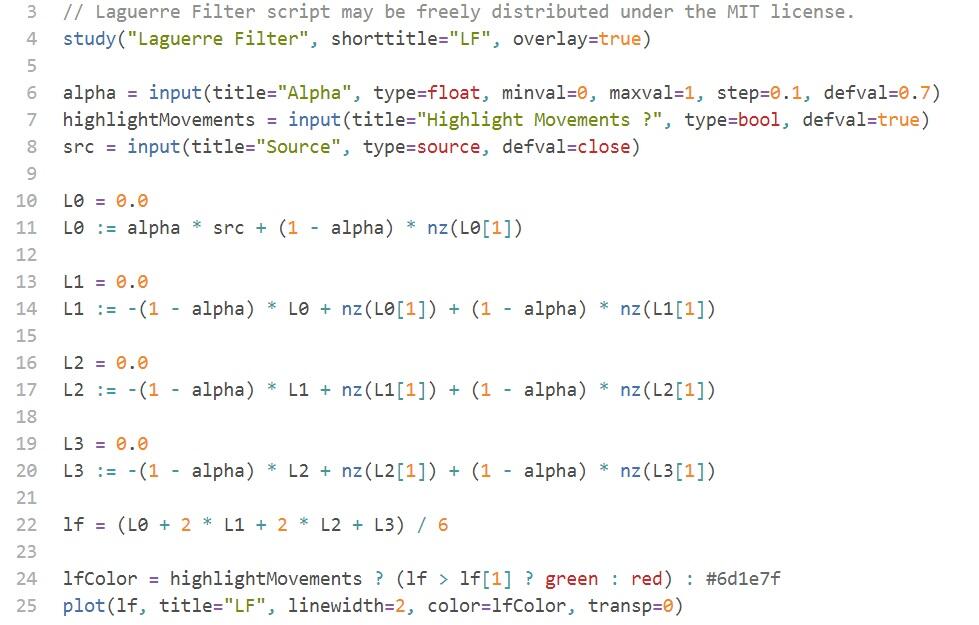
I understood this algorithm in this way, though there are different interpretations in the different sources on the Internet, or the calculation formula is not described at all in many overviews. If I am wrong, please correct me in the comments. I will present the screenshot for those who know the code, may the principle will be clearer this way.
This is just a general simplified example of the adaptive Laguerre filter formula, in particular, of the smoothing filter based on Laguerre polynomials. A series of transformations of the prices with the gamma smoothing coefficient (q) allows the indicator to filter out the price noise.
Visually, the Laguerre moving average doesn’t have such a wide range of swings as MAs with shorter periods have. Differently put, if you set a short period for the MA, there will be the wave-like chart with sharp swings during the period of high volatility. The MA with the Laguerre filter doesn’t react to the short-term random price swings, painting the so-called shelves near the key levels. This is clear in the figures presented below the descriptions of the strategies. An example of using the Laguerre filter is realized in the Laguerre RSI indicator that is thought to be the best version of the filter.
1. Forex trading strategy with the Laguerre RSI indicator
The Laguerre RSI Indicator is a modification of the well-known relative strength indicator or RSI. John F. Ehlers, the famous trader who created the Laguerre RSI, tried to avoid whipsaws (noise) and lag produced by smoothing technical indicators by applying a filter and some changes to the original relative strength indicator. The values of the recent bars are more important, so, the indicator is more responsive and could better suit short-term types of trading. I won’t go deep into the formula, but, if you need it, let me know in the comments.
Recommended timeframe is M30, currency pair traded is GBP/USD. Parameters of the Laguerre RSI: vPeriod = 15, gamma = 0.5, Levels: «0», «0.25», «0.5», «0.75», «1». You can download the template archive here.
Conditions for entering a long trade:
- The indicator has been at zero level for some time and then goes up above level 0.25.
- The candlestick when the indicator line crosses level 0.25 must be rising and have a body of at least 5 pips.
This reversal pattern signals the beginning of a new uptrend; you enter a trade at the next candlestick with a stop loss of 10 pips. Target profit is 10 pips, when it is reached, you exit the entire trade or a part of it with the subsequent protection by a trailing stop at a distance of 10 pips. In the latter case, you should move the stop to the entry point, so that the trailing stop won’t switch off if the connection is broken.
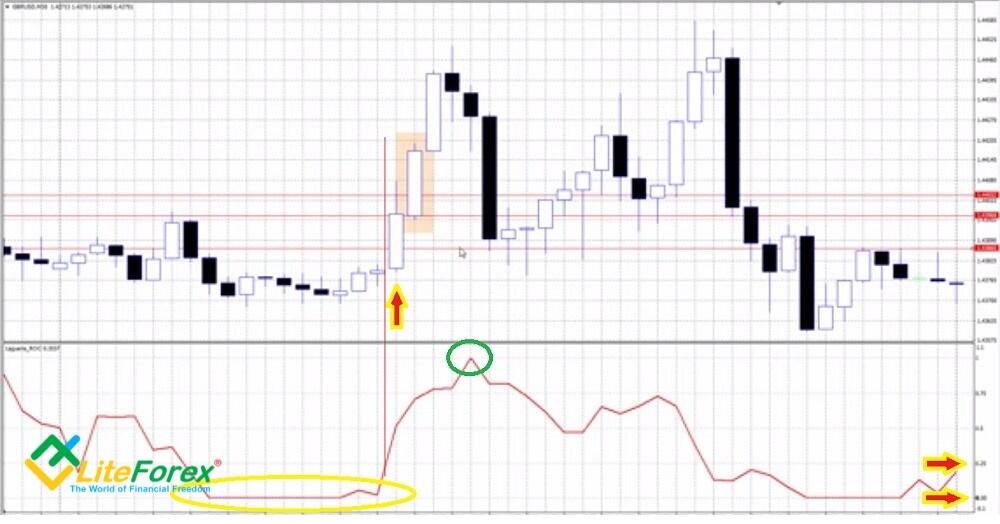
Laguerre RSI paints a shelf at zero level and goes up crossing level 0.25 after that. The moment of crossing the level is marked with a red vertical line in the chart. The signal candlestick when there is crossing is the one that is on the right (that is, it closes after the level is crossed). We enter a trade at the next candlestick that is highlighted with a pink box in the figure. Red horizontal line mark from bottom to top: stop loss, entry point, and the level where you should protect your trade with a trailing stop.
Two important notes:
- The longer is the indicator at the borderline, the better.
- The greater is the candlestick body at the moment of the indicator’s crossing of the signal level, the stronger is the signal.
The green circle marks the example of a false sell signal (conditions for a short trade will be described below): the indicator only touches level 1 which suggests that the trend is not steady. Even if this is acceptable by a risky trading style (although the signal is weak), but the candlestick is rising when level 0.75 is crossed, so one shouldn’t enter a trade
Conditions for entering a short trade:
- The indicator has been at level 1 for some time and then goes down below level 0.75.
- The candlestick when the indicator line crosses level 0.75 must be falling and have a body of at least 5 pips.
Entry conditions are similar to the long trade.
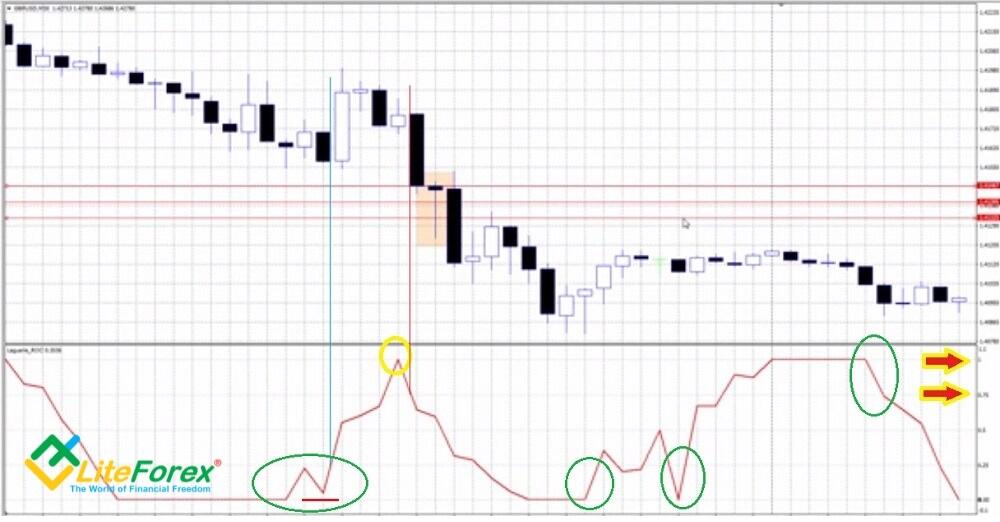
Here, the signal delivered by the indicator is weak. It only touches the signal line and then rebounds. But the size and the direction of the candlestick when there is crossing confirms the signal. In this case, the body of the candlestick is more than 5 pips and the candlestick is falling, so, one may enter a trade.
The figure also presents 4 situations with false signals, when the condition of the minimal size of the signals candlestick is not satisfied. Only in the first case, I can say that level 0.25 is crossed at the rising candlestick, but the indicator doesn’t touch the borderline, so the signal is false.
2. Trading system based on the Bulls Bears Eyes indicator
The Laguerre indicator is not directly applied in this strategy that can be used to enter swing trades. The major and the only indicator is a complex tool Bulls Bears Eyes, whose signals are smoothed by the Laguerre filter. Bulls Bears Eyes is a combination of two standard indicators:
- Bulls Power, developed by Alexander Elder. He suggested that the MA (moving average) is an agreement between sellers and buyers during a particular period of time. The highest price represents the maximum power of buyers. Bulls Power = High Price – EMA (13)
- The lowest price indicates the maximum power of the sellers within a price period. Bears Power = Low Price -EMA (13).
Timeframe – M5, currency pair traded is EUR/USD. Settings of Bulls Bears Eyes:
- Period = 13. This is the period of Bulls Bears Eyes, where the default parameter of the MA recommended by Elder is 13.
- Timeperiod = 0.0. This is the timeframe indicated in minutes and it must be equal to the standard time frames in MT4. 0 value means the timeframe of the current chart.
- Gamma = 0.6. This is Laguerre smoothing (averaging) parameter.
- Levels: «0», «0.25», «0.5», «0.75», «1».
- CountBars (the number of bars where the indicator is displayed). You may enter any value, for example, 5000.
You can download the template archive here
Conditions for entering a long trade:
- The indicator touches zero level in the time period between 9.45 and 10.15
- The indicator goes up above zero level.
The target profit is 5 pips.
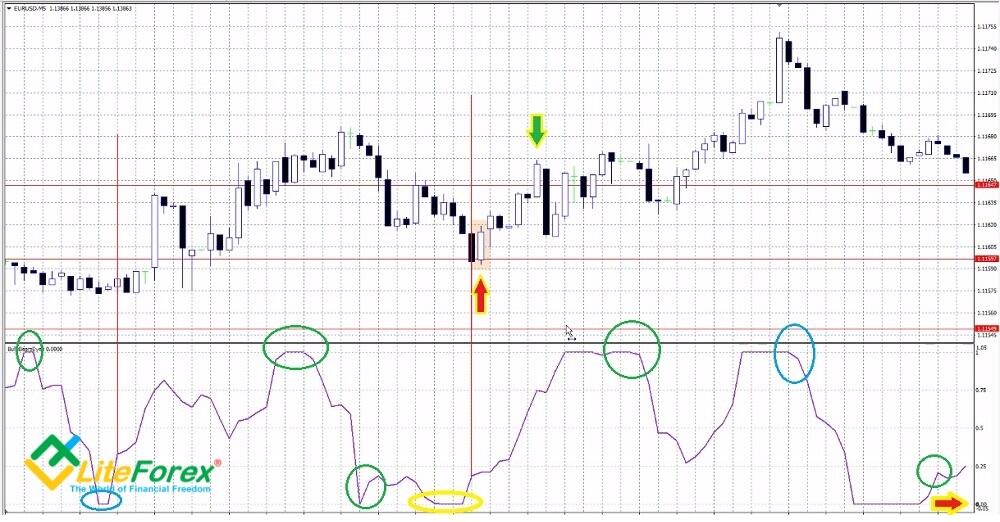
The initial condition is the time of the session, this period is marked with a yellow circle. The first hour of the European session features that traders are just beginning to identify their further targets to take investment decisions and the price is moving rather by inertia. If the trend reverses (the moment we try to pick up) during this period, the trend is likely to be strong to yield a moderate profit. You enter a trade at the next bar and exit it around the bar marked with a green arrow.
If you compare the performance of the indicator signals over a different time period, you will see that Bulls Bears Eyes performs well only at a short time interval. Blue circles mark winning trades, green – losing or not successful ones.
Conditions for entering a short trade:
- Indicator touches level 1 during the time period is between 9.45 and 10.15.
- Indicator goes below level 1.
You enter a trade according to a similar principle.
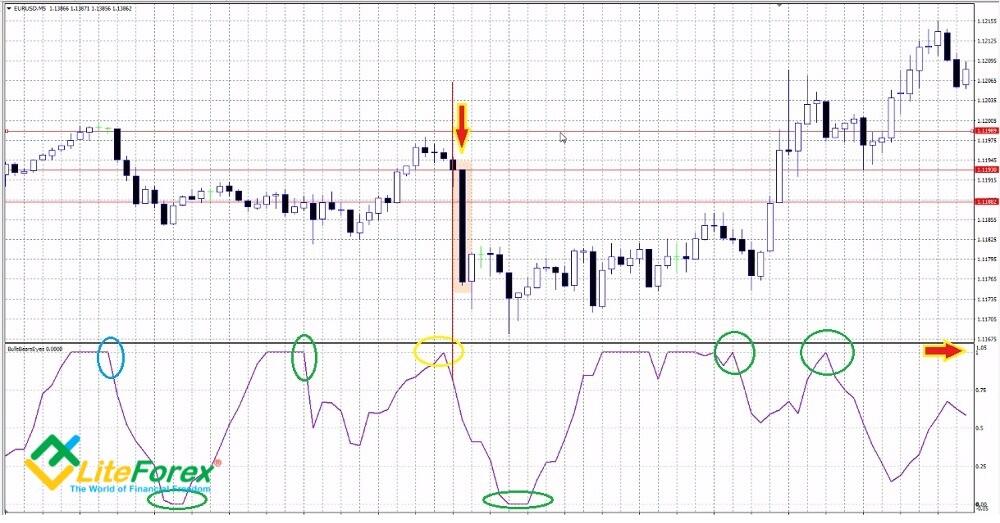
There is a similar situation: almost all the trades entered in a different time interval are losing. In other words, you can enter a trade only once a day with this strategy. However, you easily study its performance on the historical data, having compared the losing/winning trades ratio over a period of, for example, 6 months.
You can trade other currency pairs with this strategy. But you must bear in mind that the volatility of currencies is different during different trade sessions. So, you will need to find out both the most suitable time and the correct Gamma parameter.
Another example of using the Laguerre filter in the Laguerre Volume indicator is described in this overview.
Conclusion
The Laguerre indicator is a trend indicator that may be used both alone, as a trading system, and as a supplementary tool to confirm signals delivered by other indicators, that is, as an oscillator. There is eliminated the main problem, the signal lag with a relatively long period. Compared to stochastic, it sends fewer false signals due to a unique method of filtering price noise. But, still, it is better used in the conjunction with other indicators.
If you have any questions concerning this indicator or the trading strategies on its basis, or, you can provide any recommendations or criticism, you are welcome to write your comments!
P.S. Did you like my article? Share it in social networks: it will be the best "thank you" :)
Useful links:
- I recommend trying to trade with a reliable broker here. The system allows you to trade by yourself or copy successful traders from all across the globe.
- Use my promo code BLOG to get a 50% deposit bonus on the LiteFinance platform. Simply enter this code in the appropriate field when funding your trading account.
- Telegram chat for traders: https://t.me/litefinancebrokerchat. We are sharing the signals and trading experience.
- Telegram channel with high-quality analytics, Forex reviews, training articles, and other useful things for traders https://t.me/litefinance
Price chart of EURUSD in real time mode

The content of this article reflects the author’s opinion and does not necessarily reflect the official position of LiteFinance broker. The material published on this page is provided for informational purposes only and should not be considered as the provision of investment advice for the purposes of Directive 2014/65/EU.
According to copyright law, this article is considered intellectual property, which includes a prohibition on copying and distributing it without consent.