For beginner traders, intraday trading is considered to be one of the best options to get started compared to short-term trading. It is not so emotionally exhausting, but at the same time, the result is visible after a few hours – this is psychologically important for your own confidence. In day trading, there is a reserve of time to assess the situation and make a decision, you do not need to monitor the charts all the time, and the main advantage of intraday strategies is that you do not pay for the swap.
The article covers the following subjects:
This article deals with the basics of intraday trading. You will learn to choose the right asset and timeframe for a particular day trading strategy. You will also familiarize yourself with major strategies and study real examples that you can use in your trading systems.
What Beginners Should Know For Day Trading Strategies?
Intraday trading is a type of strategy that involves entering and exiting trades within one trading day. It does not matter at what point you place an order to buy or sell. The important thing is that the position is closed before the end of the day. At the same time, a swap is not calculated, which can take most of the profit.
It is not necessary to strictly follow the rules for closing positions within the day. However, from the point of view of profit optimization, holding a trade up to the next day only makes sense if you have joined a strong trend and are sure that it has not exhausted itself yet.
Benefits of Intraday Strategies for Beginner Traders:
- You don’t pay for a swap. The swap size is defined in the contract specification of each instrument. There is also a triple swap date. Novice traders are not yet experienced enough to keep track of all types of commissions and often do not take swaps into account. This is reflected in the results of trading.
- It is comfortable to make decisions. The price movement within the day in the M30 timeframe consists of 48 candlesticks, and in the H1 timeframe – of 24 candlesticks. The search for a signal, taking into account the filtering, usually occurs at an interval of 3-4 candlesticks. You have enough time to analyze the price chart, enter a trade and take the profit from a 5-10 candlesticks long trend.
- The trading process is comfortable. In the M30-H1 timeframes, you do not need to constantly monitor the candlestick chart. To control open positions, 10 minutes per hour is enough. And by the end of the day, you know the result, which is another advantage for beginners who want to see the result of their actions as quickly as possible by virtue of psychology and emotions.
- Relatively low initial deposit. There are several models for placing a stop-loss order. For example, beyond the local high/low or in proportion to the take profit. According to risk management rules, it is enough to set a stop loss at a distance of 15-20 pips from the entry point in an intraday strategy. In long-term strategies, a stop-loss order is placed at a distance of more than 50 pips so that the position won’t be closed on local corrections. And the longer the stop loss, the larger the deposit amount is required to comply with the rule “Do not risk per trade more than 1% of the deposit amount”.
I do not see any shortcomings in intraday strategies. The only point is limited profitability. If long-term strategies can bring profits of more than 200-300 pips, then the income from one transaction in day trading averages 20-50 pips. On the other hand, the potential loss is also much lower.
Intraday trading includes short-term scalping in M5-M15 timeframes, swing trading, channel, impulse, and trend strategies. All of them will be described further.
Day Trading Strategy Basics
A day trading strategy should include the following essential elements:
- Selecting a trading asset. The type of strategy depends on the type of trading instrument, its volatility, liquidity, trading volumes, and other features. For example, stocks tend to have longer trends than currency pairs. However, you can meet an opening gap or a price gap. Cryptocurrencies are highly volatile, but trading is riskier, and digital assets’ moves are difficult to predict.
- Risk management or money management. You should consider the maximum size of one position, the volume of all positions in relation to the deposit amount, and the maximum risk per trade (stop-loss level); the recommended values are 1%, 5%, and 15%, respectively.
- Time management. Time is money. You can spend 8-12 hours a day in front of your computer if your eyes and nervous system allow it, and as a result, you get a higher cost per hour. That's what scalpers do. Another option is to choose trending strategies and follow the trade for 10 minutes per hour but give up the profit. You decide how much time to devote to the charts, but it must be financially justified.
- Profit targets and their relation with the time period. You must have a clear goal. For example, get a return of at least 60% per annum or 5% per month. Otherwise, why waste time if you can invest money in US stock indices with a yield of 25%-40% per annum as a passive investment for a year?
- Education. The development of practical trading experience is also training, but it is not enough. You should devote part of your free time from charts to theory: getting to know new types of analysis, experimenting on a demo account with new indicators, scripts, and advisors, testing new auxiliary software, studying strategies, etc. Sources of information include analytical sites with statistical data, investment blogs, paid and free software, forums, trading communities, etc.
- Emotional control. The ability to manage emotions in non-standard situations is half the success. Composure, strict adherence to the trade plan, patience, and moderate self-confidence are the main psychological qualities of a professional trader.
Your action plan is an algorithm for achieving your goal. If there is a goal, then there is also a desire to learn and develop your skills to achieve it.
Components of Every Day Trading Strategy
For day trading strategies, it is important to follow the rules that will maximize profits and optimize risks:
1. Don't chase quantity, quality matters. It is not the number of transactions that matters but the accuracy of signals. Choose 3-4 trading assets and work with them. The shorter the timeframe, the more time it takes to control all positions. If your attention is distracted, you are more likely to make mistakes.
2. Clearly define the conditions to enter a trade. The following points are important here:
- Which technical indicator is primary, and which is supplementary? Which entry criterion is obligatory, and which may not be fulfilled?
- In which period should the conditions be met? For example, for the H1 timeframe, all conditions must be met on one candlestick (very desirable!), as you do not have time to wait. When scalping in the M5 timeframe, “waiting” is allowed after the appearance of the main signal of 1-2 candlesticks.
With intraday trading, you will have enough time to look for confirmation signals (except for scalping). But it's important not to be late. You should look for a strong short-term trend in the H4 timeframe and market entry points in the M30 timeframe using technical indicators.
3. Clearly define exit conditions. The following points are important here:
- Take profits when you reach your target profit. The trouble for a beginner entering a day trade is fear or greed. In the first case, positions are closed too early at the slightest hint of a correction. In the second case, the price reversal moment is missed. From the point of view of personal psychology, it is better to close 50% of the trade with a profit at the desired level and insure the remaining 50% by a trailing stop or manually move the stop following the price.
- Close losing positions on time and without any hesitation. You should not increase the stop loss manually in the hope that the trend reverses. You should observe risk management rules and follow a pre-planned action plan.
The key to your success is the presence of a trading system, strict adherence to it, and emotional stability.
How to choose the right asset for day trading?
Trading assets differ in volatility, liquidity, trading volumes at different times, the degree of influence of fundamental factors, the level of positive or negative correlation, etc. Taking into account these features, each asset has its own trading system.
Key factors affecting the choice of the asset
- Liquidity. The ability to quickly buy/sell an asset at the best price. Low-liquid assets have a high spread, there are slippages, that is, transactions are made at a less favorable price due to low trading volumes. Low-liquid assets include "junk" securities and exotic currency pairs. Highly liquid assets featuring high relative volume are “blue chips,” the major currency pairs. Assets with low liquidity are not suitable for short-term trading.
- Volatility. The higher the volatility, the more opportunities to profit from the trend movement in both directions. But the risk is also higher due to the high rate of price fluctuation. The most volatile asset is cryptocurrencies. Their daily price can change by 5% or even more.
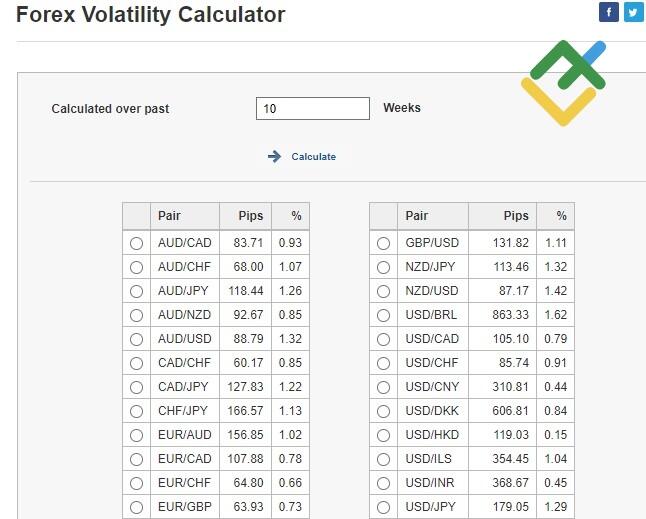
Trading volumes. They influence the moment entering a trade. For example, the largest volumes for the Japanese yen are during the Asian trading session. Also, stock trading volumes are growing before the release of financial statements.
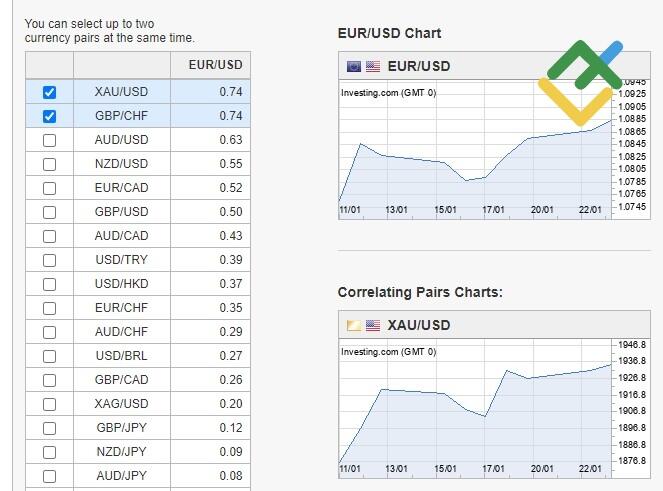
You can also select assets based on correlation. For example, currency pairs with a strong positive correlation can be used in this way: one currency can react faster to news and, accordingly, serve as a signal to open a position for another pair. The strength of the correlation is measured using calculators that can be found on a trading platform or a special website.
The List of Day Trading Forex Strategies
This section deals with different types of day trading strategies, entry rules, and trading signals to enter and exit trades.
Momentum Trading
Momentum trading involves entering trades at the moment of a sharp price surge, which is uncharacteristic of the normal market state. The advantage of the strategy is that it allows you to make big profits in a short time, as the price rises much faster than with a normal trend. But there is a drawback. You need to spot the beginning of the momentum and exit the trade on time.
Possible reasons for an unexpected price momentum
- News. Trading based on fundamental analysis. Publication of financial reports, economic data, etc.
- Short squeeze. Here, the nature of the impulse movement is technical – a lot of sell orders are automatically closed and thus create an additional volume of demand. You can read more about this in the article Short Squeeze Explained.
- Market makers. Buy and sell positions of large volumes. In this case, the impulse movements usually occur in timeframes of M5-M15.
- Pumps. Artificial price surges appear due to the collusion of traders or errors. Pumps are often found in the cryptocurrency markets. They also happen in the stock market when, for example, traders confuse tickers and mistakenly invest in the wrong company.
An example of momentum trading:
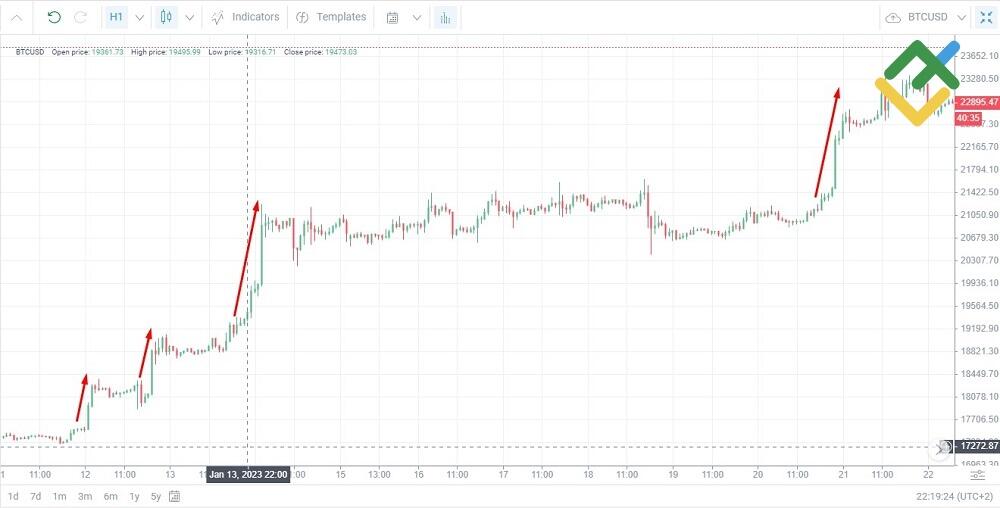
Impulse movements are clearly visible in the hourly BTCUSD chart. They are accompanied by abnormally large candlesticks, which are preceded by a sideways trend, and candlesticks with small bodies. The impulse movement begins with a short series of ascending candlesticks, followed by the main surge up. At the beginning of the chart, it can be seen that three impulses appeared in a relatively short time interval, each of which is stronger than the previous one. According to analysts, the reason is that the BTC price has reached its low. Investors needed some kind of momentum to resume the uptrend. The trigger was the US inflation report.
Scalping Strategy
Scalping is high-frequency trading, the purpose of which is to make money on short-term positions. The position is held open for several minutes, less often – up to an hour, M5-M15 timeframes are used. The profit from one position is relatively small, the trader earns due to the numerous trades. The advantage of scalping strategies is that you can enter trades in sideways trends or corrections. The disadvantage is that high-frequency trading is emotionally exhausting. Therefore, traders often use robots and advisors in scalping intraday strategies.
An example of scalping intraday trading strategy:
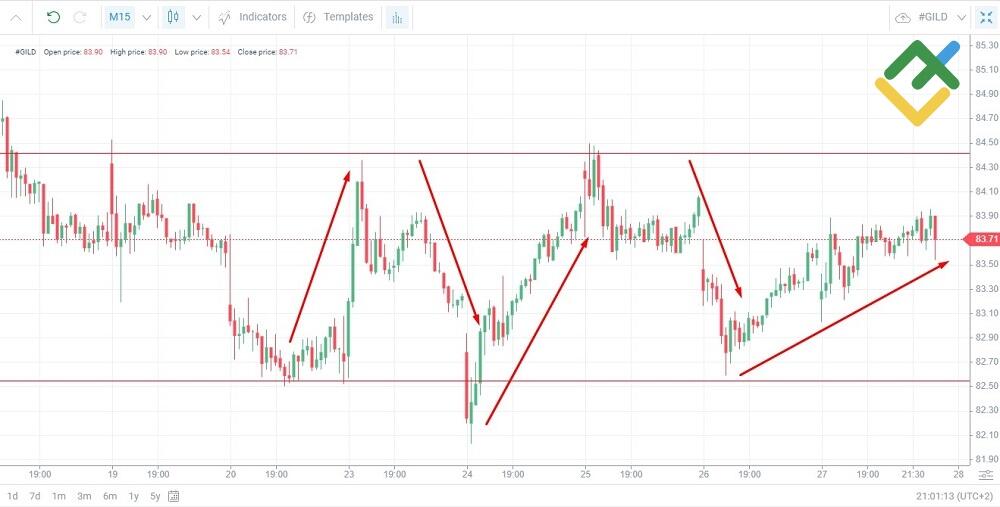
In the M15 timeframe, you can see a relatively wide corridor formed by the high volatility of the asset. Trades are opened at the moment of a rebound from the channel borders. A confirmation signal is a series of bullish or bearish candles indicating a strong short-term move.
You will learn more about the principles of high-frequency intraday trading and examples of strategies in the article dealing with Scalping in Forex.
Breakout Trading
A breakout trade involves entering a trade when a key level is broken, such as resistance, support, or a trend line. Levels are placed where a large number of buy and sell orders accumulate, including pending orders. If a strong imbalance appears in this area towards buyers or sellers, the price breaks through the level, and a new trend begins. The strategy is suitable for M30-H1 timeframes. In shorter timeframes, false breakouts are often encountered due to the actions of market makers.
Tools for intraday breakout strategies:
- Channel indicators. A breakout of the channel boundaries can mean either a strong trend or a strong momentum.
- Trend indicators. They are used to search for signals at the moment the price exits the sideways trend.
- Chart patterns and formations of graphical analysis. Flag pattern, pennant, double/triple top chart pattern, bull flag, etc. The breakout of pattern boundaries confirms the price trend.
A strong signal is a retest when the price breaks through the level, returns to it and then continues to follow the trend. Retest trading allows you to avoid opening a trade on a false breakout. It is important not to miss the moment to put an entry, as the price can break out the level without a retest, and the trend will continue.
An example of an intraday breakout strategy:
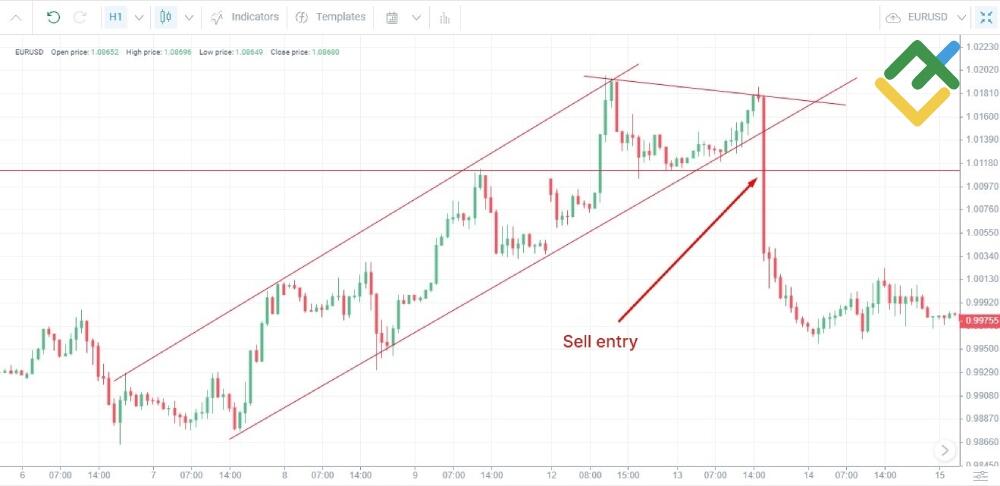
An uptrend has formed in the EURUSD hourly chart. Following three highs, each of which is higher than the previous one, a fourth high is formed below the third one. This signal shows that the trend is exhausting. There is also a Double Top pattern, another trend reversal signal. In the future, the price falls sharply, and you can open a short position at the breakout of the horizontal level.
Some trading systems based on price breakouts and Price Action can be found in the article devoted to Breakout Trading Strategies for Beginners.
News Trading
Trading on the news is also called fundamental analysis trading. The publication of news or economic data affects the value of the asset to varying degrees, and in the short term, volatility increases. The only question is how the market interprets the news and in what direction the price will go. Therefore, when trading on the news, there are two main strategies. The first is to set pending orders in both directions a few minutes before the news release. The second is to enter trades in the M5 interval in the trend direction on the second candlestick after the news release. The position holding time is, on average, up to 2 hours.
Peculiarities of day trading on the news:
- You have to take forecasts into account. For example, if a company's net income growth was 3% instead of the expected 6%, then the share price decline is expected.
- You need to consider the likelihood of an event and how traders interpret it. For example, if the market expects the Fed to increase the rate with a probability of 90% or more, the moment it is raised will have little effect on the USD rate. Sometimes an increase in the Fed rate, on the contrary, causes a decrease in the price of the US dollar.
- It is necessary to take into account the degree of influence of news. For example, the company's net profit growth against the general negative background of the entire stock market is unlikely to push the share price up.
The main tools of a trader trading Forex on the news: are an economic calendar, a calendar for the release of financial statements of large companies, and a news feed.
An example of intraday trading on the news:
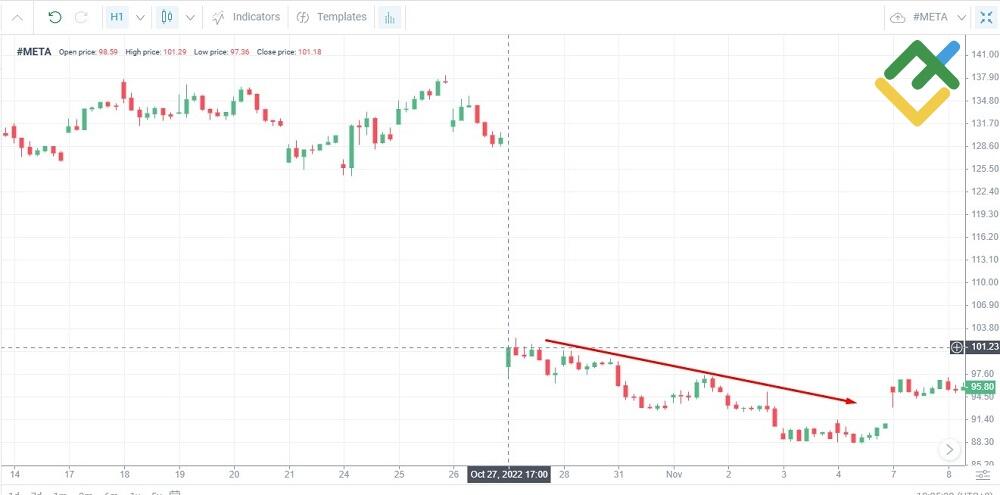
Facebook's Q3 2022 earnings report resulted in a 24% drop in share price. The reason was a 52% year-on-year decrease in net profit, a 19% increase in expenses, and pessimistic forecasts. A few days later, Facebook was reorganized into Meta, but this failed to convince investors of the company's prospects. A short position after the gap amid the release of financial statements could bring considerable profit in just a few hours.
Ichimoku Kinko Hyo Indicator
The Ichimoku Kinko Hyo indicator, the Ichimoku cloud, is a complex tool for professional strategies. It can serve as a trend indicator, a momentum indicator, and a filter. The indicator consists of 5 lines: two lines form clouds, and the other three act as filtering oscillators.
An example of intraday trading strategy with Ichimoku:
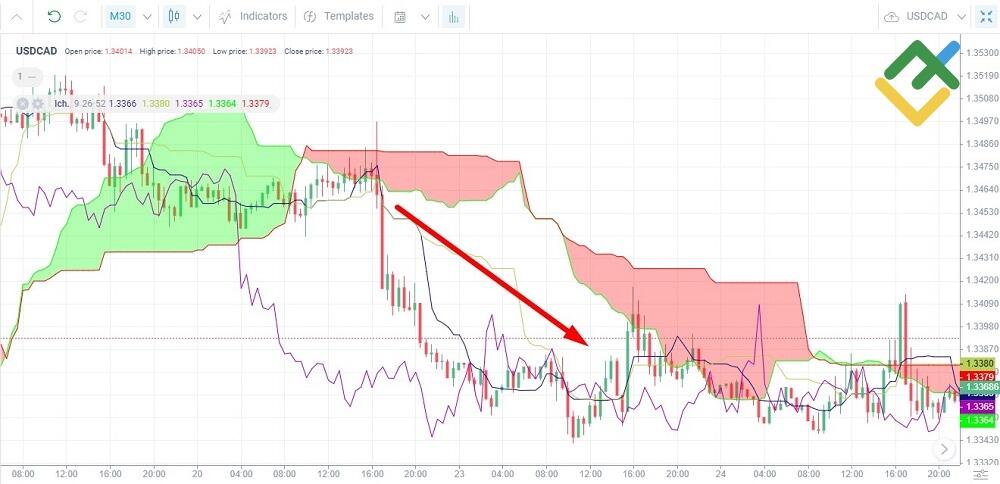
Ichimoku can serve as a full-fledged trading system. One of the options for interpreting signals is that if the price is above the ascending cloud, it is time to open a long position. If the price is below the descending cloud, you can open a short trade.
Pivot Points
Pivot points or pivot zones are the most likely trend reversal levels. The further the price moves away from its average value, the more likely it is to reverse.
Tools to detect potential pivot points:
- Supply and demand zones. Overbought and oversold zones are defined by oscillators.
- Pivot points.
- Reversal patterns, support and resistance zones.
A strong signal is the coincidence of the pivot point with the resistance or support level.
An example of intraday trading with pivot zones:
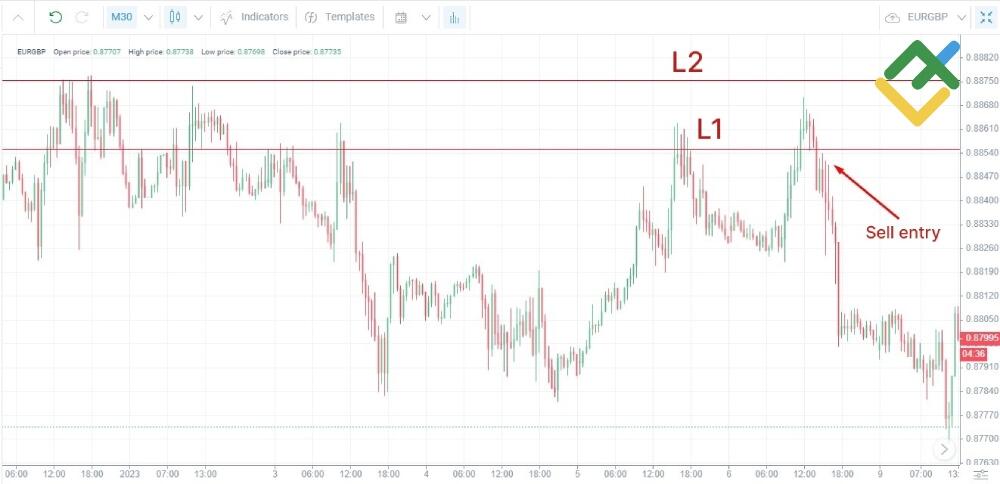
It is difficult to predict a specific pivot point, but it is possible to determine the corridor in which the price will reverse with a high probability. Based on the highs of previous periods, one can build a horizontal level L2, and the price could not break it through. The price tested the L1 level several times, bouncing down from it, but at the same time, there were breakouts.
The range between L1 and L2 is the demand zone. The breakout of L2 will signal an uptrend. The price reversal in the demand zone will signal a downtrend. If the price breaks out the L1 level following the reversal, it will signal to enter a short trade.
Trend trading
Trend intraday trading is trading in the direction of the overall trend, while corrections are ignored. The trader finds the beginning of a new trend and opens a corresponding position after the trend direction is confirmed. The position is closed after the price reversal or at the end of the trading day. When setting a stop loss or trailing stop, you don’t have to monitor the chart all the time.
The signals of a new trend beginning:
- Important news releases.
- A reversal pattern, rebound from a strong resistance or support level, or a trend line breakout in the opposite direction.
- Trend exhaustion in the supply or demand zones, trend reversal.
- Creation of artificial demand or supply by market makers.
An example of trending intraday trading:
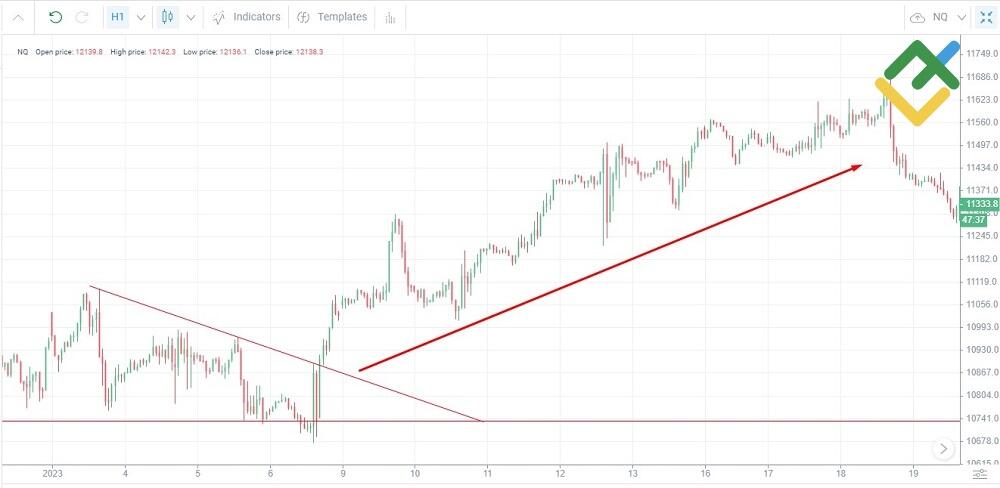
After a slight downward movement, which looks more like a high volatility sideways trend, a strong long-term trend begins with relatively deep corrections. The depth of corrections does not affect the position if it is opened at the beginning of the trend. When a trailing stop is set, the position will close with a profit sooner or later. The intraday strategy involves closing the position by the end of each day. Whether this is justified depends on the duration of the trend and the willingness to accept possible risks.
You can read more about trend day trading strategy in the article What is the Market Trend?
Swing trading or Pullback Trading Strategy
Swing trading is intraday trading on impulse movements using pullbacks in a long-term trend. With any trend, there are local corrections of different depths. One of the swing trading strategies involves entering a trade on a price swing after the end of the correction, with the trend resuming. The position is closed at the subsequent rollback counter the trend.
With swing trading, the frequency of entering trades is higher than with trend trading. The strategy also excludes local price pullbacks that take part of the profit.
An example of swing trading:
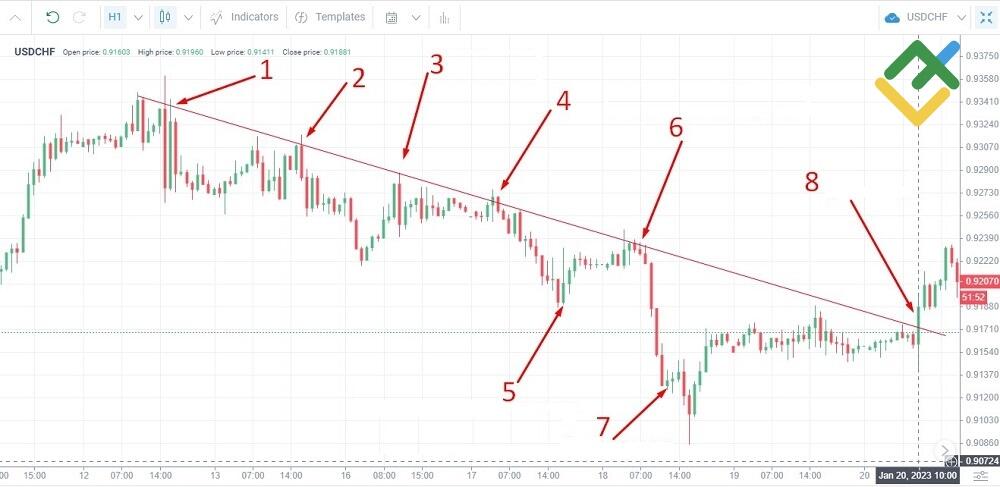
After a short volatile uptrend, the price starts declining, and the downtrend could be drawn along with points 1 and 2.
- Following point 2, the price bounces from the trend line down, you should expect the next correction.
- At point 3, the trend is confirmed. Following two pullbacks, the price has touched the trendline three times.
- Point 4 confirms the trend, the line hasn’t been broken out. The position remains open.
- At point 5, an engulfing candlestick appears, correction completes, and the trade should be exited. You might enter a long trade that will be exited when the price reaches the trendline.
- At point 6, the price touches the trendline, and a few bearish candlesticks appear subsequently – enter a short trade. First, exit the long trade if you have entered at point 5.
- At point 7, there is a signal of the correction completion; exit the trade.
- At point 8, the price breaks out the trendline, and the downtrend finishes.
With a trend strategy, a trade would be entered at point 3 and exited at point 8. Closing positions on corrections allows you to take more profit from the trend.
Read more about CFD trading on a pullback and examples of strategies based on technical analysis in the article devoted to Swing Trading.
What Are The Best Day Trading Strategies?
In this section, you will get acquainted with the best intraday strategies, the rules for opening positions, and the general principles of searching for signals to enter and exit the market.
Triple confirmation
An excellent strategy for beginners, its main advantage is the accurate interpretation of signals with a more than 80% performance. It involves entering trades at the moments of the beginning of shorts trends, which can be determined if the signals of three oscillators coincide.
Inputs:
- Currency pairs, major currency pairs.
- Timeframe – M30-H1.
- Indicators RSI (14, 35,65), stochastic(14, 1, 3), CCI (14).
A short position is opened when all three indicators are simultaneously in the overbought zone and reverse (a reversal is an essential condition). A long position opens when all three indicators turn in the oversold zone. A discrepancy between the values of the indicators by a maximum of 1 candlestick is allowed. Stop loss is set beyond the nearest local extreme. The profit target is 20-30 pips, after which the position can be partially closed and partially insured with a trailing stop.
Example:
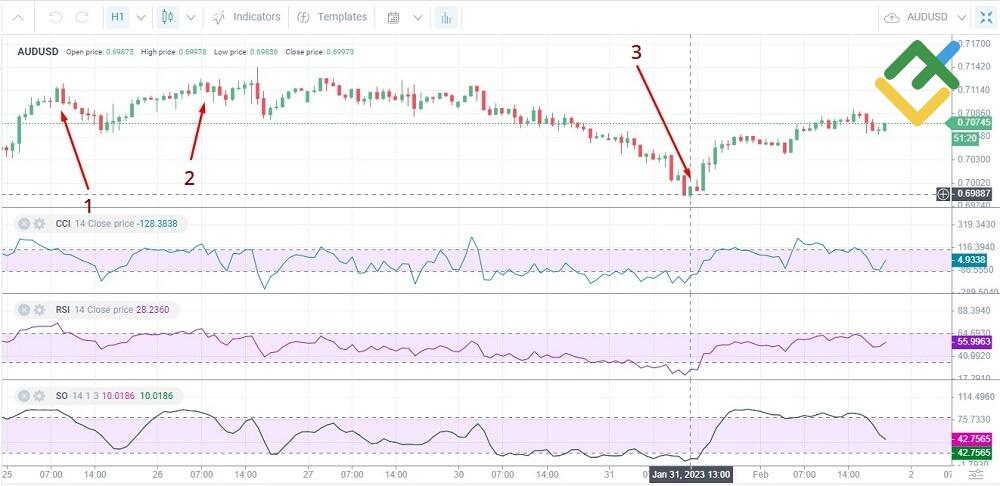
- 1 – a weak but working signal. CCI is already leaving the overbought zone, stochastic has not yet started reversal. But the risk is justified. The profit is about 35 pips.
- 2 – a weak but working signal. Indicators have only touched the overbought zone. However, the trade could have been profitable.
- 3 – a strong signal. All indicators have entered the oversold zone and reversed there. The profit is about 50 pips.
The disadvantage of the strategy is rare strong signals. More information about this trading system can be found in the article devoted to the Triple Confirmation strategy.
News trading
The fundamental analysis is most often used when trading the EURUSD pair. This pair is pretty responsive to US economic data – jobs reports, inflation, and the Fed’s interest rate.
For example, the economic calendar shows that the next Fed rate report is expected at the beginning of the year. Over the past year, US economic policy has been aimed at combating high inflation caused by the pandemic and geopolitical conflicts. Therefore, analysts predict that the Fed is likely to continue raising interest rates.
In theory, rate hikes strengthen the US dollar, but only if they are made for domestic monetary balance. In the US, the situation is different, and rates are being raised to prevent prices from rising. The Fed's rhetoric is such that the pace of rate hikes will slow down as inflation comes closer to the target level. As a result, the Fed could start lowering rates in the secong half of the year.
Before the Fed's decision was published, the US dollar had been slowly falling, approaching 9-month lows. Therefore, it would be logical to set a pending Buy Stop order 10-15 minutes before the news release at a level slightly higher than the bodies of several hourly candlesticks by about 25 points.
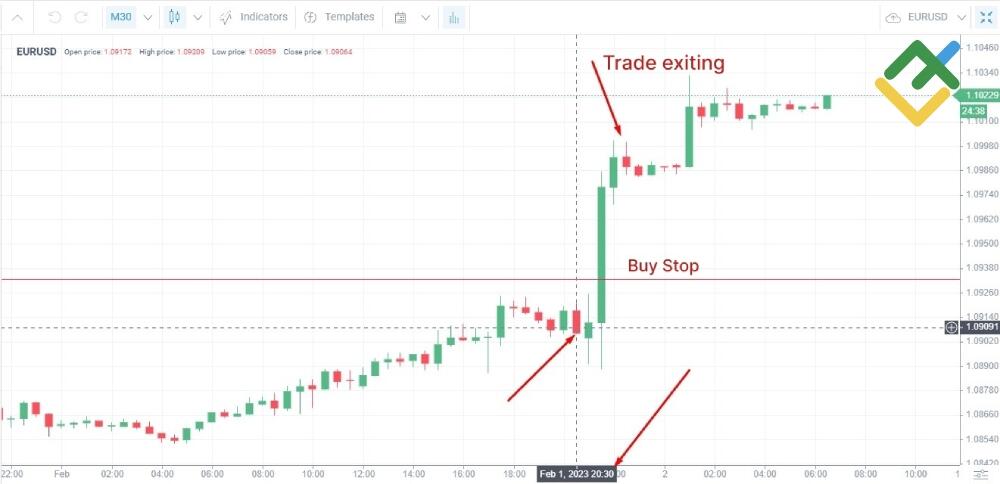
10 minutes before the closing of the candlestick, at 20.30 (GMT +2, trading server time. The discrepancy in time must be taken into account) Buy Stop is placed. The position is closed when the first reversal candlestick appears.
Profit is about 5 pips points in 2 hours. Another example of fundamental analysis trading with a limit order is described in detail in the article devoted to Non-Farm Payrolls in Forex.
Keltner Channel strategy
One of the channel trading strategies is breakout trading. If the price breaks the channel, moving away from its average value, then the market has either a strong trend or a short-term impulse. If the breakout is confirmed by the oscillator, you can enter a trade.
Inputs:
- Major currency pairs. It is easier to detect fundamental momentum confirmation on major currency pairs.
- Timeframe – M30-H1. The breakout of the channel boundary lasts several candlesticks. In shorter timeframes, you will earn almost nothing; in the H4 timeframe, you will go beyond intraday trading.
- Indicators: Keltner Channel (20,1), RSI (14, zones’ borders – 65, 35).
An early signal appears when the candlestick closes beyond the channel, and the RSI at the same candlestick goes outside the overbought or oversold zone. If RSI is already in the zone by the time of the breakdown and turns towards the median, the signal is late and should be ignored. Exit rules: following 3-4 candlesticks, or when a reversal candlestick appears, or when the RSI turns to zero. If the signal turns out to be false, and the price returns to the channel, close the position manually without waiting for the stop loss to work out.
Example:
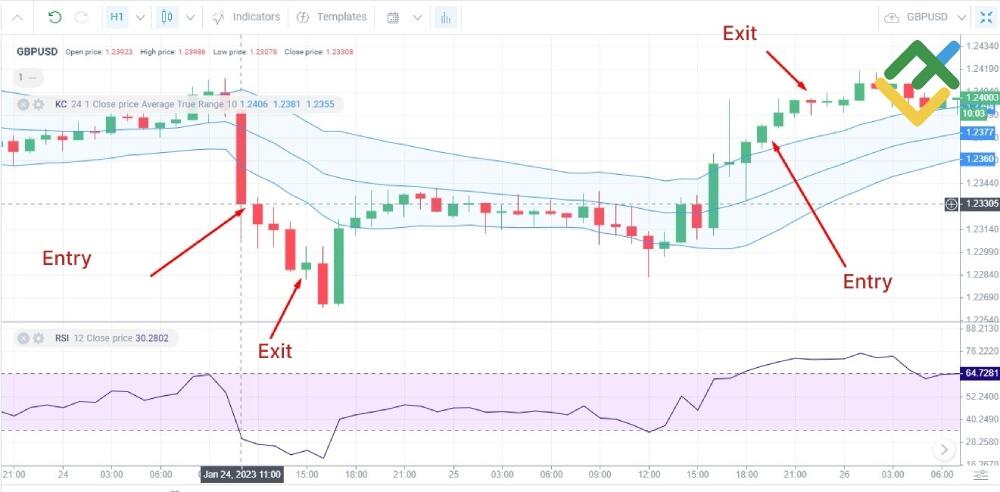
In both cases, the position is opened on the next candlestick after the channel border is broken and the RSI exits the main corridor. With a conservative approach, the position is closed with the completion of a candlestick of the opposite color; in the first case, the profit is about 37 pips without taking into account the spread. The second trade yields a profit of about 26 pips.
Day Trading Stocks Strategy
The strategies discussed above are also suitable for day trading stocks. Intraday stock trading features longer trends and price sensitivity to the news. It is important to remember that stocks do not trade around the clock, so it is important to close positions before the end of the trading session, as the next one may open with a gap. The stops don't work out in this case.
Inputs:
- Trend following strategy. A position is opened when in a confirmed trend when the price bounces off the trendline. Confirming indicator is the moving average with a period of 24 (averaging for the previous day).
- The timeframe is H1.
- The search for signals starts from the moment a new trading session opens.
The trade is entered on the next candlestick when the price bounced off the trendline, and the candle closes above/below the long/short moving average, respectively.
A real example of intraday stock trading online:
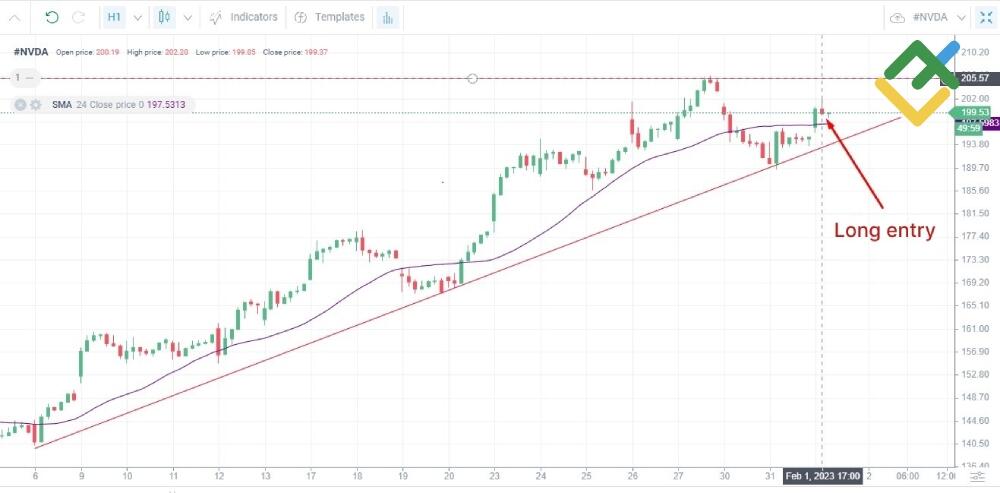
The trading asset is NVIDIA in the hourly timeframe.
The market has a clear uptrend, the price bounced up from the trend line, and the green candlestick closed above the moving average. Surely this is a continuation of the trend after the correction. We open a long position on the next candlestick at a price of about 199 USD per share. The minimum profit target is the level of the last high, which corresponds to about 205 USD per share.
We switch to a daily chart to confirm the signal.
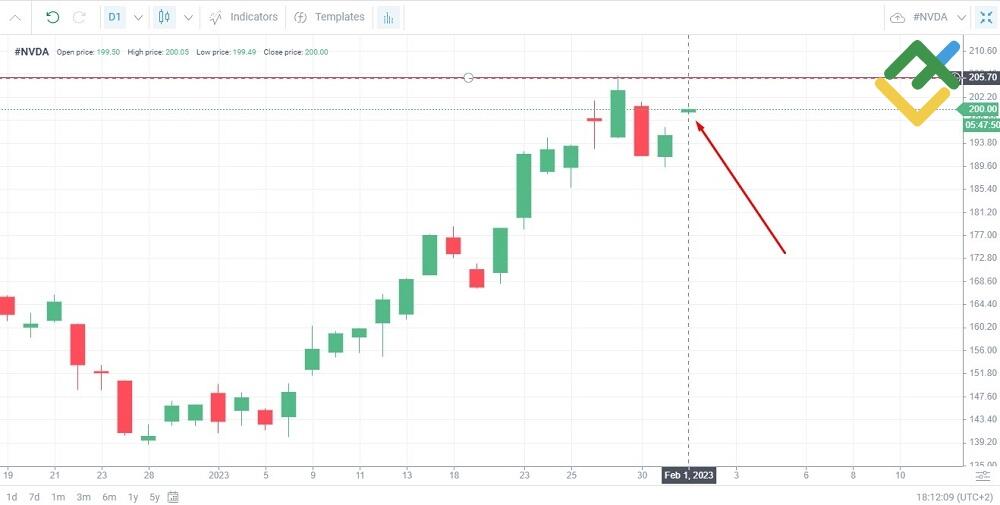
It also clearly shows that the red daily candlestick is a correction. From the new trading session, a green candlestick begins to form after a gap up, which is another confirmation of the bullish market sentiment.
It is clear from the hourly timeframe that the trade is entered on the hourly candlestick at 17.00 on February 1, 2023. Let us look at the chart a few hours later.
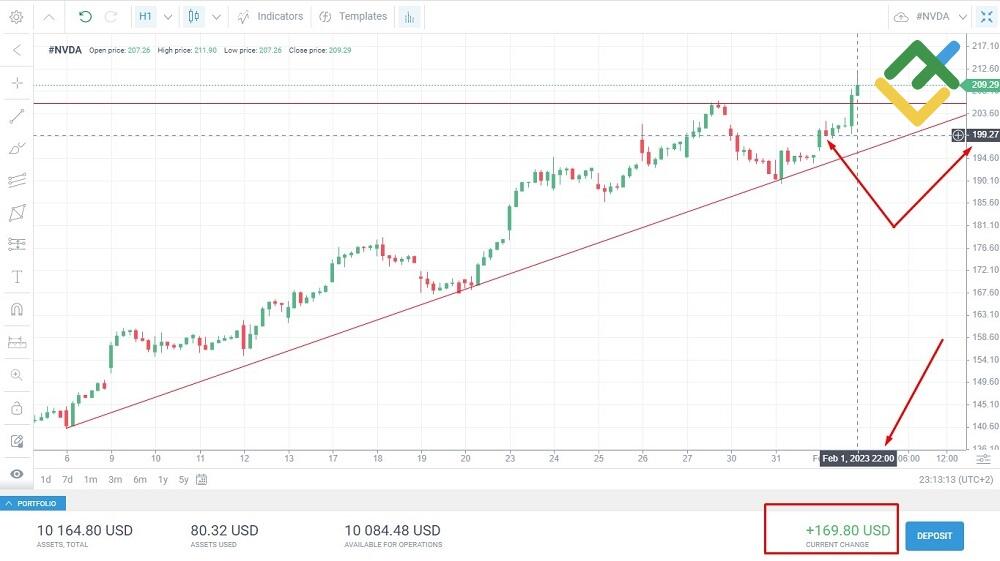
As of 22.00 February 01, 2023, bullish candlesticks break through the resistance level (the first target profit) and go further up. In the screenshot above, double arrows mark the candlestick and the trade entry price.
Profit from the trade. According to the contract specification, the minimum trade is 1 share, and the margin percentage is 2%, which corresponds to the leverage of 1:50. A position in this strategy is opened with a volume of 20 lots at a price of about 200 USD per share. Total position size = 200*20 = 4000 USD. Taking into account leverage, 4000/50 = 80 USD is involved in trading. It took 20 minutes for the preliminary analysis of the chart. Result: I spent 20 minutes, used 80 USD from the deposit, and earned more than 160 USD in 5 hours. The secret of success is a minimum of indicators, trend trading, and analysis of a longer timeframe.
Day Trading Tips
Common day trading tips for beginners, which can be found in almost any trading theory, are as follows:
- Act only according to a predetermined plan that should also consider force majeure.
- Trade only with money that you can lose painlessly. But that doesn't mean you have to take reckless risks.
- Follow risk management rules regarding trade volume in relation to deposit, total trade volume, and allowed stop-loss level.
- Gain experience and knowledge. Test new indicators, learn to intuitively feel the Forex market, and try to quickly find key levels and patterns.
- Diversify risks. Work with different types of assets: currency pairs, stocks, and cryptocurrencies. Use different timeframes and different types of trading strategies.
- Always use a stop loss.
- Learn to control emotions. Composure, rationality, and patience are the main qualities of a successful trader.
And there are some more useful tips for day trading.
Use trailing stop
A trailing stop is an order that follows the price in the direction of the forecast and is not returned if the price reverses. An example of its use:
- You entered a trade on a strong trend, moved your stop to breakeven, and moved away from the computer.
- No trailing stop: the price went in the direction of the forecast, then reversed in the opposite direction. While you weren't following the chart, the trade was exited by a stop loss with no profit.
- With trailing stop: the trailing stop moved towards the forecast following the price. The price reversed, and the trailing stop closed the position with a profit.
Use correlation
In the hourly timeframe, a good signal with confirmation appears on average once every 1-2 days. Increasing the volume of one position or opening several transactions on one asset increases the risk. It can be reduced by opening positions on assets with a strong positive or negative correlation.
Use different trading strategies
Do not chase the number of transactions – strive for their quality. Scalping due to the high frequency of opening transactions can help maximize profits, but it is better to use several strategies, the signals for which are separated in time. For example, one trading strategy allows you to earn at the opening of the London session, the other – on fundamental news in the middle of the day.
This approach solves several questions:
- It reduces the load on the deposit. Transactions are opened at different times – risk management rules are observed in terms of the ratio of the position volume to the deposit amount.
- It increases income. If, conditionally, one strategy gives one accurate signal per day, two strategies will give two signals.
- It optimizes the load on the trader. The scalper monitors the chart almost every minute. It is enough to follow trades on the H1 interval for several minutes per hour.
- It diversifies risks. If one type of trading strategy does not work for fundamental reasons, another one may work.
Try to combine all the main tools in strategies: indicators, patterns, levels, waves, news, etc.
Use strategy tester
Trying to enter several trades on a demo account is not enough. Before trading on a real account, the strategy must be tested and optimized on a time interval of at least 1 year with a number of transactions of at least 200-300. The key point that determines the quality of the strategy is the backtest. A few principles of testing:
- The MT4/MT5 platforms have built-in testers. You can use your own testers or add-ons. For example, Forex Simulator or Fx Blue.
- The main performance indicators of the strategy: the nature of the equity (deposit curve), mathematical expectation, maximum drawdown, maximum series of losing trades, and the ratio of profitable and losing trades.
- Testing with different indicator settings is carried out until the best result is obtained. Moreover, the amount of profit is not the defining criterion of a good strategy. It can be lowered in favor of reducing the maximum drawdown and the number of losing trades.
If the statistical results on a real account deviate from the test results by more than 10%-15%, it is recommended to suspend trading and re-test.
Some useful articles on testing:
- MetaTrader 4 Strategy Tester
- Rules for evaluating the trading system and its equity
- How to test an advisor in MT5
To analyze current trading, you can use MyFxBook, which can provide statistics in the form of graphs, charts, and histograms.
Conclusion
Let's summarize the main aspects of day trading strategies:
- Intraday trading is intraday trading. If you have not reached your target by the end of the day, exit the trade. You should not leave it open until the next day, no matter how profitable it is. In addition to the swap cost, you risk losing money when the market opens with a gap. An exception could be if there is a strong trend that has not passed even half of the standard movement. In this case, part of the profit has already been taken, and the rest of the volume is insured by a stop loss or a trailing stop.
- The best timeframe is M30-H1. In the H4 interval for 6 candlesticks, you are unlikely to have time to open a full-fledged intraday position. M5-M15 are timeframes for scalping, it is more suitable for professionals.
- The key to your success is sticking to your plan. It doesn't matter which asset or technical indicator you choose. Day trading involves trading almost all assets except for exotic currency pairs and low-liquid stocks. It is important to follow the rules of risk management and follow the chosen strategy.
- Be flexible. If the news has appeared that unpredictably affects the market, exit your trades earlier. If there is such a possibility, you can manually move the stop losses, but within reasonable limits, so that the position does not close on the correction.
- The strategy tester is your main tool. Any strategy is first run through the tester for an interval of at least a year or at least 200-300 trades. Comparison of backtest and statistical results will help you evaluate trading strategies in terms of profitability and risk.
- The best strategy is the one you are comfortable using. At the initial stage, do not chase profit. Your task is to minimize risks and learn to feel the market.
Believe in yourself, gain experience, and you will definitely succeed! If you have any questions, feel free to write in the comments! I will be glad to answer!
Day Trading Strategies FAQs
Day trading strategies involve completing transactions within the trading day. The maximum duration of holding a position in the market is up to 24 hours. Transactions can be open from a few minutes to several hours, but to save money on swaps, they are closed before the end of the trading day.
In day trading strategies, this is a risk management rule that limits the level of risk: you never risk more than 1% of your deposit per trade. For example, you have a deposit balance of 1000 USD. The 1% rule means:
- The volume of the transaction must be no more than 10 USD if you do not use leverage.
- When using leverage, the trade volume can exceed 10 USD, but the stop loss is set so that the potential loss does not exceed 10 USD.
Risk management has three key parameters:
- The maximum volume of one transaction in relation to the deposit. No more than 1% is recommended.
- The maximum volume of total open positions in relation to the deposit. No more than 5% is recommended.
- Maximum allowable loss on all trades. It is determined by the length of stops in pips. The value of a pip depends on the size of the position. No more than 15% is recommended.
The most profitable day trading strategies include swing trading and intra-channel trading. These strategies allow you to earn on the price movement both up and down. But unlike scalping, they have fewer false signals, which means more potential profitability.
The pip value for the EURUSD pair with a minimum allowable position volume of 0.01 lots is 0.1 USD. The average daily volatility of a pair is 80-100 pips. You have several options:
- Increase the volume of the opened positions by more than 10 times.
- Catch movements in both directions by opening several positions in a row within a day.
- Enter trades in cryptocurrencies that have much higher volatility than currency pairs.
Most often, traders use the M30 and H1 timeframes. H4 refers to long-term Forex strategies and is used in day trading only for market analysis. M5-M15 intervals can also be used, but strategies on such an interval are trading systems with increased risk. The M1 interval is not recommended.
The content of this article reflects the author’s opinion and does not necessarily reflect the official position of LiteFinance broker. The material published on this page is provided for informational purposes only and should not be considered as the provision of investment advice for the purposes of Directive 2014/65/EU.
According to copyright law, this article is considered intellectual property, which includes a prohibition on copying and distributing it without consent.